Updated September 2026 — refreshed against the live PES catalog; product pricing verified 2026-09-26.
A 35kW generator is where residential standby power stops being an appliance and starts being infrastructure. This is the class that runs a 6,000-square-foot all-electric estate without breaking a sweat, keeps a small office building or restaurant fully operational through a multi-day outage, and gives agricultural operations enough reserve for well pumps, barn ventilation, and the shop all at once. I've installed 35kW-class units on everything from a hilltop vineyard home with dual heat pumps to a dental surgery that couldn't tolerate a flicker — and the pattern is always the same: the customers who size by load math love these machines, and the ones who size by guesswork either overpay or underbuy. This guide gives you the full picture: what 35kW actually powers, the fuel and electrical math, and how it stacks up against the 26kW class below it and the 48kW class above it.

35kW in Amps: The Electrical Reality


Thirty-five kilowatts is 35,000 watts of continuous output. What that means in amps depends entirely on voltage and phase, and getting this wrong is the most expensive mistake in generator buying:
| Voltage / Phase | Full-Load Amps | 115% per NEC 445.13 | Copper THHN (75°C, NEC 310.16) | Breaker (NEC 240.6) |
|---|---|---|---|---|
| 240V / 1-phase | 146 A | 168 A | 2/0 AWG (175 A) | 175 A |
| 208V / 3-phase | 97 A | 112 A | #2 AWG (115 A) | 125 A |
| 480V / 3-phase | 42 A | 48 A | #6 AWG (65 A) | 50 A |
The 115% factor in NEC 445.13 is the detail that trips up DIY-minded buyers: at 240V single-phase, the headline current is 146A, but the code requires conductors rated for 168A — which lands you on 2/0 copper and a 175A breaker, not the 150A gear you might have guessed. Cross-check every feeder run with our NEC wire sizing guide and the NEC ampacity chart; the cost difference between #2 and 2/0 copper over a 60-foot run is real money, and the inspector will check.
What a 35kW Generator Powers: Appliance-Level Truth
Brochures say "whole house." The honest answer requires arithmetic. These are the load tables our team carries on surveys — starting and running watts from nameplates and clamp meters, not marketing material.
Kitchen and Heavy Appliance Loads
|
Appliances |
Wattage |
|
Refrigerator |
2,900/700 |
|
Electric Water Heater |
4,500/4,500 |
|
Electric Range |
2,100/2,100 |
|
Microwave Oven |
1,300/1,300 |
|
Dishwasher |
540/216 |
HVAC, Office, and Entertainment Loads
|
Appliances |
Wattage |
|
2-Ton Central AC |
8,750/3,800 |
|
2 TVs (46”) |
380/380 |
|
Security System |
550/550 |
|
Laptop |
250/250 |
|
Eight Light Fixtures |
1,100/1,100 |
Laundry Loads
|
Appliances |
Wattage |
|
Washing Machine |
1,200/1,200 |
|
Clothes Dryer |
6,570/5,400 |
Worked Example: The 6,500 Sq Ft All-Electric Estate
This tally mirrors a real project — a large custom home with geothermal heating, dual AC condensers, and a full suite of electric appliances:
| Load | Running Watts | Starting Surge |
|---|---|---|
| 4-ton geothermal heat pump | 5,200 W | Soft-start inverter drive — minimal surge |
| 3-ton AC condenser (guest wing) | 3,600 W | +7,200 W |
| Electric range + double wall oven | 6,800 W | — |
| Electric water heater | 4,500 W | — |
| Well pump (1.5 HP) | 1,400 W | +3,800 W |
| Refrigerator + 2 freezers | 1,600 W | +2,900 W |
| Lighting, receptacles, office, network | 3,500 W | — |
| Pool equipment | 2,400 W | Load-shed during outages |
| Total | ~29,000 W running | ~35,000 W worst-case surge |
Running load of ~29kW sits at about 83% of the generator's rating before load shedding — warm, but workable. Shed the pool equipment and stagger the HVAC starts (every modern transfer switch system can do this) and the operating point drops to about 76%, with surge capacity to spare. That's the whole argument for 35kW over 26kW in one table: the 26kW machine can't carry this house without aggressive load management, while the 35kW machine carries it with margin.
Fuel Consumption and Runtime
Class-typical consumption for the 30–38kW range — confirm against your model's spec sheet, because engine choice moves these numbers:
| Load Level | Diesel (gal/hr) | Propane LP (gal/hr) | Natural Gas (cu ft/hr) |
|---|---|---|---|
| 100% (35 kW) | ~2.9 | ~5.2 | ~510 |
| 75% (26 kW) | ~2.3 | ~4.1 | ~400 |
| 50% (17.5 kW) | ~1.6 | ~3.0 | ~300 |
| 25% (9 kW) | ~1.0 | ~1.9 | ~195 |
Runtime math, checked: a 500-gallon propane tank gives you about 400 usable gallons (tanks fill to 80% for expansion). At half load burning 3.0 gal/hr, that's 400 ÷ 3.0 ≈ 133 hours — five and a half days. A 1,000-gallon tank doubles that to nearly eleven days. On natural gas, runtime is unlimited as long as utility pressure holds; at 510 cu ft/hr full load, most residential meters need an upsize, so get the utility's capacity confirmation in writing before installation day. For rural properties beyond the gas main, propane configurations with a buried 1,000-gallon tank are the standard answer, and diesel remains the fuel-economy king where you can manage storage and polishing.
Where 35kW Fits: The Decision Table
| Class | Best Fit | Too Small For |
|---|---|---|
| 22kW (guide) | Homes to ~3,500 sq ft with gas heat and cooking | All-electric homes, dual AC |
| 26kW (guide) | Homes to ~4,500 sq ft with load management | All-electric estates, small commercial |
| 35kW (this class) | All-electric estates, small offices, restaurants, farm shops | Multi-tenant commercial, heavy three-phase loads |
| 48kW | Large commercial, medical, ag operations | Facilities needing 125kW-class infrastructure |
| 60kW–80kW | Churches, schools, mid-size commercial | — |
Installation: What a 35kW Project Really Involves
- Transfer switch: Whole-service installs need a service-rated 200A automatic transfer switch; selective-load installs can use smaller switches with a managed-load subpanel. Browse 200–225A transfer switches for the common residential configurations and 400A+ units for commercial services.
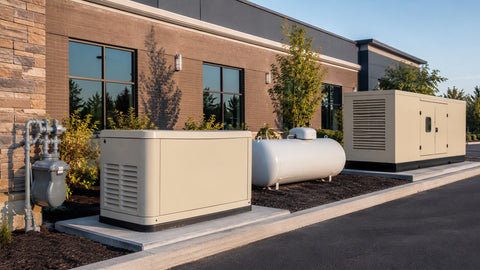
- The pad: Liquid-cooled 35kW units run 5–6 feet long and 1,300–1,900 lbs. A 4-inch reinforced concrete pad is the minimum; most jurisdictions want engineered anchoring details.
- Fuel plumbing: Full-load natural gas demand of ~510 cu ft/hr usually requires a dedicated 1"–1¼" line and often a meter upgrade. Propane regulators must be sized for the generator's full-load BTU draw, not the house's.
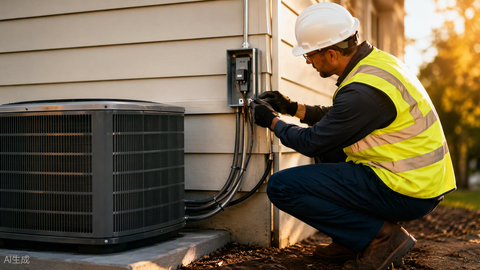
- Code articles: NEC 445 for the generator itself, Article 702 for optional standby systems, and Article 701 if any loads qualify as legally required standby. Medical and veterinary facilities sometimes straddle both.
- Noise and placement: Expect 63–70 dB at 23 feet for a liquid-cooled unit with a sound enclosure. Five-foot setbacks from openings and property lines are typical; verify your local ordinance before the pad goes in.
Maintenance Schedule
| Interval | Task | Field Note |
|---|---|---|
| Weekly | Automatic exercise, 12–20 minutes | Confirm the run happened; check the controller log monthly |
| Monthly | Oil and coolant levels, battery voltage, enclosure check | Battery failure causes most no-starts I've responded to |
| Annually / 150–200 hrs | Oil and filter change, air filter, spark plugs (gaseous) | Annual even with low hours — condensation ruins oil |
| Annually | Valve lash check (as specified), coolant test, full-system inspection | Load-bank test if the unit runs mostly unloaded |
| Every 2–3 years | Battery replacement | On schedule, not on failure — failures happen during storms |
What It Costs
Equipment-only pricing for the 35kW class typically runs $11,000–$17,000 depending on fuel and enclosure. Fully installed — pad, gas plumbing, transfer switch, electrical, permits — most projects land between $20,000 and $32,000. Operating cost at half load runs roughly $10.50/hour on propane at $3.50/gal, or about $3–4/hour on typical residential natural gas rates. Over a 20-year service life, fuel and maintenance will exceed the purchase price, so choose the fuel your property supports best rather than the one with the cheapest sticker.
Liquid-Cooled vs. Air-Cooled at This Size
35kW is the boundary where air-cooling effectively ends. Air-cooled standby units top out around 26kW because a fan-cooled engine simply can't reject enough heat for sustained higher output; everything from 30kW up is liquid-cooled, with a radiator, coolant pump, and an engine derived from automotive or industrial blocks. The practical consequences matter to a buyer: liquid-cooled units run at a lower, steadier 1,800 RPM instead of the air-cooled 3,600 RPM scream, which is why they last two to three times longer and sound civilized doing it. Oil changes stretch to 150–200 hour intervals instead of 100. The block heater option actually exists. And the machine is heavy — 1,300 to 1,900 pounds — which means the pad and the delivery path are line items, not afterthoughts. I've seen a delivery truck sink to its axles on a soggy gravel driveway because nobody walked the route; walk yours before delivery day.
The Load-Shedding Toolbox

Modern load management is what makes 35kW feel like 45kW. The tools, in order of sophistication: simple priority-based ATS modules that lock out circuits like pool equipment and water heaters while on generator power; staged compressor start delays that prevent two HVAC units from kicking simultaneously; and full smart-management systems that monitor real-time draw and dynamically shed and restore loads as capacity allows. The estate example above only works on 35kW because of that toolbox — the pool equipment sheds, the two cooling systems stagger by 30 seconds, and the water heater defers during compressor operation. Budget $400–$1,500 for load-management hardware on a residential install; it routinely saves customers a full generator class of equipment cost. One caution from the field: explain the shedding to the homeowner before the first outage. The first call I get after every storm is someone whose pool pump "broke" — it's doing exactly what it was programmed to do.
Derating, Altitude, and Hot Weather
Nameplate kW assumes sea level and mild air. Naturally aspirated gaseous engines lose about 3–4% of output per 1,000 feet of elevation, and all engines lose roughly 1% per 10°F of intake temperature above 77°F. A 35kW natural gas unit installed at 3,000 feet is effectively a ~31kW machine on a hot August afternoon. Diesel and turbocharged engines derate more gently, but they derate. If your property sits above 2,000 feet or your summers run hot, apply the derate factors from the spec sheet before you finalize the size — or plan on stepping up a class. This is one of the two most common sizing errors I correct on quotes; the other is ignoring motor starting surge, which the worked example above shows how to handle.
New vs. Used in the 35kW Class
The used market for commercial-grade 35kW sets is active, and the pricing — often 40–60% of new — tempts a lot of buyers. My honest position after servicing both: used diesels with documented maintenance and under 1,000 hours can be excellent value, particularly for prime-power agricultural use. Used gaseous standby units are riskier — exercise hours accumulate invisibly, valve lash drifts, and controller boards age out of parts support. Whatever you buy used, demand the hour meter reading, the service log, and a load-bank test before money moves. And confirm parts availability for the controller generation; I've diagnosed a dead $200 display board that orphaned an otherwise perfect $9,000 generator because the manufacturer discontinued support.
The Five Mistakes I See on 35kW Jobs
- Sizing off square footage instead of loads. A 4,000 sq ft all-electric home can outdraw a 7,000 sq ft gas-applianced home. The utility interval data or a load tally settles it.
- Ignoring the gas meter. At ~510 cu ft/hr full load, most residential meters and half-inch lines can't feed a 35kW unit. The utility capacity letter costs nothing; discovering the shortfall after the pad is poured costs plenty.
- Forgetting the 115% rule. NEC 445.13 conductor sizing — covered in the table above — is the single most common inspection failure on residential standby installs.
- Skipping load management. A $600 shedding module often stands between a customer and a $6,000 jump to the next generator class.
- No maintenance plan. Standby generators fail from neglect, not from use. The weekly exercise log, the annual service, and the scheduled battery swap are the machine's entire reliability story.
Fuel Choice Deep-Dive: Diesel vs. Propane vs. Natural Gas
Each fuel writes a different ownership story. Diesel delivers the best fuel economy per kWh, the longest engine life under load, and total independence from utilities — but you own a fuel system: storage tanks, condensation management, polishing every couple of years, and air-quality permitting in some jurisdictions. Propane stores indefinitely without degrading, burns clean, and works anywhere a tank can sit, but it carries the highest per-kWh fuel cost and the tank is a real landscaping decision. Natural gas is the cheapest per kWh and never needs refueling, but it chains your resilience to the gas utility's pressure — fine in most regions, a genuine question mark where ice storms or seismic risk threaten distribution. My default advice: if a gas main reaches your property, natural gas wins on cost and convenience for most households. If you're rural, propane with a 1,000-gallon tank is the proven answer. Choose diesel when the load is heavy, the outages are long, or the site is commercial enough to have fuel management discipline already.
The Install Timeline: What a 35kW Project Looks Like Week by Week
Customers consistently underestimate the calendar. A realistic residential 35kW timeline: Week one is the site survey, load tally, and quote. Weeks two and three are permitting — electrical and mechanical/plumbing permits, plus the utility gas-capacity letter if you're on natural gas, and that letter alone can take two weeks. Equipment lead time runs two to six weeks depending on brand and configuration; sound-enclosure and three-phase variants stretch longer. Once everything is in hand, the physical install is typically three to five working days: pad or pad verification, crane or forklift set, fuel plumbing, the 2/0 copper feeder run, transfer switch mount and wire-in, then startup. Commissioning adds a day — load test, transfer test, controller programming, homeowner walkthrough — and the inspection follows within the week. Start to energized: six to twelve weeks in a normal market. If you're reading this in September and want protection before winter storm season, start now; every fall I watch the same rush hit the same lead times.
Warranty and Service Support
Standard warranties in this class run two to five years limited, with extended coverage available. Read the exclusions before you buy: most warranties require documented annual professional maintenance, and warranty labor coverage often differs sharply from parts coverage. More important than the paper is the service network — a 35kW unit is a 20-year machine, and you want a dealer or service contractor within reasonable drive time who stocks parts for your brand. Ask two questions before purchase: who services this within 50 miles of my address, and what's their storm-response commitment? The answers matter more than a point of efficiency or a year of extra warranty.
Pairing a 35kW Generator With Solar and Batteries
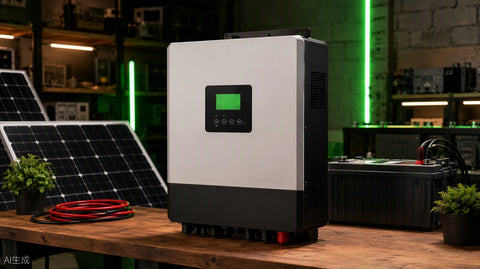
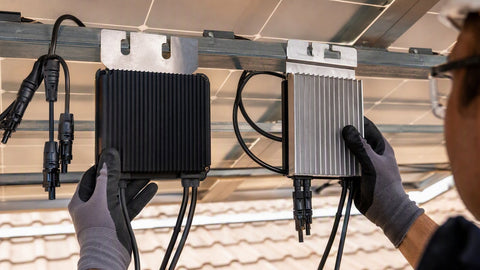
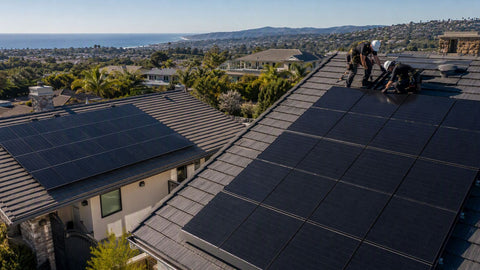
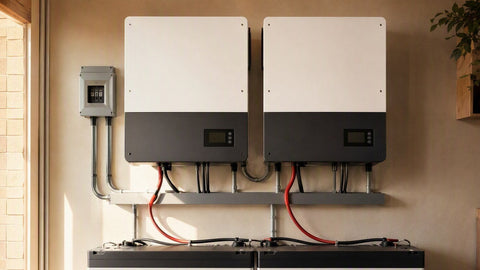
More of my 35kW projects now include solar and storage, and the integration question comes up on every quote: does the generator fight the inverter? Done right, no. The clean architecture puts solar-plus-battery on the backed-up loads panel with the generator behind the transfer switch, and the hybrid inverter manages the generator as an AC source — charging batteries during long outages so the generator runs at efficient loading for two or three hours instead of sipping at 15% load all night. The mistakes to avoid: backfeeding a grid-tie-only inverter with generator power without anti-islanding coordination, and sizing the generator smaller than the battery charger's draw plus the house load. A hybrid inverter with a proper generator input, a 15kWh-class battery bank, and a 35kW gaseous unit is currently the most resilient residential architecture I install — the batteries carry the first hours of every outage silently, and the generator only wakes for the long events. Our battery backup runtime calculator helps size the storage side of that pairing.
Commercial Applications: Where 35kW Earns Its Keep
Beyond residential estates, this class serves a distinct commercial niche: the single-occupant small business whose survival depends on staying open. A 35kW unit carries a full-service restaurant's walk-in cooler, reach-ins, hood fans, POS, and lighting with room for one rooftop HVAC unit — the difference between serving a packed dining room during a neighborhood outage and throwing away a weekend of inventory. Dental and veterinary practices use this class to protect compressors, suction, sterilizers, and imaging gear. Farm shops run welders, air compressors, and barn systems from it. In each case the arithmetic is the same one I walk through on site: tally the loads you cannot afford to lose, add the starting surges, keep the running total under 28kW, and the machine will never be the reason you close. If the tally exceeds that, stop negotiating with yourself and step up to the 48kW class — an undersized generator costs more in nuisance shutdowns than the upgrade ever would.
Frequently Asked Questions
Will a 35kW generator run my whole house? For almost any home up to about 8,000 sq ft, yes — including central AC, electric cooking, water heating, and a well pump simultaneously. All-electric estates should still run a load tally to confirm.
How much natural gas does a 35kW generator use? Class-typical consumption is about 510 cubic feet per hour at full load and 300 at half load. Most residential gas meters require an upsize to feed it.
How long will a 35kW generator run on a 500-gallon propane tank? About 133 hours — five and a half days — at half load, using roughly 3.0 gallons per hour from the tank's 400 usable gallons.
What size wire does a 35kW generator need? At 240V single-phase: 2/0 copper THHN with a 175A breaker, applying NEC 445.13's 115% rule to the 146A full-load current. At 480V three-phase: #6 copper with a 50A breaker.
Is 35kW enough for a small business? For offices, restaurants, and retail up to about 4,000 sq ft with moderate refrigeration, usually yes. Businesses with walk-in coolers plus multiple rooftop HVAC units should evaluate the 48kW class.
How loud is a 35kW generator? Liquid-cooled units with sound enclosures typically measure 63–70 dB at 23 feet — comparable to a residential heat pump.
The right generator is the one whose rating brackets your honest load tally with room for motor starts and a hot afternoon. Run the numbers, check your fuel options, and if you want the math verified before you commit, the team at Portlandia Electric Supply does this daily — bring your load list and we'll pressure-test the sizing together.
Need pricing or availability on anything in this guide?
Portlandia Electric Supply dropships direct from the manufacturer — most items Ship Direct with lead times stated up front, no surprises.
Get a quote from PESBulk, pallet and contractor pricing available.