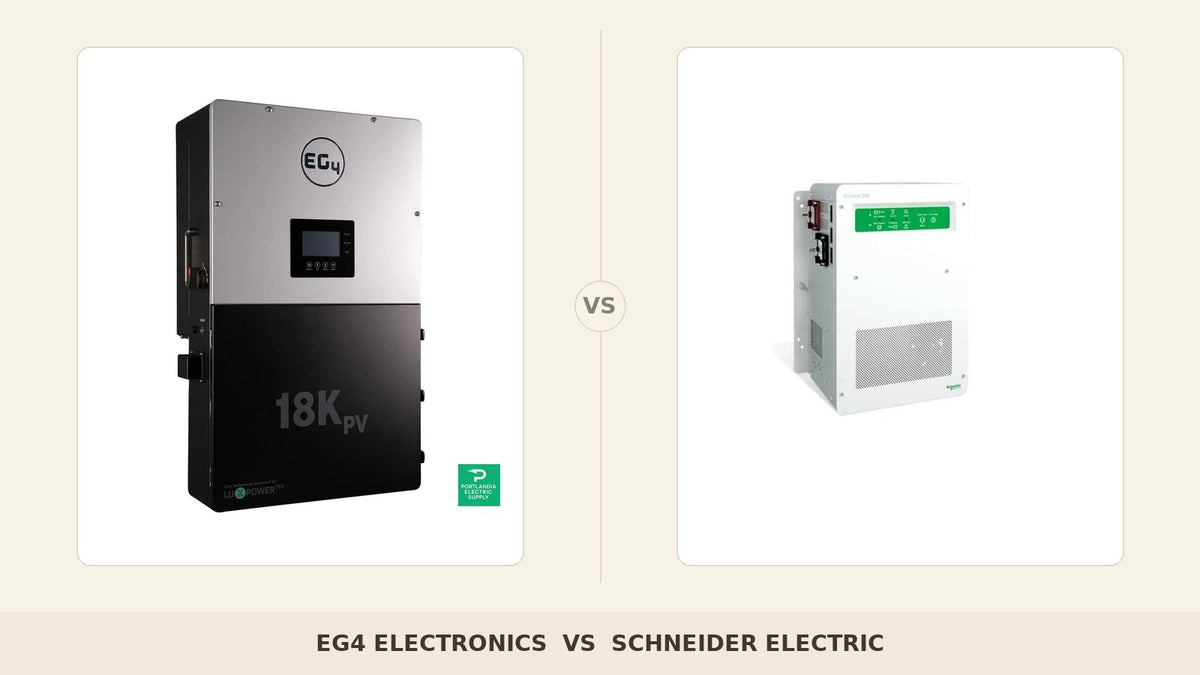
EG4 vs Schneider Electric 2026: Value Hybrid vs Premium Off-Grid Inverter
The 12 kW-class EG4 hybrids against Schneider's legendary XW Pro: continuous and surge power, efficiency, battery integration, grid-interactive features, monitoring, and total system cost — with the field notes on which survives which kind of site.
This is the inverter argument that splits the off-grid world in two. In one corner, Schneider Electric's XW Pro — the descendant of the Xantrex lineage that built the off-grid industry, a 6.8 kW transformer-based low-frequency inverter with a surge reputation older than some of its competitors' companies. In the other, EG4's 18kPV and FlexBOSS21-class hybrids — high-frequency, grid-interactive, 12 kW-class output with massive PV input, at roughly a third of the price per watt. We have commissioned both in cabins, full-time off-grid homes, and grid-interactive backup systems, and the honest framing is this: Schneider sells indestructibility; EG4 sells capability per dollar. Which one your project needs depends on what breaks first at your site — equipment or budget.
Shop the contenders in EG4 Electronics and Schneider Electric, with the full field in hybrid inverters and 48V inverters. If the system architecture is still open — DC versus AC coupling, battery voltage, grid-tie versus off-grid — read the hybrid inverter overview and 2026 inverter picks first.
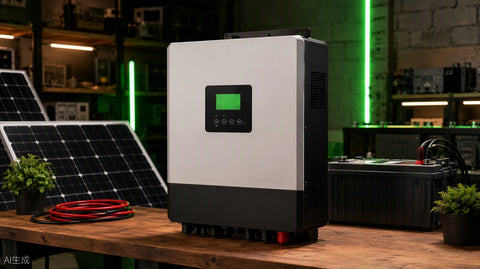
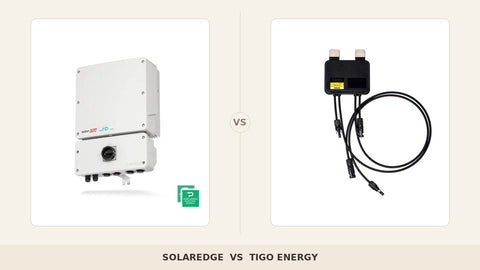
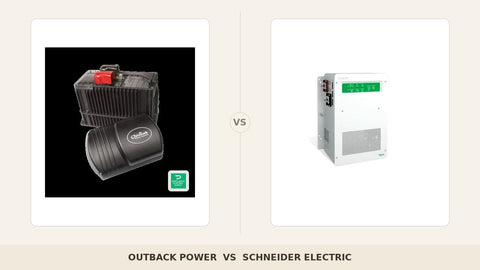
The XW Pro is a low-frequency, transformer-based inverter. Big iron, big surge, bulletproof overload behavior, and a thermal design that treats a 45°C mechanical room as a mild afternoon. It inverts DC to AC and does it forever; everything else — MPPT charging, grid interaction, monitoring — arrives as companion boxes (Schneider MPPT charge controllers, InsightHome/InsightFacility gateways) in a modular architecture.
The EG4 hybrids are high-frequency, all-in-one designs: inverter, dual MPPT charge controllers, transfer switch logic, grid-tie sell-back, generator input, and monitoring in one wall-mount box. The 18kPV-class units accept 18–21 kW-class PV input and deliver 12 kW continuous AC — spec-sheet territory that required two or three Schneider boxes and a pallet of balance-of-system hardware five years ago.
Neither philosophy is nostalgia or gimmick. Transformer LF designs survive abuse that kills HF designs; HF all-in-ones deliver features and density that LF modularity cannot touch at the price. The sections below price both sides of that trade.
Class-level comparison; confirm exact model specs. XW Pro system price grows with charge controllers and gateway — see the system-cost table.
| Attribute | Schneider XW Pro (6848 class) | EG4 18kPV / FlexBOSS21 class |
|---|---|---|
| Topology | Low-frequency, transformer-based | High-frequency, transformerless |
| Continuous output | 6.8 kW @ 120/240V split phase | 12 kW class, 120/240V split phase |
| Surge (motor starting) | 12 kW class, 1 min; legendary overload tolerance | ~2x continuous for seconds class |
| PV input | Via separate MPPT controllers (80/100A class) | Integrated dual MPPT, 18–21 kW class |
| Peak efficiency | ~93% class | ~96% class |
| Battery | 48V, closed-loop with major LFP lines | 48V, native EG4 closed-loop + common protocols |
| Grid sell / net metering | Supported with configuration | Native, simple |
| Generator support | AC-coupled input, configurable | Dedicated gen port + start logic |
| Monitoring | InsightHome/InsightFacility (separate) | Integrated app + web |
| Weight / form | ~120 lb class, wall-mount chassis | ~80–100 lb class, wall-mount |
| Unit price class | $3,500–$4,500 (before MPPTs and gateway) | $3,500–$5,000 all-in-one class |
The XW Pro's reputation rests on one behavior: it starts things. Well pumps, table saws, air compressors, older AC units with brutal locked-rotor draws — the transformer-based stage absorbs inrush that sends high-frequency inverters into fault protection. Schneider rates the surge class at 12 kW for a minute; the field reputation says the unit is conservative with that number, and our service history agrees. I have watched an XW start a 3 HP deep-well pump that faulted two different HF inverters on the same day. That pump is why the cabin owner bought the Schneider, and why he would buy it again.
EG4's hybrids manage surge electronically — typically 2x continuous for a few seconds — which covers modern inverter-driven compressors, mini-splits, and soft-start-equipped pumps cleanly. The dividing line is legacy induction loads: old well pumps, old compressors, big single-phase motors. If your load list includes one, either spec a soft starter (a $300-class fix that often settles the argument) or buy the transformer. Our generator sizing guide covers inrush math that applies identically to inverter selection.
Surge behavior by load class. 'Borderline' means commission it and test under real load before the customer moves in.
| Load | XW Pro (12 kW surge class) | EG4 12 kW hybrid (~2x sec class) | Notes |
|---|---|---|---|
| Mini-split / inverter AC (no inrush) | ✓ trivial | ✓ trivial | No differentiator |
| Modern scroll compressor + soft start | ✓ | ✓ | Soft starter: $300 class |
| Legacy 3–4 ton compressor (LRA 120–180A) | ✓ within surge class | ⚠ borderline — test before sign-off | The argument-settler load |
| 3 HP well pump, deep, old motor | ✓ the classic XW job | ⚠–✗ without soft start | Buy iron or buy a soft starter |
| Shop tools (saw, air compressor) | ✓ | ✓ individually; stack carefully | Simultaneity is the real constraint |
High-frequency designs convert more efficiently — EG4's hybrids run ~96% class peak versus the XW Pro's ~93% class — and the gap widens at partial load, where residential systems live. Over a year of daily cycling, 3 points of conversion efficiency on 10 MWh of throughput is 300 kWh you either harvested or heated the equipment room with. Small per day; real per decade.
Idle draw cuts the other way on standby-heavy sites: transformer inverters carry higher tare losses, though the XW's search mode trims no-load consumption for cabin duty. For full-time off-grid homes where the inverter never sleeps, HF efficiency wins the energy ledger. For weekend cabins where the system idles five days out of seven, compare idle watts on the actual datasheets — the answer is site-specific, and the runtime calculator helps translate idle draw into lost autonomy hours.
Both platforms live on 48V battery banks, and both do closed-loop LFP properly. The XW Pro pairs with major LFP lines through documented CAN integrations — Pylontech, Fortress, Discover AES-class partnerships — with Schneider's configuration tools governing charge parameters. EG4's hybrids pair natively with EG4 rack batteries (the tightest integration in the value tier) and speak the common third-party protocols besides.
The natural builds sort themselves: XW Pro + Fortress or Pylontech for premium inspected systems; EG4 hybrid + EG4 batteries for value systems. Cross-pairings work — we run XW Pro on EG4 batteries in two field installs with Pylontech-protocol comms — but every cross-pairing spends commissioning time that native pairings do not. Battery shopping: EG4 batteries, Fortress, Pylontech, and the full LiFePO4 category.
The XW Pro's sticker is the beginning, not the total — charging and monitoring arrive as additional boxes. Here is the honest installed comparison for a 12 kW-class output, 12 kW-class PV off-grid system:
The stacking math is where the philosophies diverge hardest: 12 kW of Schneider output requires two XW Pros; 12 kW of EG4 output requires one hybrid. Price the system, never the inverter.
| Component | Schneider path | EG4 path |
|---|---|---|
| Inverter | XW Pro 6848 ≈ $3,500–$4,500 | 18kPV/FlexBOSS21 class ≈ $3,500–$5,000 |
| PV charging for 12 kW array | 2 × MPPT 100A class ≈ $1,400–$2,000 | Integrated (dual MPPT) — $0 |
| Monitoring/gateway | InsightHome ≈ $300–$400 | Integrated — $0 |
| To reach 12 kW AC output | 2 × XW Pro (stacked) — doubles inverter line | Single unit class |
| System electronics total | ≈ $9,000–$13,000 at 12 kW output | ≈ $3,500–$5,000 |
| Balance-of-system (both paths) | DC breakers, combiner, wire, battery bank | Same category of BOS |
That table is why the value tier of this market belongs to all-in-one hybrids right now. The counterargument is not price — it is the next two sections: what fails, and what the failure costs.
Schneider's installed base includes XW-lineage inverters with fifteen-plus years of service in brutal environments — tropical humidity, desert heat, unconditioned barns. The design is serviceable at the board level, parts exist, and the company has supported the platform continuously. When an XW fails out of warranty, a tech can often repair it; the iron does not become e-waste because a gate driver died.
EG4's platform is younger — the current hybrids have years, not decades, of field history — but the early reliability record is strong, firmware development is active, and the replacement economics are stark: a full replacement hybrid costs less than some Schneider repair events once freight and labor land. Our honest counsel to off-grid customers: full-time residence in a remote location where a service visit costs $800 — weight the iron heavily. Accessible sites, budget-led builds, and grid-interactive systems — the hybrid's economics are hard to refuse. Carry a spare control board or a spare unit in the budget either way; off-grid resilience is a parts strategy as much as a product choice.
If the site has a grid, the comparison tilts fast. EG4's hybrids do grid-tie sell-back, time-of-use arbitrage, peak shaving, generator blending, and seamless sub-cycle-class transfer natively, in one box, configured from a phone. The XW Pro can be configured into grid-interactive behavior with the right peripherals and settings discipline — it has done net metering for decades — but the feature set lives in a configuration tool from a different era, and some modern utility programs simply assume capabilities the modular architecture implements awkwardly.
For backup-primary grid homes, also weigh the appliance path — EG4 vs Tesla Powerwall and the Powerwall line cover that architecture — and the generator side in standby generators with transfer switches. Hybrid inverter plus generator plus battery is the resilience trifecta; both platforms support it, one makes it a weekend project and the other makes it a design exercise.
Spec-sheet arguments resolve quickly against actual installs. Three from our recent logs:
The platform follows the site: legacy surge + remote service → iron; everything else → hybrid economics.
| Site | Load profile | Deployed | Outcome after 1+ yr |
|---|---|---|---|
| Off-grid cabin, Cascades, weekend use | Mini-split, fridge, lights, small pump | EG4 18kPV-class + 20 kWh EG4 bank | Zero faults; owner manages via app; $4k saved vs modular bid |
| Full-time off-grid ranch, high desert | 2 HP legacy well pump, shop tools, walk-in cooler | 2 × XW Pro stacked + 30 kWh Fortress bank | Starts everything, zero surge faults; premium justified by $900 service-call distance |
| Suburban grid home, TOU arbitrage + backup | 4-ton AC (soft-started), EV, critical loads | EG4 12 kW hybrid + 25 kWh bank | $130/mo average bill reduction class; seamless transfer in three outages |
Notice the ranch row: we quoted the EG4 path first and talked ourselves out of it during the load audit, because that well pump's inrush plus a 90-minute service radius turned the premium into insurance. The suburban row is the opposite story — no legacy loads, grid present, and the hybrid's arbitrage features pay a monthly dividend the XW architecture cannot match without a peripheral stack. Same product category, three correct answers.
Day-to-day ownership is software. EG4's integrated monitoring ships complete — app, web portal, per-MPPT harvest data, battery cell detail, push alerts — with an active firmware cadence that has visibly improved the platform over the last two years. The community tooling (Solar Assistant, Home Assistant integrations) is the deepest in the value tier, which matters to the owners who want it and is invisible to those who do not.
Schneider's Insight platform is professional-grade and shows its heritage: powerful, stable, and designed for installers who manage fleets rather than homeowners who check apps. Firmware changes are conservative and rare — a feature when your site is a mountain away and you need behavior that never mutates. Both platforms log the data warranty claims need; both reward the same habit we push on every customer: export or screenshot your commissioning configuration and archive it somewhere the equipment room flood cannot reach.
The operational summary our service desk gives: EG4 rewards engagement, Schneider rewards neglect. Neither punishes the other's owner, and both outlast their detractors' predictions with boring, profitable consistency across years of daily service. Choose the relationship with the machine that matches the human who owns it.
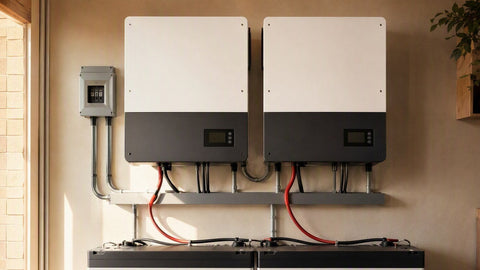
The physical install diverges more than the spec sheets suggest. A single EG4 hybrid mounts on one wall section with two techs and an afternoon: DC battery cables, PV homeruns into the integrated MPPTs, AC in and out, done. A Schneider build at equivalent capability occupies a backboard: the XW chassis, one or two MPPT controllers, the DC distribution panel with its breaker array, the gateway, and the conduit choreography between them. It is beautiful work when done well — and it is two to three times the install hours, which is real money on a professional quote and real weekends on a DIY one.
Wire sizing is unforgiving on both paths. At 48V, a 12 kW-class output means 250A-class battery interconnects — 4/0 copper, lugs crimped with a real hydraulic tool, torque witnessed with a marker. We have inspected too many DIY builds where the inverter was premium and the battery cables were an afterthought; the cable is the system at these currents. The conduit guide and fill chart cover the homerun side for the PV runs into either platform.
Both platforms carry the listing stack inspected jobs require — UL 1741-class inverter listings, with the paired batteries' UL 1973/9540 documentation riding alongside. The XW Pro's two-decade inspection history means no AHJ has questions; the EG4 hybrids' documentation package is complete and increasingly familiar to inspectors as the installed base explodes. On the wiring side, 12 kW at 240V is a 50A-class AC circuit, and the battery interconnect at 48V reaches 250A-class — size per the NEC wire sizing guide and ampacity chart, with disconnects per the NEC 690/706 requirements. The inverter choice changes nothing about those obligations; it only changes how many boxes you are landing them on.
Choose Schneider XW Pro for full-time off-grid residences, remote sites where service calls are expensive, legacy motor loads without soft starters, and owners who measure equipment life in decades. Add MPPTs and a gateway, stack units for output, and budget the premium — you are buying the platform that invented the category's reliability expectations. See Schneider inventory.
Choose EG4 for grid-interactive homes, budget-led off-grid builds, modern load profiles (mini-splits, soft-started pumps), and any project where 12 kW of output with integrated PV charging at one box's price beats three boxes at triple the price. The EG4 ecosystem — FlexBOSS21, batteries, monitoring — is engineered to commission as one system.
The bottom line from both install logs: we have never replaced a failed XW with anything but another XW, and we have never had an EG4 hybrid customer offer to pay triple for iron. Both customer sets sleep fine. Know your loads, know your site's service economics, and the inverter chooses itself.
Is the Schneider XW Pro worth the extra money over EG4?
For full-time off-grid sites with legacy motor loads or expensive service logistics, yes — the transformer-based surge capacity (12 kW class for a minute) and 15-year-plus platform longevity justify the premium. For grid-interactive homes and budget-led builds, no — EG4's all-in-one hybrids deliver 12 kW-class output, integrated MPPTs, and modern grid features at a third of the system cost.
Can an EG4 hybrid run a well pump and shop tools?
Usually yes with modern equipment: EG4's ~2x short-duration surge handles inverter-driven compressors, mini-splits, and soft-started motors cleanly. Legacy induction motors with high locked-rotor current — old deep-well pumps, elderly compressors — are the edge case; add a soft starter ($300 class) or choose a transformer-based inverter like the XW Pro.
How does the XW Pro reach 12 kW of output?
By stacking two XW Pro units — the platform supports parallel stacking for doubled output, which doubles the inverter line item. A single 6.8 kW XW Pro plus separate MPPT charge controllers and gateway lands around $5,200–$6,900 before output doubling; a 12 kW-class EG4 hybrid delivers the same AC output in one box at $3,500–$5,000 class.
Which inverter is more efficient?
High-frequency hybrids lead: EG4's units run ~96% class peak efficiency versus the XW Pro's ~93% class, with the gap widening at the partial loads where homes operate. Across 10 MWh of annual throughput, the difference is roughly 300 kWh per year. Transformer units may idle lower in search mode on weekend-cabin duty — compare datasheet idle watts for your duty cycle.
Do both work with 48V lithium batteries?
Yes — both are 48V platforms with closed-loop LFP support. XW Pro integrates via documented CAN profiles (Pylontech, Fortress class); EG4 hybrids pair natively with EG4 rack batteries and speak common third-party protocols. Native pairings commission fastest; cross-pairings work with a settings checklist.
Which is better for a grid-tied backup system?
The EG4 hybrid, in most cases: native grid sell-back, time-of-use arbitrage, peak shaving, generator blending, and app-based configuration come in one box. The XW Pro can be configured for grid interaction but belongs to a modular design era; backup-primary grid homes should also evaluate appliance batteries like FranklinWH or Powerwall for zero-configuration operation.
PES Supply stocks both platforms at wholesale — EG4 Electronics, Schneider Electric — plus the batteries, charge controllers, and BOS to complete either build. Send us your load list and site details; our design desk returns both architectures priced as systems, not boxes.