Yes — solar panels can power a whole house, and in 2026 millions of American homes do exactly that. But the honest answer has three parts: how much energy your house actually consumes, how much your roof can realistically produce, and what happens after the sun goes down. Get those three numbers right and whole-house solar is arithmetic, not faith. Get them wrong and you either overspend by thousands or end up with a system that covers half your bill. This guide walks the full calculation the way we do it with customers every week, with the real numbers, the code-math that keeps inspectors happy, and the storage decisions that determine whether "whole house" includes 2 AM in a blackout.

I have sized systems for a 900-square-foot off-grid cabin that runs on 4 kW and a 4,200-square-foot all-electric house that needed 18 kW plus 40 kWh of storage. Both are "whole house solar." The difference between them is nothing but honest load counting — so that is where we start.
Step 1 — Find out what your house really uses
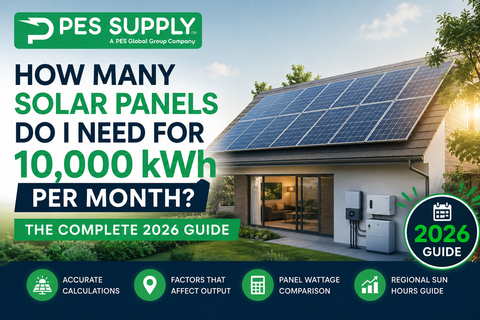
Everything begins with your consumption. Pull twelve months of utility bills and find the annual kilowatt-hour total — not the dollar amount, which hides rate changes. The U.S. Energy Information Administration puts the average American household near 10,500 kWh per year, but averages conceal enormous spreads driven by climate, home size, and whether heating, water heating, and cooking are electric.
| Household profile | Typical annual use | Daily average | Dominant loads |
|---|---|---|---|
| Small apartment / efficient condo, gas heat | 4,000–6,000 kWh | 11–16 kWh | Lighting, refrigeration, electronics |
| Average 2,000 sq ft home, gas heat, moderate climate | 9,000–12,000 kWh | 25–33 kWh | Central AC, refrigeration, laundry |
| Large home, hot climate, pool | 15,000–22,000 kWh | 41–60 kWh | Air conditioning, pool pump, second fridge |
| All-electric home with heat pump + EV | 14,000–20,000 kWh | 38–55 kWh | Heat pump, water heater, EV charging |
| All-electric + 2 EVs, cold climate | 20,000–30,000 kWh | 55–82 kWh | Heating, two vehicles, hot water |
Notice what drives the big numbers: cooling, heating, hot water, and vehicles. An EV alone adds roughly 3,000–4,500 kWh per year at 12,000–15,000 annual miles. If you plan to buy one in the next five years, size for it now — adding panels later means a second permit, a second interconnection, and often a second inverter you could have avoided.
Step 2 — Convert consumption into system size
System size is your daily energy need divided by your location's peak sun hours, grossed up for real-world losses. Peak sun hours are the equivalent number of full-output hours your array sees per day — Phoenix gets about 6.5, Chicago about 4.2, Seattle about 3.5. Losses from inverter conversion, wiring, temperature, soiling, and shading typically total 15–20%, so we design at an 80–85% performance factor.
| Step | Formula | Worked example (12,000 kWh/yr home, 5.0 sun-hours) |
|---|---|---|
| 1. Daily consumption | Annual kWh ÷ 365 | 12,000 ÷ 365 = 32.9 kWh/day |
| 2. Raw array power | Daily kWh ÷ sun hours | 32.9 ÷ 5.0 = 6.58 kW |
| 3. Gross up for losses | Raw power ÷ 0.82 | 6.58 ÷ 0.82 = 8.02 kW |
| 4. Convert to modules | System W ÷ module W | 8,020 ÷ 440 = 18.2 → 19 modules |
| 5. Final array | Modules × module W | 19 × 440 W = 8.36 kW |
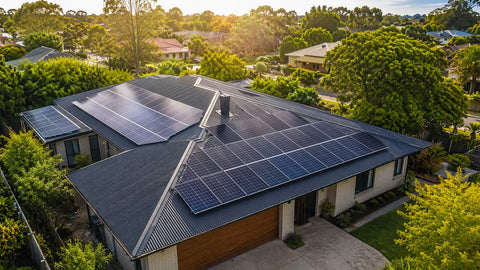
That 8.4 kW array needs roughly 420–500 square feet of usable, unshaded roof — about 18–22 square feet per modern module including setbacks and walkways. The same house in Seattle (3.5 sun hours) would need about 11.8 kW; in Phoenix (6.5 hours) only 6.4 kW. Geography is destiny, and no amount of premium equipment repeals it.
Step 3 — Check whether your roof can hold it
Before falling in love with a system size, verify the roof. South-facing planes are ideal in the northern hemisphere; east and west cost you roughly 10–15% of annual yield each; north-facing is rarely worth mounting on. Every chimney, vent, skylight, and tree shadow subtracts real watts. A roof with 60% usable area on good orientations usually supports a whole-house system; a chopped-up roof with heavy afternoon shade may cap you at partial coverage unless you trim trees or consider a ground mount. One crew I worked with in Ohio got an extra 2 kW onto a difficult roof simply by relocating two plumbing vents during a reroof — a $400 change that unlocked $6,000 of array. Roof work and solar work are the same job more often than people realize.
Step 4 — Decide what happens at night
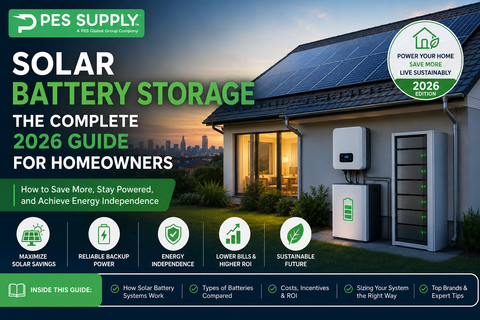
Solar panels produce power only while the sun shines. "Powering a whole house" therefore means one of two things. In a grid-tied system, the grid itself is your nighttime battery: you export surplus by day and import by night, and the annual numbers net out. In a battery-backed or off-grid system, storage carries you through the night and through outages — and storage, not panels, becomes the sizing constraint.
| Architecture | Nighttime power | Outage power | Added cost | Best fit |
|---|---|---|---|---|
| Grid-tied, no battery | Grid import | None (inverter shuts down per UL 1741 anti-islanding) | $0 | Reliable grid, favorable net metering |
| Grid-tied + 10–13.5 kWh battery | Battery, grid as backup | Essential loads, roughly 1 day | $8,000–$12,000 | TOU arbitrage, occasional outages |
| Grid-tied + 27–40 kWh | Battery most nights | Most of the home, 1–3 days | $18,000–$30,000 | Frequent outages, high self-consumption goals |
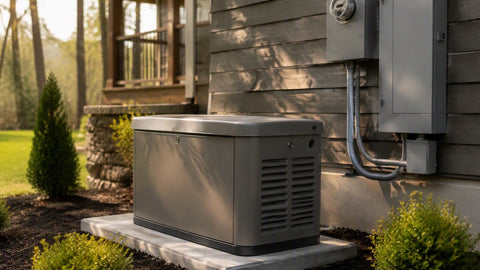
| Off-grid + generator | Battery + generator in gaps | Full independence | $30,000+ | No utility service available |
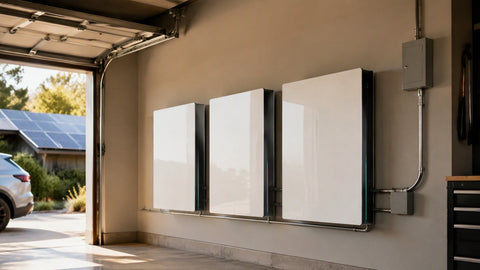
Battery sizing for overnight autonomy follows the same load arithmetic as everything else. If your home consumes 12 kWh between sunset and sunrise — typical for a house that shifts laundry and dishwashing to daylight — a 13.5 kWh battery with 90% usable depth of discharge covers it with margin: 13.5 × 0.90 = 12.15 kWh usable. Two batteries add cloudy-day reserve. I generally tell customers to size storage to the night, not to the array; panels recharge whatever you install, but an undersized battery is empty by 3 AM every single night.
Step 5 — The electrical code math that has to work
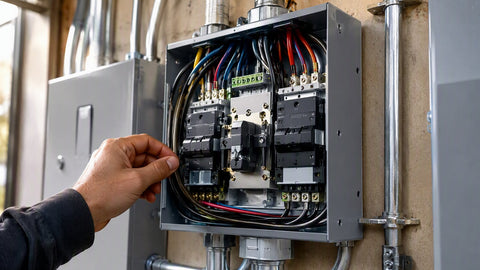
Whole-house systems run serious current, and the National Electrical Code sizing is not optional. Two calculations matter most on a residential job. First, PV circuit sizing under NEC 690.8: source-circuit current is the module short-circuit current multiplied by 1.25 for continuous duty and again by 1.25 for irradiance enhancement — 1.56 total. Two parallel strings of 13.9 A Isc each: 27.8 A × 1.25 = 34.8 A at the combined output, requiring 8 AWG copper (50 A at 75°C per NEC Table 310.16) and a 40 A breaker from the NEC 240.6(A) standard sizes. Second, the 120% busbar rule of NEC 705.12: on a standard 200 A panel with a 200 A main, solar plus battery breakers cannot exceed 40 A (200 × 1.20 − 200 = 40). An 8.4 kW inverter pushing 35 A at 240 V fits — barely — which is why whole-house jobs so often end up with a supply-side tap or a 225 A busbar upgrade.
| System element | Rating | NEC basis | Result |
|---|---|---|---|
| Single string, 13.9 A Isc | 21.7 A design current | 690.8: 13.9 × 1.56 | 10 AWG Cu (35 A @ 75°C) / 25 A breaker |
| Two parallel strings | 34.8 A design current | 690.8: 27.8 × 1.25 | 8 AWG Cu (50 A) / 40 A breaker |
| String Voc check, 10 × 49.2 V modules, −10°C | 553 V max | 690.7 Table: 492 V × 1.12 | Under 600 V residential limit — passes |
| 8.4 kW inverter on 200 A panel | 40 A allowance | 705.12(B): 240 − 200 | 35 A load-side breaker — passes with 5 A margin |
That last row is where I see the most failed inspections: designers forget that both the PV breaker and any battery inverter breaker count against the 120% allowance. Add a 40 A battery breaker to that 35 A PV breaker and you are 35 A over the limit — plan check will find it even if you hope it will not.
What whole-house solar costs and returns
National installed pricing for residential grid-tied solar in 2026 runs roughly $2.50–$3.50 per watt before incentives, with new-construction and volume jobs well below that. Our 8.4 kW example lands around $21,000–$29,000 installed, or $14,700–$20,300 after the 30% federal Investment Tax Credit. Against a $0.17/kWh national-average rate, 12,000 kWh of annual production is worth about $2,040 per year — a 7- to 10-year simple payback and 15+ further years of near-free electricity on equipment warrantied for 25. In high-rate states the same system pays back in 5–7 years; in low-rate states, 11–14. Add storage and the payback stretches but the resilience and rate-arbitrage value climb with it.
One number to treat with suspicion: any quote expressed only in monthly payments. I have reviewed competitor proposals where a "payment lower than your bill" hid a 25-year loan with a 3.9% escalator that doubled the system cost. Compare total price per watt, total interest, and the production estimate against your own bill math — the arithmetic in this article is all you need to check them.
How the pieces fit together

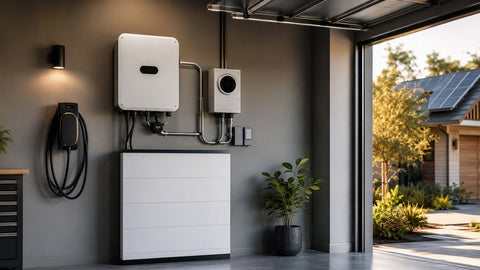
A whole-house system is four subsystems working in series, and a weakness in any one caps the rest. The array converts sunlight to DC power — modern residential modules run 430–470 W each at 20–22% efficiency, and the difference between a budget panel and a premium one over 25 years is mostly degradation rate, not day-one watts. The inverter converts DC to the 240 V AC your panel distributes; string inverters are cheapest per watt, microinverters squeeze more from shaded or multi-orientation roofs, and hybrid inverters add battery ports that make storage a plug-in upgrade instead of a rewiring project. The racking and balance of system — rails, flashing, wire, disconnects, rapid-shutdown hardware — is unglamorous but is where leaks and code failures live. Finally, monitoring closes the loop: I have diagnosed more "my system is broken" calls as tripped breakers and failed Wi-Fi gateways than as actual equipment faults, and a monitoring alert is what catches a dead optimizer in month two instead of at the annual true-up.
Panel types, honestly compared
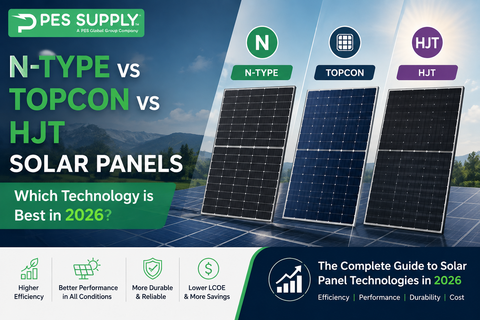
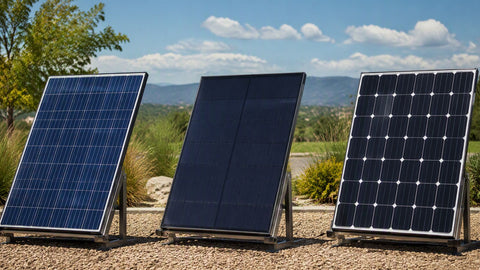
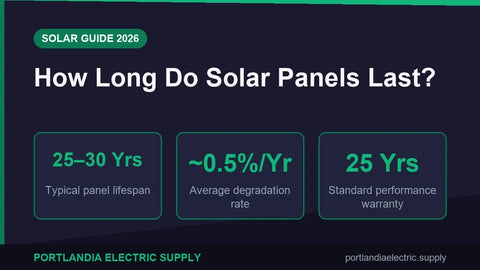
The three-way comparison that dominated a decade ago has collapsed into one sensible choice. Monocrystalline PERC and its successors — TOPCon and HJT — now hold essentially the entire residential market, because efficiency wins when roof area is the constraint, and roof area is almost always the constraint. Polycrystalline is effectively discontinued at the major factories. Thin-film survives in utility-scale plants and niche portable products, not on houses. What actually differentiates 2026 residential modules is cell architecture and degradation warranty: mainstream panels degrade about 0.5% per year with 87–89% warranted output at year 25, while premium n-type lines warrant 0.25–0.40% annual degradation and 89–92% at year 25. On an 8.4 kW array, that gap compounds to roughly 400 kWh per year by year 25 — worth $60–$140 annually depending on your rate. Pay a modest premium for degradation specs if your roof is tight; buy value panels if you have room to spare.
Inverter architecture is the second-biggest decision
After array size, inverter choice shapes system behavior more than any other decision. A string inverter with optimizers suits simple, unshaded, single-orientation roofs and costs the least per watt. Microinverters put the conversion on every module, which pays for itself on complex roofs and gives per-panel monitoring that catches failures early. Hybrid inverters — the fastest-growing category since the storage boom — combine PV and battery conversion in one box with a whole-home backup port, and they are what we recommend by default now, because the difference between "battery-ready" and "battery-retrofitted" is often $2,000 of electrician labor. One field note: whatever you choose, verify the inverter's maximum input voltage against your coldest-design-temperature string math from the NEC 690.7 calculation above. I have seen a beautiful 11-module string design die at plan check because 11 × 49.2 V × 1.14 = 617 V exceeded the inverter's 600 V ceiling — a $0 problem at the design desk and a very expensive one on the roof.
Maintenance, degradation, and the 25-year reality
Solar has no moving parts, but it is not maintenance-free. Plan on annual or semi-annual cleaning in dusty or pollen-heavy regions — soiling losses of 3–7% are routine, and we have measured 15% on arrays near agricultural operations that were never washed. Inverters are the wear item: string inverters typically carry 10–12 year warranties and often need one replacement inside the array's 25-year life, while microinverters carry 25-year warranties matched to the modules. Budget roughly $150–$300 per year in averaged maintenance and reserve, keep the monitoring alerts turned on, and your 8.4 kW system will still be producing 85–90% of its day-one output when the loan is long forgotten. The customers who get the worst long-term results are not the ones who bought cheap panels — they are the ones who never looked at the monitoring app and ran a dead string for six years.
The five sizing mistakes we correct most often
After thousands of system designs, the errors repeat. First, sizing to the dollar bill instead of the kilowatt-hours — a family that just moved in gets sized to the previous owner's window-unit habits and outgrows the array in one summer. Second, ignoring the EV that is coming; retrofitting 3 kW of additional capacity later costs roughly double per watt what it costs now, because you pay the permit, design, and mobilization twice. Third, trusting the nameplate instead of the losses: a 10 kW array does not produce 10 kW at noon in July, because cell temperatures 25°C above test conditions cost you 8–10% right when you need it most. Fourth, treating shade as a rounding error — one vent pipe shadow at 4 PM can cost a string more than the homeowner's entire efficiency upgrade saved. Fifth, undersizing the battery to hit a price point, which is how you end up importing peak-rate power at 7 PM with panels on the roof and a battery that died at sunset. Every one of these is cheaper to fix on paper than on the roof, which is why we run the full worksheet before we quote hardware.
Grid-tied versus off-grid: an honest fork in the road
Most readers should stay grid-tied. The grid is a spectacularly cheap battery — you pay only for net energy and a connection fee, and someone else maintains it. True off-grid design is a different discipline: you size for the worst week of the year rather than the average day, which typically doubles the array and triples the storage relative to grid-tied, and you add a generator for the statistical outliers. We supply both, and I enjoy an off-grid build as much as anyone in this business, but I tell every customer the same thing: go off-grid because you have no utility or you value independence for its own sake, not to save money, because you will not. For everyone else, grid-tied with honest battery capacity is the whole-house answer.
What "powering a whole house" looks like a year in
The first-year numbers from real customers tell the story better than projections. A 9.1 kW grid-tied system we supplied in Texas produced 13,700 kWh against a 12,900 kWh household — a 106% coverage year and a true-up bill of essentially the connection fee. A 7.2 kW system with 13.5 kWh of storage in coastal California self-consumed 81% of its production and cut the household's grid purchases by two-thirds under the Net Billing Tariff. And an off-grid cabin system — 4 kW of array, 20 kWh of LiFePO4, and a small inverter generator for December — ran a full year with eleven total generator hours, all of them in a two-week stretch of Pacific Northwest gloom. Three different definitions of "whole house," three correct systems. The common thread is that each owner counted their loads first and bought hardware second.
Frequently asked questions
How many solar panels does it take to power a whole house? An average American home using 10,500–12,000 kWh per year needs roughly 18–25 modern 440 W panels — an 8–11 kW array — depending on local sun hours. High-consumption all-electric homes with EVs can need 30–40 panels.
Can solar panels power a house at night or during a blackout? Panels alone cannot. Nighttime and outage power requires battery storage or a generator; a standard grid-tied inverter legally shuts down during outages for line-worker safety under UL 1741 anti-islanding rules.
Is 10 kW enough to run a whole house? For an average home in an average-sun climate, yes — 10 kW produces roughly 13,000–16,000 kWh per year depending on location. Homes with electric heat, pools, or multiple EVs may need 13–18 kW.
How many batteries does a whole house need? One 10–13.5 kWh battery covers a typical overnight load; two to three batteries provide multi-day reserve or whole-home backup including air conditioning. Size storage to your sunset-to-sunrise consumption, not to the array.
Can I run air conditioning on solar power? Yes. A 3-ton central AC draws roughly 3.5 kW while running; a whole-house array of 8 kW or more covers it easily during sunny hours, which is precisely when AC load peaks. Overnight AC requires substantial battery capacity or the grid.
What happens to solar production in winter or cloudy weather? Output falls 30–60% in winter months at northern latitudes and 50–80% on heavily overcast days. Annual production figures already include these losses — that is what the 15–20% system loss factor accounts for.
The bottom line
Whole-house solar is a solved problem: count your kilowatt-hours, divide by your sun hours, gross up for losses, check your roof, size storage to your nights, and run the NEC math before you buy. The technology is mature, the math is transparent, and the economics work in most of the country. The only remaining variable is whether the system you are quoted matches the system the arithmetic says you need.
Portlandia Electric Supply stocks complete whole-house solutions: solar panels, 400–459 W modules, hybrid inverters, 10 kWh batteries, 15–30 kWh battery banks, and complete solar kits. Keep calculating with our solar system calculator, battery sizing calculator, solar ROI calculator, installation guide, NEC compliance guide, how many watts to power a home, and battery sizing for off-grid living.