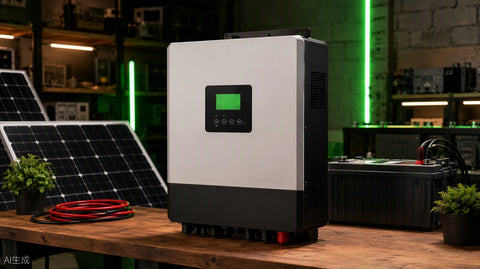
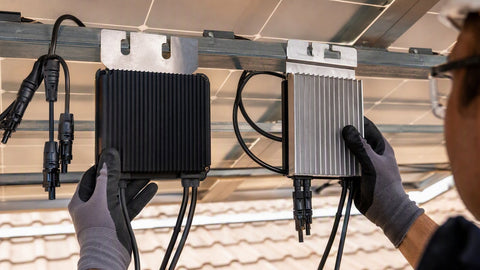
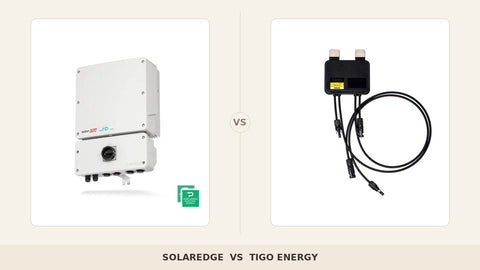
This is the oldest argument in module-level power electronics, and after fifteen years it's still the one that matters most on a residential bid sheet. Enphase puts a complete microinverter under every panel: DC goes in, grid-ready AC comes out, no central inverter anywhere in the system. SolarEdge puts a DC power optimizer under every panel and a single string inverter on the wall: the optimizers condition and monitor each module, but the actual DC-to-AC conversion happens in one box at ground level. Both approaches beat a plain string inverter on shaded or complex roofs. Between themselves, they split on questions of failure modes, clipping, storage paths, service labor, and total cost — and we stock, sell, and service enough of both to have opinions backed by truck rolls, not brochures.
The executive summary, contractor to contractor: Enphase costs more per watt, eliminates the single point of failure, and owns the cleanest storage retrofit path in the industry. SolarEdge costs less on larger systems, monitors beautifully, integrates EV charging and smart energy devices tightly, and concentrates your conversion electronics in one serviceable box at ground level — which is either a maintenance convenience or a systemic risk, depending entirely on how you think about failure. Both are excellent products backed by serious companies with real US support organizations. Neither is universally right, and anyone who tells you otherwise is selling something. The details below are how we actually decide, one roof, one budget, and one battery plan at a time.
Head-to-Head Comparison Table
| Dimension | Enphase (IQ8 microinverters) | SolarEdge (optimizers + HD-Wave/Home Hub inverter) |
|---|---|---|
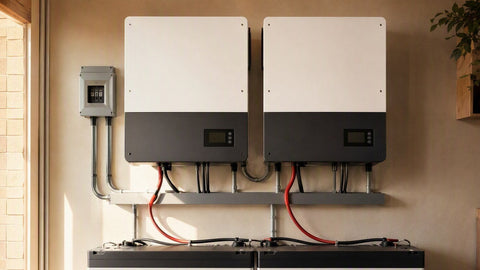
| Power conversion location | At each module — full DC-to-AC per panel | Central wall-mounted inverter; optimizers do DC-DC conditioning per module |
| Single point of failure | None at panel level; gateway is monitoring-only | Inverter failure takes the entire array offline |
| Efficiency class | ~97% peak per micro | ~99% class weighted on the inverter + ~99.5% optimizer efficiency |
| Clipping behavior | Micro output caps per-panel AC — oversizing ratio limited by micro rating | Optimizers allow higher DC/AC oversizing ratios on the central inverter |
| Monitoring | Enlighten — per-module, per-device, consumption CTs, battery integration | SolarEdge monitoring — per-module via optimizers, polished app, smart-energy device integration |
| Storage path | AC-coupled IQ Batteries; grid-forming IQ8 enables sunlight backup | SolarEdge Home Battery DC-coupled to the Home Hub; strong generator/backup integration |
| Rapid shutdown | Module-level, NEC 690.12 compliant | Module-level via optimizers, NEC 690.12 compliant |
| Warranty class | 25-year microinverters | 25-year optimizers; 12-year inverter standard (extendable) |
| Roof electronics count (24 panels) | 24 microinverters | 24 optimizers + 1 inverter on the wall |
| System cost class | Premium at small sizes; premium holds across sizes | Competitive; advantage grows with system size |
The Architecture Difference, Explained Once, Properly
Everything in this comparison descends from one design decision: where DC becomes AC. Enphase converts at the module, so the rooftop carries only 240V AC on a trunk cable — no high-voltage DC strings, no central conversion stage, and a failure of any one device costs exactly one panel's production. SolarEdge converts centrally, so the rooftop carries DC from optimizer to inverter, the wall-mounted box does the heavy lifting with genuinely excellent weighted efficiency, and its failure idles the whole array until it's swapped. Neither architecture is "better" in the abstract. They're different bets about where complexity should live: distributed across twenty-four devices that rarely fail but require a roof visit when they do, or concentrated in one device that fails more often than any single micro but can be swapped in an hour without touching the roof.
Our service logs make the trade concrete. Enphase service events: frequent-but-small — a micro here, a micro there, each one a 20-minute swap after a ladder climb, production loss limited to one panel. SolarEdge service events: rare-but-total — an inverter fault takes 100% of production offline, but the swap is a ground-level, one-tech, sub-hour job, and SolarEdge's advance-replacement logistics are quick. Optimizer failures do happen too, and they're exactly as labor-intensive as a micro swap. Total lifetime service hours in our fleet run remarkably close between the two platforms; the distribution of those hours is completely different, and that's what you should explain to the customer.
Clipping, Oversizing, and Harvest Math
SolarEdge's architecture permits aggressive DC-to-AC oversizing: pair, say, 13 kW of modules with a 10 kW inverter, let the optimizers feed it, and harvest a fatter shoulder-hour curve with modest midday clipping. Enphase clips at the micro — each panel's AC output caps at its micro's rating — so oversizing happens per-module, and pairing a 470W panel with a 350 VA micro wastes real watts on perfect afternoons. This is why Enphase model selection (IQ8+ vs IQ8M vs IQ8A vs IQ8H) matters more than SolarEdge model selection, and why our estimators run the compatibility math per module, not per system. The practical harvest difference between a well-designed Enphase system and a well-designed SolarEdge system on the same roof is small — low single digits — but "well-designed" is doing real work in that sentence. A badly matched Enphase design clips; a badly oversized SolarEdge design clips differently. Both punish lazy design; they just punish it in different months of the year.
| Design Decision | Enphase Approach | SolarEdge Approach |
|---|---|---|
| Module-to-converter matching | Match each module's Imp/Voc and wattage to a specific micro class | Match module Voc/Isc windows to optimizer; inverter sized to array total |
| DC/AC ratio headroom | Constrained by per-micro output ceiling | High — central inverter accepts substantial oversizing |
| Clipping loss location | Per-panel, peak hours only | System-level, peak hours only |
| Mixed orientations | Native — every panel independent | Native — optimizers handle orientation mixing well |
| Cold-morning voltage check | Per-micro absolute max input | String Voc math against inverter max, per NEC 690.7 |
| Best tools | Enphase compatibility calculator + our inverter sizing calculator | SolarEdge Designer + our system size calculator |
Storage and Backup: Two Very Different Roads
Enphase's storage story is the industry's cleanest retrofit. IQ8 microinverters are grid-forming: add an IQ System Controller and IQ batteries years after the PV install, and the system islands the home, keeps the roof producing through the outage, and in sunlight-backup configurations runs critical loads with no battery at all. The micros bought in 2026 are the backup system of 2030 — no rewiring, no new inverter architecture, an AC-coupled afternoon of work. For customers who say "batteries later," this is worth real money, and we price it into the comparison honestly.
SolarEdge's storage story is DC-coupled and excellent in new builds: the Home Hub inverter and SolarEdge Home Battery share the DC bus, so solar-to-battery conversion avoids a double conversion and the round-trip efficiency is among the best in residential storage. Generator integration is genuinely strong — SolarEdge has put real engineering into backup-mode flexibility — and the smart-energy ecosystem (EV charger, load controls, water heater relay) integrates through one app in a way Enphase matches only partially. The caveat: retrofitting SolarEdge storage onto a non-SolarEdge roof, or onto an older SolarEdge system, is more surgery than the Enphase AC-coupled path. Customers wanting to compare battery philosophies across brands should read our energy storage explainer and battery buyer's guide before deciding the PV architecture, because the battery decision increasingly picks the inverter, not the other way around.
Installation Labor: Where the Hours Go
| Phase (24-module residential) | Enphase | SolarEdge |
|---|---|---|
| Roof device mounting | 24 micros, trunk cable — 2.5–3.5 crew-hrs | 24 optimizers — 2–3 crew-hrs (lighter devices) |
| String/trunk wiring | AC trunk only — simplest | DC strings homerun to inverter — wire, conduit, voltage math |
| Inverter/gateway install | Gateway only — 1 hr | Inverter mount + AC/DC landing — 2–3 hrs |
| Commissioning | Scan, map, verify — 45–60 min | Pair optimizers, configure inverter — 45–75 min |
| Typical total | 5–7 crew-hours | 6–8 crew-hours |
On the electrical side both systems obey the same code book: NEC 705.12 interconnection math, 310.16 conductor sizing from our ampacity chart and NEC wire sizing guide, disconnects and labeling per the NEC 690 disconnect guide, grounding per the grounding and bonding guide, raceways per the conduit fill chart, and a service SPD we install on every job. SolarEdge adds DC string calculations; Enphase adds AC branch math. Your crew already knows both.
Reliability and Warranty: The Honest Ledger
| Factor | Enphase | SolarEdge |
|---|---|---|
| Rooftop device warranty | 25 years | 25 years (optimizers) |
| Central device warranty | N/A — no central inverter | 12 years standard, extendable to 20/25 |
| Failure profile | Many devices, low individual rate, small blast radius | Few devices; inverter failures take 100% of production |
| Service labor per event | Roof access required (20–40 min + ladder time) | Inverter swap at ground level (<1 hr); optimizer swaps = roof access |
| RMA logistics | Benchmark advance-replacement program | Fast advance replacement on inverters; strong US support |
| Expected downtime per event | One panel's production until swap | Entire array until inverter swap |
The 12-year inverter warranty is the number that surprises customers, so say it out loud at the kitchen table: SolarEdge optimizers are warranted for 25 years, but the inverter — the single box everything depends on — carries 12 years standard, extendable to 20 or 25 for a fee that belongs in the quote from day one. Enphase has no equivalent exposure because there is no central box. Over a 25-year finance term, budget one inverter replacement or the extended warranty into the SolarEdge column and the platforms' lifetime costs converge more than the day-one price suggests. Both companies stand behind their gear in our experience; neither argument is about honesty, only about architecture and arithmetic.
Monitoring and the Customer Experience
Both platforms deliver per-module monitoring that a plain string system can't touch, and both homeowner apps are good — different flavors of good. Enlighten is the data-nerd platform: per-panel history, per-device health, consumption metering, battery state, alert granularity that lets our service desk diagnose from the office. SolarEdge's app is the lifestyle platform: clean energy-flow animations, EV charging status, smart device control, production-versus-consumption storytelling that normal humans actually enjoy. Fleet operators lean Enlighten; homeowners who want a beautiful app lean SolarEdge. Both platforms give installers the commissioning and diagnostic tools needed to avoid truck rolls, and both expose APIs for the monitoring-obsessed. Browse our monitoring and communications category if the customer's network situation needs hardware help — weak Wi-Fi is the number-one cause of "monitoring problems" on both platforms, and it's never the platform's fault.
Cost: Where Each Platform Wins the Quote
On small systems — say under 6 kW — Enphase's no-central-inverter architecture is price-competitive because SolarEdge still needs its wall box. As systems grow past 8–10 kW, SolarEdge's cost curve flattens: one inverter serves 20 panels or 40, while Enphase's per-panel device cost scales linearly forever. By 15–20 kW residential or light commercial, the SolarEdge BOM advantage is commonly four figures. Storage changes the math again depending on coupling path and whether the PV is new or existing. The only responsible move is quoting both BOMs from live stock — Enphase, SolarEdge, microinverters, power optimizers, string inverters — with panels, racking, and BOS held constant so the customer sees a real comparison. Our solar ROI calculator and inverter roundup help frame the lifetime picture.
System Cost Worked Example
Because contractors ask for the number, not the adjective, here's the shape of a real comparison from our quote desk — a 28-module, ~11.5 kW residential system, hardware only, contractor pricing class. These are representative figures, not a live quote; always price from current stock.
| Line Item | Enphase BOM | SolarEdge BOM |
|---|---|---|
| Rooftop electronics | 28 × IQ8-class micros — premium per-unit line | 28 × optimizers — lower per-unit line |
| Central equipment | IQ Gateway + combiner class hardware | Home Hub inverter (one unit serves the array) |
| Trunk/string cable + terminations | AC trunk, ~28 drops | DC string wire, fewer terminations |
| Warranty equalization | Included (25-yr devices) | Add inverter extension to 20–25 yr for parity |
| Storage-ready premium | None — grid-forming already aboard | Storage adds Home Battery on DC bus (excellent, but a new-build decision) |
| Relative hardware total | Higher at this size | Lower at this size — gap widens with array |
Two honest footnotes to that table. First, labor narrows the gap: Enphase's simpler AC trunk and no-DC-string roof often saves a crew-hour or two against the SolarEdge DC homeruns, so the installed-cost delta is smaller than the hardware delta. Second, the customer who adds storage in year three rewrites the table entirely — the Enphase retrofit path is so much cheaper than re-architecting that the day-one premium can pay for itself in a single future project. Sell the roadmap, not the invoice.
Commercial, Three-Phase, and the Big-Roof Question
Above residential scale the platforms stop being symmetrical. SolarEdge's three-phase commercial line is a mature, serious product — large inverters, optimizer economics that scale, and a design tool built for big flat roofs. Enphase's commercial story exists and is growing, but the per-module cost model that makes sense at 10 kW gets examined hard at 100 kW. On a big unshaded commercial roof, also price plain three-phase string inverters from our commercial inverters and string inverter categories — module-level electronics must justify their premium against shade, monitoring granularity, and NEC 690.12 simplicity on every large job, because on many big roofs it can't. The discipline that wins bids is matching architecture to roof, not loyalty to logo.
A Decade of Watching Both Fleets
Some perspective you only get from shipping both lines for years. We watched SolarEdge's early optimizer generations mature into genuinely bulletproof hardware, and we watched Enphase's M-series era give way to the IQ platform that reset the category's reliability expectations. Both companies survived their awkward years and emerged with products we'd put on our own homes. The patterns that persist today: Enphase customers call about software and Wi-Fi; SolarEdge customers call about the inverter fan and, once in a long while, the inverter itself. Enphase service visits are short but require a roof; SolarEdge service visits are rare but sometimes total. Both monitoring platforms catch problems before customers do, when the gateway stays online — which is why we now treat gateway connectivity as a commissioning checklist item, not an afterthought. The industry's real winner in this rivalry is the customer: fifteen years of these two companies out-engineering each other is why module-level electronics went from exotic to default.
The Five Questions That Decide the Bid
After thousands of these conversations, the decision collapses into five questions we ask every customer. One: will you add batteries within five years — yes leans Enphase for retrofit economics. Two: how big is the array — past roughly 10 kW, SolarEdge's cost curve pulls ahead. Three: is the roof complex or shaded — both handle it, Enphase's per-panel independence edges the worst cases. Four: how do you feel about a single box that everything depends on — some customers hear "one inverter to service" as convenience, others hear it as risk; both readings are valid, and the warranty table above quantifies it. Five: which app will you actually open — because the best monitoring platform is the one the customer uses, and a watched system gets maintained. Answer those five honestly and the brand picks itself nine times out of ten. The tenth time, quote both and let the customer see the arithmetic — transparency closes more deals than advocacy ever has.
Choose Enphase If
- Eliminating the single point of failure matters — critical loads, remote properties, customers who fear downtime.
- Storage is likely later: the grid-forming AC-coupled retrofit path is unmatched.
- The system is small-to-medium and the roof complex, shaded, or multi-orientation.
- Per-module diagnostic depth and 25-year uniform warranty simplify your service model.
Choose SolarEdge If
- The system is large — the cost curve advantage grows with every additional panel.
- It's a new build where DC-coupled SolarEdge storage and the smart-energy ecosystem are in scope from day one.
- The customer wants one polished app for solar, EV charging, and home energy devices.
- Ground-level serviceability of the single inverter fits your labor model better than roof visits.
We've installed both on our own families' homes, which is the truest thing we can say in a versus article. Quote both, show the customer the failure-mode and warranty tables above, and let the roof, the budget, and the battery plan pick the winner. The solar inverter buyer's guide walks customers through the full decision tree, and the panel kits guide rounds out the BOM conversation.
Frequently Asked Questions
Which is more reliable, Enphase or SolarEdge?
Both are reliable by industry standards, with different failure shapes. Enphase spreads risk across many microinverters — failures are rare, small, and isolated to one panel. SolarEdge concentrates conversion in one inverter with a strong record, but an inverter fault idles the whole array until swap, and its standard warranty is 12 years versus 25 on Enphase micros. Fleet-wide lifetime service hours in our logs run close; downtime distribution differs.
Which produces more energy?
Properly designed, within a few percent of each other on the same roof. SolarEdge's higher DC/AC oversizing headroom can edge ahead on large unshaded arrays; Enphase's per-module independence can edge ahead on complex shaded roofs. Design quality — module matching, oversizing ratio, orientation layout — matters more than brand.
Which is better for battery storage?
For adding storage to an existing roof, Enphase's AC-coupled IQ Battery path is simpler and works with any AC solar. For new solar-plus-storage builds, SolarEdge's DC-coupled Home Battery offers excellent round-trip efficiency and tight smart-home integration. The battery plan should be decided before the inverter brand, not after.
What happens when a component fails?
A failed Enphase microinverter takes one panel offline; a 20–40 minute roof swap fixes it. A failed SolarEdge optimizer is similar labor with two panels' impact at most; a failed SolarEdge inverter takes the entire array offline but swaps in under an hour at ground level with advance replacement typically quick. Both brands' RMA processes are solid in our experience.
Is SolarEdge cheaper than Enphase?
Usually at larger system sizes. Below ~6 kW the platforms are close; past 10 kW, SolarEdge's single-inverter architecture typically saves four figures on the BOM. Include the inverter warranty extension to 20–25 years in the comparison for an honest lifetime number.
Do both meet rapid shutdown and monitoring codes?
Yes. Both provide module-level rapid shutdown per NEC 690.12 and per-module monitoring that satisfies NEC 690.12 and most utility data requirements. Both carry the UL listings inspectors expect across US jurisdictions.
Sources & Standards
- Enphase IQ8-series datasheets, IQ System Controller and IQ Battery documentation
- SolarEdge HD-Wave/Home Hub inverter, power optimizer, and Home Battery documentation
- NEC 2023 Articles 690 (incl. 690.7, 690.12), 705.12, and 310.16
- UL 1741 SB / IEEE 1547 listings for both platforms
- Portlandia Electric Supply service logs, RMA records, and install time studies, 2022–2026