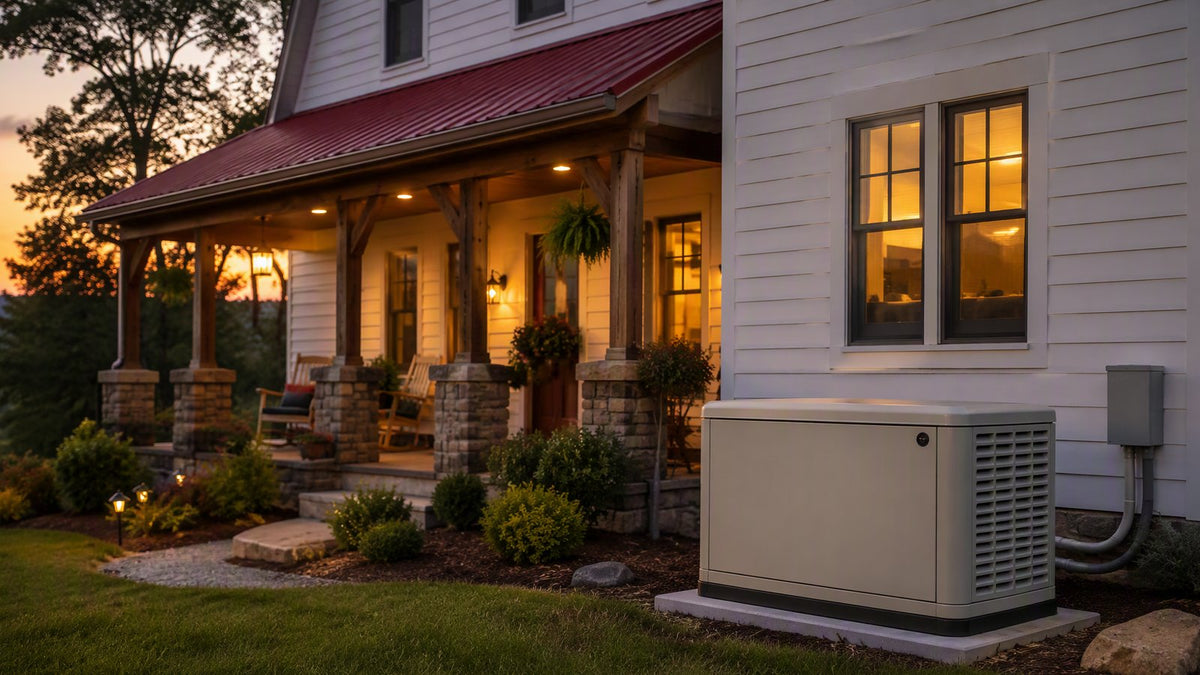
A Complete Guide to 18kW Generators
The contractor's reference for 18kW standby generator sizing, fuel systems, electrical design, and code compliance for large residential and light commercial backup power.

Eighteen kilowatts is where residential backup power crosses into light commercial territory. I've installed 18kW units on 4,000-square-foot homes with two heat pumps, on small dental offices, on farm workshops with 100-amp welders, and on multi-family buildings with shared essential circuits. The 18kW class is versatile, but it demands respect — bigger fuel lines, larger transfer switches, and stricter attention to voltage drop.
This guide covers the full engineering picture: load calculation methodology, fuel consumption math for both propane and natural gas, transfer switch and conductor sizing per NEC, and a detailed comparison of the Briggs & Stratton 040756 PowerProtect 18kW and the Generac Guardian G007226-0 18kW. Both are air-cooled standby units. Both handle 18kW continuous. The difference is in starting surge capability, enclosure durability, and controller intelligence.
If you are crossing over from a 13kW to an 18kW, understand that the installation complexity does not scale linearly. The fuel line doubles in diameter. The ATS jumps from 100A to 200A. The pad needs to handle 450 pounds instead of 315. Plan accordingly.
What an 18kW Generator Powers: The Real Load List


An 18kW generator at 240V single-phase delivers 75 amps continuous (18,000 ÷ 240 = 75A). Starting surge — what matters for motor loads — typically runs 25–40% above continuous, giving you 22–25 kVA of inrush capacity. That is enough to start a 5-ton central air conditioner while the rest of the house runs.
Here is a realistic whole-house load profile for a 3,500 sq. ft. home with all-electric appliances:
| Circuit / Appliance | Running Watts | Starting Watts | Load Type |
|---|---|---|---|
| Heat Pump (5 ton) | 4,500 | 9,500 | Motor (LRA × 240V) |
| Heat Pump Air Handler | 800 | 1,200 | ECM blower |
| Electric Water Heater | 4,500 | 4,500 | Resistive |
| Electric Dryer | 5,000 | 5,000 | Resistive |
| Electric Range (1 element) | 2,000 | 2,000 | Resistive |
| Dishwasher | 1,500 | 1,500 | Resistive + motor |
| Well Pump (3/4 HP) | 1,200 | 3,200 | Motor |
| Sump Pump (1/2 HP) | 900 | 2,200 | Motor |
| Refrigerator (25 cu. ft.) | 200 | 1,200 | Compressor |
| Freezer | 150 | 800 | Compressor |
| Lighting (LED, whole house) | 400 | 400 | Resistive |
| TV, computers, chargers | 500 | 500 | Electronic |
| Maximum Simultaneous | 17,650 | 28,000 | |
| Typical Managed Load | 12,000 | 18,500 | With load shedding |
The maximum simultaneous column assumes everything cycles on at once — an unlikely but not impossible scenario during an outage when the generator first starts and all thermostats call simultaneously. A 200-amp ATS with load management handles this by staggering motor loads. The Generac Smart Management Module (SMM) and the Briggs Symphony II both do this well. Without load management, you need a 22–26 kW generator to cover the 28 kVA surge.
In practice, an 18kW unit with load shedding runs a 3,500 sq. ft. all-electric home comfortably. The water heater drops out when the heat pump starts. The dryer waits its turn. Priority circuits — medical equipment, sump pumps, security systems — never get shed. I have a customer in rural Pennsylvania running exactly this setup through three winter outages. Never had an overload trip.
Most residential 18kW generators are 240V single-phase. Commercial models may offer 208V three-phase. The amperage formula is simple:
- Single-phase: Amps = (kW × 1,000) ÷ Volts = 18,000 ÷ 240 = 75A
- Three-phase: Amps = (kW × 1,000) ÷ (Volts × 1.732) = 18,000 ÷ (208 × 1.732) = 50A per phase
The Briggs & Stratton 040756 is single-phase only. The Generac G007226-0 is also single-phase. If you need three-phase for a commercial panel, step up to the 22–27 kW liquid-cooled class or use a phase converter — though phase converters introduce 3–5% efficiency loss and maintenance complexity.
Conductor sizing for a 75A continuous load follows NEC 310.16. At 75°C, 4 AWG THHN carries 85A. That covers the 75A load with 13% headroom. But NEC 310.15(B)(2) derates for ambient temperature and conduit fill. In an attic run with three current-carrying conductors at 50°C ambient, 4 AWG THHN derates from 85A to 68A — below the 75A requirement. In that scenario, upsize to 2 AWG. I've had to re-pull wire on two jobs where the original electrician sized for breaker rating instead of derated ampacity.
Eighteen kilowatts burns more fuel than 13kW, but the relationship is not linear. Engine efficiency improves at higher load percentages. A loaded 18kW engine runs more efficiently per kWh than an idling 13kW at 30% load.
| Load Level | Propane (gal/hr) | Propane (lb/hr) | Natural Gas (ft³/hr) | Run Time (500-gal tank) |
|---|---|---|---|---|
| 25% (4.5 kW) | 1.4 | 5.9 | 175 | 286 hrs |
| 50% (9.0 kW) | 2.2 | 9.2 | 245 | 182 hrs |
| 75% (13.5 kW) | 3.1 | 13.0 | 330 | 129 hrs |
| 100% (18 kW) | 3.9 | 16.3 | 410 | 103 hrs |
A 500-gallon propane tank at 80% fill holds 400 usable gallons. At 50% average load, an 18kW generator runs 182 hours — roughly 7.5 days of continuous operation. Most outages are intermittent. During Hurricane Ida, one of our Louisiana customers ran their 18kW Generac for 11 days on a 500-gallon tank by managing loads aggressively — no dryer, no water heater during peak heat, minimal lighting.
Natural gas simplifies logistics but requires pressure verification. An 18kW Generac at full load pulls approximately 410 cubic feet per hour. A typical residential gas meter is rated for 250–425 cubic feet per hour. If the home already has a gas furnace (80,000 BTU/hr = 80 ft³/hr), gas water heater (40,000 BTU/hr = 40 ft³/hr), and gas range (65,000 BTU/hr = 65 ft³/hr), the combined demand with generator is 410 + 80 + 40 + 65 = 595 ft³/hr. That exceeds a standard 425 ft³/hr meter. The gas company must upsize the meter and possibly the service regulator. This is a common delay in 18kW NG installs — always verify with the utility before quoting.
Transfer Switch and Conductor Sizing for 18kW

An 18kW generator requires a 200-amp automatic transfer switch (ATS) in most residential applications. Even if the home has 100-amp service, the NEC 702.4 optional standby sizing rule permits a 200A ATS with load management. This future-proofs the install if the homeowner upgrades service later.
| Component | 18kW Requirement | NEC Reference | Common Spec |
|---|---|---|---|
| ATS Rating | 200A minimum | UL 1008, NEC 702 | Generac RXSW200A3 / Briggs 71047 |
| Generator Circuit Breaker | 100A double-pole | NEC 240.6 | 100A HACR-rated |
| Generator Conductors | 3 AWG THHN (min) | NEC 310.16 | 2 AWG THHN for derating |
| Grounding Conductor | 8 AWG copper | NEC 250.122 | 6 AWG for 100A circuit |
| Conduit Size (EMT) | 1-1/4 in | NEC Chapter 9, Table 4 | 1-1/2 in for pull ease |
| Pad Specification | 4 in reinforced concrete | Manufacturer spec | 3,000 psi, rebar mesh |
| Clearance (front) | 36 in minimum | Manufacturer spec | 48 in for service access |
Voltage drop is critical on 18kW circuits. A 75A load on 2 AWG copper over 100 feet produces a 2.8V drop — within the 3% NEC recommendation (7.2V on 240V). But if the run is 150 feet, drop climbs to 4.2V. That is still acceptable for most loads, but motor starting torque suffers. I've seen compressors fail to start on long runs where the voltage sagged to 210V during inrush. The fix was upsizing to 1/0 AWG and adding a soft-start module to the heat pump.
Step 1: Pad Preparation and Placement
An 18kW generator weighs 450+ pounds wet. The pad must be 4-inch reinforced concrete over compacted gravel. I use #4 rebar on 12-inch centers. The pad should extend 6 inches beyond the generator footprint on all sides. Slope the top surface 1/4 inch per foot away from the generator base. In flood-prone areas, raise the pad 12 inches above grade with a retaining wall approach.
Step 2: Fuel System Sizing and Connection
For propane, I specify a 500-gallon tank minimum. A 320-gallon tank (known in the industry as a "100-gallon" tank — confusing, but that's what propane dealers call it) only holds 256 usable gallons. At 2.2 gal/hr average, that's 116 hours. Not enough for a multi-day outage. For natural gas, call the utility before quoting. Ask for the meter rating in cubic feet per hour and the service regulator capacity. Document the response. I've eaten costs on jobs where the utility required a $2,400 meter upgrade.
Step 3: Electrical Rough-In
The generator circuit is a 100A feeder. Pull three 2 AWG THHN conductors (L1, L2, neutral) plus one 6 AWG ground in 1-1/2 inch EMT. If the run exceeds 100 feet, upsize to 1/0 AWG. Install the 200A ATS between the meter and main panel for service-entrance rated configurations, or as a subfeed breaker for load-center rated setups. Label everything at both ends. Torque lugs to manufacturer spec — most 2 AWG lugs want 250 in-lb.
Step 4: Load Management Configuration
Set priorities before the first power outage. Priority 1 is always life safety — medical equipment, stair lifts, oxygen concentrators. Priority 2 is infrastructure — sump pump, well pump, furnace. Priority 3 is convenience — refrigerator, freezer, lighting. Priority 4 is comfort — water heater, AC. Priority 5 is discretionary — dryer, range, hot tub. Program the shed threshold at 85% of 18kW = 15.3 kW. This leaves headroom for motor starting surges without nuisance overloads.
Step 5: Startup Testing and Commissioning
Run the exercise cycle first — 12 minutes at no load. Check for fuel leaks, exhaust clearance, and abnormal noise. Then apply load: turn on the heat pump, water heater, and dryer simultaneously. The generator should carry 14–16 kW without complaint. Check voltage at the ATS output under load — should be 228–252V. Check frequency — should be 59.5–60.5 Hz. Record all readings on the startup sheet. The manufacturer requires this documentation for warranty activation.
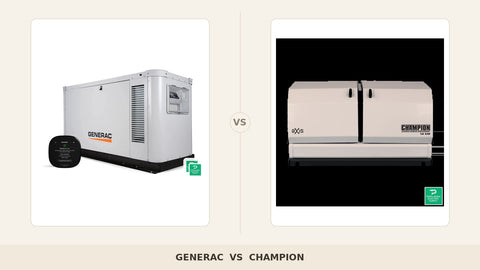
These are the two 18kW units we ship most often. Both are made in the USA. Both have nationwide service networks. The choice usually comes down to engine preference, controller features, and warranty terms.
| Specification | Briggs & Stratton 040756 | Generac Guardian G007226-0 |
|---|---|---|
| Rated Power (NG) | 18 kW | 18 kW |
| Rated Power (LP) | 18 kW | 18 kW |
| Surge Capacity | 27.5 kVA | 26.0 kVA |
| Engine | Vanguard 993cc V-Twin OHV | Generac G-Force 816cc V-Twin |
| Sound Level | 68 dB at 23 ft | 67 dB at 23 ft |
| Enclosure | Aluminum, Dura-Zen coating | Galvanized steel, powder coat |
| Clearance to Structure | 18 in (side), 36 in (front) | 18 in (side), 36 in (front) |
| Controller | InfoHub Wi-Fi / cellular | Mobile Link Wi-Fi / cellular |
| Warranty | 6-year parts & labor | 5-year limited |
| Weight (dry) | 463 lb | 445 lb |
| Price | $5,195 | $5,450 |
The Briggs & Stratton carries the longer warranty and slightly higher surge capacity — useful if you are running large motor loads without load management. The Generac has the broader dealer network and the Mobile Link ecosystem, which integrates with their PWRcell battery systems. I specify Briggs when the customer wants maximum warranty coverage and Generac when they may add battery storage later.
Both units operate at 67–68 dB. That is quieter than normal conversation at 3 feet but audible from 50 feet. If the generator pad is within 20 feet of a bedroom window, specify an acoustical barrier or consider a liquid-cooled unit at 62 dB. The cost jump to liquid-cooled is significant — $8,500+ — but noise ordinances in some communities make it unavoidable.
Higher load means higher wear. An 18kW unit running at 75% load stresses the engine more than a 13kW at 50%. Shorten service intervals accordingly.
- Every 3 months (or 50 run hours): Check oil level, inspect air filter, clear debris from enclosure, verify battery voltage >12.4V, run exercise cycle.
- Every 6 months (or 100 run hours): Change oil and filter (SAE 5W-30 synthetic), replace air filter if dusty, inspect spark plugs for fouling, test battery under load, check coolant on liquid-cooled units.
- Every 12 months (or 200 run hours): Replace spark plugs, inspect fuel regulator and lines, torque all electrical connections, clean battery terminals, verify ATS contact wear, exercise under 50% load for 30 minutes.
- Every 3 years: Replace battery (proactive), replace fuel filter, inspect enclosure for corrosion, pressure-test propane regulator, verify gas pressure at full load.
Propane burns cleaner than natural gas. Less carbon fouling. Longer spark plug life. But propane vaporization drops in extreme cold. At -20°F, a 500-gallon tank may not vaporize fast enough to feed an 18kW unit at full load. The solution is either a larger tank (more surface area for vaporization) or a propane vaporizer. We specify 1,000-gallon tanks for northern climate 18kW installs. The extra tank cost pays for itself in reliability.
Frequently Asked Questions
Will an 18kW generator run my whole house with two AC units?
Yes, with intelligent load management. The Generac Smart Management Module or Briggs Symphony II system staggers AC compressor starts so they never pull simultaneously. Without load management, two 5-ton units starting together could demand 19+ kW of surge — exceeding even an 18kW unit's capacity.
How many amps does an 18kW generator produce?
75 amps continuous at 240V single-phase. The Briggs & Stratton 040756 delivers 27.5 kVA surge, which translates to approximately 115 amps for motor-starting events lasting under 2 seconds.
How much propane does an 18kW generator use per hour?
2.2 gallons at 50% load. 3.9 gallons at full load. Plan your tank size for your longest expected outage plus a 30% margin. In hurricane country, that means 1,000 gallons.
What size transfer switch for an 18kW generator?
200 amps. The ATS rating should match or exceed the main panel rating. A 200A ATS with load management gives you the most flexibility and future-proofs the installation.
How much does an 18kW standby generator cost installed?
$9,500–$13,000 all-in. The generator itself is $5,200–$5,450. The ATS, conduit, wire, pad, and labor add $4,000–$7,000. Propane tank installation is additional ($1,500–$3,000).
Can I run a welder on an 18kW generator?
A 180-amp MIG welder at 220V draws about 6,500W running. An 18kW unit handles this with room for lights and tools. Just do not fire up the heat pump at the same time. For 250-amp industrial welders, step up to 22–27 kW.
What wire size for a 100-amp generator circuit?
3 AWG THHN for short runs under 75 feet. 2 AWG for longer runs or attic derating. Always pull in conduit — NM-B is not rated for outdoor generator circuits and cannot handle the ampacity when derated.
How long will an 18kW generator run on a 500-gallon propane tank?
182 hours at 50% load. In a real outage with load cycling, figure 10–14 days. We had a customer in upstate New York run 16 days on a 500-gallon tank during a February ice storm by shedding non-essential loads.
- 13kW Generator Guide
- AC Unit Electrical Requirements — 2026 Contractor Guide
- Furnace Electrical Requirements — 2026 Contractor Guide
- Solar System Calculator
- Battery Sizing Calculator
- Inverter Sizing Calculator
- NEC Code Compliance Guide
- Grounding & Bonding Guide
- Solar Incentives by State
- Pro Account — Wholesale Pricing
- PowerLink Network — Contractor Program
- Generac Brand Guide
- Briggs & Stratton Brand Guide
- Generac PWRcell Cost Guide
- Shop All Generators
Need an 18kW Generator for Your Project?
Briggs & Stratton and Generac 18kW standby generators in stock. Contractor pricing and bulk quotes available. Ship nationwide.
Get a Quote