AC Unit Electrical Requirements: 2026 Contractor Guide
Breaker sizing, wire gauge, disconnect placement, and NEC 440 compliance for central air conditioners, heat pumps, and mini-split installations.
Every air conditioner — whether a 3-ton central unit or a 12k BTU mini split — is a continuous load that defines the circuit it sits on. Get the breaker, wire, or disconnect wrong and you get callbacks, failed inspections, or compressor damage. I've seen a $12,000 compressor replacement because the electrician pulled 12 AWG for a 4-ton unit that needed 8 AWG. The wire overheated, the voltage dropped, and the compressor ran starved for 18 months before it seized.
This guide is the electrical side of AC installation: breaker sizing, wire gauge, disconnect placement, and the NEC rules that actually matter in 2026. Portlandia Electric Supply does not stock HVAC equipment — we stock the electrical infrastructure that makes it run: breakers, wire, conduit, disconnects, panels, and transfer switches. If you are sizing the circuit, you are in the right place. For condenser-specific details, see our AC Condenser Electrical Requirements guide. For furnace circuits, see the Furnace Contractor Guide.
This table covers central AC, heat pumps, and mini-splits. Breaker sizes are HACR-rated. Wire is copper THHN/THWN-2 at 75°C.
| AC Type | Typical Load | Breaker | Wire (Cu) | Disconnect | NEC Article |
|---|---|---|---|---|---|
| 1.5-ton central (18k BTU) | 12–15A running | 25–30A | 10 AWG | Fused or non-fused 30A | 440 |
| 2-ton central (24k BTU) | 14–18A running | 30A | 10 AWG | Fused or non-fused 30A | 440 |
| 2.5-ton central (30k BTU) | 18–22A running | 35–40A | 8 AWG | Fused or non-fused 40–60A | 440 |
| 3-ton central (36k BTU) | 20–25A running | 40–45A | 8 AWG | Fused or non-fused 60A | 440 |
| 3.5-ton central (42k BTU) | 25–30A running | 45–50A | 8 AWG / 6 AWG | Fused or non-fused 60A | 440 |
| 4-ton central (48k BTU) | 28–32A running | 50A | 6 AWG | Fused or non-fused 60A | 440 |
| 5-ton central (60k BTU) | 35–40A running | 60A | 6 AWG | Fused or non-fused 60A | 440 |
| Heat pump 3-ton | 22–28A running | 40–50A | 8 AWG | Fused or non-fused 60A | 440 |
| Heat pump 5-ton | 35–42A running | 60A | 6 AWG | Fused or non-fused 60A | 440 |
| Mini split 9k–12k BTU | 5–10A running | 15–20A | 12 AWG | Shutoff within sight (15–20A) | 440 |
| Mini split 18k–24k BTU | 10–16A running | 20–25A | 12 AWG / 10 AWG | Shutoff within sight (20–30A) | 440 |
| Mini split 36k BTU | 16–22A running | 30A | 10 AWG | Shutoff within sight (30A) | 440 |
Key rule: Compressors are motor loads. NEC 440 applies, not the standard branch-circuit sizing in Article 310. Breakers are sized to handle locked-rotor amperage (LRA) on startup — often 5–7× running amps — which is why a 15A-running compressor needs a 30A breaker. I've had apprentices argue that 14 AWG on a 15A breaker should work for a mini split. It won't. The LRA on a 12k BTU mini split can hit 45A for half a second. The HACR breaker handles that. A standard breaker trips.
Article 440 gives two methods for sizing overcurrent protection:
- Standard method (440.22(A)): Breaker size = 175% of rated-load current (RLA) or branch-circuit selection current (whichever is larger). Round up to the next standard breaker size.
- Alternate method (440.22(B)): Breaker = 225% of RLA. Only permitted if the breaker does not trip under normal starting — and you must use time-delay fuses or HACR-rated breakers.
| Unit Size | RLA | LRA | Std Method (×1.75) | Breaker | Alt Method (×2.25) | Breaker |
|---|---|---|---|---|---|---|
| 2-ton | 11A | 58A | 19.3A | 20A HACR | 24.8A | 25A HACR |
| 2.5-ton | 14A | 72A | 24.5A | 25A HACR | 31.5A | 35A HACR |
| 3-ton | 17A | 95A | 29.8A | 30A HACR | 38.3A | 40A HACR |
| 3.5-ton | 20A | 110A | 35.0A | 35A HACR | 45.0A | 45A HACR |
| 4-ton | 23A | 125A | 40.3A | 40A HACR | 51.8A | 50A HACR* |
| 5-ton | 28A | 145A | 49.0A | 50A HACR | 63.0A | 60A HACR* |
*Alternate method limited by nameplate MOP. If MOP is 50A, you cannot use the alternate method result of 51.8A. The nameplate governs.
Practical example: a 3-ton condenser rated 17A RLA / 95A LRA. Standard method: 17A × 1.75 = 29.75A → 30A breaker (HACR-rated). Alternate: 17A × 2.25 = 38.25A → 40A breaker with HACR rating. Most condenser nameplates list "Max Fuse / HACR Breaker" — size to that. Never exceed the nameplate maximum. I had a job in Texas where the nameplate said 35A MOP but the electrician installed a 40A because "that's what we always use on 3-ton units." The inspector caught it. The breaker came out. The drywall patch cost $300.
Do not size wire to the breaker — size to the load with proper derating:
- Attic runs: Ambient can hit 55–65°C. NEC 310.15(B)(2) derates THHN from 75°C ampacity. A 10 AWG THHN rated 35A at 75°C drops to ~28A in a hot attic with three current-carrying conductors. For a 22A compressor in attic conduit, 8 AWG is the safe call. I learned this the hard way on a Houston job in July. The attic was 140°F. The 10 AWG was smoking.
- NM-B (Romex): Limited to 60°C ampacity. 10 AWG NM-B = 30A. For a 25A load, you are at 83% — legal, but hot. Upsize to 8 AWG NM-B or run THHN in conduit. I do not spec NM-B for AC circuits over 20A. The temperature derating kills you.
- Conduit runs to pad-mount: Use THHN/THWN-2 in PVC or EMT. Wet locations require W-rated insulation. EMT is my preference — it provides physical protection and an equipment grounding path if properly bonded.
| Wire Type | 10 AWG Rating | 8 AWG Rating | 6 AWG Rating | Best Use Case |
|---|---|---|---|---|
| THHN/THWN-2 (75°C) | 35A | 50A | 65A | Conduit runs, outdoor |
| THHN (60°C) | 30A | 40A | 55A | Rarely used now |
| NM-B (60°C) | 30A | 40A | 55A | Indoor branch circuits |
| THHN/THWN-2 (3 conductors, 45°C attic) | 28A | 40A | 52A | Attic runs (derated) |
| THHN/THWN-2 (6 conductors, 45°C attic) | 24A | 35A | 45A | Conduit fill + derating |
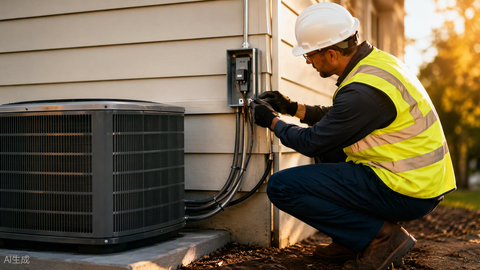
AC condensers require a disconnect within sight and within 50 feet of the unit:
- Fused disconnect: Provides overcurrent protection if the breaker is remote. Common on commercial and multi-unit installs. I use fused disconnects when the breaker panel is in a mechanical room 80 feet from the condenser.
- Non-fused (pullout) disconnect: Cheaper, lighter, but relies on the upstream breaker. Standard on residential split systems. We sell thousands of these — the 30A non-fused disconnect at $99.99 is our top seller.
- Lockable: Required in many jurisdictions for service access and OSHA lockout/tagout compliance. If the disconnect does not have a hasp, add one. Inspectors check this.
Mini splits are simpler: most inverter-driven units have an integral disconnect or require only a shutoff within sight. Check the installation manual — some brands require a dedicated disconnect; others accept the breaker as the disconnecting means if it's within sight. Mitsubishi, Daikin, and LG all have different requirements. I keep a binder of installation manuals in the truck. Saves callbacks.
A 3-ton central AC on a 30A 240V circuit draws ~7.2kW. On a 200A service, that is fine. On a 100A service already feeding electric range, dryer, and water heater, a NEC 220.83 load calculation often fails. Common fixes:
- Load-shed device: Automatically drops the water heater or EV charger when the AC starts. Cheaper than a panel upgrade. The Generac Load Control Module handles up to 50A of managed load.
- Subpanel: Feed a new 60A subpanel from spare lugs or a dual-feed breaker if the main has capacity. We stock Square D and Siemens subpanels for exactly this scenario.
- Service upgrade to 200A: The right answer if you are also adding a heat pump, EV circuit, or home battery later. A 200A service upgrade runs $2,500–$4,500 in most markets. Factor it into the proposal if the load calc is close.
NEC 220.83 Load Calculation Trap
Many contractors skip the formal load calc for a simple AC addition. Do not. If the existing service is 100A and the home has electric cooking, the addition of a 30A AC circuit may push the calculated load over 100A. The inspector will ask for the load calc. Have it ready. We provide load calculation worksheets through our Pro Account portal.
Mini splits run two cables that must be kept separate:
- Line set (refrigerant): Not electrical — but the condensate pump and line-set penetration need compliance with local mechanical codes.
- Power (high voltage): 240V to the outdoor unit, typically 10–12 AWG depending on amperage and run length. Some small single-zone units run 120V. Always check the nameplate — I've seen 9k BTU units that need 20A 240V circuits because of inverter inrush.
- Control (low voltage): 14–18 AWG two-conductor between indoor head and outdoor condenser. Manufacturer-specified; do not substitute thermostat wire unless the spec allows it. Mitsubishi uses shielded 18/2. LG uses unshielded 16/2. Using the wrong cable can cause communication errors and fault codes.
Max run length: Most manufacturers spec 25–50 feet of line set without refrigerant charge adjustment. Beyond that, wire voltage drop matters too — keep 240V drops under 3%. For a 20A mini split circuit, 10 AWG is good to 80 feet. At 100 feet, upsize to 8 AWG.
| Mini Split Size | Running Amps | Breaker | Power Wire | Control Wire | Max Line Set |
|---|---|---|---|---|---|
| 9k BTU (0.75 ton) | 4–6A | 15A | 14 AWG | 18/2 shielded | 25 ft |
| 12k BTU (1 ton) | 5–8A | 15–20A | 14 AWG | 18/2 shielded | 25 ft |
| 18k BTU (1.5 ton) | 8–12A | 20A | 12 AWG | 16/2 unshielded | 35 ft |
| 24k BTU (2 ton) | 10–15A | 20–25A | 12 AWG | 16/2 unshielded | 50 ft |
| 36k BTU (3 ton) | 16–20A | 25–30A | 10 AWG | 16/2 unshielded | 65 ft |
| Multi-zone (2–4 heads) | 15–25A | 25–35A | 10 AWG | 16/2 per head | 65 ft |
Step 1: Perform Load Calculation
Before you add a 30A circuit to a 100A panel, run the numbers. NEC 220.83 gives you an optional calculation for existing dwellings. Add the existing loads (general lighting, appliances, HVAC) and compare to the service rating. If the calculated load exceeds 80% of service rating, you need a service upgrade or load management. I keep a spreadsheet template on my phone. Takes 5 minutes and saves hours of rework.
Step 2: Select HACR Breaker
Read the nameplate RLA. Multiply by 1.75. Round to the next standard breaker size. Verify the result is ≤ MOP. If it is not, use the nameplate MOP as your breaker size and verify the wire still handles the MCA. Order the breaker before you start — HACR breakers in 25A, 35A, and 45A can be special-order items at big-box stores. We stock them for next-day delivery.
Step 3: Size Conductors
Use NEC Table 310.16 at 75°C. For a 30A circuit, 10 AWG THHN is rated 35A — adequate for MCA up to 28A. But if the run passes through a 130°F attic with two other circuits in the same conduit, derating applies. Three current-carrying conductors at 55°C ambient: derating factor 0.71. 35A × 0.71 = 24.9A. If MCA is 22A, you are legal but tight. I upsize to 8 AWG and forget about it.
Step 4: Install Disconnect
Within sight means visible and not more than 50 feet away. Mount the disconnect between 4 and 6 feet above grade. Face it so the HVAC technician can read the label from the service position. Use raintight fittings on the bottom. Weep holes down. I've seen disconnects mounted upside down with water pooling inside. Rusted contacts. Failed inspection.
Step 5: Run Conduit and Wire
EMT is my preference for commercial. PVC Schedule 80 for residential pad-mount condensers. Minimum burial depth: 18 inches for PVC (NEC Table 300.5). Use expansion fittings where the conduit exits the slab — freeze-thaw will crack rigid PVC without them. For the whip from disconnect to condenser, use liquid-tight flexible metal conduit (LFMC) with raintight connectors. Length should not exceed 6 feet per NEC 440.14.
Step 6: Ground and Bond
Run a dedicated equipment grounding conductor. Do not rely on the conduit alone, even though EMT is an acceptable grounding path per 250.118. A separate green wire gives you redundancy and makes troubleshooting easier. Bond the condenser frame with a grounding lug and anti-oxidant compound on aluminum enclosures.
Step 7: Label and Inspect
Label the disconnect "AC Condenser" with the circuit number. Update the panel directory. If this is a subpanel, add a placard showing the feeder source. Megger the circuit at 500V DC — you want 100 MΩ or higher. Below 25 MΩ and I start hunting for a nail through the cable. Schedule inspection before the HVAC crew charges the system. Once refrigerant is in, the electrical inspector may not want the unit powered for testing.
In virtually every U.S. jurisdiction, a new AC circuit requires:
- Electrical permit for the new 240V branch circuit.
- HVAC permit for the refrigerant work (if you are the mechanical contractor).
- Inspection of the disconnect location, wire gauge, breaker sizing, and grounding.
Common inspection failures: disconnect not within sight, undersized ground (must match circuit ground, not the smaller control wire), NM-B run underground without conduit, and breaker not HACR-rated. I've also seen failures for missing weep holes in PVC conduit, unsupported EMT sagging more than 1/4 inch per foot, and unlabeled subpanels. The inspectors are not being difficult — they are checking the same items that cause fires and electrocutions.
What size breaker for a 3-ton AC unit?
30–35A HACR-rated. Calculate from RLA × 1.75. If RLA is 17A, 17 × 1.75 = 29.75A → 30A breaker. If the nameplate MOP is 30A, you are at the limit. If MOP is 35A, you have options. Never guess — read the plate.
What wire for a 30-amp AC circuit?
10 AWG THHN in conduit for standard conditions. 8 AWG if the run is over 75 feet, in a hot attic, or with multiple circuits in one conduit. NM-B is limited to 30A at 60°C and cannot be used outdoors.
Does a mini split need a disconnect?
Yes. NEC 440.14 applies to all air conditioning equipment. Some mini split manufacturers accept the breaker as the disconnect if it is within sight. Others — especially multi-zone systems — require a dedicated shutoff at the outdoor unit. The installation manual governs.
Can I use a standard breaker for AC?
No. Standard thermal-magnetic breakers trip on compressor LRA. HACR breakers have magnetic trip curves that tolerate the 5–7× inrush for a few cycles. The difference is engineered. The markup is $3–$8 per breaker. Use the right one.
How far can the disconnect be from the AC unit?
50 feet and within sight. That means the technician standing at the unit can see the disconnect handle and reach it without tools. If a fence blocks the view, move the disconnect or cut a sight window.
What is the 125% rule for AC?
NEC 440.6 requires branch-circuit conductors to carry 125% of RLA. A 20A RLA compressor needs 25A conductor ampacity. Since 12 AWG is only 20A at 60°C, you need 10 AWG (35A at 75°C). The 125% rule is why even "small" ACs often need 10 AWG.
Can I run NM-B to an outdoor condenser?
No. NM-B is for dry, interior locations. Outdoor condensers are wet locations with physical damage potential. Use THHN/THWN-2 in EMT or PVC. The W rating is for wet — it matters.
What is the difference between MCA and RLA?
RLA is what the compressor draws at full load. MCA is what the wire must handle — RLA × 1.25 plus condenser fan amps. Always size wire to MCA. Size breaker to MOP. Those are the two numbers that matter.
Portlandia Electric Supply stocks the electrical infrastructure AC contractors need: breakers and panels, wire and conduit, AC disconnects, and load management devices. For project-specific quantities and contractor pricing, request a quote — we ship nationwide with same-day fulfillment on orders before 2 PM ET.
- AC Condenser Electrical Requirements — 2026 Contractor Guide
- Furnace Electrical Requirements — 2026 Contractor Guide
- How to Size a Circuit Breaker
- NEC Code Compliance Guide
- Grounding & Bonding Guide
- PES Wire & Cable Collection
- PES Safety & Protection Collection
- PES Electrical Accessories Collection
- Pro Account — Wholesale Pricing
- PowerLink Network — Contractor Program
Contractor-Grade Electrical Supply
Breakers, wire, conduit, disconnects, and panels shipped direct to your job site. Bulk pricing available through PowerLink Network.
Get a Quote