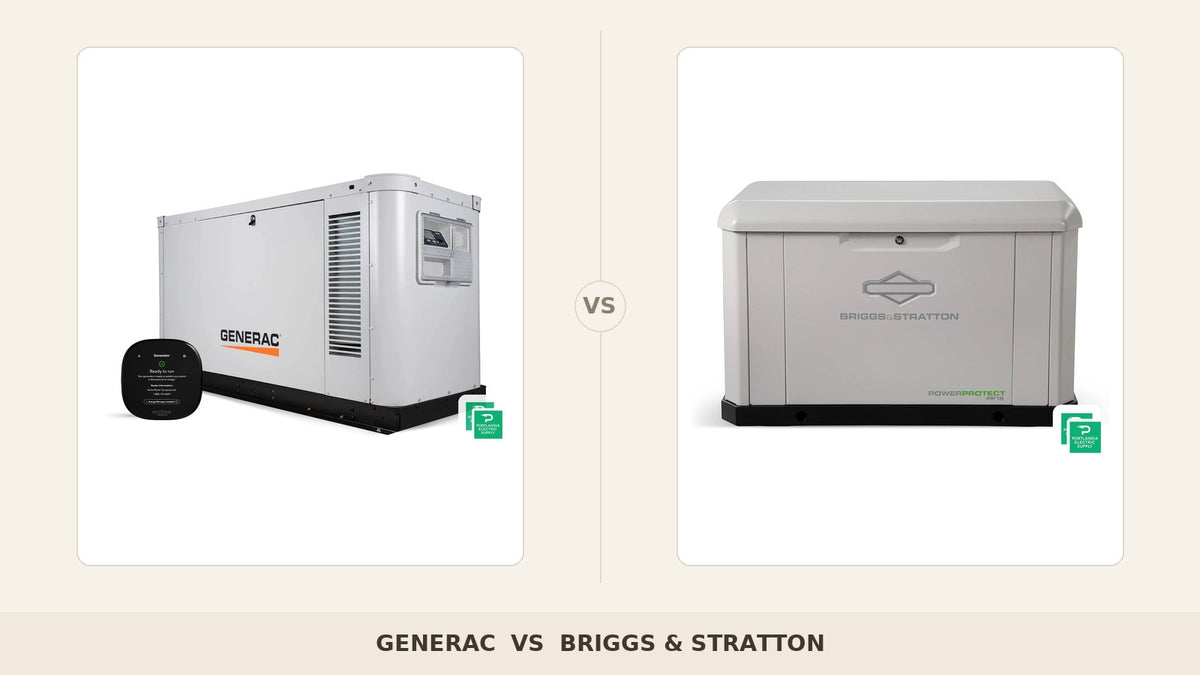
Generac vs Briggs & Stratton (2026): Standby Generators Compared
Air-cooled home standby head-to-head: engines, warranty, monitoring, load management, and installed cost — from a supply house that stocks parts for both.
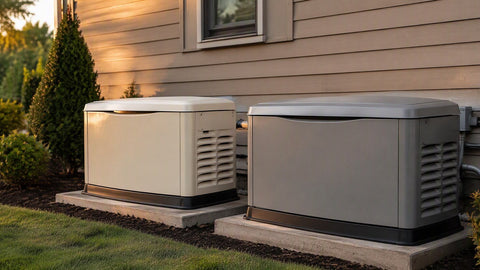
When a homeowner calls us after the third outage of the season, the shortlist almost always comes down to two badges: Generac and Briggs & Stratton. Generac owns the majority of the US residential standby market by volume — you see the orange-and-gray Guardian boxes on pads everywhere. Briggs & Stratton is the value challenger with over a century of small-engine history behind it, selling essentially comparable wattage for less money. We've wired both brands onto 200-amp services, and the honest answer is that the generator itself is rarely the part that fails — the installation and maintenance are. Still, there are real differences, and they matter.
This comparison covers the air-cooled residential lines where these two brands actually compete: Generac's Guardian series (the 22 kW and 26 kW units we move constantly, including the Generac 7291 26 kW Guardian with 200A SE transfer switch) against Briggs & Stratton's PowerProtect and standby line in the same 20–26 kW class. Liquid-cooled commercial units are a different fight — that one's Generac vs Cummins, and it's covered separately.
Both brands publish clean spec sheets, but they organize them differently. Here's the working comparison we use when we quote, normalized to the same categories. Figures are published ratings for current-model air-cooled units in the 20–26 kW class; always confirm against the specific model number's datasheet before you order.
| Category | Generac Guardian (22–26 kW) | Briggs & Stratton (20–26 kW) |
|---|---|---|
| Engine | Generac G-Force 999cc air-cooled V-twin, purpose-built for standby duty | Briggs & Stratton Vanguard or Commercial Series V-twin, decades of field history |
| Fuel | Natural gas or LP, field-convertible | Natural gas or LP, field-convertible |
| Rated output (NG / LP) | Typically 22 kW NG / 22 kW LP; 26 kW unit derates slightly on NG | 20–26 kW class; NG ratings typically a notch below LP |
| Alternator | Brushless, <5% THD on current models | Brushless, low-THD utility-grade power on current PowerProtect units |
| Transfer switch | 200A service-entrance-rated Smart Switch, whole-home or load-managed | 200A SE-rated options with Symphony II load management |
| Monitoring | Mobile Link Wi-Fi (free and paid tiers) | InfoHub / proprietary remote monitoring |
| Sound rating | ~65–67 dB at 23 ft, exercise mode quieter | ~64–67 dB class; comparable in practice |
| Warranty | 5-year limited (parts + labor tiers by year) | Up to 5–6 years depending on model and promo; some lines advertise longer coverage |
| Street price (equipment, 22 kW + ATS) | ~$5,500–$6,800 | ~$4,700–$6,000 |
A few honest footnotes. First, the engine debate is closer than brand loyalists admit: Generac's G-Force is a fine purpose-built standby engine, and Vanguard V-twins have decades of commercial mowing and industrial duty behind them. We've pulled valve covers on both after 500+ exercise hours; wear patterns look similar when the oil got changed on schedule. Second, sound ratings measured at 23 feet in a lab field don't tell you what it sounds like through your bedroom window at 2 a.m. — siting matters more than a decibel or two. Third, THD under 5% on either brand is clean enough for modern electronics, including variable-speed HVAC boards.
The equipment gap is real — Briggs & Stratton typically comes in $800–$1,500 cheaper at the same nameplate wattage. But equipment is less than half the ticket. Here's the full cost stack we itemize on every standby quote:
| Cost Line | Typical Range (USD) | Notes |
|---|---|---|
| Generator unit, 22 kW class | $4,700–$6,800 | Briggs at the low end, Generac at the high |
| 200A SE-rated automatic transfer switch | $800–$1,400 | Often bundled; load-shed modules add cost |
| Composite or poured pad + siting | $300–$900 | Must meet NFPA 37 clearances from openings |
| Gas line work (plumber/mechanical) | $800–$2,500 | Long runs or meter upsizing push this up fast |
| Electrical labor, feeders, and connections | $2,000–$4,000 | Includes ATS cut-in at the service |
| Permits, inspection, utility coordination | $300–$900 | Gas and electrical permits both |
| All-in installed, 22 kW whole-home | $9,000–$15,000 | Regional labor and gas-run length are the swing factors |
So yes, Briggs & Stratton saves you money — call it 8–12% on the total job, not the 20% the box price suggests. Whether that savings is worth it depends on the next two sections. If you want a sanity check on whether 22 kW is even the right size for your house before you compare brands, run your panel schedule through our whole-home generator sizing guide or the Spanish-language version at guía de dimensionamiento de generadores 2026, and cross-reference the 22 kW deep-dive and 26 kW complete guide.
The gas meter trap
A 22–26 kW air-cooled unit burns roughly 200–330 cubic feet of natural gas per hour at full load. Plenty of residential meters and half-inch branch lines can't feed that alongside a furnace and water heater. We've seen beautiful installs that couldn't start the generator at full load because nobody sized the gas service. Get the BTU math done before the pad gets poured — it's a $400 utility call now or a $2,000 repipe later.
Both brands publish fuel curves, and in the 22 kW air-cooled class they're within a few percent of each other — physics is physics, and a 999cc-ish V-twin making the same watts drinks roughly the same gas. Here's the working table we give customers, using representative published figures for the class (verify your exact model):
| Load Level | Natural Gas (ft³/hr) | Propane (gal/hr) | 24-hr outage cost, NG @ $1.20/therm* |
|---|---|---|---|
| No load (exercise) | ~90–110 | ~1.0–1.3 | — |
| 25% (~5.5 kW) | ~150–180 | ~1.6–2.0 | ~$45–$55 |
| 50% (~11 kW) | ~220–260 | ~2.4–2.9 | ~$65–$80 |
| 75% (~16.5 kW) | ~280–320 | ~3.0–3.6 | ~$85–$100 |
| 100% (22 kW) | ~330–380 | ~3.6–4.3 | ~$100–$120 |
*1 therm ≈ 100 ft³ of natural gas. Propane: 500-gal tank at ~$2.50/gal makes a 3-day full-tilt outage a ~$650–$900 fuel event — size LP storage accordingly.
The lesson we drill into every buyer: a whole-home standby generator is not cheap to run flat-out, and it doesn't need to run flat-out. Real outage duty cycles average 30–50% load. Both brands' load-management systems exist precisely to keep you in that efficient band — more on that below. For runtime planning against your actual appliances, our backup runtime calculator works for generator fuel budgets too.
The transfer switch is the part of the system that touches your house's nervous system, and it's where the brand ecosystems genuinely differ. Generac's Smart Switch and load-shed modules (Smart Management Modules, up to eight per system) are the most deployed residential load-management hardware in the country — any electrician who does standby work knows them cold. Briggs & Stratton's Symphony II system does the same job: it watches generator load and stages heavy appliances (AC compressors, water heaters, ranges) so a 20 kW unit can carry a house that would naively need 26 kW.
Field take: we've commissioned Symphony II systems that ran a 4-ton AC plus normal house loads on a 20 kW Briggs without a hiccup. Load management is the great equalizer — it lets the cheaper, smaller generator punch above its nameplate. Generac's ecosystem is broader and parts availability is better in rural markets, but functionally both systems shed and restore loads the same way. Either way, NEC 702 governs the install, the ATS must be service-entrance rated if it's ahead of your main panel, and the feeder sizing follows NEC 310.16 ampacity — our wire sizing guide has the tables, and we stock automatic transfer switches, 200A-class ATS gear, and manual and automatic options for both ecosystems.
Both brands install the same way, because the code drives the sequence regardless of badge. If you've never watched a standby install, here's the honest timeline we quote customers, start to finish:
Site work and pad (day 1, morning)
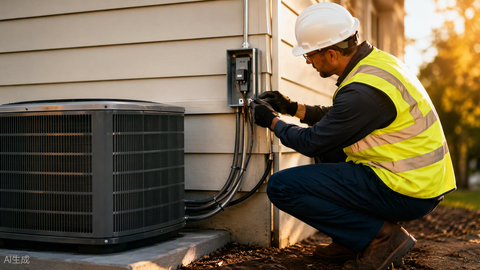
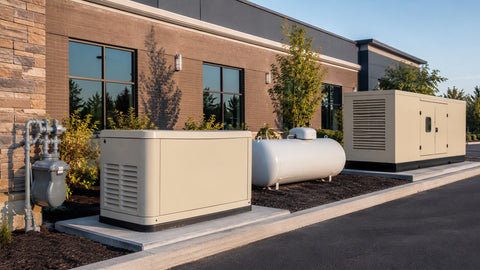
The unit lands on a composite pad or poured concrete, sited to meet NFPA 37 clearances — typically 5 feet from operable windows, doors, and vents, 18 inches minimum from the wall on the service side. Siting is where DIY fantasies die: the inspector will measure, and a unit that fails clearance gets moved at your expense.
Gas rough-in (day 1)
The plumber runs the branch from the meter with proper sizing — usually 3/4-inch or 1-inch for a 22 kW unit depending on run length, per the fuel gas sizing tables. Sediment trap, shutoff, flex connector at the unit. Pressure test before anything gets buried or closed up.
Electrical cut-in (day 1–2)
The transfer switch mounts next to the main panel, the service conductors get re-landed through the ATS, and the generator feeder (typically 6–3 AWG copper in conduit for a 100A-rated circuit, per NEC 310.16 at 75°C) runs to the unit. Control wiring lands in the same trench in a separate conduit or as listed TC cable.
Commissioning (day 2)
Fuel pressure check, first start, exercise clock set (we recommend a weekday mid-morning so the weekly run doesn't wake anyone), transfer test under load, and a walk-through with the homeowner on the status LEDs and the app. Total elapsed: two working days for a clean job, plus inspection scheduling.
We've supervised this exact sequence on both brands dozens of times, and the brand swap changes maybe 20 minutes of the day. The Briggs control wiring lands slightly differently, the Generac Wi-Fi setup takes five minutes longer, and that's about it. Which is why we keep telling people: pick your installer at least as carefully as your brand.
The purchase price is the down payment. The maintenance line is the mortgage. Both brands publish nearly identical service intervals, and the parts cost about the same. Here's the real 10-year ownership table we hand to customers who ask what they're signing up for:
| Interval | Service Item | DIY Cost | Dealer Cost |
|---|---|---|---|
| Every 6 months (visual) | Check oil, clear debris, verify exercise ran, inspect battery terminals | Free | Usually rolled into plan |
| Annually or 100–200 hrs | Oil + filter change (synthetic 5W-30, ~2 quarts), air filter, spark plugs on schedule | $40–$80 | $250–$400 |
| Every 2–3 years | Valve lash adjustment (both brands' V-twins need it) | Shim/tools, $20 | $150–$300 |
| Every 3–4 years | Starter battery replacement (Group 26R or 51R class) | $120–$180 | $200–$300 |
| Every 5 years | Coolant n/a (air-cooled), full inspection, firmware updates, gas pressure re-check | — | $200–$350 |
| 10-year maintenance total | — | ~$600–$1,100 DIY | ~$2,800–$4,500 dealer plan |
A maintenance contract from either brand's dealer network runs $250–$450 a year and is genuinely worth it for the first few years while you learn the machine. After that, oil changes on an air-cooled standby are lawnmower-simple if you're inclined. The one item we never let slide on either brand is the battery: a generator with a dead starting battery is a 700-pound lawn ornament, and it always dies during the outage, not before it. Put the battery on a calendar reminder, not on your memory.
One more ownership note that surprises people: exercise cycles are not optional theater. The weekly 12-minute self-test circulates oil, evaporates moisture from the crankcase, keeps the battery on a charge curve, and — most importantly — proves the machine will actually start before you need it. We've taken service calls where the owner had disabled the exercise schedule to save gas and discovered a failed starter relay during an ice storm, three years too late. Let it exercise. A dollar of natural gas a week is the cheapest insurance the system offers, and both brands' controllers will alert you through their apps when the weekly run didn't complete.
Generac's market share buys you something tangible: service density. In most US counties there's a Generac-authorized tech within an hour's drive, and parts flow fast. Briggs & Stratton's dealer network is thinner in some regions — fine in metros, occasionally painful in rural areas. Before you buy either, ask who within 50 miles is factory-authorized to warranty-work the unit. That answer matters more in year four than anything on the spec sheet.
On warranty: both brands offer multi-year limited warranties in the 5-year class, with Briggs & Stratton periodically running extended-warranty promotions that beat Generac's standard terms on paper. Read the labor coverage tiers — most warranties cover parts longer than labor, and a control board swap billed at three hours of labor is where "free warranty" gets expensive. Whichever brand you choose, the maintenance schedule is the same: oil and filter annually or every 100–200 run hours, valve adjustment on schedule, battery every 3–4 years. We've never seen a well-maintained air-cooled standby of either brand fail to reach 10+ years; we've seen plenty of neglected ones die in five.
Browse the current hardware: Generac lineup (including the G007290 and G007291 series units and portables like the PM4500), and the Briggs & Stratton collection. Cross-shopping the other big name? Our Generac vs Kohler comparison and Generac vs Champion breakdown finish the bracket.
Choose Generac if...
You value the deepest service network in the category, the most electrician-familiar transfer ecosystem, Mobile Link monitoring maturity, and the resale recognition that comes with the market leader. You're in a rural area where the nearest authorized tech matters. The $800–$1,500 premium buys support infrastructure you can actually reach.
Choose Briggs & Stratton if...
Budget is a real constraint and your metro area has solid dealer coverage. The Symphony II load management lets a smaller, cheaper unit carry your whole panel. A current extended-warranty promo tips the value math. You want Vanguard engine pedigree and don't care about brand ubiquity.
Do this regardless of brand...
Size the gas service before the pad. Itemize the ATS and load modules on the quote. Confirm the authorized service tech within 50 miles. Budget annual maintenance — $200–$400 a year of oil, filters, and battery is what turns a 5-year machine into a 15-year one. And if outages are your concern but a pad-mounted unit isn't feasible, a battery system can cover shorter events — our solar battery buyer's guide maps that alternative honestly.
Is Generac more reliable than Briggs & Stratton?
Field failure data doesn't support a big reliability gap on current models — both use proven V-twin engines and brushless alternators. The real differences are service network density (Generac wins) and purchase price (Briggs wins). Maintenance history predicts longevity better than the badge does.
Is 22 kW enough for a whole house?
For most homes up to ~3,000 sq ft with gas heat and one AC unit, yes — especially with load management staging the big appliances. All-electric homes with two AC compressors, electric water heat, and an EV charger should look at 26 kW or plan managed loads carefully. Run your actual panel schedule rather than guessing from square footage.
What does a 22 kW standby generator cost installed in 2026?
All-in, expect $9,000–$15,000 including the unit, 200A transfer switch, pad, gas line work, electrical labor, and permits. Briggs & Stratton typically lands near the bottom of that band, Generac nearer the top. Gas service upgrades and long gas runs are the most common budget-breakers.
How loud are these units?
Both brands rate in the mid-60s dB at 23 feet during full operation — about conversation-plus level — and noticeably quieter during weekly exercise. Siting (distance, barriers, which side of the house) affects perceived noise more than the one-or-two dB between brands.
How long will a standby generator run continuously?
Air-cooled units of either brand are designed for extended outage duty — multi-day runs are fine with natural gas, since the fuel never runs out. On propane, your tank size sets the limit: a 500-gallon tank (400 gal usable) runs a 22 kW unit at half load for roughly 5–7 days. Check oil daily during extended runs per both manuals.
Can I install a standby generator myself to save money?
Not legally or safely in most jurisdictions. You're touching the service entrance (NEC 702, 200-amp transfer equipment) and the gas system (NFPA 54), both of which require permits and licensed trades in most areas. DIY also typically voids the warranty. The electrical and gas labor is where professional installs earn their cost.
Price a real system, pad to panel
We ship both brands and the transfer gear to match — with sizing help from people who wire these for a living.
Shop standby generatorsRelated reading
Sources & standards: manufacturer spec sheets for Generac Guardian 22/26 kW and Briggs & Stratton PowerProtect class units; NEC 2023 Articles 702, 310.16, 240.6; NFPA 37 (stationary engine siting) and NFPA 54 (fuel gas). Prices and ratings verified against published documentation as of early 2026 — confirm current model-year specs before ordering.