Cummins vs Briggs & Stratton 2026: Standby Generators Compared
Two of the three biggest names in home standby power, head to head: engine platforms, real output on natural gas vs propane, fuel burn math, sound levels, warranty terms, and the install details that decide which one belongs on your pad.
Cummins and Briggs & Stratton both build serious home standby generators, and both will carry a whole house through a week-long outage if the unit is sized and installed correctly. The differences live in the engine architecture, the alternator's motor-starting ability, the fuel consumption curve, the warranty structure, and — the one nobody puts in the brochure — the dealer network that answers the phone when the unit throws a fault code at 2 a.m. in an ice storm. We sell, install, and service both brands, so this comparison comes from pads we have poured, gas lines we have sized, and warranty claims we have filed, not from a spec-sheet reading exercise.
If you are earlier in the process, start with how to size a whole-house standby generator or the 2026 sizing guide, then come back here for the brand decision. Shopping already? Jump to Cummins generators or Briggs & Stratton inventory.
The Two Lineups: Who Builds What


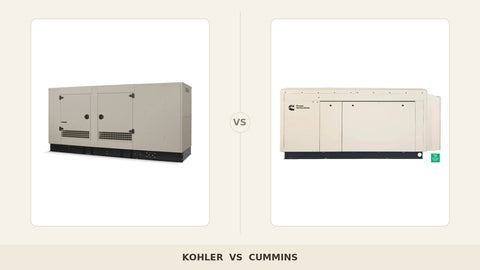
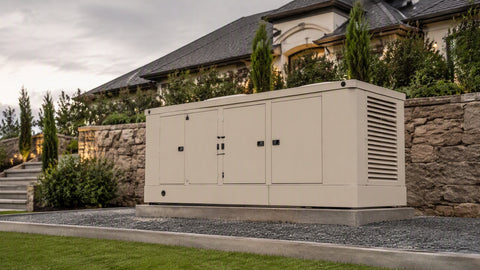
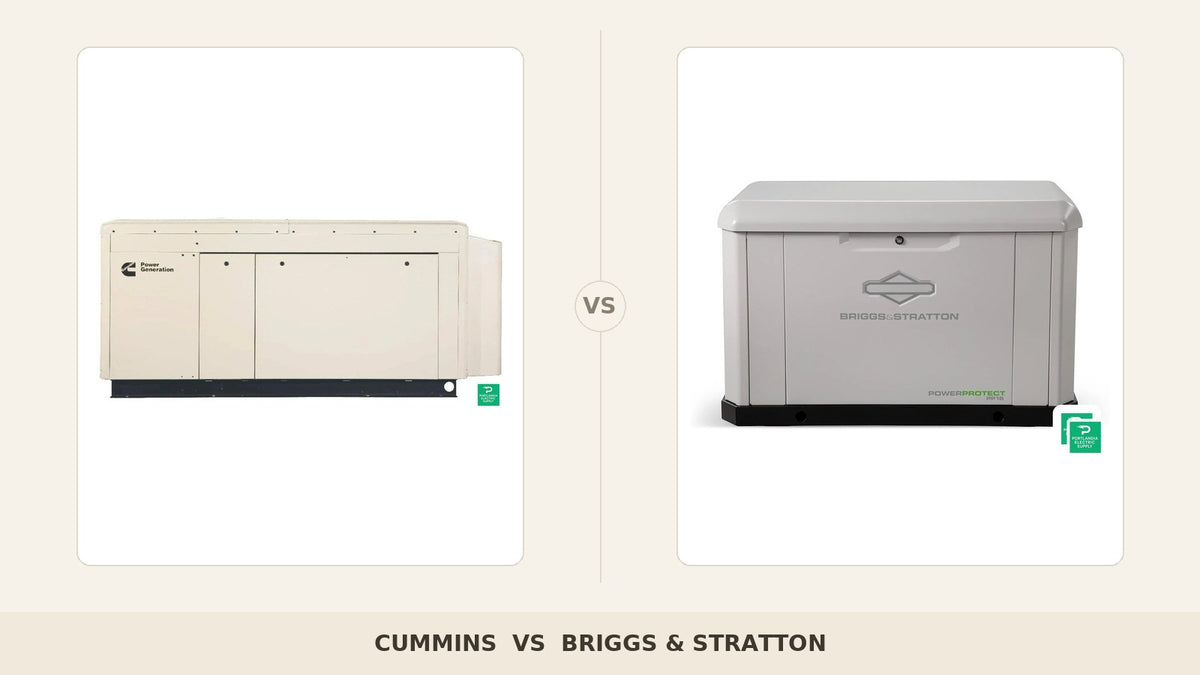
Cummins brings a commercial-industrial pedigree down into residential. The QuietConnect RS series — the 20 kW and 25 kW class units most homes take — runs Cummins' own V-twin engines, a permanent-magnet alternator design on recent revisions, and the QuietConnect enclosure that genuinely earns the name; these are among the quieter units on a pad at full load. The control ecosystem (remote monitoring, load management) is mature and dealer-friendly.
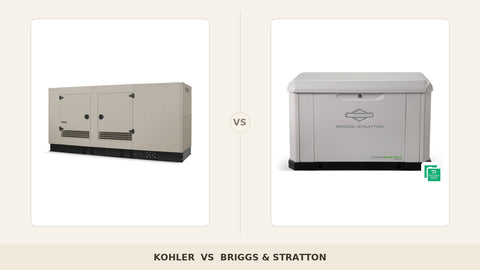
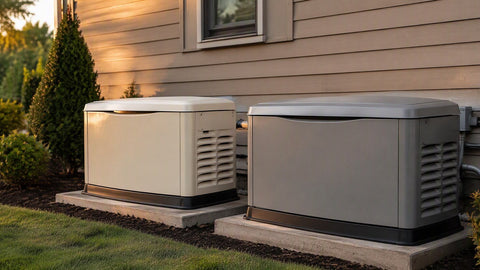
Briggs & Stratton has been building small engines since 1908 and residential standby units for decades. The current PowerProtect line — 20 kW and 26 kW class units — leans on value pricing, aggressive warranty programs, and a broad dealer bench. Briggs units historically deliver strong motor-starting kVA for the price, which matters more than nameplate kW when a 4-ton compressor kicks at full house load.
Class-level comparison; confirm the exact model's published specs on your quote. Model revisions change engine and sound numbers.
| Attribute | Cummins QuietConnect class | Briggs & Stratton PowerProtect class |
|---|---|---|
| Residential sweet spot | 20 kW / 25 kW class | 20 kW / 26 kW class |
| Engine | Cummins V-twin, liquid-cooled (class) | Briggs V-twin, air-cooled on 20kW class / liquid on larger (class) |
| Enclosure / sound | QuietConnect, ~65–67 dBA class at 23 ft | ~66–69 dBA class at 23 ft |
| Fuel | NG or LP, field-convertible class | NG or LP, field-convertible class |
| Monitoring | Remote monitoring via app/dealer portal | InfoHub / app-based monitoring class |
| Warranty program | 5-year class comprehensive | Extended programs up to 10-year class on flagship lines |
| Dealer network | Strong commercial crossover | Strong residential volume |
Every standby unit makes less power on natural gas than on propane, because NG carries fewer BTUs per cubic foot. This is the single most-misread line on the datasheet, and it is where undersized installs are born. A "22 kW" unit that makes 22 kW on LP may deliver 19.5–20 kW class on NG — and if your load calc needed 21 kW, you just bought an automatic load-shedding conversation.
NG derate is ~8–12% across the class for both brands. Always spec against the NG number if the home is on natural gas.
| Class | On propane (LP) | On natural gas (NG) | Whole-home reality |
|---|---|---|---|
| 20 kW class | 20 kW | ~18 kW class | Most 2,000–2,500 sq ft homes with managed AC |
| 22 kW class | 22 kW | ~19.5–20 kW class | 3-ton to 4-ton AC + typical loads, NG-fed |
| 26 kW class | 26 kW | ~24 kW class | 4–5 ton AC, larger homes, NG-fed |
Both Cummins and Briggs publish honest NG numbers; the problem is buyers who shop the LP headline. Our quoting desk specs every NG job against the NG column, then adds the NEC 220 load calculation to prove it. I have torn out exactly one undersized competitor install where a "22 kW" unit on NG stalled trying to start a 4-ton scroll compressor with the well pump already running — the fix cost the homeowner a second generator pad and a new 26 kW unit. Size once, cry once.
Standby generators burn fuel roughly proportional to load. Here is the class-level burn data with the cost math worked at typical 2026 residential energy prices ($1.50/therm NG, $3.00/gal LP):
Burn rates are class ranges from published consumption curves; 1 therm ≈ 100 cu ft NG, LP ≈ 91,500 BTU/gal. Both brands sit inside these bands — fuel economy is not a differentiator.
| Load | NG burn (20–26 kW class) | NG cost/hr | LP burn | LP cost/hr |
|---|---|---|---|---|
| 25% load | ~150–190 cu ft/hr | $2.25–$2.85 | ~1.0–1.3 gph | $3.00–$3.90 |
| 50% load | ~210–260 cu ft/hr | $3.15–$3.90 | ~1.3–1.8 gph | $3.90–$5.40 |
| 100% load | ~280–360 cu ft/hr | $4.20–$5.40 | ~2.2–2.9 gph | $6.60–$8.70 |
Runtime on stored propane: a 500-gallon LP tank (400 gallons usable) feeding a unit at half load (~1.5 gph) runs about 11 days continuous. A 250-gallon tank (200 usable) runs about 5.5 days. That is why we push rural LP customers to 1,000-gallon tanks — outage duration, not generator brand, is what strands you. NG customers have effectively unlimited runtime but are hostage to gas utility pressure; both brands' units will fault out if inlet pressure sags below spec during peak winter demand, which is a gas-pipe sizing problem, not a generator problem.
Nameplate kW is a resistive-load number. Air conditioners, well pumps, and refrigerators are inductive loads that demand 2–3x running current for a few cycles at start. The alternator's motor-starting kVA and the controller's response decide whether your lights dip and the compressor groans or the start is invisible.
Both brands' current residential alternators handle a 4-ton compressor start within their NG-rated output when the load calculation was done honestly. Briggs has historically advertised strong starting kVA on the PowerProtect line; Cummins counters with tight voltage regulation and low harmonic distortion (sub-5% THD class), which sensitive electronics — variable-speed HVAC, modern furnaces, network gear — appreciate over years of run time. Pair either with a proper automatic transfer switch from the 200A service-entrance class for whole-home coverage, and consider whole-home surge protection at the transfer point; generator switching events are hard on electronics.
The install is identical in structure for both brands, and this is where jobs actually succeed or fail:
- Load calculation per NEC 220. Documented demand calc, not a guess from square footage. Our service upgrade guide covers the panel side when the existing service complicates the transfer switch.
- Gas line sizing. A 20–26 kW unit at full load pulls 280–360 cu ft/hr — on a long run from the meter, that means 1-inch or 1¼-inch pipe, not the ¾-inch stub the HVAC crew left. Pressure test before startup, always.
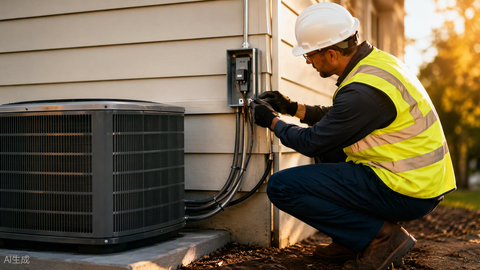
- Pad and clearances. Manufacturer clearance specs (typically 18 inches from the wall, 5 ft from openings per code class) and a level composite or poured pad. Both brands' composite pads install fast on level ground.
- Electrical per NEC 702. The ATS carries UL 1008 listing; feeders sized per NEC ampacity rules; grounding electrode bonding per Article 250. Our ampacity chart handles the feeder sizing.
- Commissioning. Full-load test with a clamp meter on every leg, exercise schedule set, monitoring registered, homeowner walkthrough. We film the load test for the file — it has settled two warranty disputes.
Budget lines from recent installs in our service area; regional labor swings these numbers.
| Install item | Typical cost class | Common failure when skipped |
|---|---|---|
| Load calc + design | Included in a real quote | Undersized unit, nuisance shedding |
| Gas line upgrade (1"+ run) | $400–$1,500 | Low-pressure fault at full load |
| Composite/poured pad | $300–$900 | Vibration, settling, code violation |
| 200A service-rated ATS | $900–$1,800 installed class | Partial coverage, unsafe backfeed risk |
| Permits + inspection | $150–$600 | Unpermitted work, insurance denial |
Cummins' residential warranty sits in the 5-year comprehensive class — parts, labor, and travel — backed by a network built on commercial service discipline. Briggs & Stratton has made warranty length a headline, with programs on flagship residential lines reaching the 10-year class (registration and terms apply; read them). On paper, Briggs wins the term-length contest.
In the field, the warranty is only as good as the servicing dealer within driving distance. Our service log shows both brands' residential units as reliable — the failures we see cluster around battery neglect, rodent damage, and skipped exercise cycles, not engine defects. Cummins' edge is parts logistics inherited from the commercial side; Briggs' edge is dealer density in suburban markets. Ask who services the unit locally before you ask how long the warranty runs. A 10-year warranty with no local tech is a 10-year paperweight.
Either brand pairs cleanly with battery storage for hybrid resilience — the generator carries surge and long outages while the battery covers the transfer gap and overnight hours. See the battery runtime calculator and the backup kit collection if you are designing a hybrid system.
Choose Cummins when power quality headroom matters — sensitive electronics, variable-speed HVAC, home medical equipment — when you value commercial-grade service culture, or when the QuietConnect sound spec settles an HOA or neighbor concern. Start at the Cummins collection and the 20–28 kW standby class.
Choose Briggs & Stratton when budget discipline and warranty term length lead the decision, when strong motor-starting kVA per dollar matters (big compressor, NG feed), or when the local Briggs dealer is the strongest service shop in your county. Browse Briggs & Stratton units including the 26 kW class and 22 kW class.
The honest answer: sized correctly on the NG column, installed with a real gas line and a service-rated ATS, and maintained on schedule, both brands will outlast their warranties. The failures we get called to fix trace to sizing, gas plumbing, and maintenance — never to the badge on the enclosure. For deeper sizing reads, see our 26 kW generator guide, the 22 kW guide, and the standby generator overview.
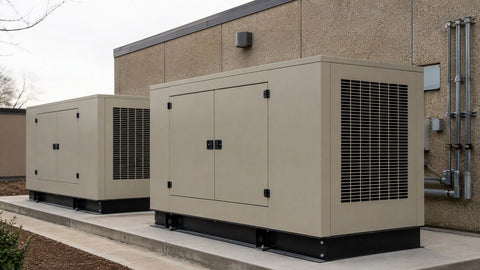
Sound ratings are measured at 23 feet under normal load, and both brands land in the 65–70 dBA class there — conversation-level noise. But the number on the datasheet assumes open-field placement. Back a unit into a corner between the house and a fence and reflected sound adds 3–6 dB at the property line. Our siting checklist: keep the exhaust pointed away from windows and the neighbor's patio, maintain manufacturer clearances (they are about cooling airflow as much as fire code), and use the composite pad on level, compacted ground so vibration does not telegraph into the slab.
Weekly exercise cycles are the noise complaint generator, not outages. Both brands let you set exercise time and low-speed quiet exercise modes on current controllers. Set it for mid-morning weekday, and the neighbors never notice. We had exactly one HOA complaint last year and it was a unit exercising at 6 a.m. Sunday — a controller setting, not a hardware flaw.
Both brands publish near-identical residential maintenance schedules, and both can deny warranty claims for neglected service. The cadence our service contracts follow:
Skip the annual service and you are gambling the warranty and the next ice storm at the same time.
| Interval | Service items | DIY or tech | Cost class |
|---|---|---|---|
| Weekly (automatic) | Exercise cycle, self-diagnostics | Automatic | — |
| Every 6 months | Visual inspection, battery terminals, enclosure pests | DIY-able | $0 |
| Annually / 100 hr | Oil + filter, air filter, spark plugs (class), firmware check | Tech recommended | $250–$450 |
| Every 2–3 years | Valve adjustment (model-dependent), coolant on liquid-cooled class | Tech | $300–$600 |
| As needed | Battery replacement (~3–5 yr life) | DIY-able | $80–$150 |
The battery is the number-one no-start cause across both brands in our service log — a $120 part that strands a $6,000 machine. Put battery replacement on a 4-year calendar reminder regardless of test results. Second place: rodents nesting in the enclosure and chewing harness insulation. A $12 pest screen kit beats a $900 wiring repair every time.
Brand debates ignore the fact that ownership cost is dominated by install quality and maintenance, not the unit price. Here is the ten-year picture for a 22 kW-class install on natural gas:
Class-level budgeting for planning. Compare against one spoiled freezer, one flooded basement, or three nights in a hotel — the ROI case for standby power is avoided loss, not generated watts.
| Line item | Year 0 | Years 1–10 total | Notes |
|---|---|---|---|
| Unit + ATS + install | $8,500–$13,000 class | — | Brand spread is ~$500–$1,000 of this |
| Annual service | — | $2,500–$4,500 | 10 annual visits |
| Battery ×2 | — | $160–$300 | Years 4 and 8 |
| Fuel (exercise + ~30 outage hr/yr) | — | $1,200–$2,200 | NG at $1.50/therm class |
| Repairs outside warranty | — | $0–$1,500 | Variance is maintenance-driven |
| 10-year total | $8,500–$13,000 | $3,900–$8,500 | ≈ $1,240–$2,150/yr all-in |
That last row reframes the brand question: over ten years, the Cummins-versus-Briggs price difference is 3–8% of total cost of ownership. Pick the dealer, not the badge. Then pick the unit the dealer services best. For homes weighing generator-plus-battery hybrid resilience, the battery sizing guide and PWRCell cost guide round out the comparison set.
Two derates rarely make the sales conversation. First, altitude: air-cooled engines lose roughly 3–4% of output per 1,000 feet above sea level class. A 22 kW unit installed at 5,000 feet behaves like an 18–19 kW unit — which is why our Colorado quotes start a class size up from our sea-level quotes. Both brands publish altitude derate curves; both brands' reps forget to mention them until you ask.
Second, extreme cold: LP tank pressure sags in deep cold, and a half-full 250-gallon tank at −20°F cannot vaporize fast enough to feed full load on the 22–26 kW class. The fix is tank sizing (bigger surface area vaporizes more) or NG where available — not a different generator brand. We spec battery warmers and cold-weather kits on any install north of the snow belt line; both brands offer them, both cost under $200 class, and both pay for themselves the first January morning the unit has to crank at −10°F.
These two paragraphs have saved our customers more grief than any brand comparison ever written. Derate for altitude, vaporize for cold, and either badge performs. Ignore them and the best generator on the market still stalls when the weather does what weather does. One more field note from our service van: if your site sits above 3,000 feet or below zero for weeks at a time, put the derate math in the same email as the quote so everyone signs off on the real expected output. Surprises belong in birthday parties, not in commissioning reports.
Frequently Asked Questions
Is Cummins better than Briggs & Stratton for home standby?
Neither is universally better. Cummins leads on power quality (low harmonic distortion), quiet enclosures, and commercial-grade service culture; Briggs & Stratton leads on price per kW, motor-starting kVA for the money, and headline warranty terms up to the 10-year class. Sized correctly on natural gas output and installed properly, both reliably carry whole-home loads.
What size Cummins or Briggs & Stratton generator do I need?
Most 2,000–2,500 sq ft homes with one AC unit land in the 20–22 kW class; homes with 4–5 ton AC or multiple systems take the 26 kW class. Always spec against the natural gas output column — roughly 8–12% below the propane nameplate — and require an NEC 220 load calculation from your installer before choosing.
How much natural gas does a 22 kW standby generator use?
The 20–26 kW class burns roughly 210–260 cubic feet per hour at half load and 280–360 cubic feet per hour at full load — about $3.15–$5.40 per hour at $1.50 per therm. Actual burn tracks the load on the unit, not the nameplate.
How long will a 500-gallon propane tank run a standby generator?
A 500-gallon LP tank holds about 400 usable gallons. At half load (~1.5 gph for the 20–26 kW class), that is roughly 11 days of continuous run; at full load (~2.5 gph), about 6–7 days. Rural LP installs should consider 1,000-gallon tanks for extended outage coverage.
Which brand has the better warranty?
Briggs & Stratton advertises longer headline terms — up to the 10-year class on flagship lines with registration — while Cummins' residential coverage runs in the 5-year comprehensive class including parts, labor, and travel. Local dealer service quality matters more than term length; confirm who services the brand in your area.
Can a standby generator run my whole house including central AC?
Yes, when sized for it. A 4-ton compressor typically needs 17–20 A running at 240V but 2–3x that to start. A 22 kW-class unit on natural gas (~19.5–20 kW real output) handles a 3–4 ton AC plus normal household loads; 5-ton systems or dual ACs push you to the 26 kW class or require load-management modules.
Do standby generators need a permit and inspection?
Yes, in virtually every US jurisdiction — electrical permit for the transfer switch and wiring (NEC 702 governs), mechanical or plumbing permit for the gas line, and sometimes zoning review for pad placement and setbacks. Unpermitted generator installs risk insurance claim denial after a fire or carbon-monoxide incident, and they surface badly at home sale. Both brands' dealer networks handle permitting as standard practice.
PES Supply stocks both brands with install-ready kits: Cummins, Briggs & Stratton, transfer switches, and the 14–17 kW class for smaller homes. Our desk runs the load calc free with every standby quote.