Ten kilowatts is the most misunderstood size in the generator aisle. It is far beyond anything you would wheel out for a campsite, yet it still fits on a two-foot pad behind the house and sips fuel instead of gulping it. For a lot of homeowners — gas heat, gas water heater, a normal complement of appliances — a 10kW unit is exactly the right amount of backup, and buying bigger is buying capacity that never gets used. For an all-electric house with two condensers, it is not enough, and no amount of wishful load management changes that. This guide gives you the real numbers: what 10kW runs, what it burns per hour, how many amps it makes, and what a good one costs.
Explore the Generator Hub → sizing guides, Generac/Kohler/Cummins comparisons, brand guides, and shop links in one place.
We sell and service standby equipment every week, so the numbers below come from spec sheets and from what actually happens on site — not from marketing copy. Where a figure varies by model, we say so and give you the range.
What a 10kW Generator Runs: Essential Circuits at a Glance


Ten kilowatts sits in a sweet spot: far beyond campsite portables, but still manageable on fuel. The table below shows typical running and starting watts for the circuits most homeowners prioritize during an outage.
| Circuit / Appliance | Running Watts (typical) | Starting Watts (surge) |
|---|---|---|
| Refrigerator / freezer | 700 W | 2,200 W |
| Furnace blower (gas heat) | 800 W | 2,300 W |
| Well pump (1/2 HP) | 1,500 W | 3,000 W |
| Sump pump | 1,000 W | 2,500 W |
| Central A/C (3 ton, with soft start) | 3,500 W | 5,000-7,000 W |
| Microwave | 1,000 W | 1,000 W |
| Lighting + Wi-Fi + device charging | 700 W | 700 W |
| Electric water heater | 4,000 W | 4,000 W |
Planning a standby install? Get a whole-home generator quote — units in stock at 12+ PES hubs, or browse our generator lineup.

Beyond the big motor loads, the small stuff barely registers. A TV, a laptop, a game console, and the satellite receiver together pull a few hundred watts — the same is true of a ceiling fan or a box fan. Kitchen loads like the coffee maker and dishwasher matter only while they run, and a gas oven's electric ignition is a rounding error. The budget gets eaten by motors and resistance heat, full stop.
Worked example: a real outage load
- Refrigerator running: 700 W
- Gas furnace blower running: 800 W
- Well pump running: 1,500 W
- Lights, Wi-Fi, chargers: 700 W
- Simultaneous running total: 3,700 W
- Largest single surge (well pump start): +3,000 W → worst-case 6,700 W
That leaves better than 3,000 W of headroom on a 10kW unit — enough for the microwave or a window A/C, and enough margin that the generator is loafing instead of screaming. We tell customers to run this exact arithmetic on their own panel schedule before they shop; our standby sizing calculator walks the same math.
Every generator has two ratings. Running (continuous) watts are what it can produce all day. Starting (surge) watts are the short burst it can tolerate for a few seconds while a motor spins up. Motors are the problem: a refrigerator compressor, a well pump, or an A/C condenser can demand two to three times its running draw for the first second or two. A 10kW standby typically offers 10,000 running watts with surge capacity in the 12,000–14,000 W range depending on the engine and alternator.
Two practical consequences. First, your generator can be "big enough" on paper and still stall when the well pump and the furnace blower decide to start at the same moment — stagger big loads or let a load-management system do it for you. Second, a soft-start kit on the central A/C is the single cheapest capability upgrade you can buy, often cutting locked-rotor surge by half or more. That is the difference between "10kW can't run my air conditioner" and "10kW runs it fine."
Amps are just watts divided by volts, and this is where spec-sheet confusion starts. A 10kW residential standby is a single-phase 120/240V machine. Do the division once and the whole electrical side of the project gets clearer:
| Question | Math | Result |
|---|---|---|
| Full-load amps at 240V, single phase | 10,000 W ÷ 240 V | 41.7 A |
| Total current if everything ran at 120V | 10,000 W ÷ 120 V | 83.3 A (split across both legs) |
| Real power from a "10 kVA" unit | 10 kVA × 0.8 power factor | 8 kW |
So a 10kW standby feeds the house through a 45A or 50A two-pole breaker, and the feeder wire has to match: 6 AWG copper minimum for a 50A circuit in NM-B (55A at the 60°C column of NEC 310.16), or 8 AWG THHN in conduit (50A at 75°C). That last table row is the one that stings people shopping imported portables — a "10 kVA" machine at 0.8 power factor is an 8kW machine. Always shop in kW, and always ask which rating is continuous and which is standby.
Fuel burn tracks load, not the nameplate. A 10kW unit idling through the night with only the fridge cycling uses a fraction of what it burns with the water heater and A/C running. Ambient temperature, altitude, and fuel quality move the numbers too, so treat every consumption figure as a range, not a promise.
| Fuel | Half-load consumption (approx.) | Full-load consumption (approx.) |
|---|---|---|
| Gasoline | ~0.7-0.9 gal/hr | ~1.3-1.6 gal/hr |
| Propane (LP) | ~1.2-1.5 gal/hr | ~2.0-2.4 gal/hr |
| Natural Gas | ~110-130 ft³/hr | ~180-220 ft³/hr |
For a concrete reference point, Briggs & Stratton's 10kW PowerProtect burns 0.7 gallons of LP per hour at no load, 1.2 gallons at half load, and 1.9 gallons at full load — right in the middle of the ranges above. Our generator fuel consumption chart extends these numbers from 5kW portables up to 26kW liquid-cooled units.
Propane runtime: how long the tank actually lasts
Propane is stored under pressure and tanks are only filled to 80% for expansion, so a "500-gallon tank" holds 400 usable gallons. Runtime at 10kW-class burn rates:
| Tank | Usable propane | Half load (1.2–1.5 gal/hr) | Full load (2.0–2.4 gal/hr) |
|---|---|---|---|
| 20 lb grill cylinder | 4.7 gal | 3–4 hours | 2–2.5 hours |
| 100 lb cylinder | 23.6 gal | 16–20 hours | 10–12 hours |
| 250 gal home tank | 200 gal | 5.5–7 days | 3.5–4 days |
| 500 gal home tank | 400 gal | 11–14 days | 7–8 days |
Field note from the service truck
We've set dozens of 10kW standbys on pads behind ranch houses and colonials, and the propane question is where homeowners get surprised. The unit itself is never the problem — the tank is. A 100-pound cylinder looks serious until a January outage runs it dry before lunch on day two. If you're on LP, 250 gallons is the honest minimum for a standby, and 500 gallons is what we recommend anywhere the plow truck might not reach you for a week. On natural gas, none of this matters; the meter never runs empty.
Both make the same electrons. Everything around the electrons is different.
| Factor | 10kW Portable | 10kW Standby |
|---|---|---|
| Typical price (unit only) | $1,200-$2,500 | $3,500-$5,500 + installation |
| Fuel | Gasoline (some dual-fuel LP) | Natural gas or propane |
| Startup | Manual (recoil or electric start) | Fully automatic via ATS, ~10 seconds |
| Runtime | 8-12 hr per tank; refuel by hand | Unlimited on NG; days on LP tank |
| Best for | Job sites, occasional outages, budget backup | Homes needing seamless, hands-free protection |
The underrated difference is the transfer equipment. A portable ties in through an interlock or a manual transfer switch, and you are the automation — home or not, the power stays off until somebody wheels the unit out. A standby pairs with an automatic transfer switch that senses the outage, starts the engine, and transfers the house in about ten seconds, whether you're asleep or on vacation. Our transfer switch sizing chart covers matching the ATS to your service size.
Sound is the first thing neighbors notice. The Briggs & Stratton 10kW PowerProtect is rated at 67 dB at test distance — about the level of a window air conditioner, quieter than most portable open-frame units, which commonly run 74–80 dB. You'll hear it from the patio; you won't hear it over the TV indoors. Sound drops roughly 6 dB every time you double the distance, so placement matters as much as the rating.
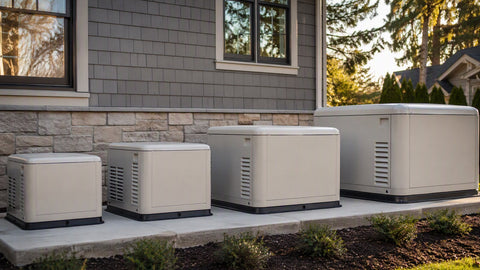
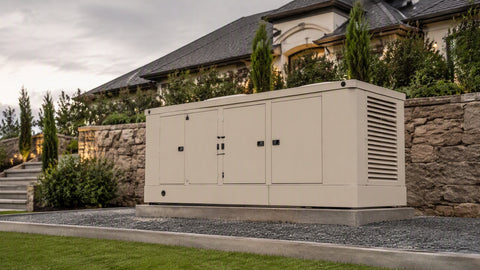
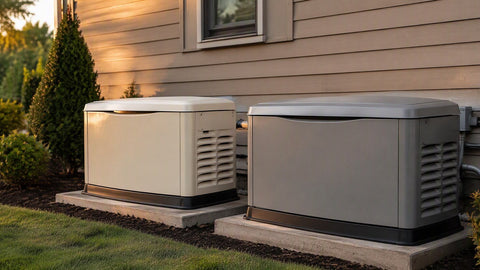
Physical size is the pleasant surprise at this capacity. The B&S 10kW assembles to 28L × 24.5W × 34.8H inches — about the footprint of a large condenser — and ships at 39L × 33.5W × 42H on the pallet. Assembled weight is 123 kg (about 271 lb), 150 kg packaged: heavy enough that two people and an appliance dolly can position it on a pre-fab pad, light enough that nobody needs a crane. Concrete or a rated composite pad is non-negotiable; setting any standby on bare ground is asking for a tilted, flooded unit in two seasons.
The unit we've watched longest in the 10kW class is the Briggs & Stratton 040684 PP10 PowerProtect, built around a Vanguard engine — the same engine family that shows up in commercial turf and construction equipment that runs ten-hour days. It is engineered and assembled in the US, and at $3,278 for the unit it undercuts most of the name-brand competition at this capacity.
Three things stand out after seeing these in service:
- The Symphony power management system. Instead of stalling when the house asks for too much, Symphony sheds and re-prioritizes loads — it will let the water heater wait while the well pump starts. On paper it's a convenience feature; in practice it's what lets a 10kW behave like a bigger unit.
- The footprint. Briggs advertises the PowerProtect line as roughly 50% more compact than comparable units, and side-by-side on a pad the claim holds up — it fits side yards and tight setbacks where a 20kW-class enclosure simply won't.
- The warranty. Six years covering parts, labor, and travel. Travel is the clause that matters — most warranties quietly exclude the service call itself, and the service call is the expensive part in rural zip codes.
Where does it fall short? At 10kW on LP (9kW class on natural gas), an all-electric house will outgrow it — that's arithmetic, not a defect. And like every air-cooled standby, it wants its oil changes on schedule or the warranty conversation gets difficult. If you need more headroom, the same PowerProtect family steps up through the 13kW PP13 and 22kW models, and we stock the full standby generator lineup across brands including Generac.
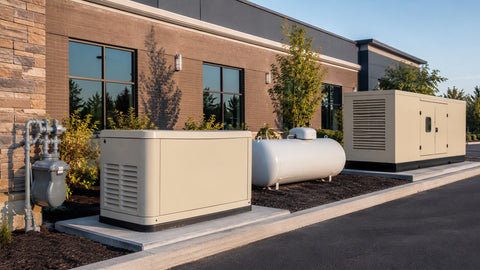
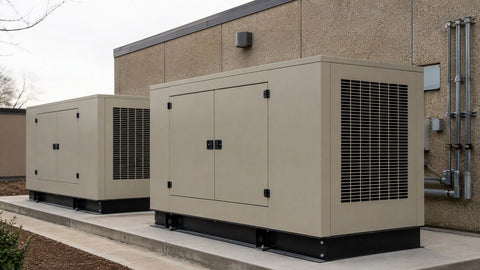
A standby generator is a permitted electrical and mechanical installation in nearly every jurisdiction. The framework: NEC Article 702 governs optional standby systems (including the transfer equipment and its listing), and NFPA 37 governs where stationary combustion engines may sit. The placement rules inspectors actually check: manufacturer-required clearances from the structure (commonly 18 inches minimum, more from combustible siding) and at least 5 feet from doors, operable windows, and combustion-air intakes, because carbon monoxide finds openings. The gas line sizing is the other frequent failure — a 10kW at full load drawing ~200 ft³/hr of natural gas needs adequate pipe diameter and pressure, especially if the furnace and water heater share the meter.
Field note from failed inspections
The red tags we've been called to fix are almost never the wiring. They're the pad set too close to a bedroom window, the flex gas connector run where code wants hard pipe, or the ATS installed as a generic "transfer switch" that isn't service-rated for where it landed. Spend an hour with the inspector's checklist before the concrete truck shows up. Our NEC compliance guide and whole-home sizing guide cover the electrical half of that conversation.
A standby generator is a car engine that sits outside for months and then must start on the coldest, worst night of the year. Maintenance is not optional; it's the product. The core schedule:
- Exercise cycle: modern units self-test weekly for 10–15 minutes. Confirm it's enabled — a unit that hasn't turned over in six months is a lawn ornament.
- Oil and filter: check monthly, change per the manual (typically annually or every 100–200 run hours). Low-oil shutdown exists to save the engine, and it will choose the middle of an outage to do it if you let the level drop. Briggs sells a 10–13kW maintenance kit with the oil, filter, and plugs in one box.
- Battery: the number-one no-start cause, bar none. Budget a replacement every 2–3 years and keep the terminals clean.
- Airflow: keep mulch, leaves, and snowdrifts clear of the enclosure louvers. Starved cooling air overheats the alternator long before it overheats the engine.
A portable 10kW covers essentials for the price of a used ATV; a 10kW standby installed costs roughly what a 22kW unit-only costs - but covers far less. If outages are rare and short, portable wins. If you work from home, have medical equipment, or face multi-day storm outages, stepping up to an automatic standby - even a larger standby generator - usually pays for itself in the first major event. Our whole-home sizing guide helps you run the numbers.
The honest way to decide: price the 10kW installed, then price the next size up installed, and divide the difference by the number of outage days you actually logged in the last five years. For most gas-appliance homes the 10kW wins that math. For all-electric homes it loses, and buying it anyway is the most common sizing regret we hear about. Browse the full generator catalog or send your load list through the quote form — we size these every day and would rather sell you the right unit than the big one.
Frequently Asked Questions: 10kW Generators
What will a 10kW generator run?
A 10kW generator comfortably runs the essential circuits of a typical home: refrigerator, furnace blower, well pump, sump pump, lighting, Wi-Fi, and outlets - with enough headroom left for a window A/C or microwave. With careful management it can even start a smaller central air conditioner.
Can a 10kW generator run central air conditioning?
Usually one smaller (2-3 ton) central A/C, yes - a 3-ton unit draws roughly 3,500 running watts but needs up to 10,000+ watts to start without a soft starter. Pairing a soft-start kit with the A/C makes a 10kW generator much more capable.
Is a 10kW generator enough for a whole house?
For smaller homes (under about 1,500 sq ft) with gas heat and gas water heating, often yes. Larger all-electric homes will outgrow 10kW quickly - that is when a 22-26kW standby unit becomes the right tool.
How long will a 10kW generator run on propane?
At half load a 10kW-class unit burns roughly 1.2-1.5 gallons of propane per hour, so a standard 20 lb grill tank (4.7 gal) lasts about 3-4 hours, a 100 lb cylinder about 16-20 hours, and a 500-gallon home tank several days of typical cycling.
Should I buy a portable or standby 10kW generator?
Choose portable if you want lower upfront cost, job-site flexibility, and manual setup during outages. Choose a 10kW standby if you want automatic, hands-free backup that starts within seconds of an outage and runs on your home's natural gas line.
How loud is a 10kW generator?
A quality enclosed standby like the Briggs & Stratton 10kW PowerProtect is rated around 67 dB — comparable to a window air conditioner. Open-frame portables are significantly louder, commonly 74–80 dB at the same distance.
How many kW is 10 kVA?
Multiply by the power factor: 10 kVA × 0.8 = 8 kW of real power. kVA is apparent power; kW is what actually runs your appliances. Always compare generators in kW.
- NEC (NFPA 70) Article 220 — Branch-Circuit, Feeder, and Service Load Calculations (nfpa.org)
- NEC Article 702 — Optional Standby Systems (nfpa.org)
- NFPA 37 — Standard for the Installation and Use of Stationary Combustion Engines and Gas Turbines (nfpa.org)
- Generac protector/guardian series specification sheets (generac.com)
- Kohler residential standby generator specification sheets (kohlerpower.com)
- Cummins Power Generation residential spec sheets (cited by document name)
Related Resources
- Quote My System — free project pricing from PES
- Generator Hub — all generator guides in one place
- Generator Fuel Consumption Chart
- Transfer Switch Sizing Chart
- Standby Generator Sizing Calculator
- Whole-Home Generator Sizing Guide
- NEC Code Compliance Guide
- Grounding & Bonding Guide
- Battery Sizing Calculator
- Solar ROI Calculator
Related Products

Briggs and Stratton 040684 PP10 PowerProtect Vanguard Engine NG/LPV 10kW Home Standby Generator
Shop Standby Generators
Briggs and Stratton 040746 PP13 PowerProtect Vanguard Engine NG/LPV 13kW Home Standby Generator
View