When the grid fails, a standard solar array shuts down with it — a fact that surprises thousands of new solar owners every storm season. True disaster resilience requires a system designed for islanding: panels, a battery bank, a hybrid inverter that can form its own grid, and usually a generator for the long tail of multi-day events. I've spent fifteen years designing and commissioning exactly these systems across the Pacific Northwest and the Gulf Coast — through ice storms that took out feeders for nine days, wildfire public-safety shutoffs that ran on utility schedules rather than weather, and hurricane seasons where the customers with properly integrated systems simply never lost power. The pattern across all of them is consistent: resilience is won in the design phase — in the load list, the worst-month math, and the drill calendar — not purchased in a box. This guide lays out the complete architecture: how to size storage against real outage data, what the NEC requires of islanded systems, how to pair generators with batteries, what the regional playbooks look like from ice storms to hurricanes, and what resilience actually costs at each tier.

The Outage Problem, Quantified
Resilience design starts with knowing what you're designing against. US outage data paints a consistent picture: the average customer experiences roughly 5–8 hours of interruption per year under normal conditions, but the average conceals the distribution that matters — major-event outages lasting days to weeks, concentrated in storms, wildfires, and heat events. The events that drive solar-plus-storage purchases aren't the two-hour flickers; they're the tail:
| Event Type | Typical Duration | Warning Time | Resilience Implication |
|---|---|---|---|
| Routine faults (trees, equipment, animals) | 1–6 hours | None | Battery-only systems cover these entirely |
| Heat storms / grid emergencies | 4–24 hours, rolling | Hours | Battery + solar recharging daily |
| Wildfire PSPS events | 1–4 days | 24–48 hours | Full islanding with conservation discipline |
| Ice storms / windstorms | 2–9 days | 12–24 hours | Generator integration usually required |
| Hurricanes | 3–21 days | 2–5 days | Full architecture plus fuel planning |
The design rule I apply on every resilience quote: cover 95% of your region's historical outage hours with battery-plus-solar, and cover the remaining 5% — the multi-day tail — with a generator or a conservation plan. Customers who try to cover the tail with batteries alone buy three times the storage they need for the other 95% of events. Conversely, customers who skip batteries and buy only a generator discover that a generator running 24/7 through a five-day event consumes fuel, makes noise, and demands attention around the clock — the hybrid architecture's entire point is that each technology does the job it's good at. Batteries are silent, instant, and maintenance-free for the common short events; the generator exists for the rare long ones; solar refills the tank every day the sky cooperates.
The Anatomy of a Resilient Solar System
A disaster-capable system has five subsystems, and weakness in any one of them defines the system's real capability:
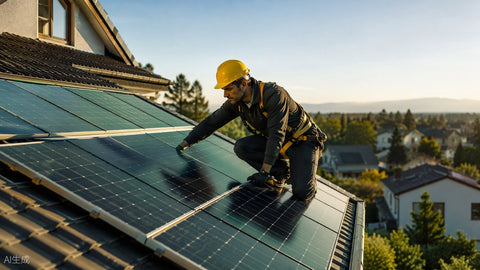
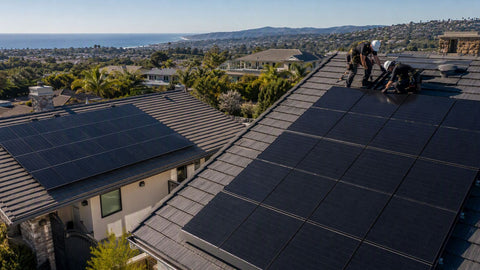
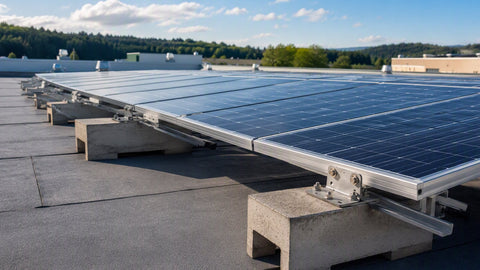
- Generation: The solar array itself, sized to recharge the battery daily even in winter. In the Pacific Northwest's December, a south-facing array produces roughly 20–25% of its July output — resilience sizing uses the worst month, not the average.
- Storage: The battery bank, sized in kilowatt-hours against the critical-load budget and the target autonomy days. LFP chemistry has taken this market completely — 6,000+ cycle life and thermal stability are what daily disaster-adjacent cycling demands.
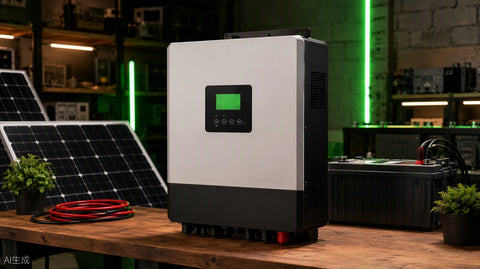
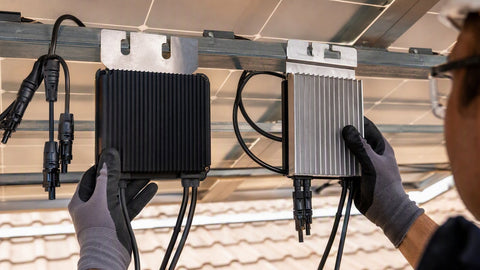
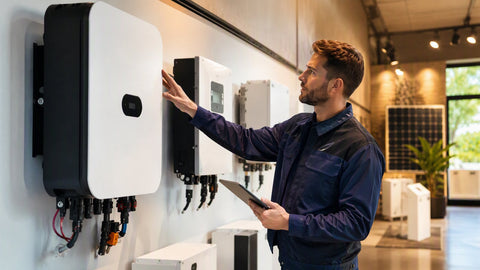
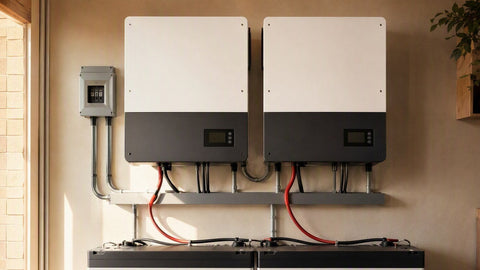
- The hybrid inverter: The system's brain — converting, charging, and critically, forming a stable islanded grid when the utility fails. Grid-forming capability is a specification, not an assumption; not every inverter sold as "backup-capable" can start motors or carry imbalanced loads cleanly.
- The critical loads panel: A separated subpanel carrying only the circuits worth backing up. Whole-home backup is possible at sufficient budget; critical-loads backup is how most real systems deliver week-long endurance.
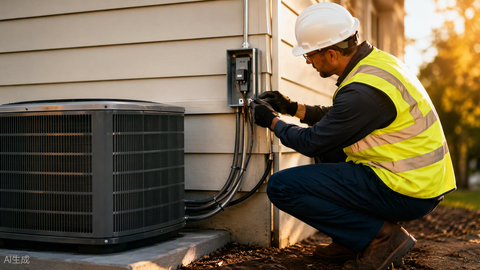
- The generator interface: For the multi-day tail. A hybrid inverter with a proper generator input turns a modest standby unit into a battery charger that runs a few efficient hours per day instead of running continuously at poor loading.
Sizing the Battery: The kWh Math
Battery sizing is an energy budget exercise. List the critical loads, multiply watts by hours of use per day, and sum for daily consumption. Then multiply by autonomy days and divide by usable depth of discharge:
| Critical Load | Watts | Hours/Day | Daily Wh |
|---|---|---|---|
| Refrigerator + freezer | 250 (avg) | 24 | 6,000 |
| Lighting (LED, essential rooms) | 200 | 5 | 1,000 |
| Internet, router, phones | 60 | 24 | 1,440 |
| Gas furnace blower (winter) | 600 | 8 | 4,800 |
| Well pump (1 HP) | 1,500 | 0.7 | 1,050 |
| Medical device (CPAP) | 60 | 8 | 480 |
| Microwave / cooking | 1,200 | 0.5 | 600 |
| Daily total | — | — | 15,370 Wh ≈ 15.4 kWh |
Checked math: this household needs 15.4 kWh per day from storage. For two days of autonomy at 90% usable depth of discharge: 15.4 × 2 ÷ 0.9 = 34.2 kWh of nominal battery capacity — call it two 15kWh units with margin. The battery backup runtime calculator and the battery sizing guide walk through this arithmetic for your own load list, and the home battery bank guide covers bank configuration. Note what did the heavy lifting in that table: refrigeration and the furnace blower, not electronics. In cold-weather resilience design, the heating system's electrical draw is usually the make-or-break load — a gas furnace keeps a house livable on 600W of blower, while electric resistance heat is simply outside the battery paradigm.
Solar Alone vs. Solar + Battery vs. Full Architecture
| Capability | Grid-Tie Solar Only | Solar + Battery | Solar + Battery + Generator |
|---|---|---|---|
| Power during 2-hour outage | None — anti-islanding shutdown | Full critical loads | Full critical loads |
| Power during 24-hour outage | None | Yes, with daytime solar recharge | Yes, comfortably |
| Multi-day outage, sunny | None | Indefinite with load discipline | Indefinite |
| Multi-day outage, winter storm | None | 1–3 days, then conservation crisis | Indefinite with fuel |
| Typical installed cost increment | Baseline | +$10,000–$25,000 | +$20,000–$45,000 |
The middle column covers the vast majority of events; the right column covers the events that make the news. The question I ask every customer: which column does your region's history — and your household's medical or business dependencies — actually require? For a household with a CPAP and a freezer full of food in PSPS country, the middle column suffices. For a rural household on a well pump with medical refrigeration needs in ice-storm territory, I recommend the right column without apology.
Island Mode, Black Start, and the NEC Requirements
The technical requirements separating a resilient system from a grid-tie system with a battery sticker on it:
- Islanding and anti-islanding: Grid-tie inverters must cease energizing a dead grid (IEEE 1547 / UL 1741) — protecting line workers. A backup-capable system adds an automatic transfer device that physically separates the home from the grid before the hybrid inverter forms its island. This is why a standard solar array goes dark in an outage while a properly designed one doesn't.
- Black start: The system must start itself with no grid and a depleted battery — some hybrid inverters can black-start from solar alone; others require battery reserve or generator input. If your resilience plan assumes a morning-after restart, verify black-start behavior on the spec sheet, not the brochure. I've tested units whose "backup" mode couldn't restart without a live grid; that's a discovery to make in commissioning, not in an ice storm.
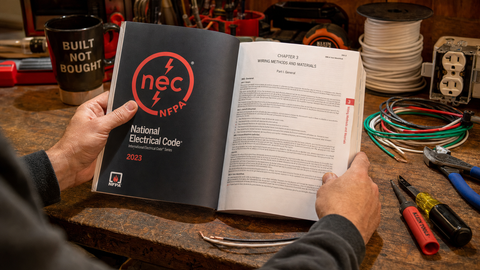
- NEC Article 705 governs interconnected power sources; Article 706 covers energy storage systems; 690.12 rapid shutdown and 690.7/690.8 voltage and current calculations apply as in any PV system. Standby generator interconnections fall under Article 702. An inspector who knows these articles will check the transfer equipment listing, the disconnecting means, and the labeling — budget the time to do the paperwork right.
- Surge and motor-starting capacity: The inverter's surge rating must start the well pump, the furnace blower, and the refrigerator compressor — often simultaneously. A 10kW continuous hybrid with 15kW surge handles most critical-loads panels; central air conditioning usually needs a soft starter or exclusion from the backup panel.
Pairing the Generator: The Long-Tail Answer
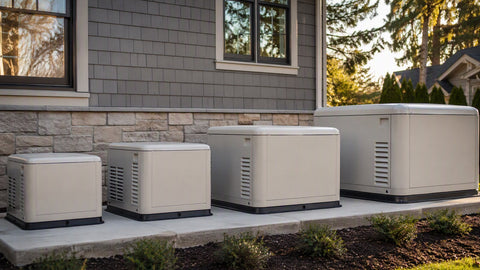
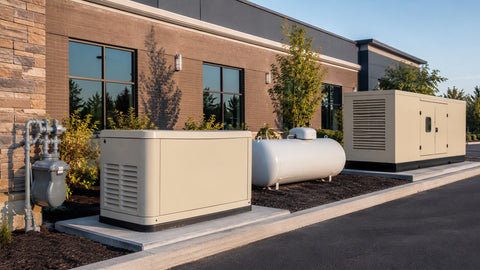
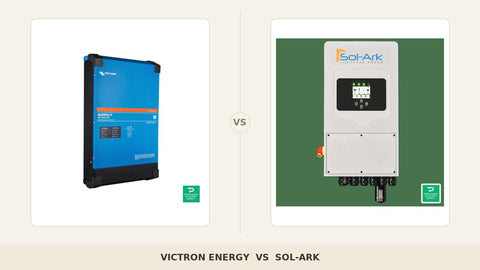
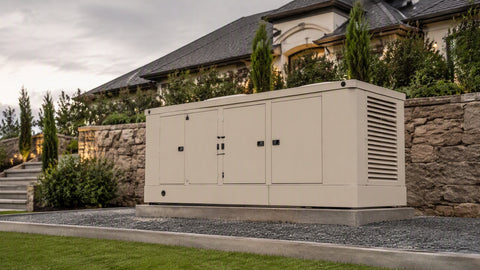
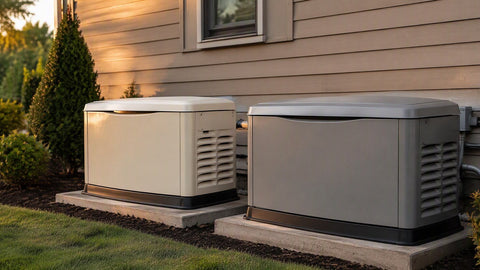
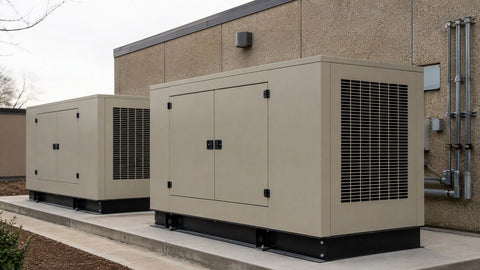
Generator integration done right changes the generator's role: instead of running continuously at 15% load (wet-stacking and burning fuel around the clock), it runs two to four hours daily at 60–75% load, charging the battery bank through the hybrid inverter while the battery carries the house the rest of the time. Fuel autonomy roughly triples on the same tank. The architecture requires a hybrid inverter with a dedicated generator input — the Sol-Ark line and similar battery-agnostic hybrids are the workhorses here — or an AC-coupled system with generator pass-through. Sizing the generator to the inverter's charge acceptance matters more than sizing it to the house: a 22kW standby unit (see our 22kW guide) feeding a 48V battery bus through a hybrid inverter covers nearly any residential scenario; larger estates step to the 48kW class. Fuel autonomy planning for a 5-day ice storm on propane looks like this:
| Configuration | Generator Runtime/Day | Fuel/Day (propane, ~50% load) | 5-Day Total |
|---|---|---|---|
| Generator-only, continuous at 20% load | 24 hrs | ~48 gal | ~240 gal |
| Hybrid + battery, generator 3 hrs/day at 65% load | 3 hrs | ~14 gal | ~70 gal |
Same house, same five days, a third of the fuel — and the house is silent 21 hours a day. In extended outages where propane delivery is impossible, that fuel ratio is the difference between a week of autonomy and two.
Off-Grid vs. Grid-Tied Resilience: Know Which System You Actually Have
A confusion I untangle monthly: customers say "off-grid capable" when they mean "grid-tied with backup," and the difference matters legally, electrically, and financially. A true off-grid system has no utility interconnection at all — no net metering, no grid services, and every kilowatt-hour accounted for by design. A grid-tied resilience system lives connected, exports surplus daily, and islands only during outages. The grid-tied resilience system is almost always the right answer where a grid exists: it earns its keep every day through self-consumption and export rather than waiting for disasters, and the grid itself serves as infinite overflow storage. True off-grid design — battery bank sizing discipline taken to its logical extreme with 3+ autonomy days and generator integration as standard — applies where the utility line ends or where interconnection costs exceed the value of the connection. The dangerous middle ground is the "grid-optional" system designed by someone who understood neither: undersized for autonomy, non-compliant for interconnection, and disappointing in both modes. Pick a lane, design to it, and permit it accordingly.
Sizing the Array for Winter, Not for the Bill
Conventional solar sizing targets annual offset; resilience sizing targets the worst month. In Portland, a 12kW array that produces 1,400 kWh in July produces roughly 300–400 kWh in December — a 4:1 seasonal swing that bill-sizing logic ignores. The resilience design question is whether December production can cover the critical-loads daily budget with margin for consecutive overcast days: 12 kWh/day of critical loads against ~10–13 kWh/day of December average production is marginal, which is precisely why the generator integration exists and why critical-loads discipline matters more than array size. East of the Cascades or in the mountain West, winter production roughly doubles on the same array — and in the Gulf Coast's hurricane season, production during events is rarely the constraint at all. Run your own location's monthly production numbers (any installer can model them, and the system size calculator frames the inputs) and design against the worst month of your region's disaster season. This single change in design philosophy — worst month instead of average year — is what separates systems that perform in emergencies from systems that perform on spreadsheets.
The Critical Loads Panel: Where Resilience Is Actually Designed
The cheapest kWh of resilience is the load you don't back up. Critical-loads design moves the circuits that matter — refrigeration, heating blowers, well pumps, medical devices, communications, a few lighting and receptacle circuits — onto a dedicated subpanel, and leaves the energy hogs on the grid side of the transfer equipment: electric water heaters, dryers, ranges, central AC, EV chargers, hot tubs. The discipline is unglamorous and it is the single highest-leverage decision in the whole system: a house that needs 15 kWh/day of critical loads can ride a week on equipment half the size of one backing up 40 kWh/day of everything. During commissioning I walk customers through the panel and label every breaker with its outage behavior — green tags run on battery, red tags wait for the generator, unmarked means grid-only. In the second hour of a real outage, nobody remembers the design meeting; everybody understands the labels.
Regional Playbooks: Match the Architecture to the Disaster

Ice storms and windstorms (Pacific Northwest, Midwest, Northeast): Long duration, poor solar production during the event, and heating loads at their peak. Prioritize generator integration and furnace-blower backup; size batteries for the furnace plus refrigeration; treat solar as shoulder-season recovery capacity rather than storm-period supply. Snow-covered panels produce nothing — plan around them.
Wildfire PSPS (California, increasingly the interior West): Multi-day shutoffs announced in advance, usually in dry, sunny weather — the one disaster where solar shines literally. Batteries plus daily solar recharge deliver near-indefinite endurance; generators are optional if load discipline holds. Smoke reduces irradiance 10–30%; size the array with the smoke derate.
Hurricanes (Gulf and Atlantic coasts): Days-long outages with excellent warning time. Pre-storm protocol matters as much as hardware: charge batteries to 100% before landfall (override normal 80% reserve settings), fill the propane or diesel supply, and verify the generator start. Wind ratings on racking and panels are code issues — verify your array's mechanical load certifications match your wind zone before the season, not after the claim.
Heat waves and grid emergencies (everywhere, increasingly): Rolling outages of hours, at peak cooling demand. Air conditioning is the load that matters; soft starters and a correctly sized hybrid can carry a single condenser, or a dedicated mini-split for one conditioned safe room cuts the cooling requirement by 75%. This is the scenario where microinverter-plus-battery AC-coupled architectures earn their premium for existing solar owners.
A Worked Case Study: The 9-Day Ice Storm House
Numbers from a real-style rural installation I've commissioned variants of repeatedly: 3,200 sq ft all-electric-leaning home on a well, propane furnace and water heater, one occupant with refrigerated medication. Design loads: critical loads panel at 12.8 kWh/day winter. Architecture: 12kW array (winter production ~35–45 kWh/day in clear weather, ~8–12 kWh in storm overcast), 30 kWh LFP bank, 12kW hybrid inverter with generator input, 22kW propane standby generator, 500-gallon propane tank. Performance during a nine-day outage: days one and two ran on battery plus storm-degraded solar (~10 kWh/day harvest against 12.8 consumed); the generator ran 2.5 hours each evening from day three, restoring the bank to 85%; total propane consumption for nine days was roughly 165 gallons of the tank's 400 usable — the house could have continued another two weeks without delivery. The homeowners' report afterward was the one I design for: "We watched the neighbors' trees take down the line, and then we stopped thinking about it." That sentence is the product.
Emergency Response Beyond the Home: Trailers, Hubs, and Mutual Aid
The same architecture scales outward. Mobile solar-plus-battery trailers — a 5–15kW array, 20–60 kWh of LFP, and a hybrid inverter on a road-legal trailer — have become standard equipment for fire departments, county emergency managers, and disaster-relief organizations; they deploy in an hour and power communications, medical refrigeration, and device charging indefinitely in sunny weather. Community resilience hubs apply the residential architecture at commercial scale: a school or church with a 100kW array, 100–200kWh of commercial battery storage, and a 48kW-class generator becomes the cooling center, charging station, and meal site for a neighborhood. Federal and state resilience funding — FEMA's BRIC program and its successors, plus state energy-office grants — has made these projects genuinely financeable for municipalities that plan two budget cycles ahead. We supply both scales and can attest the design discipline is identical: critical loads first, worst-month solar, generator for the tail.
Equipment Choices That Matter for Resilience
- Batteries: LFP only, from manufacturers with US warranty support. Cycle life matters less than the BMS's behavior at temperature extremes — verify operating range if the bank lives in an unconditioned space. Our battery longevity guide covers the maintenance side in detail.
- Inverters: Grid-forming hybrid with a real generator input, documented motor-starting surge, and black-start capability. Browse the 10–12kW hybrid class for whole-home critical-loads coverage, and verify the exact battery compatibility list before ordering.
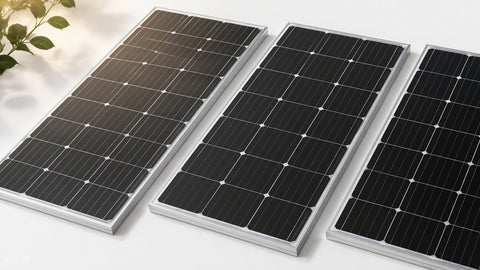
- Panels: Resilience adds mechanical requirements — hail ratings (UL 61730 with enhanced hail testing), wind-load certifications matched to your zone, and in wildfire country, ember-resistant mounting details. The 2026 panel roundup tracks which current models carry which certifications.
- Balance of system: Resilience systems live or die on the unglamorous parts — the transfer switch listing, the disconnect labels, the conduit and wire sized per the NEC ampacity guide, and the charge controllers on any DC-coupled subsystems.
Communications, Monitoring, and the Human Side of Outages
Hardware gets the budget; behavior determines the outcome. The households that ride out week-long outages well share practices that cost nothing. Everyone in the house knows which circuits are backed up and what the conservation priorities are — refrigeration and furnace first, entertainment last. The monitoring app is on two phones, not one, with alerts enabled for battery state of charge and generator faults. A laminated card near the panel documents the transfer sequence, the reserve-floor settings, and the "call this number" list — because the person home during the outage may not be the person who sat through commissioning. Communications redundancy deserves explicit design: the backed-up loads panel should always include the router and modem, and in cellular-fringe rural areas, the signal booster too. In the nine-day ice storm case above, the household's internet stayed up the entire event on 60 watts of backed-up network gear — which meant work, school, weather radar, and the simple morale of a functioning household. I've come to believe that last item is undersold: a house with lights, heat, refrigeration, and Wi-Fi isn't enduring a disaster, it's just having a quiet week. That psychological shift — from crisis to inconvenience — is what the whole architecture is actually for.
Permitting, Insurance, and Resale Value
Three administrative realities shape resilience projects. Permitting: battery systems trigger NEC 706 review in most jurisdictions, generator installs need mechanical and electrical permits, and transfer equipment requires listing documentation — an experienced installer absorbs this, but verify it's in the quote. Insurance: carriers increasingly ask about battery installations, and a permitted, code-compliant system with UL 9540-listed storage is the difference between a rider and a refusal; some carriers now offer resilience discounts, and a documented backup system can also matter enormously in post-event claims. Resale: studies of home resale consistently show solar adding value, and agent feedback in storm-prone markets increasingly treats whole-home backup as a differentiating feature — a permitted resilience system with transferable warranties is a selling point, while an unpermitted one is a liability discovered at inspection. Keep the permit cards, the interconnection agreement, and the warranty documents together; that folder pays for itself at sale time.
Cost and Incentives, Honestly
Resilience tiers, installed, in current pricing: adding battery backup to a new solar installation runs $12,000–$20,000 for a single 10–13.5 kWh unit; a serious critical-loads system with 27–30 kWh lands at $25,000–$38,000; full architecture with generator integration totals $40,000–$60,000 on top of the array. The 30% federal residential clean energy credit applies to solar and to battery storage of 3 kWh and larger, whether or not it's paired with solar — that alone pulls $7,500–$11,000 back from a mid-tier system. State resilience programs add more in wildfire and hurricane territories; California's SGIP equity-resilience tier has historically covered near-total cost for qualifying medical-baseline and high-fire-risk households. The counterfactual math deserves one honest sentence: a nine-day outage with a failed well pump, a thawed freezer, and a hotel stay costs $3,000–$8,000 and carries risks no dollar figure captures — the customers who buy these systems after their first disaster always wish they'd bought before it.
Readiness: The Maintenance and Drill Discipline
| Cadence | Task | Why It Matters |
|---|---|---|
| Monthly | Check battery SOC history and reserve settings in the app | Reserve settings drift; storm season needs 80–100% reserve, not the 20% default |
| Quarterly | Simulated outage drill — kill the main breaker for 2 hours | Discovers transfer failures and confused household members before the real event |
| Seasonally (pre-storm season) | Generator service, fuel check, battery firmware updates | Firmware updates fix real bugs; stale fuel and dead batteries fail on cue |
| Annually | Full-load test: run critical loads on battery to the reserve floor | Verifies actual capacity against the design, catches degradation early |
The quarterly drill is the item everyone skips and the one I'd defend most stubbornly. I've watched a family's first "real" outage reveal that nobody knew which refrigerator circuit was backed up and the teenager's aquarium heater wasn't — a two-hour drill in October turns those surprises into a checklist instead of a crisis.
Portable and Renters' Resilience: Not Everyone Owns a Roof
A third of households rent, and evacuation scenarios don't care about homeownership. The portable tier of resilience has matured dramatically: 2–5kWh LFP power stations with 1,800–3,600W inverter output now run a refrigerator, a CPAP, and device charging for one to three days, recharge from a folding 400W solar blanket in a day of decent sun, and store in a closet the other 360 days of the year. For renters, the calculus is straightforward — a $1,500–$3,000 power station delivers the core of the resilience benefit with zero landlord negotiation and moves with you. For evacuation planning, it's the only tier that works: you can't island a house you're leaving, but a power station in the trunk runs the medication cooler and the phones at the motel that still has power to share. I've started recommending the portable tier even to customers commissioning full home systems — when the evacuation order comes, the house system stays behind, and the grab-and-go unit is what rides along. See the portable lithium power station category for current options, and size against the same critical-loads arithmetic, just with smaller numbers: refrigeration at ~1.5 kWh/day for an efficient unit, CPAP at ~0.5 kWh/night, phones and radios in the noise.
The Five Design Failures I See in the Field
- Assuming grid-tie solar backs up the house. The most common and most painful misunderstanding — discovered during the first outage. Anti-islanding is non-negotiable physics and law; backup requires island-capable hardware, period.
- Sizing batteries to the average month. December production in the Northwest runs a quarter of July's. Resilience sizing uses the worst month of the disaster season, or the battery bank is decorative.
- Backing up the whole panel instead of critical loads. The water heater, dryer, and range belong on the grid side. Every unnecessary backed-up circuit doubles the battery you needed to buy.
- No generator integration in long-outage territory. Batteries cover 95% of outage hours; the storm tail requires the generator. Skipping it in ice-storm or hurricane country is designing to the brochure.
- Never drilling. Untested systems fail in novel and creative ways. The quarterly two-hour drill is the cheapest reliability investment in the entire architecture.
Frequently Asked Questions
Do solar panels work during a power outage? Not by themselves. Standard grid-tied inverters shut down during outages for line-worker safety (anti-islanding). Solar works in an outage only when paired with a battery and a grid-forming hybrid inverter that creates an islanded home grid.
How much battery storage do I need for a power outage? Tally your critical loads in kWh per day — a typical household needs 12–16 kWh daily for refrigeration, heating blower, communications, and lighting — then multiply by autonomy days and divide by usable depth of discharge. Two days of autonomy typically requires 27–34 kWh of nominal capacity.
Can a solar battery run my whole house during an outage? A single battery can run critical loads for a day; whole-home backup including air conditioning or electric cooking requires multiple batteries, a high-output inverter, and load management. Most resilient systems back up a critical loads panel rather than the whole house.
Should I get a generator or a battery for backup power? Batteries cover short outages (hours to a day or two) silently and instantly; generators cover multi-day events. The strongest architecture pairs both: the battery carries the house while a generator runs a few efficient hours daily to recharge it, tripling fuel autonomy.
What is black start and why does it matter? Black start is a system's ability to restart with no grid and a depleted battery. Verify that your hybrid inverter can black-start from solar alone; some systems cannot restart without grid power or generator input, which is a poor surprise during a multi-day outage.
Does the federal tax credit cover backup batteries? Yes. The 30% residential clean energy credit applies to battery storage of 3 kWh or larger, whether or not it's paired with solar, through the credit's current statutory window. Confirm eligibility details with your tax professional.
How do I prepare my solar-plus-storage system before a hurricane? Charge batteries to 100% (override reserve settings), fill generator fuel supplies, verify the generator starts, review which circuits are backed up, and secure documentation of your system's wind-load certifications for insurance.
Resilience is a design discipline, not a product: critical loads identified, storage sized to the worst month, the generator integrated for the tail, and the whole system drilled before it's needed. Portlandia Electric Supply stocks every layer of that architecture — panels, batteries, hybrid inverters, generators, and the transfer equipment connecting them — and our team designs these systems weekly for storm country. Bring us your load list and your region's outage history, and we'll build the system that lets you stop thinking about the weather.