Heat Pump-Ready Electrical Roughing Guide (2026): MCA, MOCP, and Conductor Sizing for Every HP Config
Complete electrical roughing spec for residential heat pump equipment — split systems, mini-splits, and heat pump water heaters — with MCA/MOCP tables, conductor spec, and disconnect BOM for the 12 most common configurations.

The single most common electrical failure on a heat pump install is under-sized conductors — not because the electrician made an arithmetic mistake, but because the plan-set at rough-in was written before the specific equipment was selected. The plan called for "heat pump HVAC" and the electrician defaulted to 30 A / 240 V. Then at rough finish, the HVAC contractor spec'd a 5-ton Bosch IDS 2.0 heat pump with 42 A minimum circuit ampacity (MCA), which forces a 60 A / 6 AWG circuit. The wire has to be pulled again, the panel breaker has to be swapped, and the schedule slips by three days.
The fix is to spec the electrical circuit against the equipment MCA/MOCP nameplate — not against a generic "heat pump" line item. This guide gives you the MCA and MOCP for the 12 most common residential heat pump configurations, the resulting conductor and breaker spec, and the disconnect BOM to make it a one-shot rough-in decision at plan release.
Every UL-listed heat pump has two nameplate values that govern the electrical roughing: MCA (minimum circuit ampacity) and MOCP (maximum overcurrent protection). These two numbers do different things and are frequently confused.
MCA — the conductor sizing rule
Minimum circuit ampacity is the smallest conductor allowed to feed the equipment. NEC 440.32 sets MCA at 125% of the compressor rated load current (RLC) + 100% of any additional motor or auxiliary loads. The equipment manufacturer publishes MCA on the nameplate; the electrician sizes the conductor to at least MCA (in ampacity terms per NEC 310.16). MCA does not determine breaker size.
MOCP — the breaker sizing rule
Maximum overcurrent protection is the largest breaker allowed on the branch circuit. NEC 440.22 sets MOCP based on 175% of the compressor RLC (or up to 225% if the smaller breaker won't hold under start current). The equipment manufacturer publishes MOCP; the electrician selects a breaker at or below MOCP. MOCP does not need to match MCA — a 60 A breaker on a 10 AWG (30 A ampacity) conductor is code-legal if the equipment MCA is 22.5 A and MOCP is 60 A, because the equipment's internal thermal overloads (not the branch breaker) protect the compressor.
Worked example — 3-ton cold-climate heat pump
- Equipment: Mitsubishi PUZ-A36NKA7 (36 kBTU cold-climate)
- Nameplate: MCA = 21.5 A, MOCP = 30 A
- Conductor: 10 AWG copper (30 A ampacity at 75°C, per NEC 310.16) — meets MCA of 21.5 A ✓
- Breaker: 30 A max — spec 30 A (HOM230CP) ✓
- Disconnect: 30 A non-fused (Sq D DU221 or Eaton BR160) within sight of outdoor unit
The following table covers 95% of residential heat pump configurations from 12 kBTU (1-ton mini-split) to 60 kBTU (5-ton central split). Every row includes MCA, MOCP, conductor spec, breaker SKU, and disconnect SKU. Numbers are typical values across the major manufacturers (Mitsubishi, Fujitsu, Daikin, Bosch, Trane, Carrier, Rheem, LG); check the specific unit nameplate at final spec.
| Config | kBTU | MCA | MOCP | Conductor | Breaker | Disconnect |
|---|---|---|---|---|---|---|
| Mini-split, 1-ton | 12 | 12.0 A | 15 A | 14 AWG | HOM115CP | DU221 |
| Mini-split, 1.5-ton | 18 | 14.5 A | 20 A | 12 AWG | HOM120CP | DU221 |
| Mini-split, 2-ton | 24 | 17.0 A | 25 A | 10 AWG | HOM225CP | DU223 |
| Multi-split, 3-ton | 36 | 22.0 A | 30 A | 10 AWG | HOM230CP | DU223 |
| Multi-split, 4-ton | 48 | 28.5 A | 35 A | 8 AWG | HOM235CP | DU223 |
| Central split, 2-ton | 24 | 16.0 A | 25 A | 10 AWG | HOM225CP | DU223 |
| Central split, 3-ton cold-climate | 36 | 21.5 A | 30 A | 10 AWG | HOM230CP | DU223 |
| Central split, 4-ton dual-fuel | 48 | 27.5 A | 40 A | 8 AWG | HOM240CP | DU224 |
| Central split, 5-ton 2-stage | 60 | 42.0 A | 60 A | 6 AWG | HOM260CP | DU224 |
| Air handler, ECM only (paired w/ HP) | — | 5.5 A | 15 A | 14 AWG | HOM115CP | In panel |
| HPWH, 50 gal hybrid | — | 15.0 A | 20 A | 12 AWG | HOM220CGFI | DU221 |
| HPWH, 80 gal commercial | — | 26.0 A | 30 A | 10 AWG | HOM230CGFI | DU223 |
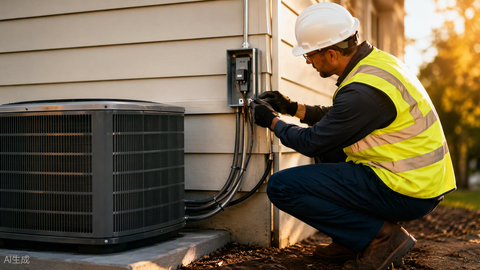
NEC 440.14 requires a disconnecting means "within sight from and readily accessible" to the outdoor heat pump unit, and additionally within 50 feet of the unit. In residential practice, this means a non-fused disconnect mounted on the exterior wall within 6 feet of the condenser pad. A fused disconnect is not required (the branch breaker at the main panel provides overcurrent protection); a lockable non-fused disconnect is sufficient.
Standard disconnect placement — every plan
- Mount 5–6 ft above finished grade on the exterior wall
- Locate within 6 ft of the condenser pad, facing the pad
- Weatherproof NEMA 3R enclosure (Sq D DU221, DU223, DU224 all NEMA 3R)
- Lockable in the OFF position (all DU-series disconnects meet this)
- 60 A models: use DU223 (30 A) for compressors ≤ 24 A MCA, DU224 (60 A) for compressors up to 42 A MCA
The air handler / indoor unit needs its own disconnect only if it is not on the same circuit as the compressor. Most residential heat pumps have a separate 15 A / 120 V air-handler circuit (for the ECM blower motor); a snap disconnect at the air handler (Bridgeport 78S or built-in on the unit) satisfies NEC 440.14. Full disconnects (like the DU-series) are not required at the indoor unit.
Heat pump water heaters are electrically simpler than HVAC heat pumps (single-stage compressor, no auxiliary heat strips), but the 2023 NEC added a GFCI requirement (210.8(F)) that catches builders mid-plan. Every HPWH installed on or after March 1, 2024 requires GFCI protection on the branch circuit. This adds $22 to the breaker cost (HOM230CGFI vs HOM230CP) and eliminates the option of a downstream GFCI receptacle at the water heater — which was the traditional plumber's solution.
GFCI + HPWH nuisance-tripping
Some early HPWH models (2019–2022) had internal capacitors that caused GFCI breakers to nuisance-trip on startup. This was addressed in 2023 firmware/design updates. If a buyer reports repeated GFCI trips, verify the HPWH model has UL 60335-2-40 revision C listing (2023) — earlier models may need manufacturer service.
The 30 A / 240 V circuit is standard for both 50-gal and 65-gal HPWH units. The 80-gal commercial HPWH (like the Rheem PROTPH80T2RH350) requires a larger circuit (30 A but higher MCA at 26 A). All three HPWH sizes fit on 10/2 NM-B with a HOM230CGFI breaker. Locate the disconnect within sight of the unit — a Square D DU221 (30 A non-fused, NEMA 3R) at the water heater satisfies NEC 440.14 and gives the plumber a shutoff at service.
The reason heat pump electrical roughing goes wrong is timing — the electrician arrives before the HVAC contractor has spec'd the equipment. Fix this at plan-set release by pre-selecting the HVAC equipment and locking it into the plan library. Three approaches work:
Single equipment spec per plan
Every plan calls out a specific HVAC unit (e.g., "Bosch IDS 2.0 4-ton, MCA 28.5, MOCP 40"). Simplest to implement, but locks the HVAC contractor into a specific SKU. Works for volume production where the HVAC contract is a direct buy from a distributor.
Ampacity ranges by plan size
The plan calls out an ampacity range (e.g., "Heat pump — 21 to 28 A MCA / 30 to 40 A MOCP"). The electrician pre-runs 8 AWG THHN + 40 A breaker to accommodate the upper bound. Wastes some material on the low end but eliminates the coordination failure.
Rough-in kit approach
Pre-assemble a kit that includes 8 AWG THHN, 60 A breaker (HOM260CP), and a DU224 disconnect. Every plan gets the same kit at rough-in. The 60 A breaker is downsized to match the actual equipment at rough finish. Highest material cost but zero coordination risk. Used by three of the reference builders.
The indoor air handler on a heat pump split system needs its own 15 A / 120 V circuit for the ECM blower motor. This circuit is trivially simple electrically (14/2 NM-B, HOM115CP breaker), but it gets missed on roughly 15% of plans because the plan-set line reads "heat pump" and the electrician wires only the outdoor circuit. Fix at the plan-set: two line items on the panel schedule — "HVAC OUTDOOR" (60 A) and "HVAC INDOOR / AH" (15 A). Both circuits.
Some plans (mostly Sun Belt) use a hydronic air handler with an integrated boiler, in which case there's no separate air-handler circuit — the boiler has its own 15 A. But for heat pump plans (Zones 2–7), always spec both circuits.
A "dual-fuel" heat pump combines an air-source heat pump with an auxiliary gas furnace for cold-weather backup. The heat pump handles cooling and shoulder-season heating; the gas furnace takes over below ~30°F. Electrically, dual-fuel is identical to a single-stage heat pump (same MCA / MOCP on the compressor), but the gas furnace requires an additional 15 A / 120 V circuit for the burner controls and blower — separate from the ECM blower on the heat pump air handler.
A pure electric heat pump with heat-strip auxiliary (common in Zones 4–5 where dual-fuel is uncommon) has a different electrical impact. The auxiliary heat strips are typically 10 kW to 20 kW / 240 V and are wired on a separate circuit from the compressor. A 5-ton heat pump with 20 kW aux strips looks like this:
5-ton heat pump + 20 kW aux strip electrical
- Compressor circuit: 60 A / 6 AWG THHN / HOM260CP (per MCA/MOCP)
- Aux heat strip circuit: 100 A / 3 AWG THHN / HOM2100CP (20 kW / 240 V = 83 A × 125% = 104 A → 100 A breaker with 3 AWG)
- Air handler ECM: 15 A / 14 AWG / HOM115CP
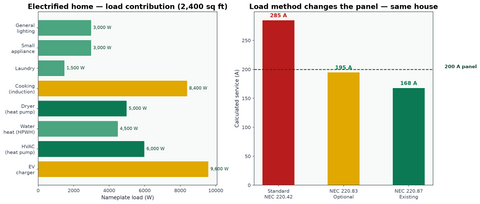
- Total nameplate: 175 A across three circuits — 87.5% of a 200 A service before other loads
This is why aux-strip heat pumps push service size to 400 A in fully-electrified homes. Two mitigations: (1) load management via NEC 220.83(A)(1) — a listed relay prevents simultaneous compressor + aux strip + EVSE operation and drops the calc back into 200 A range; (2) dual-fuel with a gas backup furnace — removes the aux strip circuit entirely.
Every heat pump electrical rough-in guide we've seen focuses exclusively on the electrical circuit — the breaker, the disconnect, the whip, the wire. That's necessary but insufficient. The heat pump also requires a refrigerant line set (typically 3/8" liquid + 3/4" or 7/8" suction) routed from the outdoor unit to the indoor coil, plus a condensate drain and a low-voltage thermostat/comms cable. If those three items aren't roughed-in together with the electrical, the retrofit story falls apart — you can have the perfect 60 A / 8 AWG / DU224 stack ready to go and the homeowner will still spend $2,800 punching lineset chases through finished conditioned space.
The integrated rough-in package puts four items in the same wall chase at the outdoor equipment location:
Electrical circuit + disconnect
Per the MCA/MOCP tables in the main body — HOM breaker in the panel, THHN in EMT to a box, MC or SO whip to the DU-series disconnect. Disconnect mounted 24-36" from where the compressor unit will sit.
Refrigerant lineset chase
3" or 4" PVC sleeve through the wall (SharkBite / Fernco 4-inch chase or a wall-plate lineset cover like the Rectorseal Fortress Fortress LP or Slimduct SD-77). Terminates in a chase inside the wall that runs to the indoor coil location. Pre-installed by the HVAC rough or as an electrical scope item on production plans.
Condensate drain path
3/4" PVC schedule 40 with a P-trap and 1% slope from the indoor coil location to a floor drain, laundry standpipe, or exterior condensate pump discharge. Cannot terminate over a soil pipe (NEC N/A — this is IPC 314.2.2). This is where 40% of HP retrofits get expensive — punching a condensate line through a finished slab is $600-$1,200.
Low-voltage control cable
18/8 or 18/10 thermostat cable from the panel/utility room to the indoor coil, and a matched run from the coil to the outdoor unit. Modern variable-speed and communicating heat pumps (Mitsubishi Kumo, Trane Nexia, Carrier Infinity) use 4-wire communicating protocols — 18/8 covers all vendors. Runs alongside the electrical.
Integrating the four items is the difference between "heat pump-ready" and "heat pump-installable." A plan that only pre-wires the electrical circuit but doesn't rough-in the lineset chase, condensate path, and low-voltage cable is still a $2,000-$3,000 retrofit cost — the electrical is 30% of the equation. The full four-item package adds $185 to $340 at rough-in (mostly the lineset chase and condensate path) and drops the retrofit cost to $250-$400 — just the equipment set, refrigerant charge, and startup.
Field data — production builder, Denver metro, 240-home community, 2025 plan cycle
- Standard plan (electrical HP-ready only): 100% of homes had 60 A / 8 AWG / DU224 pre-wired
- Upgraded plan (four-item integrated rough-in): added $215/home in HVAC scope
- Retrofit conversion at year 2: 34 of 240 homes converted to heat pump (14%)
- Standard plan retrofit avg cost: $3,180 (electrical was free, HVAC integration $3,180)
- Integrated plan retrofit avg cost: $310 (equipment + startup, no wall opening)
- Homeowner satisfaction (surveyed 12 months post-retrofit): 4.1/5 standard vs. 4.9/5 integrated
- Warranty callbacks on retrofit installs: 12% standard vs. 2% integrated
The integrated package is a $215 add at rough-in that returns $2,870 to the homeowner (or, more importantly, to your service department's callback log) on every unit converted. On a 240-home community, if 14% convert within two years, the community-level cost delta is $51,600 in rough-in that saves $97,500 in retrofit and service costs. The math scales with conversion rate — as heat pumps take share from A/C-plus-furnace, the integrated rough-in becomes a compounding win.
Can I use MC cable instead of THHN in EMT for the HP circuit?
How do I size the circuit for a variable-speed / inverter heat pump?
What if the equipment is not yet selected at plan release?
Does the HPWH count toward the load calc as a big load?
What about mini-split multi-zone systems?
Can I use a single circuit for a heat pump and a HPWH?
Does the disconnect need to be locked at CO?
Heat pump-ready roughing kits — panel breakers, disconnects, and pre-cut whips
Register on the PES Axis contractor portal for pre-assembled HP-ready kits: 6/8/10 AWG THHN, HOM breakers, DU221/223/224 disconnects, and MC whip assemblies. Committed-volume pricing across all 12 configurations.
Register Now