Canadian Solar vs JA Solar 2026: Budget Tier-1 Shootout
The two value kings of Tier-1 solar, compared line by line — efficiency, degradation, warranty, real distributor pricing, and which one we reach for by application.
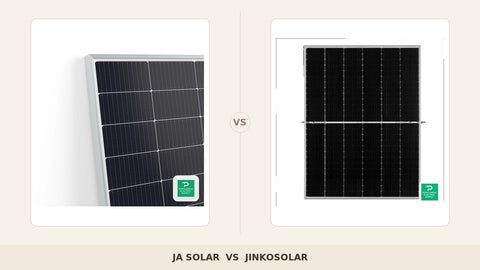
If you're shopping solar panels on value in 2026, you've already landed on the right shortlist. Canadian Solar and JA Solar are the two names that dominate the "Tier-1 quality without the premium-brand tax" conversation — both BloombergNEF Tier-1 bankable, both vertically integrated, both shipping tens of gigawatts a year, and both priced well below the SunPower-class premium brands. We stock both lines — Canadian Solar panels and the JA Solar lineup — and we genuinely sell them interchangeably when inventory shifts. But "interchangeable" isn't "identical." The differences are small, real, and worth understanding before you buy a pallet.
One disclosure up front, because it matters for how you read this: we are a distributor for both brands. We have no margin incentive to push one over the other — wholesale spreads between them run within a couple cents per watt. What follows is the comparison our technical sales desk actually gives, including the warranty-mechanics details that don't fit on a datasheet.
Canadian Solar (founded 2001, HQ in Ontario, manufacturing across China and Southeast Asia, plus US module assembly in Texas) is the more diversified company — it's also a major project developer through its Recurrent Energy arm, which matters because it means the company eats its own cooking at gigawatt scale. JA Solar (founded 2005, Beijing) is the more manufacturing-pure play: one of the world's largest cell producers, deeply vertically integrated from wafer to module, and historically the technology-quiet but volume-loud member of the Tier-1 club. Both survived every industry shakeout of the last two decades — which, in solar, is the strongest bankability signal there is.
| Specification | Canadian Solar (HiKu6/HiKu7 classes) | JA Solar (DeepBlue 4.0/Pro classes) |
|---|---|---|
| Residential flagship class | HiKu6 all-black, ~440–470W | DeepBlue 4.0 (JAM54D41 class), ~440–465W |
| Commercial/utility class | HiKu7 / HiKu7 bifacial, ~580–700W+ | DeepBlue 4.0 Pro (JAM66D42 class), ~600–640W |
| Cell technology | N-type TOPCon (current gen), PERC legacy | N-type Bycium+ TOPCon (current gen), PERC legacy |
| Module efficiency (residential class) | ≈ 21.5–22.8% | ≈ 21.5–22.5% |
| Temp coefficient (TOPCon class) | ≈ −0.29%/°C | ≈ −0.29–0.30%/°C |
| First-year degradation | ≈ 1.0% | ≈ 1.0% |
| Annual degradation (yrs 2–30) | ≈ 0.40%/yr | ≈ 0.40%/yr |
| Product warranty (TOPCon residential) | 25 years class | 25 years class (extended from legacy 12–15) |
| Performance warranty | 30 years, ≥87.4% at year 30 class | 30 years, ≥87.4% at year 30 class |
| Bifacial options | Yes — HiKu7 bifacial, dual glass | Yes — DeepBlue bifacial dual glass |
| US assembly / domestic content | Texas module plant — strongest domestic story of the two | Phoenix-area assembly announced/ramping — verify current content status |
| Typical distributor $/W (2026, residential class) | ≈ $0.30–0.38/W | ≈ $0.28–0.36/W |
Read that table and you'll see the honest truth: on specs, this is a coin flip. Both ship n-type TOPCon with ~22%+ efficiency, identical tempcos, identical degradation curves, matching 25/30-year warranty structures. JA Solar typically lands a cent or two per watt cheaper at the distributor level. Canadian Solar typically wins the domestic-content conversation (more on that below — in 2026 that's worth real money on some projects). Anyone who tells you one of these brands is "obviously better" on paper is selling something.
Since the degradation curves are essentially identical, the lifetime-energy comparison comes down to starting efficiency and price. Run it on a 10kW residential array, 4.5 peak sun hours, 0.80 system derate, 30-year horizon:
| Lifetime Metric (10kW array) | Canadian Solar HiKu-class | JA Solar DeepBlue-class |
|---|---|---|
| Year-1 production (8 kW DC example base) | ≈ 10,500 kWh | ≈ 10,500 kWh |
| Cumulative 30-yr degradation path | 1.0% + 29 × 0.40% ≈ 87.4% remaining | Identical ≈ 87.4% |
| 30-year lifetime energy | ≈ 292,000 kWh | ≈ 292,000 kWh |
| Module cost @ typical $/W | 10,000W × $0.34 ≈ $3,400 | 10,000W × $0.32 ≈ $3,200 |
| Module cost per lifetime kWh | ≈ 1.16¢/kWh | ≈ 1.10¢/kWh |
The takeaway: a 5–6% difference in module price per lifetime kWh. On a $30,000 installed project, the $200 module-price gap between these brands is under 1% of project cost. Which means the decision rightly moves to everything around the panel: availability, warranty mechanics, domestic content, and the specific SKU on the truck.
Domestic content and IRA adders. Canadian Solar's Texas assembly plant gives it the cleaner paper trail for projects chasing the 10% domestic-content ITC adder, and its module-level documentation has been smoother in our experience. JA Solar's US assembly story is improving — confirm current content percentages with us at order time, because they shift by production batch. For a commercial customer where the adder is worth tens of thousands, this alone can decide the shootout.
Warranty claims in practice. Both are real Tier-1 companies that honor paper — but the mechanics differ. Canadian Solar runs claims through regional service offices with established US infrastructure; resolution in our records runs a few weeks for straightforward DOA/underperformance cases. JA Solar historically routed claims through the installer/distributor chain more heavily; having a distributor (us) who handles the RMA legwork matters more with JA. Neither has given us a denied legitimate claim in years. Both beat the no-name import lottery by a mile.
Availability and format coverage. Canadian Solar's catalog skews broad: residential all-black (all-black class), commercial large-format (commercial class), bifacial (bifacial class), utility-scale (utility class). JA Solar is equally broad on paper but US-channel inventory concentrates in the high-volume commercial formats. For a one-off residential order, whichever brand has your wattage class on the shelf this week is often the right answer — a panel that ships beats a panel that's 2% better on a spreadsheet.
Reliability data. Both score consistently in the middle-to-upper pack of PVEL's Module Reliability Scorecard — not the chart-toppers (that's the premium brands' whole pitch), but solid passes on damp heat, thermal cycling, and mechanical load. In our own warranty records across thousands of modules, both run well under half a percent field-failure rates. For context, that's the same neighborhood as brands costing 30% more.
| Project Type | Our Pick | Reasoning |
|---|---|---|
| Residential rooftop, price-driven | Whichever is in stock at lower $/W this week | Specs are a coin flip; availability wins |
| Residential, all-black aesthetic priority | Canadian Solar HiKu all-black class | Stronger all-black residential inventory in US channel |
| Commercial flat roof / ground mount, 100kW+ | JA Solar DeepBlue Pro class | Typically sharper $/W at pallet/container volume |
| Project chasing domestic-content adder | Canadian Solar | Texas assembly paper trail is cleaner today |
| Bifacial ground mount / carport | Either — compare current bifacial SKUs | Both ship credible dual-glass bifacial |
| Off-grid / DIY small system | Either — buy the deal | Put savings toward batteries; see LiFePO4 options |
Abstract brand comparisons only go so far — here's the shelf-level view of the residential SKUs moving through distribution in 2026:
| Attribute | Canadian Solar HiKu6-Class Residential | JA Solar DeepBlue 4.0 Residential |
|---|---|---|
| Wattage band | ≈ 440–470W | ≈ 440–465W |
| Cell / count | N-type TOPCon, 108 half-cells | N-type Bycium+ TOPCon, 108 half-cells |
| Dimensions | ≈ 1.9 × 1.13m class | ≈ 1.9 × 1.13m class |
| Weight | ≈ 21–23 kg | ≈ 21–23 kg |
| All-black option | Yes — strong US channel stock | Yes — thinner US stock |
| Pallet count / watts per pallet | 31–36 pcs class | 31–36 pcs class |
| In-stock example at PES | CS3N-395MS class and current HiKu SKUs | DeepBlue SKUs via JA Solar collection |
Mechanically interchangeable — same racking, same clamps, same string math. Your layout drawings don't care which logo is on the frame; your budget and lead time might.
On logistics: both brands move through US distribution in pallet and container quantities with typical residential lead times of one to three weeks when stateside stock exists, six to ten weeks on factory-direct containers. Both have regional warehouses; both honor freight-damage claims through the distributor channel (inspect and photograph at delivery — freight claims die without same-day documentation, whatever the brand). If your project date is fixed, ask us what's physically in the country before falling in love with a specific SKU; the best panel is the one on the truck.
On bankability — the word lenders and commercial buyers actually use: both are BloombergNEF Tier-1 stalwarts, both appear on major lender approved-vendor lists, and both have the multi-gigawatt shipment history that makes a 30-year performance warranty worth more than the paper. Where they differ is corporate shape: Canadian Solar's project-development arm (Recurrent) ties module fortunes to a development business, which cuts both ways in a downturn; JA Solar's manufacturing purity means module margins are the whole story. Neither structure keeps us up at night; both beat the vast field of non-Tier-1 imports where a warranty claim in year 12 starts with discovering the company no longer exists. That, in the end, is the real "budget Tier-1" value proposition — not the specs, but the near-certainty that someone answers the phone in 2045.
Value-tier pricing attracts gray-market noise, so two verification habits are worth thirty seconds each. First, serial-number validation: both manufacturers verify module serials through their support channels — a legitimate distributor (us included) will hand you documentation without flinching, and flash-test reports per pallet are a normal ask on commercial orders. Second, datasheet matching: the label on the module's rear should match a current datasheet revision from the manufacturer's site, including the exact model code, connector type, and warranty terms. Mismatched labels or "OEM surplus" language at suspicious prices is the tell for re-flashed or off-spec product. Both brands' warranties attach to the module serial and require proof of purchase from an authorized channel — keep your invoice with the house documents, because that's the warranty.
Pairing either brand with the rest of the system. Both play perfectly with every mainstream inverter line we sell — string inverters from the solar inverter lineup, microinverters for shade-complicated roofs, or hybrid inverters when storage is in the plan. String sizing uses the same NEC 690.7 cold-voltage correction for both brands' TOPCon classes (Voc and tempco are nearly identical, so strings are interchangeable), and racking compatibility is universal across the standard 30–35mm frames. In other words: the rest of your BOM doesn't change with this decision — which is one more reason to let price, availability, and domestic content make the call.
Two currents shape this comparison right now. First, the industry-wide n-type transition is complete: both brands' PERC lines are legacy at this point, and the TOPCon generation is where inventory, warranty terms, and efficiency gains all live — if a quote you're comparing still lists PERC SKUs at "discount" pricing, you're looking at stock clearance, which can be a fine deal with eyes open. Second, trade policy keeps rewriting landed costs quarter by quarter. Tariff exposure, AD/CVD cases on Southeast Asian supply chains, and the domestic-content bonus all mean the cheapest panel this quarter may not be the cheapest next quarter — and they're the strongest argument for buying from a distributor with multi-brand inventory rather than locking to one brand's supply chain. We watch both brands' landed cost weekly; the spreads move.
Residential vs commercial warranty nuance. Both brands' generous 25-year product terms apply to their current residential n-type lines; large-format commercial SKUs sometimes carry different product terms (12–15 years class on some utility lines) even when the performance warranty stretches 30. Read the warranty sheet for the exact SKU on your quote — the line item, not the brand brochure. This trips up commercial buyers annually, and it takes two minutes to verify.
Resale and the paper trail. For financed or leased residential systems, both brands pass lender review without friction — Tier-1 status plus long warranty plus US presence checks every box. Keep the flash-test reports, serial lists, and invoice; that packet is worth real money if you ever sell the house with the system, whatever brand wins your shootout.
The sustainability angle, briefly, because commercial buyers now ask. Both manufacturers publish ESG reports and run take-back/recycling partnerships; Canadian Solar's developer arm gives it more visible project-level sustainability storytelling, while JA Solar's wafer-to-module integration gives it tighter process control and marginally lower embodied-energy variance batch to batch. Neither is a differentiator for a residential buyer; both satisfy the procurement questionnaires that increasingly gate commercial work. If your RFP includes ESG scoring, ask us for both brands' current documentation — we keep it on file.
What we run on our own demo arrays. For the record: our current Portland demo roof carries a Canadian Solar residential string, and our last commercial ground-mount quote that shipped went out with JA Solar large-format — chosen on availability and $/W on the respective order dates, which is exactly the advice in this article worn as a uniform. Next quarter could flip both. That's not indecision; that's how a distributor with no brand allegiance is supposed to buy.
The one-sentence version for your notes: these two brands are the value Tier-1 duopoly for a reason — pick by price, stock, and domestic content on your order date, spend the saved dollars on design and storage, and keep the serial-number packet forever.
And the question that started a hundred forum wars — "which will still exist in 20 years?" Both companies carry two decades of operating history, multi-gigawatt annual shipments, and the kind of balance-sheet scrutiny that comes with bankability audits. No manufacturer is immortal — solar's graveyard of 2010s brands proves it — but if you're ranking survival probability across the industry, these two sit comfortably in the top tier. Buy either with confidence; keep your documentation; move on to the decisions that actually move your project's economics.
Last procurement tip from the desk: ask for both brands' current flash-test summaries with your quote. Thirty seconds of reading tells you the actual measured output spread of the pallet you're buying — positive-tolerance sorting is common on both, and a pallet testing +2% over nameplate is found money that never appears in any comparison chart. Good distributors share this without being asked; great ones sort for it.
This shootout ends in a draw, and that's the useful answer. Canadian Solar vs JA Solar is Coke-vs-Pepsi for people who read spec sheets: marginally different flavors of the same Tier-1 value proposition. Buy Canadian Solar when domestic content, all-black residential aesthetics, or US service infrastructure tip the scales. Buy JA Solar when pure $/W at volume is the mission. Buy whichever one is on the shelf when your project window opens. And spend the energy you saved agonizing on the decisions that actually move system economics: string design, shading mitigation, derate honesty, and storage sizing — our Best Panels 2026 ranking, kits buyer's guide, and inverter buyer's guide cover those. Browsing the format classes — 400–459W, 460–549W, 550–709W, monocrystalline, n-type — will show you live inventory from both brands side by side, including value-adjacent alternatives like Trina and current stock like the Canadian Solar CS3N-395MS.
Is Canadian Solar better quality than JA Solar? Not measurably at the module level. Both are BloombergNEF Tier-1, both ship n-type TOPCon with ~22% class efficiency, identical ~0.40%/yr degradation, and matching 25/30-year warranty structures. Distributor return data shows both under 0.5% field failure. The decision lives in price, availability, domestic content, and warranty logistics — not quality.
Which is cheaper, Canadian Solar or JA Solar? JA Solar typically prices $0.01–0.03/W lower at distributor level on comparable SKUs — roughly $100–$300 on a 10kW residential array. Pricing flips with inventory cycles, so the honest answer is: quote both on your order date.
Do either qualify for US domestic-content incentives? Canadian Solar assembles modules in Texas and currently has the cleaner domestic-content documentation. JA Solar's US assembly operations are ramping — content percentages vary by batch, so verify at order time if your project is chasing the 10% ITC adder.
Are budget Tier-1 panels risky compared to premium brands? The data says no for mainstream applications. Premium brands win on peak efficiency and PVEL category leadership; value Tier-1 brands match them on degradation, warranty structure, and real-world failure rates at 25–35% lower module cost. On most residential economics, the value tier produces a better internal rate of return.
What warranty do both brands offer in 2026? Both offer 25-year product and 30-year performance warranties (≥87.4% retained at year 30) on current n-type residential lines — a major upgrade from the 12–15-year product warranties both carried on legacy PERC lines. Confirm the warranty sheet for your exact SKU at purchase.
Can I mix Canadian Solar and JA Solar panels in one array? On separate MPPT inputs, yes. In the same series string, no — even small Imp/Vmp mismatches between brands cost production and can stress bypass diodes. Mixed-brand expansions are common and safe when each brand lands on its own inverter input or module-level electronics.
Sources: manufacturer datasheets and warranty documents (Canadian Solar, JA Solar), BloombergNEF Tier-1 listings, PVEL Module Reliability Scorecard, PES Supply distributor pricing and RMA records 2023–2026. Ready to quote both brands on your project? Get a free quote — we'll price them side by side, same day.