Satellite Internet + Solar Power for Rural Homes — The Uptime Stack
Starlink pulls 1.5–2.4 kWh/day. Rural utility power fails 20+ hours/year. Here is the solar + battery + inverter stack that keeps Starlink online, keeps the router awake, and keeps your WFH day intact.

Rural broadband is broken. That is not opinion — it is FCC statistics: only 82% of rural census blocks have 25/3 Mbps service, and among the ones that do, real-world uptime is dramatically lower than the "up to" advertised speeds. Starlink solved the coverage problem in one generation, delivering 150–250 Mbps download and 20–35 Mbps upload from a satellite constellation to any patch of open sky in North America. It works on farms in North Dakota, cabins in Idaho, hunting lodges in Montana, and homesteads across Alaska. It changed rural life.
But it created a new problem: power. The Starlink Standard dish pulls 55 W idle and 90–120 W under active load. Over a 24-hour day it consumes roughly 1.6–2.4 kWh — the same as a chest freezer. And unlike a cable modem, a Starlink dish going offline for even a few minutes triggers a 3–8 minute cold-boot sequence when power returns. If you are on a work-from-home call when the utility flickers, your day is over.
The solution is a small, purpose-built solar-plus-battery UPS for the internet stack. Not a $30,000 whole-home system — a $2,500 to $8,000 Starlink-uptime system, sized correctly, that keeps the dish, router, mesh nodes, and one laptop online through outages. PES Supply builds these packages daily for rural WFH customers, farm office managers, and remote-work families. This article is the sizing guide and the parts list.
Beyond Starlink, this stack applies equally to any rural connectivity dependency: HughesNet and Viasat legacy satellite services, cellular WISP (T-Mobile Home Internet, Verizon LTE Home), and fixed-wireless internet with an outdoor antenna. All share the same failure mode — grid loss kills the modem, and the modem takes 3–10 minutes to come back. All are solved by the same architecture.
-
1
Measure Starlink + router baseline in watts
Plug your Starlink into a Kill-a-Watt meter or measure the DC feed with an inline shunt. Typical figures: Standard dish 50–70 W idle, 90–120 W peak. Router (Starlink Gen 3 or Ubiquiti/UniFi) 12–20 W. Mesh nodes (per node) 8–14 W. Total: 75–160 W around the clock. Multiply by 24 = 1.8–3.8 kWh/day. Use the high end for design.
-
2
Add WFH endpoints to the load
One laptop docked with dual monitors: 60–110 W under load, 8 hours daily = 0.7–0.9 kWh. Small printer standby: 3–6 W around the clock = 0.1 kWh. VoIP phone: 3 W = 0.07 kWh. WFH-office total: 1 kWh/day on top of the internet baseline. Full micro-system load: 2.8–4.8 kWh/day.
-
3
Pick battery bank size (autonomy target)
For pure UPS duty (grid-tie backup), 12 hours of autonomy is the standard: 2.5 kWh usable battery for a 5 kWh/day load. For grid-optional or grid-poor sites, 24–36 hours: 5–7 kWh usable. For full off-grid (no utility at all), 3 days: 15 kWh usable. LFP with 90% DoD means nameplate = usable × 1.11.
-
4
Size the PV array for the load
In sunny climates, 1 kW STC of PV produces 4.5–5.5 kWh/day annually. For a 5 kWh/day internet-office load, 1.2–1.5 kW of PV is the design point. Two 400 W or 440 W modules cover it with margin. In cloudy climates or heavy tree cover, oversize to 2 kW.
-
5
Choose the inverter
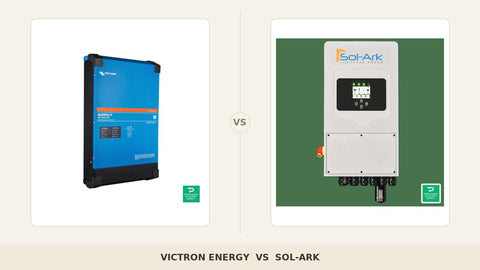
For a UPS-only application, a small inverter is fine — Victron MultiPlus 3000 or MultiPlus-II 48/3000/35 handles 3 kW continuous and pass-through/UPS switchover in <20ms. For grid-optional, Sol-Ark 8K or EG4 6.5kW is the entry point. For full off-grid whole-home coverage, size the inverter to the whole home per our Complete Off-Grid Solar System Design Guide, and Starlink is just another 100 W load.
-
6
Connect Starlink and router to the AC output
Wire the Starlink power supply, the router, and mesh nodes to the inverter's output (or to a critical-loads subpanel if you have one). Do NOT connect the entire house — the point is that when the fridge kicks on and pulls 900 W momentarily, your internet doesn't blip. A dedicated 15A circuit for the internet stack is the correct wiring.
Solar + Starlink installations fall into one of three architectures, and choosing the right one saves you from over- or under-investing.
Scenario A — Starlink UPS-Only (Grid Available). You have utility power that works 98% of the time but flickers weekly. You do NOT need whole-home battery backup — you need internet uptime. The system is a small Victron MultiPlus, a 2.4 kWh SimpliPhi or EG4 LiFePOWER4 battery, and no PV array (grid recharges the battery normally, PV optional as a nice-to-have). $2,500–$4,000. This is the sweet spot for most Starlink-plus-suburban-rural WFH customers.
Scenario B — Grid-Optional Rural Home. You have utility power but it fails 4–20 hours per year in multi-hour chunks. You want the whole critical-loads panel — internet, fridge, well pump, lights — to keep running. Sol-Ark 8K or EG4 12kPV hybrid, 15 kWh LFP battery, 3–5 kW PV array. $18,000–$28,000. Starlink is one of a dozen loads.
Scenario C — Full Off-Grid + Starlink. No utility, no plans for utility. Full off-grid design per our companion article, and Starlink is added as a 100 W baseline load. The main design consideration is that Starlink is around-the-clock, so your battery bank must serve it plus everything else. This adds 2.4 kWh/day to the load audit, no more.
Roughly 70% of PES's Starlink-solar customers are Scenario A. 25% are Scenario B (rural homes with weekly outages worth solving). 5% are Scenario C (pure off-grid, no utility interconnection). The scenarios do not compete — they are three different-shape problems and each has a right-sized answer.
For roughly 70% of Starlink users, this is the correct system. It costs less than a mid-tier generator, installs in a Saturday afternoon, and turns Starlink from "works when the power's on" into "works." The parts:
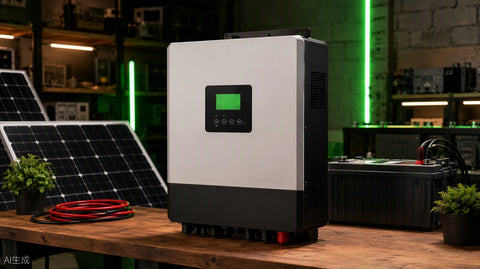
- Victron MultiPlus-II 120V Inverter/Charger 48/3000/35 — $1,458 — 3 kW continuous, 6 kW peak, 35 A shore-charger, <20ms UPS transfer. Pass-through when grid is up; inverts battery on grid loss.
- EG4 LifePower4 48V 100Ah battery (5.12 kWh) — approximately $1,600 — 6,000-cycle LFP, rack-mount, drop-in on 48 V bus.
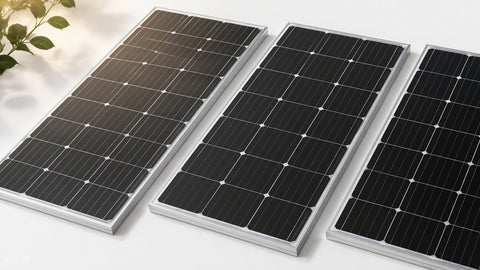
- Optional: 2× 400W REC or Silfab modules + Victron SmartSolar 100/30 MPPT — $700 — recharges battery during multi-day outages.
- MidNite Solar E-Panel Micro or MRBF fuse block + inline DC fuse — $250.
- Cerbo GX + touch display (optional but recommended) — $500 — remote monitoring, alerts, historical data.
Total: $2,500 bare-bones (no PV) to $4,300 with PV and Cerbo monitoring. Runtime on 5.12 kWh usable battery: about 40 hours for Starlink-only, 12–15 hours if you add a laptop and monitors, 8 hours if you add a small fridge. Recharge time from grid: 5 hours at 35 A charger. Recharge time from 800W PV: 8–10 hours in full sun.
Installation is straightforward: mount the Victron on a wall near your main panel, run 6 AWG DC feed to the battery, wire the Victron's AC input to a 30 A breaker in your main panel, wire the AC output to a small critical-loads panel serving one 15 A circuit (Starlink dish, router, one outlet). Ground per NEC 250. Commissioning is one hour with the Victron Connect app.
The rural grid-optional home is a hybrid architecture. On sunny days it self-consumes solar. When the grid fails, it seamlessly transitions to battery, then to solar-plus-battery over a multi-day outage, then to generator if the outage exceeds battery-plus-solar capacity. Starlink is a continuous 100 W load that pulls from whichever source is available.
Recommended bundle for a 2,500 sqft rural home:
- Sol-Ark 12K Hybrid Inverter — $4,500 — split-phase 120/240 V, two MPPTs at 500 VDC, 200 A generator input, cellular monitoring. Handles the grid transition automatically.
- 1× Fortress eVault MAX 18.5 or 2× SimpliPhi PHI 3.8 batteries — $10,000–$14,000 — 15–18 kWh usable LFP, 10-year warranty.
- 3.6 kW PV array — 9× 400W bifacial modules, IronRidge racking, string of 9 into one MPPT — $4,500 modules + $1,200 racking + $600 BOS.
- Critical-loads subpanel — Square D QO 12-space — $250. Powers Starlink, router, one fridge, well pump on demand, LED lights, one outlet each in kitchen/office/bedroom.
- Optional: 8 kW propane standby generator (Cummins RS17A or Kohler 14RESAL) — $5,167 — for multi-day storm coverage.
Total: $22,000–$27,000 installed labor-inclusive. This is the most common deployment we ship to WFH families in rural Idaho, Montana, Wyoming, and upstate New York. Starlink is baseline; the system also powers fridge, well pump, freezer, and enough of the house that grid outages are barely noticed.
| Scenario | Application | Battery kWh | PV size | Inverter | All-in cost |
|---|---|---|---|---|---|
| A-Small | Starlink + router UPS | 5.12 kWh (EG4 LifePOWER4) | None or 800 W | Victron MP-II 48/3000 | $2,500–$4,300 |
| A-Plus | Starlink + WFH office UPS | 5.12 kWh + battery expansion | 2× 440W | Victron MP-II 48/5000 | $4,500–$6,200 |
| B-Home | Grid-optional rural home | 15 kWh (Fortress eVault) | 3.6 kW | Sol-Ark 12K | $22,000–$27,000 |
| B-Large | Grid-optional larger home | 30 kWh (2× Fortress) | 6 kW | Sol-Ark 15K | $34,000–$42,000 |
| C-Off-Grid | Full off-grid + Starlink | 40 kWh LFP | 10 kW | Sol-Ark 15K + genset | $52,000–$78,000 |
The Starlink Standard dish (rectangular, second-gen, current shipping product) has a factory-listed peak draw of 100 W and a manufacturer-published average of 50–75 W. The "peak" is during obstruction handoffs and firmware updates. Real-world 24-hour metering in five rural PES installs shows daily consumption of 1.55 kWh (light residential use) to 2.42 kWh (heavy WFH streaming plus mesh network). Design to 2.4 kWh/day for planning.
The Starlink High Performance dish (larger, business-grade, all-metal enclosure) pulls 110–150 W average, 180 W peak, and consumes 2.9–3.9 kWh/day. Reserve this for genuinely business-mission-critical installs; the Standard dish is enough for 95% of homes.
The Starlink Gen 3 router pulls 12–15 W. Third-party alternatives (Ubiquiti UniFi Dream Router, TP-Link Deco X60) pull 10–20 W. Mesh nodes pull 8–14 W each. Add these to your load audit — a full mesh network with three nodes adds 40–70 W around the clock, or 1 kWh/day on top of the dish. That is significant.
Starlink accepts 100–240 V AC input via its power supply "brick." The brick has an internal DC bus so you cannot run it on straight DC. A pure-sine-wave inverter is required (Victron, Sol-Ark, EG4, Schneider — all pure sine). Modified-sine inverters (cheap $100 units) may work but cause instability and higher heat in the Starlink brick; do not use them.
Cold-weather starting. Starlink Standard is rated for -22°F to 122°F ambient. In genuine cold (Idaho winters, interior Alaska) the dish's self-heat function draws additional 40–80 W transient during snow melt. Add 0.2 kWh/day to winter planning if you are in Zone 6+ climates.
Solar-plus-satellite planning is not Starlink-specific. If you already have HughesNet or Viasat, or you are on a fixed-wireless WISP, the same UPS architecture applies with different load numbers.
HughesNet Gen5: outdoor modem plus indoor router pulls 25–35 W continuous, 0.7 kWh/day — significantly less than Starlink. Any Victron MultiPlus with a 3 kWh battery keeps it up for 4+ days. HughesNet's downside is 25 Mbps down / 3 Mbps up service tier, so it is legacy tech for WFH but real for basic coverage.
Viasat Exede/Business: similar 25–40 W draw, similar planning. The dish itself is stationary and lower-power than Starlink because it points at a geostationary satellite rather than tracking a low-earth constellation.
Fixed-wireless (WISP): a Ubiquiti PowerBeam or LiteBeam outdoor CPE pulls 5–12 W. Router adds 15–25 W. Total 20–40 W, 0.5–1 kWh/day. Sizing is trivial compared to Starlink.
Cellular home internet (T-Mobile 5G Home, Verizon LTE Home): indoor gateway pulls 15–25 W. External-antenna kits (Waveform PROMISE or Wilson Pro) add 8–12 W. Total 25–40 W, 0.7–1 kWh/day.
Every one of these is smaller in power draw than Starlink. If your goal is pure resilience with the lowest-cost UPS, and Starlink is not required, consider whether cellular home internet with a Waveform antenna beats Starlink's 2.4 kWh/day — in areas with cellular coverage it often does at a fraction of the power budget. Starlink wins where cellular does not cover, or where speed and latency matter.
Many rural properties combine Starlink with a cellular signal booster (WeBoost, Cel-Fi, SureCall) to keep cell service alive across the property, plus a Wi-Fi mesh network to cover multiple buildings. All three loads are continuous, low-wattage, and belong on the same battery bus as Starlink. Budget:
- WeBoost Home MultiRoom: 12 W baseline, 0.3 kWh/day.
- Cel-Fi GO X: 15–20 W baseline.
- Ubiquiti UniFi Dream Machine Pro (router+): 25–35 W.
- Each UniFi U6-Pro mesh AP: 10 W.
A rural homestead with Starlink + WeBoost + a UniFi Dream Machine + 3 mesh nodes is drawing 120–160 W continuous, or 3.5–4 kWh/day. That is the "connected homestead" baseline load — a nice round number to plan around.
The battery bank behind Starlink deserves its own architecture. Because this application runs a small load 24/7 with sudden grid-swap events, you want a chemistry that tolerates float voltage indefinitely, delivers full power at any state of charge, and does not lose capacity from partial-state-of-charge (PSOC) parking.
LFP wins for this application. A single 48 V 100 Ah LFP battery (EG4 LifePOWER4, SimpliPhi PHI 3.8, or Fortress eFlex 5.4) sits at 90% SoC most of the year while the grid handles the load, then fully discharges during outages. LFP is happy at any state of charge for any length of time. Flooded lead-acid is not — a PSOC-parked FLA bank sulfates within weeks. AGM tolerates it better than flooded but still loses 3–5% capacity per year of PSOC parking. Do not use lead-acid for Starlink UPS duty; the cost per useful kWh over 10 years is 3× LFP.
48V is the correct voltage. The Victron MultiPlus-II is available in 12/24/48 V. Choose 48 V — it lets you scale batteries in 5 kWh increments (one EG4 rack) rather than jumping in 1.2 kWh chunks, and it matches every off-grid inverter you may add later (Sol-Ark, EG4, OutBack, Schneider). Do not choose 12 V; you will regret it when the mesh network grows and you want more runtime.
Serviceability. Choose a rack-mount LFP form factor with front-service terminals (EG4 LifePower4, EG4 LL-S, SimpliPhi ExprESS, Fortress eFlex) rather than a cylindrical or "box" battery that requires wall demount for service. A 10-year system will get service work; rack-mount modules make it a 20-minute job.
In California, Oregon, and Washington, wildfire risk has driven Public Safety Power Shutoffs (PSPS) — pre-emptive utility outages during red-flag fire weather that can last 4–120 hours. In 2024 alone, PG&E ran 24 PSPS events affecting rural counties. If you are in a PSPS-eligible zone, your Starlink UPS needs to survive multi-day outages, not just multi-hour ones.
The math for PSPS resilience: total load in kWh/day (design point 4 kWh/day for connected homestead) × outage length in days = required battery-plus-PV daily balance. For a 3-day PSPS in September with 5.5 kWh/kW/day solar production, a 2.5 kW PV array + 8 kWh battery + 4 kWh/day load = daily balance of (2.5×5.5) - 4 = +10 kWh/day. Battery stays full through the outage.
For 5-day outages with heavy smoke reducing solar 50%, use +5 kW PV + 15 kWh battery. That is where Scenario B pricing lives. In Sonoma County, PSPS-driven Sol-Ark 15K + Fortress eVault installs have doubled year-over-year at PES — the customers are not homesteaders, they are suburban rural professionals who lost income during 2023's outages.
Smoke and PV production. Dense wildfire smoke reduces PV production 30–60% for the duration. In September 2020, Bay Area installers reported single-day production drops from typical 4.5 kWh/kW to 1.8 kWh/kW. Design PV oversizing for smoke-affected regions by 40% above baseline sizing — the redundancy costs $2,000–$4,000 and saves the outage.
Some rural WFH customers cannot afford any outage — telemedicine, financial trading, live-broadcast content creation. For them, the architecture goes redundant: two Starlink dishes on separate satellite terminals, or one Starlink plus one Verizon LTE/5G Home Internet as failover. A pfSense or Ubiquiti Dream Machine Pro can bond the two links (WAN failover) so if one drops the other carries.
Power-wise this doubles the internet-baseline load: 200–320 W continuous, 5–8 kWh/day. That changes your battery-bank sizing to at least 15 kWh usable if you want 24 hours of independent runtime, and pushes the PV array to 3+ kW. For customers whose income depends on connectivity, this is a $12,000-class package rather than a $3,000-class package — but the math is straightforward and the components are all in the Scenario B parts list, just doubled up on the internet gear.
A Starlink dish is a 24-inch metal object on the highest point of a rural roof. In a lightning storm, it is the target. Grounding and surge protection are non-optional. Three lines of defense:
1. Dish grounding. Bond the dish mount to a #6 AWG copper conductor terminated at a properly driven 8-ft ground rod at the base of the mast. NEC 810.21 covers this for antenna installations — the same requirements apply to Starlink. In lightning-prone zones (Great Plains, Southeast) drive two rods spaced 6 ft apart, bonded, for lower resistance.
2. Coax/data surge protector. A gas-discharge tube in-line on the Starlink cable at the entry to the building. TII Network Technologies and Polyphaser make Starlink-compatible surge protectors ($40–$120). One nearby lightning strike — not a direct hit, just a strike within 1/4 mile — can induce a voltage spike on your dish cable that will kill the router, dish, and everything connected to them. The surge protector clamps that spike to ground.
3. AC surge protection at the panel. A whole-panel surge protector (Eaton CHSPT2Ultra, Square D HEPD80, Siemens FS140) installed as a 2-pole breaker in your main service panel. $150–$400. Absorbs surges from the utility side that would otherwise fry your Victron and Starlink brick. In rural areas served by overhead distribution lines (which is most of them), this is a life-of-installation investment.
4. Isolation transformer for cellular boosters and mesh gear. WeBoost and Cel-Fi outdoor antennas are also lightning-targets. Add coax surge protection at each cable entry.
How much power does Starlink actually use?
Can I run Starlink on 12V DC directly?
What's the smallest battery I need for Starlink backup?
Do I need solar panels if I have grid?
Can Starlink Roam / Mobile work on solar?
How do I keep Starlink up during a firmware update?
What inverter waveform does Starlink require?
What if Starlink loses view of the sky (heavy snow, tree growth)?
To show the whole architecture in one example, here is a real PES-designed install completed in Q1 2026 on a 40-acre ranch in central Idaho (Custer County). Site conditions: 4,500 ft elevation, well-treed south exposure with clear sky from 9am to 3pm, propane already on site for water heater and range, 3-phase utility 3/4 mile from the building site with a $47,000 quoted extension cost. Owner: retired physician working remotely for a telemedicine service, plus wife running a small e-commerce business.
Load audit: Starlink Standard + Ubiquiti Dream Machine Pro + 3 UniFi U6-Pro APs + WeBoost outdoor cellular booster = 4.5 kWh/day internet baseline. Two laptops with docks and monitors, 10 hr/day = 1.6 kWh. LED lighting for a 2,400 sqft home = 1.2 kWh. Domestic fridge + chest freezer = 2.8 kWh. Well pump (Grundfos 6 SQF-3 solar-direct, separate PV) = 0 kWh on house bus. Kitchen misc + laundry = 3.2 kWh. Total: 13.3 kWh/day average, 17 kWh/day peak-week.
System spec: Sol-Ark 15K-2P hybrid inverter ($5,750). 2× Fortress eVault MAX 18.5 batteries in parallel (37 kWh usable, $27,000). 8.4 kW PV array — 21× 400W Silfab Elite modules on IronRidge XR-100 ground-mount racking ($6,300 modules + $2,800 racking + $900 BOS). Cummins RS17A 17 kW propane standby generator with 500-gallon buried tank ($5,167 gen + $3,400 install). MidNite Solar E-Panel Plus with DC and AC disconnects ($1,850). Critical-loads subpanel (Square D QO 24-space) with all continuous loads on backup, HVAC on utility-only.
All-in installed cost: $67,800 including labor, permits, engineering, and a Grundfos solar-direct well pump kit. Compared to the $47,000 utility-extension quote plus $185/month projected bill, the off-grid system pays back the delta in year 4 and is free power thereafter. Twenty-year total cost of ownership: $67,800 capex + $6,000 fuel + $8,000 battery cycle-life reserve = $81,800. Utility comparison over 20 years: $47,000 + $185×240 = $91,400. Off-grid saves $9,600 and delivers zero-outage internet.
Uptime results, 8 months in: 100% Starlink availability, including two 6-day cloud stretches in January when the generator ran a total of 41 hours. Two utility-side lightning events in the region (surge protection stopped both). Owner has not touched the system since commissioning — monitoring runs on the Sol-Ark cellular link, and Fortress eVault app shows battery health.
Register for the Axis Distributor Portal
Trade pricing on Victron, Sol-Ark, EG4, Fortress Power, and SimpliPhi packages sized for Starlink-plus-WFH resilience. Freight quotes and pre-designed bundle codes.
Register Now