Heat Pump Panel + Breaker Sizing Guide (NEC 2023)
How to size the service panel, breaker, and conductor for a residential or light-commercial heat pump install per NEC 2023 — with MCA, MOCP, wire gauge, and voltage drop tables you can hand a helper.

Every heat pump install triggers an electrical decision. The compressor draws 20-60 amps at 240 V single-phase, the air handler draws 10-15 amps, and if the home has strip-heat backup you're adding another 20-40 amps of resistive load. On homes with 100 A or even 200 A panels, the heat pump is often the largest single load — and the load calc that used to fit in a technician's head is now a real NEC 220 exercise.
This guide covers the four sizing decisions that come up on every heat pump install:
- Whole-house load calculation (does the panel accept the new load?).
- Circuit breaker and conductor sizing (MCA and MOCP per NEC 440).
- Voltage drop for long line-set runs to outdoor units.
- Panel upgrade decisions when the calc doesn't clear.
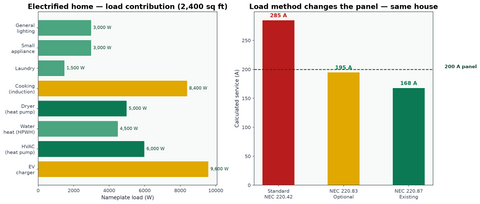
NEC 220 defines two methods for whole-house load: the Standard method (220.42-.55) and the Optional method (220.83, single-family dwellings only). For heat pump retrofits, the Optional method is usually the right tool.
Optional method (220.83) inputs:
- General lighting and receptacles: 3 VA per square foot.
- Small appliance branch circuits (kitchen): 1,500 VA each, min 2 circuits.
- Laundry: 1,500 VA.
- Fixed appliances (dishwasher, disposal, HPWH, etc.): nameplate rating.
- Range: 8 kW or nameplate.
- Heat pump: larger of heating or cooling load (do not double-count).
- Electric strip heat backup: 100% at nameplate.
- EV charger: 40 A continuous at 240 V = 9,600 VA.
Demand factors (220.83): First 10 kVA at 100%, remainder at 40%. Heat pump + backup is treated as the largest of heating/cooling, added to the general load and then demand-factored.
Worked example — 2,400 ft² home retrofit:
- General lighting/receptacles: 2,400 × 3 = 7,200 VA
- Small appliance (2 kitchen + 1 laundry): 4,500 VA
- Fixed appliances (DW, disposal, HPWH): 3,500 VA
- Range: 8,000 VA
- Heat pump (4-ton, 40A × 240V): 9,600 VA
- Strip heat backup (10 kW): 10,000 VA
- EV charger: 9,600 VA
- Subtotal: 52,400 VA
- First 10,000 VA at 100%: 10,000
- Remainder 42,400 VA at 40%: 16,960
- Total demand: 26,960 VA / 240 V = 112 A
A 100 A panel does not accept this load. A 200 A panel does, with 88 A of spare capacity — but you're at 56% loading, which is the sweet spot for panel longevity.
Heat pump outdoor units publish two numbers on the nameplate: Minimum Circuit Ampacity (MCA) and Maximum Overcurrent Protection (MOCP). These are the numbers you size to, not the FLA (full-load amps) alone.
MCA = (largest motor FLA × 1.25) + sum of other motor FLAs. This is what determines the conductor size.
MOCP = a manufacturer-computed number (usually 175% of largest motor FLA + other loads) that sets the maximum breaker size. Never exceed MOCP. Never use a fuse/breaker smaller than the manufacturer's minimum.
| Tonnage | MCA (typ) | MOCP (typ) | AWG copper (75°C) | Notes |
|---|---|---|---|---|
| 1.5 ton | 15 A | 20 A | 14 | Small mini-split condenser |
| 2 ton | 18 A | 25 A | 12 | Common ducted residential |
| 2.5 ton | 22 A | 30 A | 10 | Common ducted residential |
| 3 ton | 26 A | 35 A | 10 | Sweet spot for 3-BR |
| 3.5 ton | 30 A | 40 A | 8 | 4-BR mixed-load home |
| 4 ton | 35 A | 45 A | 8 | Large home / cold climate |
| 5 ton | 44 A | 60 A | 6 | Large / commercial |
| 6 ton | 55 A | 70 A | 4 | Light commercial VRF outdoor |
NEC recommends (but doesn't mandate) a 3% voltage drop limit for branch circuits and 5% total (feeder + branch). For heat pump outdoor units mounted 50+ feet from the panel, voltage drop can force you up a wire gauge even when ampacity allows the smaller conductor.
Voltage drop formula (single-phase 240 V): VD = (2 × K × I × L) / cmil, where K = 12.9 for copper, I = amps, L = one-way distance in feet, cmil = conductor circular mils.
Practical rule of thumb — 3% VD limit at 240 V (7.2 V drop):
- #12 AWG (6,530 cmil): 20 A × 45 ft one-way
- #10 AWG (10,380 cmil): 25 A × 60 ft one-way
- #8 AWG (16,510 cmil): 35 A × 75 ft one-way
- #6 AWG (26,240 cmil): 45 A × 100 ft one-way
PES portal's voltage-drop-calculator handles the math automatically — enter amps, run length, and target VD%, and it returns the required AWG.
Three triggers force a panel upgrade on a heat pump retrofit:
1. Load calculation exceeds panel busbar rating. If NEC 220.83 optional method returns more than 100 A on a 100 A panel or 200 A on a 200 A panel, the panel is undersized. Common failure mode on 100 A panels serving 1970s-1990s homes when adding a 4-ton heat pump + EV charger.
2. No available double-pole breaker space. Even if the calc clears, you need two adjacent single-pole slots for the outdoor unit breaker. Older FPE / Zinsco panels often have no available space (and should be replaced anyway for safety).
3. Service entrance conductors undersized. A 100 A panel with 4/0 aluminum SE conductors can technically be re-labeled as 200 A if the utility feed supports it — but most 100 A services have 2/0 or 4/0 aluminum SE, which is 100 A capacity. Upgrading the panel without upgrading the service is not code-compliant.
The 25C credit provides $600 for a panel upgrade when performed alongside a qualifying heat pump install. HEEHRA provides up to $4,000 for a service panel upgrade for income-qualified homeowners.
-
1
Perform NEC 220.83 load calc BEFORE quoting
Never quote a heat pump install without running the load calc. Overpromising 'your panel is fine' and then having to add a $3,000 panel upgrade at the last minute kills margin and referrals.
-
2
Read the heat pump nameplate MCA and MOCP
Do not assume based on tonnage — different manufacturers and different models vary. The nameplate on the outdoor unit is the source of truth.
-
3
Size conductor to MCA plus voltage drop check
Use the ampacity table (NEC 310.16 for 75°C copper) then run the voltage drop calc. Take the larger of the two.
-
4
Install breaker matching or below MOCP
Never exceed MOCP. Rounding up from a 24A MCA to a 30A breaker is fine if the MOCP is 30A or higher. Never round up past MOCP.
-
5
Verify GFCI/AFCI requirements per NEC 210.8, 210.12
NEC 2020 and 2023 expanded GFCI requirements for HVAC circuits in certain locations. Check local code adoption. Some jurisdictions require GFCI-protected outdoor disconnect.
The NEC 220.83 optional method load calc is the point where many heat pump quotes hit a fork. When the calc returns above the panel's busbar rating, the contractor has four options — and picking the right one is a real skill because two of them are code-compliant workarounds and two require actual panel work.
Option 1 — Full panel upgrade to 200 A. The cleanest solution. Utility upgrades the service drop and meter socket, contractor installs a new 200 A panel, all existing branch circuits are reterminated. Cost: $2,500-4,500 depending on service length and complexity. Time: full-day job with utility coordination. Best for: homes with active-service constraints, homes planning multiple electrification systems.
Option 2 — Sub-panel from existing panel. If the main panel busbar allows one more double-pole slot but the panel space is full, install a 100 A sub-panel from a 100 A double-pole in the main and terminate the heat pump circuit in the sub-panel. Cost: $800-1,500. Time: half-day job. Best for: homes where the main service capacity is fine but panel space is exhausted.
Option 3 — Load management device (LMD). A newer NEC 2020 option: install a UL-listed load management device (Span smart panel, Emporia Vue, Lumin) that dynamically sheds non-critical loads when the total demand would exceed panel capacity. Common example: LMD prevents the EV charger and heat pump from running simultaneously with the electric range. Cost: $400-2,500 depending on device sophistication. Best for: homes near but not exceeding panel capacity; homes where the homeowner accepts occasional load prioritization.
Option 4 — Downsize the heat pump. If the calc returns close to but not far above panel capacity, and the home's Manual J load is on the low side of the heat pump's tonnage range, a smaller (2.5-ton instead of 3-ton) heat pump can bring the calc under the panel limit. Cost: savings on the equipment. Best for: homes where the Manual J actually supports the smaller tonnage.
Practical rule: for retrofits where the panel is 5-10 A over capacity, load management or a smaller heat pump can defer the panel upgrade. For panels 15+ A over capacity, do the panel upgrade — it will pay for itself on future electrification work.
Heat pump outdoor units require equipment grounding conductors (EGC) sized per NEC 250.122 based on the overcurrent device (breaker) size, not the circuit ampacity. Common contractor mistake: sizing the EGC to match the phase conductors, which is often oversized (wasted copper) but sometimes undersized.
EGC size table (NEC 250.122 — copper):
- 15-20 A breaker → 14 AWG EGC
- 25-30 A breaker → 10 AWG EGC
- 35-40 A breaker → 10 AWG EGC
- 45-60 A breaker → 10 AWG EGC
- 70-100 A breaker → 8 AWG EGC
- 150 A breaker → 6 AWG EGC
Note that EGC size does not always match phase conductor size. On a 60 A breaker with #6 AWG phase conductors, the EGC per 250.122 is #10, not #6.
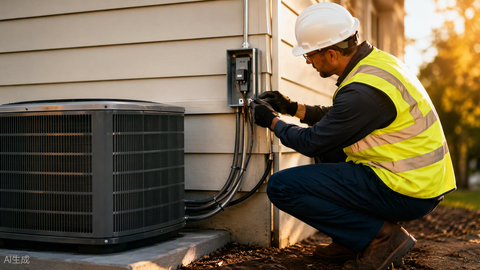
Bonding at the outdoor disconnect: NEC 250.32 requires that when a separate structure or a disconnect is fed by a feeder, the grounded conductor (neutral) and equipment grounding conductor be kept separate. The outdoor disconnect enclosure must be bonded to the equipment grounding conductor and NOT bonded to the neutral. This is a common inspection failure point.
Grounding electrode at the outdoor unit: Not required if the outdoor unit is a branch circuit device (not a separate structure feeder). Some jurisdictions still require a ground rod at the outdoor unit — check local code.
The indoor air handler and strip-heat backup are a separate circuit conversation from the outdoor unit. Two configurations are common:
Configuration A — Air handler and heat pump outdoor on separate circuits. Air handler has its own dedicated circuit (typically 15 or 20 A, 240 V for the blower motor and controls). Outdoor unit has its own MCA/MOCP-sized circuit. If strip heat backup is present, it may be a third dedicated circuit (typically 20-60 A depending on strip-heat kW).
Configuration B — Air handler and strip heat on a single high-amp circuit. When the strip heat is integrated into the air handler (e.g., a 5 kW or 10 kW resistance element in the air handler cabinet), the total draw is 20-45 A. Single 40-50 A double-pole circuit feeds the air handler and its integrated strip heat.
Strip-heat sizing rules of thumb:
- 3.4 kW strip heat = 14 A at 240 V — supplements a 3-ton heat pump at moderate cold-climate temperatures.
- 7.5 kW strip heat = 31 A at 240 V — supplements a 3.5-4 ton heat pump at cold-climate temperatures.
- 10 kW strip heat = 42 A at 240 V — provides full backup for a 4-ton heat pump (equivalent to ~34,000 BTU/hr of resistive heat).
- 15-20 kW strip heat = 60-83 A at 240 V — full home backup, typical for cold-climate configurations.
NEC 424.3 requires strip heat circuits to be sized at 125% of the connected load for continuous duty. A 10 kW strip heater with 42 A actual draw needs a 52.5 A minimum circuit ampacity — round up to a 60 A breaker with #6 AWG copper.
Line-set penetrations through walls and floors are a common inspection point that isn't strictly electrical but affects the install. NEC 300.4 requires physical protection of conductors passing through structures — this applies to the electrical conductor jacket that often runs alongside the refrigerant line-set from outdoor unit to indoor unit.
Best practice: route the branch circuit conductor separately from the refrigerant line-set, either through a dedicated conduit or through the same wall penetration with proper firestop. Common contractor shortcut: taping the electrical conductor to the outside of the line-set insulation. This works mechanically but is inspection-vulnerable — the conductor jacket must be rated for outdoor exposure or protected by conduit.
For long line-set runs (50+ ft), consider a dedicated conduit route for the electrical conductor. It adds 20-30 minutes of install time but eliminates a common failure mode: rodent damage to the conductor jacket. Rodents chew line-set insulation for the pecan-nut-textured foam, and the electrical conductor next to it often becomes collateral damage.
The panel-side calculations are easiest to internalize through worked examples. Below are four common scenarios covering the range of residential heat pump installs.
Example 1 — 2-ton mini-split, 100 A panel, 1,600 sq ft home.
- Manual J load: 24,000 BTU heating, 22,000 BTU cooling. 2-ton nominal chassis works.
- Outdoor unit: Mitsubishi MUZ-FS24, MCA 15A, MOCP 20A. Wire size: 14 AWG copper on 20A breaker.
- Indoor unit: 3 wall-mount heads, dedicated 15A/120V circuit for controls.
- Load calc: existing 100A panel carries range (40A), dryer (30A), water heater (30A), general lighting (20A demand-factored to 12A). Total existing demand: ~90A. Adding 15A heat pump = 105A total — over the 100A busbar rating.
- Decision: sub-panel from existing 60A range circuit? No — that circuit is dedicated. Better: 100A panel is at end of life anyway (typical for 1970s FPE panel), upgrade to 200A. $2,800 with utility upgrade included. HEEHRA covers most for income-qualified household.
Example 2 — 3-ton ducted heat pump, 200 A panel, 2,400 sq ft home.
- Manual J load: 42,000 BTU heating, 34,000 BTU cooling. 3-ton with variable-speed handles both.
- Outdoor unit: Carrier Infinity 24VNA6, MCA 26A, MOCP 35A. Wire size: 10 AWG copper on 35A breaker.
- Indoor unit: variable-speed air handler with 5kW strip heat backup. Air handler + strip heat draws 25A on a 30A double-pole circuit, 10 AWG copper.
- Existing panel: 200A, has room. Load calc clears at 145A total demand. Panel accepts new load.
- Total electrical work: 2 double-pole breakers, 60 ft of 10 AWG copper, 2 disconnects, one day of electrician labor. $1,200-1,500 electrical cost.
Example 3 — 4-ton cold-climate heat pump with EV charger, 200 A panel, 3,000 sq ft home.
- Manual J: 60,000 BTU heating design, 40,000 BTU cooling. 4-ton chassis with cold-climate variant.
- Outdoor: Mitsubishi PUZ-HA48, MCA 35A, MOCP 45A. Wire: 8 AWG copper on 45A breaker.
- Indoor: variable-speed air handler with 10kW strip heat. Air handler + strip heat: 45A on a 60A double-pole, 6 AWG copper.
- Existing electric: range 40A, dryer 30A, existing water heater (converting to HPWH, 20A circuit added), general lighting 15A demand. HPWH 20A. EV charger 48A hardwired on 60A breaker.
- Load calc: 40 + 30 + 20 + 15 + 45 + 60 = 210A un-diversified. Optional method with 10kVA at 100% and remainder at 40%: (10 + (50.4 - 10)*0.4)*240V/240V = 26.2 kVA / 240V = 109A. Panel accepts this comfortably.
- Panel space check: 4 double-pole slots needed (HP outdoor, air handler+strip, HPWH, EV charger). Verify panel has 8 available single-pole slots for these 4 double-pole breakers.
Example 4 — 5-ton commercial-style heat pump, 400 A service panel, 4,500 sq ft home.
- Manual J: 78,000 BTU heating, 55,000 BTU cooling. 5-ton with 2-stage compressor.
- Outdoor: Trane XV20i 5-ton, MCA 44A, MOCP 60A. Wire: 6 AWG copper on 60A breaker.
- Indoor: variable-speed air handler, 15kW strip heat. 65A total, 80A double-pole breaker, 4 AWG copper.
- 400A service handles the additional load comfortably.
- Complexity note: at this size the outdoor unit exceeds most local noise ordinances at the property line. Contractor should quote sound-dampening measures and possibly acoustic screening.
Coming Soon: PES Multi-Brand Heat Pump Distribution
PES is onboarding Carrier, Trane, Mitsubishi, Bosch, and Rheem heat pump lines. Register at axis.pesdistribution.com for early access — contractor pricing, freight quotes, and portal-only calculators the moment stock lands.
Register for Early AccessDo I need a load calc for every heat pump install?
Can I use MCA and skip the load calc?
What breaker size for a 3-ton heat pump?
Do heat pump circuits need GFCI protection?
How do I handle voltage drop on long runs?
Can I share a neutral between two heat pump circuits?
Does PES have a portal load calculator?
Open a PES Contractor Account — Reserve Heat Pump Access
Register at axis.pesdistribution.com for early heat-pump distribution access, trade pricing, and portal calculators.
Register Now