Complete Off-Grid Solar System Design Guide
Load audit, PV sizing, battery bank, inverter architecture, charge control, generator backup, and the wire between them — a distributor's step-by-step method for building a system that runs your house without a utility bill.

The single most common mistake in off-grid design is treating it as a grid-tie system with a battery bolted on. It is not. A grid-tie system exports and imports freely; the utility is an infinite battery that hides every sizing sin. Off-grid has no such forgiveness. If your PV array is undersized, you burn diesel. If your inverter is undersized, your well pump trips. If your battery bank is undersized, you cycle it to death in a season. Every component must be right, not just present.
PES Supply has been shipping direct-distributor off-grid gear for two decades — Sol-Ark 15K hybrids, OutBack Radian and FLEXpower prewired systems, Schneider Conext XW Pro, Magnum MS-PAE inverter/chargers, MidNite Classic charge controllers, Morningstar TriStar controllers, SimpliPhi PHI batteries, Fortress Power Avalon and eVault batteries, Rolls-Surrette flooded and gel banks, and MidNite Solar E-Panels. This guide is the design method we walk contractors and self-installers through when a rural customer calls asking for "a system to run my house." It is not marketing — it is the math and the parts list.
Off-grid design is a five-step sequence, and every step feeds the next. Skip one and the system fails in a way that costs $8,000–$40,000 to correct. Do all five in order, and the system runs for 20 years on the same battery bank if you specified lithium, or 8–12 years if you chose flooded lead-acid.
-
1
Audit real daily loads in kWh/day
Walk the house circuit by circuit. Every fixture, every appliance, every phantom draw. Record wattage × hours/day. Sum by season. Winter loads dominate in cold climates (well pumps run against frozen ground, furnace blowers run 18 hours). Summer loads dominate in cooling climates. Use the higher season. Add 15% contingency for measurement error and future loads. Result: two numbers, your winter kWh/day and summer kWh/day.
-
2
Size the PV array for the worst-solar-month
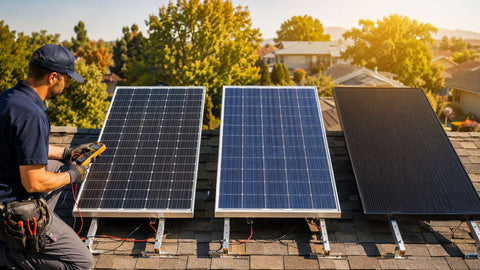
Not the annual average. The worst solar month for your latitude — typically December for northern homes. Use NREL PVWatts with fixed tilt = latitude + 15° for winter bias. Divide your winter daily kWh by that month's kWh/kW/day insolation and multiply by 1.4 for system derating (soiling, wire loss, inverter efficiency, battery cycling loss). That is your minimum kW-STC array. Round up. A 15 kWh/day winter load in Idaho becomes a 6.5–7 kW STC array.
-
3
Size the battery bank for 2-3 days of autonomy
Autonomy is how many cloudy days the bank carries you before the generator starts. Two days for lithium (LFP) at 90% DoD; three days if you can afford it. For lead-acid, size for 3 days at 50% DoD and expect faster aging. A 15 kWh/day load at 2 days LFP autonomy = 30 kWh usable = about 33 kWh nameplate. In real parts: 8× SimpliPhi PHI 3.8 (30.4 kWh) or 2× Fortress eVault MAX 18.5 (37 kWh) or 3× EG4 LL-S 15.36 (46 kWh raw).
-
4
Size the inverter for peak simultaneous load
Sum the largest three simultaneous loads: well pump surge (LRA on the pump nameplate, typically 4–7× running), refrigerator start, and one big load like a table saw or induction cooktop. Add a 25% margin. A well pump with 40 A LRA plus a 900 W fridge start plus 1,800 W induction is 40×240 + 900 + 1,800 = 12.3 kW instantaneous. That is a Sol-Ark 15K or an OutBack Radian GS8048A stacked to 16 kW. Do not pick a 6 kW inverter — you will nuisance-trip forever.
-
5
Add a generator sized to 2× the battery-recharge current
The generator's job is to recharge the bank fast during a multi-day storm, not to run the house. Size it so that at battery-charger max input current, the genset loads to 60–70% of its nameplate — that is where it burns fuel cleanest and lasts longest. A 15 kW inverter that can absorb 100 A of charge at 48 V (4.8 kW DC input, roughly 6 kW AC in) wants a 10–12 kW generator. Cummins RS17A, Generac Guardian 14 kW, or Kohler 14RESAL are the rural-home standard.
The single number that drives every other number in your design is kWh per day. Get this wrong and everything downstream is wrong. Most owner-installers guess. Most contractors use "rules of thumb" that overestimate by 60% (which sells more panels but wastes $10,000 on the customer). The right way is a spreadsheet, not a rule.
Walk every circuit in the house. For each device, record three things: nameplate watts (from the label or manual, not marketing copy), average hours per day of operation, and any duty cycle (a well pump is on 20% of the time it "runs"; a refrigerator's compressor is on 30–45% of every hour). Multiply watts × hours × duty and divide by 1,000. That is that device's kWh/day.
Sum everything. Then apply three corrections most audits miss. First, phantom loads: modems, routers, satellite receivers, chargers, garage door openers, freezer defrost cycles, water softener regenerations. These are 40–120 W around the clock and add 1.0–2.9 kWh/day silently. Second, seasonal swings: well pumps double their runtime in dry summers, furnace blowers run 20 hours/day at -20°F, and ceiling fans get replaced by A/C in July. Run the audit twice — once for January and once for July — and design to the worst case. Third, the appliance category you swore you were not going to add: dishwashers, dryers, EV chargers, hot tubs, workshops. If any of those appear in the next five years, size for them now.
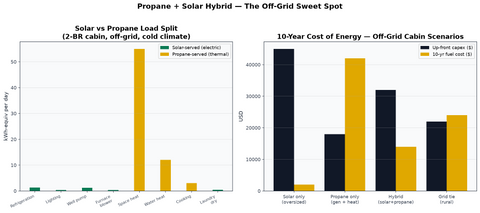
The chart at the top of this page shows two realistic homesteads. The frugal cabin runs a propane fridge, LP water heat, wood or propane space heat, and 4.5 kWh/day of electric loads. The full-comfort homestead is fully electrified — heat pump, resistive water heat, induction cooktop, washer, laptop, well pump — and lands at 24.8 kWh/day. Those are the two ends of the design envelope for rural off-grid homes; every real system lives somewhere between.
The mistake is annual-average kWh/kW/day figures. Off-grid systems are constrained by the worst month — the month where solar production is lowest and load is often highest. In northern Idaho, that month is December, and it delivers 2.4 kWh/kW/day, not the annual 4.8 kWh/kW/day. If you size to the annual number, your generator runs 200 hours a year instead of 40, and you pay for it in fuel and rebuild costs.
Use NREL PVWatts (nrel.gov/pvwatts) with these off-grid-specific settings: DC system size (start with a guess), module type "standard," array type "fixed (open rack)" or "fixed (roof-mount)," system losses at 14% default is fine, tilt at latitude + 15° for winter-biased production, azimuth 180° (true south) unless obstructions dictate otherwise. Run the report. Note the December kWh/kW/day figure. That is your worst-month insolation.
Now the design equation: PV kW-STC = (winter daily kWh × 1.4) / (worst-month insolation). The 1.4 multiplier is the off-grid derate — it accounts for battery round-trip losses (5–8%), MPPT charge controller efficiency (95%), wire losses (2%), soiling (3–5%), and the reality that on cloudy days you will get 20% of clear-sky output, not zero, so oversizing by 40% brings winter break-even close to real weather. In sunny climates like Arizona high desert, 1.25× is enough. In wet northwest climates, use 1.5×.
For a 15 kWh/day winter load in northern Idaho: 15 × 1.4 / 2.4 = 8.75 kW STC. Round to a real string count: 22× 400 W REC Alpha Pure or 20× 440 W Silfab Elite gets you 8.8–8.8 kW. That is the array. If you have snow country, size 15% higher — snow blocks panels for 20–40 days a winter unless you steep-tilt.
Battery choice is the largest capital line item and the most consequential design decision. Get it right and it lasts 15 years. Get it wrong and you replace it in 5, sometimes 3.
Chemistry. In 2026, lithium iron phosphate (LFP) is the correct answer for 95% of rural off-grid homes. It cycles 6,000+ times at 80–90% DoD, sits at partial state of charge without sulfation damage, tolerates -5°F to 130°F operating range on the good brands, and comes with a 10-year warranty from Fortress Power, SimpliPhi, and EG4. Lead-acid (flooded or AGM) is the correct answer only for two cases: (1) you need a bank that survives a 12-week off-season sit at 0% cycles with zero maintenance calls, and flooded is provably better at that, or (2) you are budget-constrained and cannot afford LFP capex, in which case a Rolls-Surrette S-1400 bank at 24 V or 48 V will run 8–10 years if you cycle it right.
Voltage. For any inverter above 3 kW, run 48 V DC. Lower voltages (12 V, 24 V) are only correct for RVs and micro-cabins with sub-1 kW loads. 48 V halves the DC current for the same power, which means smaller wire, smaller fuses, smaller busbars, and less resistive loss. A 6 kW inverter at 48 V pulls 140 A DC continuous; at 24 V it pulls 280 A, which requires 4/0 cable, 300 A class-T fuses, and Marathon studs. Every off-grid platform sold by Sol-Ark, EG4, OutBack, Schneider, Victron, MidNite, Fortress, SimpliPhi, and Discover assumes 48 V unless spec-noted.
Capacity. Size the usable bank as (daily kWh × autonomy days) / (DoD × round-trip efficiency). Example: 15 kWh/day × 2 days / (0.9 × 0.94) = 35.4 kWh usable. In LFP nameplate: 40 kWh. That is roughly 2× SimpliPhi PHI 3.8 stacks of 4 (30 kWh) plus a stub, or 2× Fortress eVault MAX 18.5 (37 kWh), or 4× EG4 LL-S 15.36 (61 kWh — the "next size up" step in modular LFP). In practice, LFP is priced per kWh so nudging up to the next parallel step is cheap and saves you a rebuild in year 8 when you add a workshop.
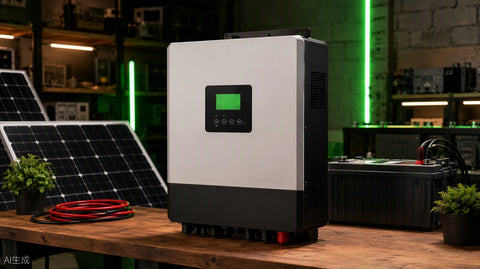
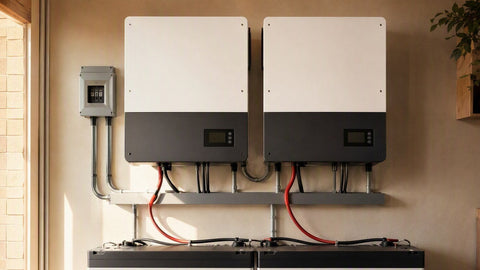
The inverter is the beating heart of an off-grid system. It has three simultaneous jobs: pass PV energy to the battery through its integrated charge controller (in hybrid inverters) or from a separate charge controller (in classic architectures), invert battery DC to 120/240 V split-phase AC for the house, and provide seamless transfer between battery, generator, and inverter loads when the generator kicks in. Pick the wrong one and every rural chore is a fight.
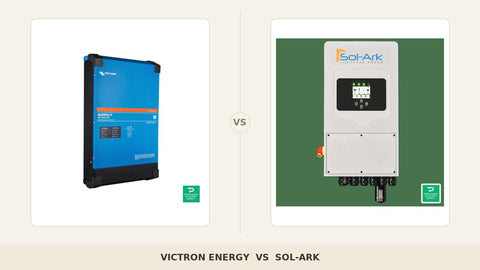
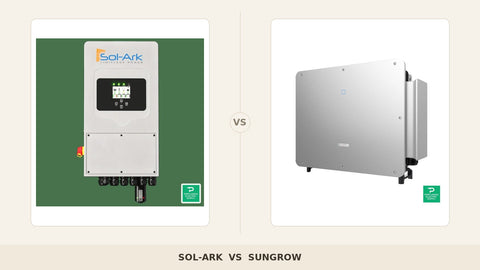
Architecture 1: All-in-one hybrid. Sol-Ark 12K and 15K, EG4 18kPV, EG4 12kPV, EG4 FlexBOSS21. One box, MPPT charge controller built in, 200 A generator input, split-phase 120/240 V output, cellular monitoring standard. This is the modern default. Fewer boxes, faster install, one warranty. The Sol-Ark 15K-2P at $5,750 is the single most-shipped off-grid inverter in the PES catalog for whole-home installs.
Architecture 2: Stackable modular. OutBack Radian GS8048A stacked, Schneider Conext XW PRO 6848, Magnum MS4448PAE stacked. Two or three units in parallel give you 12–24 kW continuous, N-1 redundancy (one fails, the others carry), and the ability to grow the system without a total inverter swap. The OutBack Radian GS7048E at $5,319 is the workhorse for cold-climate systems where reliability trumps a nice app.
Architecture 3: Prewired system. OutBack FLEXpower and MidNite E-Panel prewired systems. The inverter, charge controller(s), transfer switch, DC and AC disconnects, battery combiner, and monitoring come on a single steel back-plate that you hang on the wall and connect three wires to. FLEXpower TWO 7.0 kW at $8,428 or FLEXpower 12 kW at $17,047. Contractors love these because they cut two days off a site install and the wiring is factory-verified.
Peak-load sizing. Add the three largest simultaneous starting loads. For most rural homes: well pump LRA (locked rotor amps — check the pump nameplate) + refrigerator start (2× running) + one large motor load like a shop compressor or table saw. A 3/4 HP submersible well pump has an LRA of about 40 A at 240 V, or 9.6 kVA momentary. A refrigerator adds 900 W momentary. A 1.5 HP compressor adds 4.4 kVA. Sum: 14.9 kVA momentary. A Sol-Ark 15K peak is 22 kVA for 10 seconds — comfortable. A 6 kW inverter would trip.
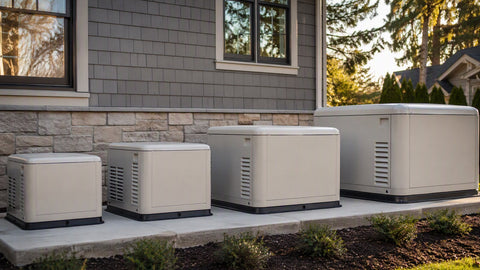
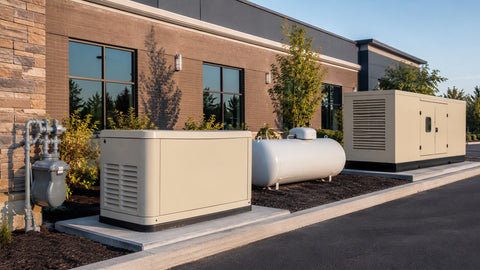
Every off-grid system needs a generator. The reason is not power — the reason is time. During a 4-day cloud stretch in December, your PV array delivers 25% of nameplate. Even a huge array cannot refill the battery. The generator's job is to burn 30 gallons of propane once a week and top the bank in 3 hours, then shut off. It is not a house-running generator; it is a battery charger with a diesel motor attached.
Size the generator to match the inverter's charge input, not the house load. A Sol-Ark 15K accepts up to 200 A AC on its generator input, which is 48 kVA — but you never need to feed it that. You need to feed it enough to hit the battery-charger max current, typically 100–140 A DC at 48 V, which is about 6–8 kW AC input. Sizing the generator at 12–14 kW gives you 50–65% loading — the sweet spot for diesel and propane engines.
Fuel choice. For rural off-grid, propane wins. Diesel has more energy per gallon but requires monthly exercise, gels in cold weather, and has a 12–18 month fuel-storage life without additives. Propane stores indefinitely, exercises itself cleanly, has no cold-weather issues down to -40°F, and can share a tank with your water heater, cook range, and space heat. A 500-gallon propane tank runs a Kohler 20RCA at 50% load for 92 hours — three storm cycles. The Kohler 20RCA at $8,000-class pricing or Cummins RS17A at $5,167 are the rural-home benchmarks. Champion 201319 4,500W dual-fuel inverter generator at $739 is the budget backup for cabins.
Auto-start and transfer. The inverter watches battery state-of-charge. When SoC drops below a threshold (typically 40%), the inverter closes a dry-contact relay that fires the generator's two-wire auto-start. The generator warms for 60 seconds, the inverter transfers loads to generator power, feeds the battery charger from the AC input, and runs until SoC hits an upper limit (typically 90%). Then it shuts off. All Sol-Ark, EG4, OutBack, Schneider, and Magnum inverters ship this feature standard. Wire the AGS (auto-generator-start) two-conductor cable from the inverter to the generator control board and it works out of the box.
| Model | Continuous kW | Peak kVA (10s) | MPPTs / Ampers | Gen input | Approx PES price |
|---|---|---|---|---|---|
| Sol-Ark 15K-2P | 15 kW split-phase | 22 kVA | 3 × 195 V / 500 VDC | 200 A AC | $5,750 |
| Sol-Ark 30K 3-Phase | 30 kW 208/240 V | 45 kVA | 3 × 195 V / 500 VDC | 200 A AC | $11,125 |
| EG4 18kPV | 18 kW split-phase | 27 kVA | 3 × 500 VDC | 200 A AC | $3,999 |
| EG4 12kPV | 12 kW split-phase | 18 kVA | 2 × 500 VDC | 150 A AC | $2,999 |
| EG4 FlexBOSS21 | 16 kW split-phase | 24 kVA | 3 × 500 VDC | 180 A AC | $3,599 |
| OutBack Radian GS8048A | 8 kW × N stack | 13 kVA per unit | External FM80/100 | 60 A per unit | ~$5,300 |
| Schneider XW PRO 6848 | 6.8 kW × N stack | 12 kVA per unit | External MPPT 60/80 | 60 A per unit | $3,299 |
| Magnum MS4448PAE | 4.4 kW × N stack | 8.8 kVA per unit | External PT-100 MPPT | 60 A per unit | $2,500 |
| Growatt SPF 5000ES | 5 kW off-grid only | 10 kVA | Built-in 100 A MPPT | 60 A AC | $1,500 |
Below is the head-to-head we walk customers through. LFP wins on 20-year total cost of ownership by a wide margin, but flooded lead-acid still has a role in specific edge cases — remote hunting camps that sit dead 8 months a year, cost-constrained first-build systems, and installations in ambient temperatures where LFP has to be climate-controlled.
| Bank configuration | Chemistry | Usable kWh | Cycle life | Warranty | Approx capex |
|---|---|---|---|---|---|
| 2× Fortress eVault MAX 18.5 | LFP high-V | 36 kWh usable | 6,000 @ 80% DoD | 10 yr | $28,000–$32,000 |
| 8× SimpliPhi PHI 3.8 | LFP low-V | 30.4 kWh @ 90% DoD | 5,000 @ 80% DoD | 10 yr | $26,000–$30,000 |
| 4× EG4 LL-S 15.36 (LiFePO4) | LFP low-V rack | 55 kWh @ 90% DoD | 8,000 @ 80% DoD | 10 yr | $18,000–$22,000 |
| Fortress Power Avalon HV Pro 14.7 + 7.6 inverter bundle | LFP + inverter | 14.7 kWh @ 90% DoD | 6,000 @ 80% DoD | 12 yr | $15,700 |
| 24× Rolls S-550 (48V bank) | Flooded lead-acid | 23 kWh @ 50% DoD | 1,500 cycles | 7 yr prorated | $14,000–$16,000 |
| 8× Trojan L16RE-2V (48V bank) | Flooded lead-acid | 20 kWh @ 50% DoD | 1,600 cycles | 5 yr prorated | $6,000–$7,500 |
| 16× Concorde Sun Xtender PVX-1080T | AGM sealed | 18 kWh @ 50% DoD | 1,200 cycles | 5 yr prorated | $10,000–$12,000 |
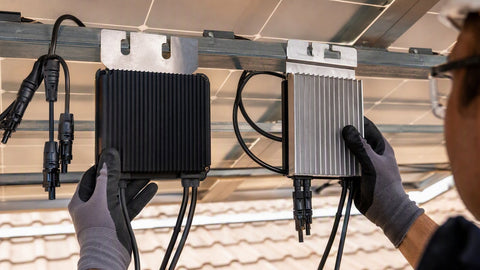
If you chose a hybrid inverter (Sol-Ark, EG4, Schneider XW PRO, OutBack SkyBox), the charge controller is inside the inverter — you skip this section. If you chose a modular stack architecture (OutBack Radian + FM80s, Magnum MS + PT-100s, or a legacy setup), you size a separate MPPT charge controller here.
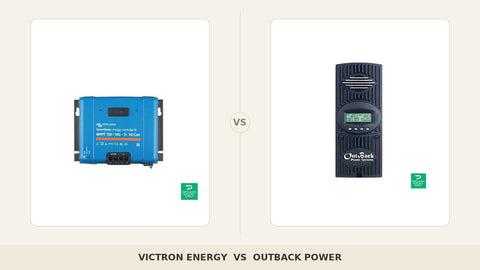
MPPT vs PWM. Always MPPT for arrays above 400 W. PWM controllers were the standard 15 years ago when solar modules matched battery bank voltages; today's 60-cell modules run at 30–41 V open-circuit and modern MPPT controllers "boost" that to 60-cell strings running at 400 V DC, dramatically reducing wire cost. PWM controllers waste 20–30% of your PV production if the module Vmp is above battery voltage. MidNite Solar Classic 150, 200, and 250 series controllers, MidNite KID, Morningstar TriStar MPPT-60, TriStar MPPT-45, Victron SmartSolar 250/100-MC4, and OutBack FLEXmax 80 and 100 are the direct-distributor MPPT staples. Prices range from $220 (Morningstar TS-45) to $835 (Victron 250/100 VE.Can).
Sizing. The controller must handle the array's max power point current with margin. A 6 kW array at 48 V battery output is 125 A DC — you need a 150 A controller or two 80 A controllers in parallel. A MidNite Classic 200 handles 79 A output at 48 V; a Classic 250 handles 94 A. For our 8.75 kW array example, that is 182 A max — two Classic 200s in parallel, or one Sol-Ark 15K internal 3× MPPT with each string on its own MPPT.
How much does a whole-home off-grid solar system cost in 2026?
How long do lithium (LFP) batteries last off-grid?
Do I need a generator if I have enough solar and battery?
Sol-Ark vs EG4 vs OutBack Radian — which off-grid inverter should I buy?
Can I do a hybrid grid-tie + off-grid capable system?
What is the biggest sizing mistake homeowners make?
Does hail damage solar panels on a rural install?
What NEC code sections govern off-grid installations?
Register for the Axis Distributor Portal
Trade pricing on Sol-Ark, EG4, OutBack, Schneider, Magnum, MidNite, Fortress, SimpliPhi, and Rolls-Surrette off-grid inventory. Freight quotes, string sizing, and battery/inverter compatibility on demand.
Register Now