Ask ten homeowners how many watts it takes to run their house and you'll get ten shrugs. Ask the same question after a three-day outage and every one of them can tell you exactly which breaker fed the fridge. I've sized backup systems for cabins in the Cascades and 4,000-square-foot new builds with dual heat pumps, and the math always starts the same way: an honest load inventory. This guide gives you the real numbers — running watts, starting surge, NEC load calculations, and worked examples — so you can size a generator, inverter, or solar-plus-storage system without guessing.
Your Quick Guide to Home Wattage Needs
Most homes don't run on a single number. They run on two: the continuous load (what everything draws while it's running) and the surge load (the two-to-five-second kick when motors start). A system that covers the first but not the second will trip its breaker the moment your well pump and refrigerator decide to start at the same time. We've watched undersized inverters fault out over and over in the field, and nine times out of ten the culprit is a compressor that nobody counted.
Typical Home Wattage Requirements at a Glance
| Home Size | Typical Continuous Watts | Estimated Surge Watts (Peak) | Primary Use Case & Target Audience |
|---|---|---|---|
| Small Home / Cabin | 2,000–4,000 W | 4,000–6,000 W | For Homeowners: Powering essentials like a refrigerator, lights, and a few outlets via a critical loads sub-panel. |
| Medium Home (1,500–2,500 sq ft) | 5,000–7,500 W | 8,000–12,000 W | For Installers: Sizing for whole-home backup, including HVAC, kitchen appliances, and well pump. |
| Large Home (2,500+ sq ft) | 7,500–12,000+ W | 12,000–20,000+ W | For Developers & EPCs: Powering large homes with multiple AC units, an EV charger, and other high-demand appliances. |
| All-Electric Home w/ EV + Heat Pump | 12,000–18,000 W | 20,000–28,000 W | For Off-Grid Builders: Full electrification loads requiring stacked inverters or a 22 kW+ standby unit. |
Treat these as brackets, not answers. Two homes with identical square footage can sit 5 kW apart once you account for a hot tub, a shop welder, or a second refrigerator in the garage.
Watts vs. Watt-Hours: Getting This Right is Non-Negotiable
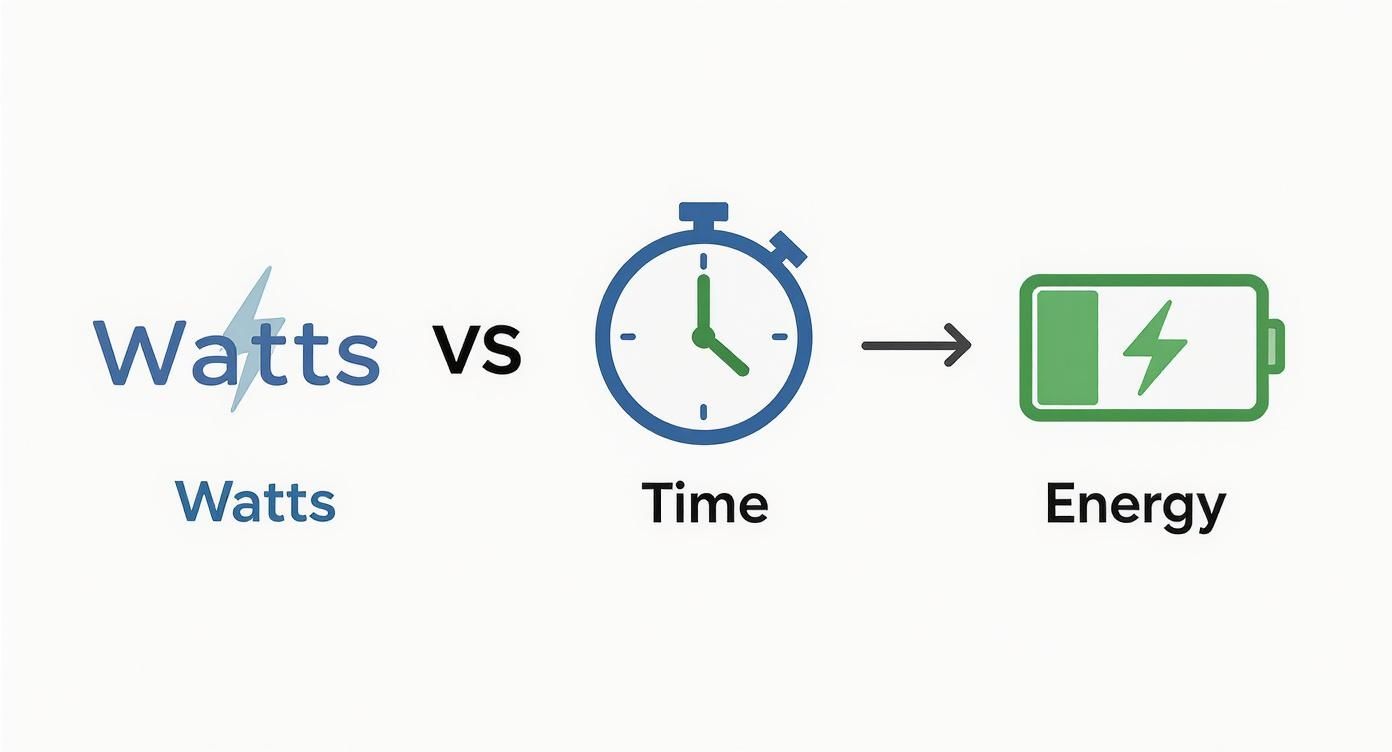
Watts measure instantaneous demand — how hard your house is pulling right now. Watt-hours measure consumption over time — how much total energy you burned. Your utility bills you in kilowatt-hours (kWh). Your generator and inverter are rated in watts. Confusing the two is how people end up with a 5 kW inverter feeding a house that needs 9 kW at dinnertime.
The conversion is simple: watts × hours = watt-hours. A 1,000 W microwave running six minutes consumes 100 Wh. A 40 W LED left on all night consumes about 400 Wh. When we audit a home for an off-grid build, we log both numbers — the peak simultaneous watts for inverter sizing and the daily kWh for battery and array sizing.
Why This Spells Success or Failure for Your Project
Undersize the wattage and your system trips offline during the exact moment you need it. Undersize the watt-hours and your batteries hit cutoff at 2 a.m. on night two of an outage. Both failures are math failures, not equipment failures, and both are avoidable with the tables below.
A Quick Look at Average Home Energy Use
The U.S. Energy Information Administration puts the average American home at roughly 10,500 kWh per year — about 29 kWh per day, or an average continuous draw near 1,200 W. That average is misleading for sizing, though. Nobody's house draws a flat 1,200 W. Real homes idle at 300–600 W overnight and spike past 8,000 W when the AC, dryer, and water heater stack up. Size for the peaks and the simultaneity, not the average.
How to Calculate Your Home's Exact Power Needs
Here is the five-step process we run on every site survey before quoting a standby generator or an inverter-based backup system. It takes about an hour with a notepad and your appliance nameplates.
Step 1: Inventory Your Appliances (The Energy Audit)
Walk the house. Write down everything with a plug or a hardwired connection that you actually want running during an outage. Split the list into two columns: essential (refrigerator, furnace blower, well pump, medical devices, some lights, internet) and nice-to-have (dryer, hot tub, second freezer, EV charger). That split determines whether you're building a critical-loads system or a whole-home system, and it can cut your required wattage in half.
Step 2: Find Running and Starting Watts
Every appliance has a nameplate — a metal tag or sticker listing volts and amps, sometimes watts directly. If it only shows amps, multiply by volts: a 120 V device pulling 5 A runs at 600 W. Motor-driven appliances (anything with a compressor or pump) also have a locked-rotor starting surge, typically two to three times running watts for modern equipment and up to five times for older motors.
Common Appliance Wattage and Surge Demand
| Appliance | Typical Running Watts | Typical Starting/Surge Watts |
|---|---|---|
| Refrigerator/Freezer | 700 W | 2,200 W |
| Central Air Conditioner (3 ton) | 3,500 W | 5,000 W |
| Window AC Unit (10k BTU) | 1,200 W | 1,800 W |
| Heat Pump (3 ton, heating) | 4,500 W | 6,000 W |
| Furnace Blower (1/2 HP) | 800 W | 2,350 W |
| Sump Pump (1/2 HP) | 1,050 W | 2,150 W |
| Well Pump (1/3 HP) | 750 W | 1,500 W |
| Well Pump (1 HP) | 2,000 W | 4,000 W |
| Electric Water Heater | 4,500 W | 4,500 W |
| Electric Range/Oven | 2,000–5,000 W | N/A |
| Microwave (1000 W class) | 1,000 W | N/A |
| Electric Clothes Dryer | 5,400 W | 6,750 W |
| Washing Machine | 500 W | 1,150 W |
| Dishwasher | 1,200 W | 1,800 W |
| Coffee Maker | 1,000 W | N/A |
| EV Charger (Level 2, 32 A) | 7,680 W | 7,680 W |
| Desktop Computer + Monitor | 300 W | 500 W |
| LED Lighting (whole house, 25 bulbs) | 250 W | 250 W |
| Wi-Fi Router + Modem | 20 W | 20 W |
| Garage Door Opener (1/2 HP) | 875 W | 2,350 W |
One field trick I've used for years: a plug-in kilowatt meter on the fridge and freezer for 48 hours tells you their real duty cycle — usually 30–40% — which matters far more for battery sizing than the nameplate number. For hardwired 240 V loads like the well pump, a clamp meter on one leg at the disconnect gives you the actual running amps in about thirty seconds.
Step 3: Calculate Your Total Load
Add up the running watts of everything you expect to operate at the same time. Then identify the single largest motor load and add its surge on top — that's your peak requirement. The NEC offers a formal version of this in Article 220.83 (the optional method for existing dwellings), which applies demand factors instead of summing nameplates, because nobody runs every appliance simultaneously.
Worked Example: NEC 220.83 Optional Calculation for a 2,000 sq ft All-Electric Home
| Load Item | Nameplate / Calculated VA | Demand Factor Applied | Demand VA |
|---|---|---|---|
| General lighting & receptacles (3 VA/sq ft × 2,000) | 6,000 VA | First 10 kVA at 100%; remainder at 40% | 10,000 + (13,500 − 10,000) × 0.40 = 11,400 VA |
| Small-appliance circuits (2 × 1,500 VA) | 3,000 VA | ||
| Laundry circuit | 1,500 VA | ||
| Electric range (8 kW nameplate) | 8,000 VA | 40% (bundled above) | Included above |
| Electric water heater | 4,500 VA | 100% if not bundled; here at 40% | Included above |
| Heat pump (larger of heat/AC) | 4,500 VA | 100% | 4,500 VA |
| EV charger (7.7 kW) | 7,700 VA | 100% if unmanaged | 7,700 VA |
| Total calculated service load | — | — | ≈ 23,600 VA (23.6 kW) |
That 23.6 kW result is why all-electric homes with EVs land in 100–125 A service upgrade territory, and why their backup systems need serious capacity — or a load-management strategy that sheds the EV charger and water heater during outages.
Hidden Cost/Compliance Watchout: The Hidden Loads
The loads that blow up sizing jobs are the ones nobody lists: the septic aerator running 24/7, the basement dehumidifier, the pellet stove auger, the heated gutters, the server rack in the home office. We once found 900 W of continuous draw in a "small cabin" from a single crawl-space heat tape circuit the owner forgot existed. NEC 220.87 lets you use actual metered peak demand data from the utility instead of a calculated estimate — if you can get 12 months of interval data, it is the most honest number you can put on a permit application.
Sizing Your Generator and Solar System Correctly

Translating Watts to Generators
Generator ratings come in two flavors: running (rated) watts and starting (surge) watts. You need your total running load under the first number and your peak with motor surge under the second. Then add 20–25% headroom — running a generator pinned at 100% of rating shortens its life and leaves no room for the load you forgot.
Generator Sizing by Load Profile (Worked Math)
| Load Profile | Simultaneous Running Load | Largest Motor Surge Added | Peak Requirement | × 1.25 Headroom | Recommended Generator |
|---|---|---|---|---|---|
| Essentials only: fridge, furnace blower, lights, Wi-Fi, sump pump | 2,475 W | Sump pump +1,100 W | ≈ 3,575 W | ≈ 4,470 W | 5,000–7,500 W portable or 10 kW standby |
| Medium home, no central AC: essentials + well pump + kitchen | 5,200 W | Well pump +1,500 W | ≈ 6,700 W | ≈ 8,375 W | 10–14 kW standby |
| Whole home with 3-ton central AC | 8,500 W | AC compressor +1,500 W (soft-start) | ≈ 10,000 W | ≈ 12,500 W | 14–18 kW standby |
| Large home, two AC units, EV charger managed | 14,000 W | Second AC +2,000 W | ≈ 16,000 W | ≈ 20,000 W | 22–26 kW standby |
A soft-start kit on the AC compressor is the cheapest wattage you'll ever buy — it typically cuts starting current by 60–70% and can move you down an entire generator size. Browse our generator lineup or the Generac standby series once you have your number, and read our generator sizing walkthrough for the transfer-switch side of the equation.
Sizing for Solar and Battery Storage
Solar sizing flips the question. Instead of "what's my peak," the array cares about daily energy (kWh) and your local peak sun hours. The inverter still cares about peak watts. Battery capacity cares about both — total kWh stored and continuous inverter output.
Solar + Battery Sizing by Daily Consumption (Assuming 4.5 Peak Sun Hours, 80% Battery DoD)
| Daily Usage | Required Array (kW DC) | Inverter Size (Continuous) | Battery Bank (Usable kWh) | Example Kit |
|---|---|---|---|---|
| 10 kWh (cabin, efficient home) | ≈ 2.5–3 kW | 4–6 kW | ≈ 12.5 kWh nominal | 5 kW solar kit |
| 20 kWh (average home, essentials + more) | ≈ 5–6 kW | 6–8 kW | ≈ 25 kWh nominal | 10 kW solar + battery kit |
| 30 kWh (US average) | ≈ 7.5–8.5 kW | 8–12 kW | ≈ 37.5 kWh nominal | Stacked hybrid inverters + EG4 battery rack |
| 45+ kWh (large all-electric home) | ≈ 11–13 kW | 12–15 kW+ | ≈ 56+ kWh nominal | Custom design — run the system calculator |
The math checks like this: 30 kWh per day ÷ 4.5 sun hours = 6.7 kW of ideal production, ÷ 0.80 system derate (temperature, wiring, inverter losses, soiling) ≈ 8.3 kW of nameplate array. On the battery side, 30 kWh ÷ 0.80 depth of discharge = 37.5 kWh nominal. I tell every customer the same thing on the first call: round the battery up, not the array. Panels are cheap per watt now; storage is where undersizing hurts. Our battery sizing calculator runs this math with your own numbers, and the battery buyer's guide explains why LiFePO4 banks like the lithium lineup tolerate deeper cycling than anything lead-acid ever offered.
The Importance of Expert Verification
DIY the audit, then have a licensed electrician verify before you pull permits. NEC 220 load calculations, 705 interconnection rules for solar, and 702 requirements for standby systems all interact, and your AHJ (authority having jurisdiction) will check. Our NEC compliance guide covers the articles that come up most on inspections, and our power-consumption calculation guide goes deeper on metering individual circuits.
Real-World Sizing Scenarios for Different Homes
Scenario 1: The Small Home with an Essentials-Only Backup Plan
A 1,100 sq ft home in the foothills: fridge (700 W), furnace blower (800 W), ten LED bulbs (100 W), Wi-Fi (20 W), laptop (65 W), and a 1/2 HP sump pump (1,050 W running). Simultaneous running load: 2,735 W. Largest surge: the sump pump at 2,150 W, adding roughly 1,100 W over its running draw. Peak: ≈ 3,835 W. With 25% headroom, that's 4,800 W — a 5 kW inverter or a compact 7.5 kW generator covers it comfortably. Daily energy for this load profile runs about 8–10 kWh, so a single 5 kWh EG4-class battery gets through a long evening, and two of them get through the night.
Scenario 2: The Medium Family Home Aiming for Whole-Home Backup
A 2,200 sq ft home with natural gas heat and water (a huge break for the electric budget) but a 3-ton AC, electric dryer, and a 1 HP well pump. Simultaneous running load lands around 6,500 W on a summer evening; the well pump surge pushes the peak to roughly 8,500 W. Add headroom: 10.6 kW. A 12–14 kW standby generator or a pair of stacked 6 kW hybrid inverters handles it. Daily summer consumption with AC runs 30–40 kWh, so true whole-home solar backup wants a 9–10 kW array and 30+ kWh of storage — this is the classic 10 kW kit territory, and our whole-house solar analysis walks through whether your roof can hold it.
Scenario 3: The Large Modern Home with High-Draw Appliances
A 3,800 sq ft all-electric new build: two heat pumps, induction range, heat-pump water heater, and a 40 A EV charger. The NEC 220.83 calc from the table above lands near 24 kW of service load. Realistic simultaneous peak is closer to 14–16 kW because of diversity, but you must respect surge stacking. This home gets a 22–26 kW standby generator with a 200 A service-rated transfer switch (see the service-rated ATS options for the sub-panel style), or a 15 kW inverter stack with aggressive load management that locks out the EV charger and one compressor leg during outages. After fifteen years of spec'ing these systems, my rule hasn't changed: in an all-electric house, load management is not optional equipment — it's the difference between a 12 kW system and a 20 kW invoice.
Your Top Questions About Home Power Sizing, Answered
Can I Just Use My Utility Bill to Figure Out My Wattage Needs?
Partially. Your bill gives you kWh — great for sizing solar arrays and batteries, useless for peak watts. A home using 1,000 kWh a month might peak at 4 kW or 14 kW. Ask your utility for 12 months of interval (green button) data, or install a whole-home energy monitor for a few weeks before you buy anything.
What's the Big Deal If I Undersize My Generator or Inverter?
The system trips on overload during the highest-demand moment — usually when a motor starts while everything else is running. Repeated overload faults stress inverter components, and chronic overloading on a generator glazes cylinders and shortens engine life. A 25% headroom margin is cheap insurance.
Do I Really Need to Power My Entire House During an Outage?
No, and most people shouldn't try. A critical-loads sub-panel covering the fridge, heating blower, well, some lights, and communications typically needs 40–50% of whole-home capacity. That halves your generator size, your battery bank, and your budget.
How Does Adding an EV Charger Change My Calculations?
Dramatically. A 32 A Level 2 charger is a continuous 7.7 kW load — bigger than most central AC units — and the NEC counts it at 100% demand with no diversity allowance. Either size for it, install a managed charger that throttles during outages, or accept that the car stays parked during grid-down events.
How Many Watts Does a House Use Per Day on Average?
The EIA average is about 29 kWh daily, which averages 1,200 W continuously — but efficient small homes run 10–15 kWh/day and all-electric homes with EVs can exceed 60 kWh/day. Your own interval data beats any national average.
What Size Inverter Do I Need If I Already Know My Peak Load?
Take your peak simultaneous load (including the largest motor surge), multiply by 1.25, and choose the next inverter size up. A 6 kW peak wants an 8 kW-class inverter. Our inverter sizing calculator and inverter buyer's guide cover surge ratings and topology choices, and the solar inverter collection is organized by output class.