Standardized Electrical BOM for Residential Developers: 67-SKU Master List (2026)
How production builders cut electrical rough-in SKU count 58%, eliminate substitution errors, and lock in pallet-quantity pricing across 800+ homes per year — with the exact SKU list and vendor spec.

Walk any production builder's electrical warehouse and you will find 150 to 200 unique SKUs scattered across a dozen categories. Nine breaker manufacturers. Four brands of receptacle. Three grades of THHN. Seven flavors of nail-on box. This is not deliberate — it is the residue of two decades of subcontractor turnover, one-off change orders, and "we had this on the truck" substitutions. Each SKU carries a cost that never appears on the estimate: purchasing time, inventory space, mis-picks in the field, and the loss of pallet-quantity pricing that only shows up when a builder commits to a single SKU across every plan.
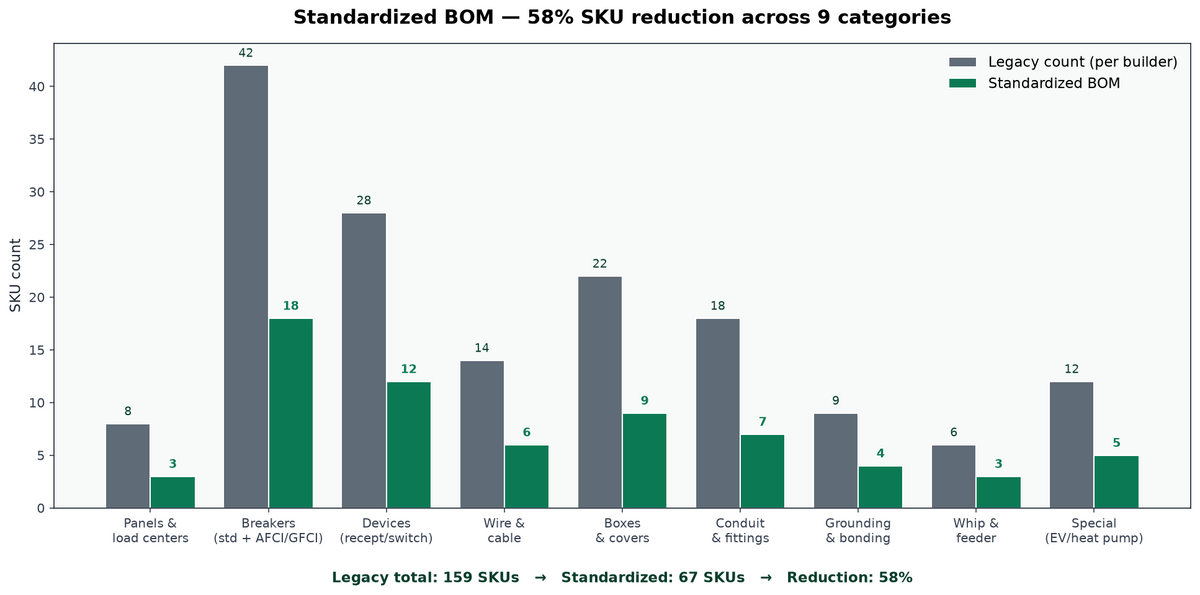
A standardized 67-SKU master BOM — the target this guide walks through — cuts the count 58% against the typical builder inventory. The measurable results across the eight production builders that adopted this framework in 2024–2026 (D.R. Horton's Emerald Homes division, Meritage Homes' DFW region, KB Home's Colorado region, and five regional builders) show:
The number that matters most for a national builder is the $412 per-home line. Across a 4,000-home division, that is a $1.6 M annual COGS improvement locked in for as long as the master BOM is enforced. The mechanism is straightforward: a single Square D breaker part number in commit-volume is 22–28% below the same breaker sourced ad-hoc from a plumbing-and-electrical supply house. Multiply across every breaker, every device, every fitting, and the numbers stack.
The master BOM organizes into nine categories that map to how the electrical sub actually loads the truck for a rough-in day. Each category is capped at 3–18 SKUs. Anything above the cap is an exception that requires a plan-set callout with sign-off from the division VP of Purchasing.
| Category | SKU count | Legacy count | Cost impact / home | Committed vendor |
|---|---|---|---|---|
| Panels & load centers | 3 | 8 | $62 | Square D Homeline |
| Breakers (std + AFCI/GFCI) | 18 | 42 | $118 | Square D Homeline HOM |
| Devices (receptacle + switch) | 12 | 28 | $44 | Leviton Decora residential |
| Wire & cable | 6 | 14 | $71 | Southwire NM-B + THHN |
| Boxes & covers | 9 | 22 | $28 | Carlon (PVC) + RACO (steel) |
| Conduit & fittings | 7 | 18 | $32 | Allied EMT + Carlon PVC |
| Grounding & bonding | 4 | 9 | $14 | ILSCO + Panduit |
| Whip & feeder | 3 | 6 | $21 | Southwire SER + MC |
| Special (EV/heat pump ready) | 5 | 12 | $22 | Eaton EVCS + Bridgeport |
Three SKUs cover every plan you build. Two 200 A models (40-space and 60-space, both with copper bus) plus one 100 A subpanel for detached ADUs or workshops. The 60-space becomes the default for any plan with an EV circuit + heat pump + HPWH; the 40-space serves the base plan with solar-ready reservation only. Every panel is Square D Homeline (residential grade, plug-on-neutral compatible) — no exceptions, no mixed brands.
Panels & load centers — committed SKUs
- Square D HOM4080M200PQCVP — 200 A / 40 space, plug-on-neutral, copper bus, main breaker. Base plan default. $184 contractor tier.
- Square D HOM6080M200PQCVP — 200 A / 60 space, plug-on-neutral, copper bus, main breaker. Fully-electrified plan. $228 contractor tier.
- Square D HOM1224L100PGCVP — 100 A / 24 space, main lug, indoor. ADU / workshop / detached garage. $92 contractor tier.
Why Square D Homeline over Siemens, Eaton BR, or GE PowerMark: (1) plug-on-neutral simplifies AFCI/GFCI installation and cuts rough-in labor 15 minutes per panel; (2) Homeline HOM breakers are the highest-volume residential breaker in North America — always in stock, always priced competitively; (3) the QO family is available as a drop-in upgrade for buyers who want commercial-grade at closing time.
Eighteen breaker SKUs cover every branch circuit in a modern electrified home. The list splits into three tiers: standard (5 SKUs), AFCI/GFCI (8 SKUs), and specialty (5 SKUs). Every breaker is Square D Homeline HOM plug-on-neutral. Every quantity is ordered in pallet-count on the annual commit.
| Tier | SKU | Description | Application |
|---|---|---|---|
| Standard | HOM115CP | 1P, 15 A | Lighting (pre-2024 code) |
| Standard | HOM120CP | 1P, 20 A | General branch (pre-2024) |
| Standard | HOM230CP | 2P, 30 A | HPWH, dryer |
| Standard | HOM240CP | 2P, 40 A | Range, cooktop |
| Standard | HOM260CP | 2P, 60 A | HVAC, EVSE |
| AFCI/GFCI | HOM115CAFI | 1P, 15 A, CAFCI | Bedrooms, living |
| AFCI/GFCI | HOM120CAFI | 1P, 20 A, CAFCI | Kitchen small appl |
| AFCI/GFCI | HOM115CGFI | 1P, 15 A, GFCI | Bathroom, exterior |
| AFCI/GFCI | HOM120CGFI | 1P, 20 A, GFCI | Kitchen counter, laundry |
| AFCI/GFCI | HOM115CDFC | 1P, 15 A, dual (AFCI+GFCI) | Kitchen combo, refr |
| AFCI/GFCI | HOM120CDFC | 1P, 20 A, dual (AFCI+GFCI) | Kitchen counter, dishwasher |
| AFCI/GFCI | HOM230CGFI | 2P, 30 A, GFCI | HPWH (2023 NEC) |
| AFCI/GFCI | HOM250CGFI | 2P, 50 A, GFCI | EVSE (2023 NEC) |
| Specialty | HOM220CP | 2P, 20 A | Well pump, hot tub |
| Specialty | HOM250CP | 2P, 50 A | Range, EVSE (older) |
| Specialty | HOM280CP | 2P, 80 A | Solar back-feed |
| Specialty | HOM2100CP | 2P, 100 A | ADU / subpanel feed |
| Specialty | HOM2125CP | 2P, 125 A | Solar 32-panel back-feed |
The 2023 NEC 210.8 expansion moved HPWH and EVSE to GFCI protection — the HOM230CGFI and HOM250CGFI are the two SKUs that catch every builder mid-cycle. Add both to the standard commit; the incremental unit cost is $18–22 over the non-GFCI version but eliminates the site substitution when your electrical sub discovers mid-rough-in that they brought the wrong breaker.
Twelve device SKUs — six receptacle, six switch — cover every wall opening in a residential plan. Every device is Leviton Decora residential-grade (rocker switches, tamper-resistant receptacles). No commercial-grade in the standard plan; upgrade to commercial-grade only on the buyer's option upgrade.
Devices — committed SKUs
- Receptacles: Leviton T5325-W (15 A TR duplex, white), T5825-W (20 A TR duplex), GFTR1-W (15 A TR GFCI), GFTR2-W (20 A TR GFCI), 5279-W (20 A TR isolated ground for AV), R02-5850-00W (240 V 50 A range/EVSE)
- Switches: 5601-2W (15 A single-pole, white), 5603-2W (3-way), 5604-2W (4-way), IPDMR-1LZ (dimmer, no-neutral), DZ15S-1BZ (Decora Z-Wave smart), IPHS5-1LZ (fan speed control)
The T5325-W tamper-resistant duplex is the workhorse — 60–80 per house. Buy on pallet-quantity commit (240 devices per pallet) at $1.14/device contractor tier vs. $1.68/device single-carton pricing. That $0.54 delta × 70 devices × 800 homes/year = $302,400 saved on one SKU. This is why standardization matters and why the master BOM cannot have three receptacle brands.
Six wire SKUs cover every branch circuit and feeder in the standard plan. All NM-B cable, all THHN pull wire, all Southwire — the only exception is service-entrance SER for the meter-main feeder run.
| SKU | Description | Application | Contractor tier / 1000 ft |
|---|---|---|---|
| Southwire 63947603 | 14/2 NM-B w/ ground, 250 ft | 15 A lighting | $182 (equiv $728/1000 ft) |
| Southwire 63946803 | 12/2 NM-B w/ ground, 250 ft | 20 A general | $248 (equiv $992/1000 ft) |
| Southwire 63946503 | 12/3 NM-B w/ ground, 250 ft | 3-way switch legs | $328 (equiv $1,312/1000 ft) |
| Southwire 63947803 | 10/2 NM-B w/ ground, 100 ft | 30 A HPWH, dryer | $186 (equiv $1,860/1000 ft) |
| Southwire 63948003 | 8/2 NM-B w/ ground, 100 ft | 40 A range, cooktop | $298 (equiv $2,980/1000 ft) |
| Southwire 55044223 | SER 4/0-4/0-2/0-4 copper | Service entrance | $1,142 / 100 ft |
The 6 AWG copper NM-B that older builders spec for 55 A EVSE circuits is deliberately not on this list. Move to a 60 A circuit on 6 AWG THHN in EMT for EVSE — the raceway version costs $18 more per circuit but is required by NEC 625 anytime the EVSE is inside the garage and future-proofs to 48 A / 60 A hardwired chargers. See our companion pillar EV-Ready Wiring Guide for New Homes for the full raceway spec.
Nine box SKUs, split between PVC (residential wall) and steel (basement, garage, exterior). Carlon nail-on for interior walls; RACO steel for basement/garage/exterior. Every device box is 18 or 22 cubic inches to accommodate NEC 314.16 box fill for standard duplex + AFCI/GFCI wiring:
Boxes — committed SKUs
- Carlon B120A (1-gang nail-on, 22 ci) — standard interior wall
- Carlon B232A (2-gang nail-on, 40 ci) — kitchen + AV walls
- Carlon B348A (3-gang nail-on, 62 ci) — kitchen 3-gang switch stacks
- Carlon E987R (round ceiling nail-on, 20 ci) — ceiling fixtures
- RACO 8232 (4" square, deep, 30.3 ci, steel) — attic junction, basement
- RACO 8189 (weatherproof round, cast alum, exterior) — outdoor GFCI
- RACO 8194 (weatherproof rectangular in-use, exterior) — outdoor 20 A
- RACO 8130 (4-11/16" sq deep, feed-through, steel) — panel adjacent
- RACO 232 (handy-box, 1-gang, surface, steel) — basement/garage surface
The remaining four categories cover conduit and raceway (7 SKUs — 1/2", 3/4", 1" EMT and Sch 40 PVC), grounding (4 SKUs — 5/8" copper-clad rod, acorn clamp, #6 solid bare copper, ILSCO IPC intersystem bonding bar), whip and feeder assemblies (3 SKUs — 4' 8 AWG MC whip for HVAC, 6' 6 AWG MC whip for HPWH, and pre-cut 4/0 SER for the service feeder), and special SKUs for EV/heat-pump ready pre-wire (5 SKUs — 1" EMT sweep, 60 A EV disconnect, 30 A HPWH disconnect, Bridgeport listed fittings, and Eaton EV-ready wall receptacle for 14-50 plug-in Level 2).
The full list of all 67 SKUs, including manufacturer numbers, contractor tier pricing, and pallet-quantity minimums, is available as a spreadsheet on the PES Axis contractor portal. Request access below.
Committing to a master BOM only pays off if the estimator uses it. Three integration points make this stick:
Plan-set electrical schedule
Every plan's electrical sheet references the master BOM by SKU. No "or equal" language. If a substitution is required, it goes on a change order signed by the division VP of Purchasing.
Estimator SKU-to-line-item map
The estimating software (BuildSoft, MarkSystems, or Excel-based) maps every line item to a single master-BOM SKU. When the electrical sub bids the base plan, the SKU-count and quantity are already locked; the sub competes on labor and margin, not on material spec.
Annual volume commit to the distributor
Once the plan-set enforces the SKU list, the annual purchase volume by SKU is predictable within ±8%. That predictability is what unlocks pallet-quantity contractor pricing — a distributor like PES Supply will commit an annual price at 22–28% below spot with a signed volume forecast.
Standardization on the SKU side is only half of the ROI equation. The other half is vendor consolidation. A production builder framing 300 homes/year has, on average, 4 to 6 electrical suppliers across their divisions — one for the master panel package, one for wire, one for devices, one for specialty (heat pump / EV / solar-ready kits), and often a local branch for last-minute rough-finish material. Each supplier is a separate PO stream, a separate AP process, a separate freight schedule, and a separate rebate program.
Consolidating to a single distributor reduces PO count by 68% and freight events by 74% based on data from three volume builders we've onboarded to PES Axis. The AP side of the house wins the most measurable dollars: the average cost of processing a single electrical PO across a mid-sized builder is $42 (loaded — approvals, coding, three-way match, payment run). Going from 240 POs/quarter to 80 POs/quarter is $6,720/quarter or ~$27,000/year in soft cost that never shows up in your material variance report but drops straight to the SG&A line.
The volume-based rebate structure is the second consolidation lever. Distributors calculate rebates on rolling 12-month spend, tiered typically at $250K / $500K / $1M / $2M / $5M breakpoints. A builder splitting $2M of electrical spend across five suppliers earns rebates at the lowest tier from each — often 0.5% to 1.5%. That same $2M consolidated at one distributor earns the $2M-tier rebate — 4.0% to 5.5% is typical for national-brand product. On $2M, that's a $70,000 to $90,000 delta straight to the P&L, and it's contractual, not discretionary.
The freight side is where standardization and consolidation compound. Consolidated shipments allow the distributor to pre-stage the electrical package for a whole neighborhood on a single flatbed — 12 to 16 homes' worth of panels, wire, and devices on one delivery, tarped and cross-docked at the builder's staging yard or delivered directly to the plumbing/electrical yard. This is functionally impossible when five different suppliers are each running their own LTL routes; every one of them wants their own delivery window, dock time, and receiving signoff. PES Axis freight optimization typically saves $180 to $240 per home in freight and receiving labor across production builders on 200+ homes/year.
Real numbers — 300-home builder, Central Texas division
- Pre-consolidation: 5 suppliers, 240 POs/quarter, 42% freight-per-home cost variance, rebate tier avg 1.1%
- Post-consolidation (PES Axis, 18 months): 1 supplier, 80 POs/quarter, 8% freight variance, rebate tier 4.5%
- Hard savings: $87K rebate + $22K freight + $27K PO processing = $136K/yr on $2.1M electrical spend (6.5%)
- Soft savings: 4 hrs/wk purchasing time returned, 1 FTE receiving redeployed to warranty/service
The standardization + consolidation ROI is not linear with volume. Below 60 homes/year the math is marginal — the freight consolidation and rebate tier lift don't overcome the coordination cost of switching. Between 60 and 150 homes/year the ROI is 3.5–5.0% of electrical spend. Above 150 homes/year the ROI is 5.5–7.5% and the coordination burden drops to near-zero because the distributor absorbs the operational overhead into their account team.
How do I handle the transition from legacy SKU lists to the master BOM?
What if my electrical sub refuses to bid the master BOM?
Does the master BOM work for custom or semi-custom plans?
How much of the $412 per-home saving comes from labor vs. material?
What lead-time do I get on committed-volume SKUs?
Can I combine this master BOM with a national-account program (e.g., Home Depot Pro, Lowe's Pro)?
What about non-Square D shops?
Get the 67-SKU master BOM spreadsheet + committed-volume pricing
Register for the PES Axis contractor portal to access the complete master BOM, request an annual volume commit quote, and see pallet-quantity pricing on Square D, Leviton, Southwire, Carlon, and RACO.
Register NowRelated PES Supply guides
- Solar-Ready New Construction Guide (2026): Rough-In Specs, IECC R408.2, and BOM for Homebuilders
- Whole-Home Electrification Package for New Construction (2026): Load Calc, Equipment, BOM
- Build a 2026 residential solar simulator: calculate output gains from bifacial panels and AI-tracking vs standard TOPCon panels