Updated September 2026 — refreshed against the live PES catalog; product pricing verified 2026-09-26.
2026 product line update
| Product | Class | Price |
|---|---|---|
| Canadian Solar 710W TOPCon Bifacial Solar Panel | 710W | $340.80 |
| Hyundai 640W 156-Cell TOPCon Bifacial Solar Panel | 640W | $220.78 |
| Thornova Solar TS-BGT72(600) 600W Bifacial Solar Panel | 600W | $165.76 |
| Thornova Solar 595W Solar Panel 144 Cell Bifacial TS-BGT72(595) Wholesale 31 panels per pallet | 595W | $164.64 |
| ZNShine Solar 585W 144-Cell Bifacial Solar Panel | 585W | $246.99 |
| Hyundai HiS-S585OJ 585W Clear on Transparent156 Half-Cell Bifacial Solar Panel | 585W | $195.86 |
Live prices verified 2026-09-26. The current pallet line tops out at 550–640W, plus the Canadian Solar 710W TOPCon flagship panel.
The solar inverter is the hardest-working box in a PV system and the least understood. Panels get the roof space and the marketing; the inverter converts their DC output into grid-synchronous AC, tracks the maximum power point of every string a hundred times a second, enforces safety shutdowns, and generates the production data your monitoring app shows off. After years of swapping failed string inverters in August heat and commissioning microinverter arrays panel-by-panel on steep roofs, I can tell you the technology choice matters less than the sizing and install quality — but the technology choice still matters. This guide covers the three inverter families, the sizing math, the performance numbers that separate good from mediocre, and the installation details that decide whether the system outlives its warranty. Browse the current solar inverter lineup as you read.

Inverter Technologies: Types and How They Work
String inverters
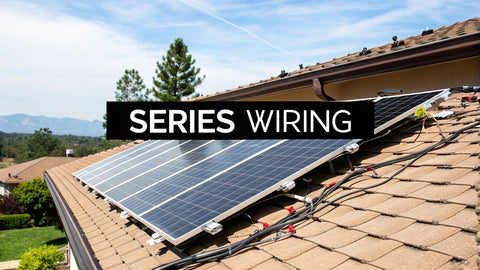
A string inverter takes series-wired panels — typically 6 to 13 modules per string on residential systems, keeping the string under the 600 V residential DC limit (1,000 V and 1,500 V on commercial) — and converts their combined DC to AC through one or more MPPT inputs. It's the lowest-cost topology per watt, the simplest to service (one box at ground level), and the most vulnerable to mismatch: one shaded panel drags its entire string down toward its own output, because the string current is limited by its weakest module. Bypass diodes soften this, they don't eliminate it.
Microinverters and power optimizers
Module-level power electronics (MLPE) move the power conversion to the roof. A microinverter behind each panel converts DC to AC right at the module, so every panel produces independently and a shaded or soiled module affects only itself. Power optimizers are the hybrid approach: a DC-DC converter per panel conditions the output, but a central string inverter still performs the DC-AC conversion. Both topologies add panel-level monitoring and satisfy NEC 690.12 rapid shutdown natively — a real permitting advantage since module-level shutdown became the norm. The tradeoffs: more electronics in the harshest environment on the property (roof temperatures behind dark glass run 65–80 °C in summer), and replacement requires roof work, not a garage-wall swap.
Hybrid/smart inverters
Hybrid inverters add a bidirectional battery port and an internal transfer switch to a string-style platform, enabling storage, backup power, and time-of-use dispatch in one chassis. If batteries are anywhere in your three-year plan, a hybrid (or at least a battery-ready string unit) is the right buy today — retrofitting storage around a plain string inverter means AC coupling, a second inverter, and extra efficiency losses. Our hybrid inverter guide goes deep on that category, and the hybrid collection shows current models from value units like EG4 to premium platforms like Sol-Ark and SolarEdge.
| Attribute | String Inverter | Microinverters | Optimizers + String | Hybrid Inverter |
|---|---|---|---|---|
| Installed cost per watt | Lowest | Highest | Mid-high | Mid |
| Shade tolerance | Poor (string-level) | Excellent (panel-level) | Very good | Poor–good (string-level, MPPT-dependent) |
| Battery-ready | No (AC-couple later) | Via AC coupling | Ecosystem-dependent | Native |
| Backup power without extra hardware | No | No (needs battery inverter) | No | Yes |
| Panel-level monitoring | No | Yes | Yes | Optional with optimizers |
| Service access | Ground level, single box | Roof, per-panel | Roof (optimizers) + ground (inverter) | Ground level, single box |
| Typical warranty | 10–12 years | 25 years | 12–25 years (ecosystem) | 10 years |
| Best fit | Unshaded, simple roofs, budget builds | Complex/shaded roofs, maximum yield | Shaded roofs in a closed ecosystem | Storage, backup, off-grid, TOU arbitrage |
Sizing and Configuration: How to Size for Daily Energy and Uptime
Estimate required AC capacity from daily energy use
The array is sized from energy (kWh); the inverter is sized from the array. Work backward from the utility bill: annual kWh ÷ 365 gives daily consumption; daily consumption ÷ local peak sun hours gives ideal array size; ÷ 0.80 system derate gives nameplate array. A home using 30 kWh/day in a 4.5-PSH climate needs 30 ÷ 4.5 ÷ 0.80 ≈ 8.3 kW of panels. The solar system calculator runs this with your actual bill, and our home wattage guide covers the load-audit side.
Panel configuration and MPPT considerations
String design is constraint satisfaction: string voltage at record-low temperature (voltage rises as temperature falls, roughly +0.3%/°C for silicon) must stay under the inverter's max input voltage; operating voltage at hot-roof conditions must stay above the MPPT minimum; string current must stay under the MPPT input limit. Panels from Qcells, REC, Trina, JA Solar, and Mission Solar all publish the temperature coefficients needed for this math — use the datasheet values, not rules of thumb, when the design is close to a limit.
Worked String-Sizing Example (400 W Module, Voc 49.6 V, −0.27%/°C, Inverter Max 600 V / MPPT 120–500 V)
| Design Check | Calculation | Result | Pass/Fail |
|---|---|---|---|
| Cold-weather max voltage, 13 modules @ −10 °C (ΔT = −35 °C) | 49.6 V × (1 + 0.0027 × 35) × 13 | ≈ 706 V | FAIL — exceeds 600 V limit |
| Cold-weather max voltage, 10 modules @ −10 °C | 49.6 V × 1.0945 × 10 | ≈ 543 V | PASS — under 600 V |
| Hot-roof operating voltage, 10 modules @ 70 °C cell temp (ΔT = +45 °C) | ≈ 41.5 V Vmp × (1 − 0.0030 × 45) × 10 | ≈ 359 V | PASS — inside 120–500 V MPPT window |
| String current vs. MPPT input limit (Imp 10.2 A, limit 14 A) | 10.2 A ≤ 14 A | — | PASS |
| Final string design | 10 modules × 400 W | 4.0 kW per string | Two strings on two MPPTs = 8.0 kW array |
The first row is why string sizing is a winter calculation, not a summer one: voltage climbs as temperature falls, and a string that looks fine on a September afternoon can exceed the inverter's input limit on a January morning and void the warranty. We run this math on every design with the coldest recorded temperature for the zip code, per NEC 690.7.
MPPT channels and voltage windows
Each MPPT channel tracks one electrical array independently. Two strings on the same MPPT must face the same direction at the same tilt with identical module counts — otherwise the tracker optimizes for the average and both strings lose. Put each roof plane on its own MPPT. This is why a two-plane roof wants a two-MPPT inverter minimum, and why the "one big inverter with one input" discount option often costs more energy than it saves.
DC/AC Ratio: How Much Array per Inverter Watt
| DC/AC Ratio | Behavior | Annual Yield Effect | Best Use |
|---|---|---|---|
| 1.0 | Inverter never clips; oversized for the array | Baseline yield; inverter cost per kWh is high | High-irradiance sites, future array expansion planned |
| 1.2 | Rare clipping on the clearest cool days | ≈ −0.5 to −1% vs. 1.0 | Default residential target |
| 1.35 | Clips a few hundred hours/year at solar noon | ≈ −1.5 to −3% | Cloudier climates; maximizes inverter utilization |
| 1.5+ | Frequent midday clipping | ≈ −3 to −6% | Only with storage that captures the clipped energy (DC-coupled hybrids) |
Clipping sounds like failure and isn't — panels spend most of their life below nameplate, so a modestly oversized array keeps the inverter working at its efficient midrange more hours per year. I typically spec 1.2–1.3 on string systems and go as high as 1.5 on DC-coupled hybrids where the surplus charges batteries instead of clipping away. The inverter sizing calculator shows the ratio for your design.
Performance Metrics and Reliability: Efficiency, Derating, and Warranties
Efficiency, derating, and real-world performance
Three efficiency numbers matter. Peak efficiency (97–98.5% on modern units) is the best case at one specific load point. CEC/EU weighted efficiency averages across the load curve and is the honest comparison number. MPPT tracking efficiency (99%+) measures how well the tracker holds the array at its true maximum power point. Beyond conversion, thermal derating decides real output: most inverters begin throttling between 45 °C and 60 °C internal temperature, and a unit jammed into a hot, unventilated garage corner will give back several percent of production every summer afternoon.
| Metric | Budget Tier | Mid Tier | Premium Tier |
|---|---|---|---|
| Peak efficiency | 96.5–97.5% | 97.5–98.0% | 98.0–98.5%+ |
| CEC weighted efficiency | 96.0–97.0% | 97.0–97.5% | 97.5–98.0% |
| Full-power ambient (no derate) | to ≈ 40 °C | to ≈ 45 °C | to ≈ 50–60 °C |
| Cooling | Passive or small fan | Variable-speed fan | Oversized heatsink / smart fan curves |
| Standard warranty | 5–10 years | 10 years | 10–12 years (extendable to 20–25) |
| Arc-fault (AFCI) + rapid shutdown | Varies — verify listing | Standard | Standard, often with module-level shutdown pairing |
Warranty, service network, and reliability
The inverter is the most likely component to need service in the first 15 years — power electronics and fans wear; panels mostly don't. Ten years parts-and-labor with an advance-replacement RMA process is the bar; check who pays shipping and whether a US service center stocks the unit. A cheap inverter with a two-week overseas RMA turns a $300 repair into a month of lost production. We've eaten that lesson on behalf of customers before, and it's why our inverter buyer's guide weights service logistics as heavily as spec sheets.
Protective features and safety
Non-negotiable listings: UL 1741 (with SA/SB grid-support functions) and IEEE 1547-2018 compliance for interconnection approval. Integrated AFCI (arc-fault circuit interrupter) per NEC 690.11, ground-fault protection per 690.41, and DC disconnect per 690.13 come standard on listed units. On roofs, NEC 690.12 rapid shutdown is effectively a module-level requirement now — microinverters and optimizers satisfy it natively; string systems need MLPE add-ons or listed module-level shutdown devices.
Installation Considerations: Location, Cooling, Grid Connection, and Permits

Location, cooling, venting, and enclosure ratings
Mount in shade, out of direct afternoon sun, with the clearances in the manual — typically 6–12 inches on the sides and 24 inches in front for service access. NEMA 3R or IP65 ratings permit outdoor mounting; garages are fine if summer temperatures stay reasonable. North-facing exterior walls are the field favorite for a reason: zero direct sun, weather protection from the eave, and short conduit runs to the meter. Noise matters more than spec sheets admit — fan-cooled units push 40–50 dBA under load, so keep them off bedroom walls.
Grid interconnection requirements and permits
The interconnection application goes to the utility before installation; approval timelines run two weeks to three months depending on territory. The utility reviews inverter listing, system size relative to service and transformer capacity, and export settings. Some jurisdictions now mandate limited-export or zero-export configurations — hybrids handle this with a current transformer on the service conductors. Our NEC compliance guide covers Articles 690, 705, and 706 as inspectors apply them, and state incentive rules increasingly bundle interconnection standards.
Cable routing, maintenance accessibility, and codes
DC string wiring in sunlight-resistant USE-2 or PV wire, in metallic raceway where required by local amendment (Chicago, looking at you). Keep DC runs out of attic ridges where thermal cycling is worst, and label both ends of every conductor — NEC 690.31 and 690.53 want specific placards, and inspectors want to see them. Torque every termination to the manufacturer's value with a calibrated driver; loose MC4 connections are the leading cause of the arc faults that trigger AFCI trips years after commissioning. Leave a ladder-free service path to the inverter, and photograph the nameplate and settings screens for the file.
Monitoring, Diagnostics, and Maintenance: Keeping Performance Visible and Healthy
Monitoring and interoperability
Every modern inverter ships with a monitoring platform — the differentiators are data granularity (string-level vs. panel-level), local API access (Modbus TCP or SunSpec for Home Assistant and third-party loggers), and what happens to your data if the vendor's cloud shuts down. Panel-level monitoring pays for itself the first time it pinpoints one dead optimizer in a 40-panel array instead of a day of roof troubleshooting.
Routine maintenance and firmware updates
Inverter maintenance is light but not zero: clean the heatsink fins and fan intake annually (compressed air, power off), check terminal torque on the DC and AC connections at year one, and keep firmware current — grid-code requirements evolve, and utilities occasionally mandate firmware updates to retain interconnection approval. Log into the monitoring platform monthly; a 10% production dip you catch in week one is a warranty claim, but the same dip discovered in month eight is eight months of lost energy.
Diagnostics and service pathways
Most failures announce themselves through error codes: insulation resistance faults (wet or damaged DC wiring), grid voltage/frequency faults (utility-side problems or failing relays), ground faults, and overtemperature. Know your inverter's RMA pathway before you need it — who to call, what serial and event logs they want, and whether advance replacement is available. Keep the commissioning report and photos; they cut days off every service interaction.
Myths, ROI, and Cost Considerations
Cost components and total cost of ownership
On a typical 8 kW residential system, the inverter represents roughly 10–15% of hardware cost — $1,500 to $3,500 depending on topology, with microinverter systems at the top and value string units at the bottom. Total cost of ownership adds one probable inverter replacement or extended warranty inside the panels' 25-year life for string and hybrid topologies. Microinverter 25-year warranties price that replacement in up front.
ROI considerations: incentives, rates, and storage use
The inverter choice interacts with ROI through three levers: yield (MLPE recovers 5–25% on shaded arrays), rate structure (time-of-use rates reward hybrid+storage dispatch), and incentives (the federal residential credit applies to the inverter and batteries alike — check current rules in our incentives guide). Run the ROI calculator with your actual tariff before locking the design.
Myths to avoid
- "Inverters make power." They convert it. Undersized arrays stay undersized no matter how premium the inverter.
- "String inverters can't do backup." True for plain grid-tie units — but it's an argument for hybrids, not against strings in general.
- "Microinverters are unreliable because there are more of them." Field data shows modern MLPE failure rates comparable to string units; the failures just distribute differently.
- "Efficiency percentage is the top spec." A 1% efficiency gap is ~1% of annual production; a bad shading decision or failed RMA process costs far more.
Trends, Standards, and Market Dynamics
Three currents are reshaping the category through 2026. First, storage-attachment: hybrids are eating the residential market as batteries move from upsell to default, with value platforms like EG4's 18Kpv class putting 12 kW hybrid capability at price points that were string-only territory two years ago. Second, grid-interactive functions: IEEE 1547-2018 ride-through and volt-var support are now interconnection requirements in leading states, and utilities are beginning to pay for aggregated inverter services. Third, module-level electronics keep absorbing the string market on complex roofs as rapid-shutdown enforcement tightens. If you're speccing a system today, buy the hybrid unless a specific constraint says otherwise — the backup capability alone has paid for the delta on every storm-season install we've done in the last three years. The full inverter catalog is organized by topology, and our installation guide covers the build side.
Frequently Asked Questions
What size solar inverter do I need for my home?
Size from the array, not the house: total array DC watts ÷ your target DC/AC ratio (1.2–1.3 for most homes). An 8 kW array pairs with a 6–7 kW inverter. For backup-capable hybrids, also confirm continuous output covers your peak simultaneous load with 25% headroom.
How long do solar inverters last?
String and hybrid inverters: typically 10–15 years, often outliving their 10-year warranties but rarely matching the panels' 25–30 years. Microinverters carry 25-year warranties designed to match module life. Fans and capacitors are the wear items.
Do solar inverters work during a power outage?
Standard grid-tie inverters shut down during outages (anti-islanding law). Only hybrid/battery inverters or systems with a dedicated backup inverter keep producing, and only for the circuits behind their backup output.
Can I mix solar panel brands on one inverter?
On separate MPPT inputs with matched string designs, yes. Never mix different module models within a single string — the string current is limited by the weakest panel, and mismatched modules waste capacity and can stress bypass diodes.
What is the difference between a solar inverter and a charge controller?
A charge controller regulates DC from panels into a DC battery bank (used in RVs and small off-grid). An inverter converts DC to AC. Hybrid inverters integrate both functions, which is why they've largely replaced separate charge controllers in residential storage systems.
Related Resources
- Hybrid Solar Inverters: Understanding, Sizing, and Choosing
- How Many Watts to Power a Home
- 10 kW Solar + Battery Kit · EG4 vs. Tesla Powerwall · Solar Battery Buyer's Guide
Need pricing or availability on anything in this guide?
Portlandia Electric Supply dropships direct from the manufacturer — most items Ship Direct with lead times stated up front, no surprises.
Get a quote from PESBulk, pallet and contractor pricing available.