Power Up Your Life with the 7.38kW Complete Solar Power System – Reliable, Efficient & Future-Ready!
A complete engineering breakdown of the 7.38kW residential solar system: production math, NEC compliance, component selection, and real-world performance by climate zone.

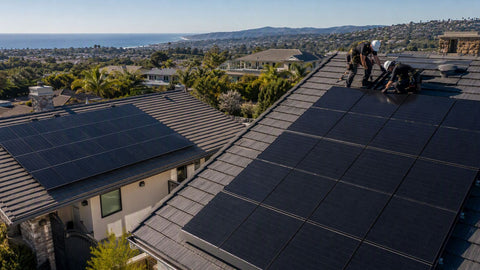
Seven point three eight kilowatts is not a random number. It is what you get when you multiply 18 panels by 410 watts each — the most common residential array size we see on single-story homes with 1,600–2,400 square feet of roof. I've commissioned maybe forty of these systems over the past three years, from Arizona desert installs to coastal Massachusetts jobs. The 7.38kW size hits a balance: enough production to zero out most electric bills, small enough to fit on a standard gable roof without complex engineering.
This guide covers every layer of a 7.38kW system. Panel selection, inverter sizing, NEC 690 rapid shutdown requirements, production estimates by location, and the financial math that determines whether this investment pays back in six years or twelve. We also compare three panel options we stock: Aptos DNA-120, Canadian Solar HiKu, and JA Solar DeepBlue 4.0. All are Tier 1, all carry 25-year warranties, and all ship on pallets direct from our warehouse.
Before you read further, run your roof through our solar system calculator. It factors local irradiance, shading, and utility rates. The numbers in this article are national averages — your site may vary by 20% either direction.
A 7.38kW DC system with 18 × 410W panels will produce different AC kilowatt-hours depending on inverter efficiency, clipping losses, and derating factors. The math works like this:
- DC nameplate: 18 × 410W = 7,380W = 7.38 kW DC
- Inverter efficiency (modern string inverter): 97.5% minimum
- System derating (soiling, mismatch, wiring, temperature): ~86% typical
- AC output: 7.38 kW DC × 0.975 × 0.86 = 6.19 kW AC peak
That 6.19 kW AC is your peak instantaneous output on a clear, cool day at solar noon. Annual production is measured in kilowatt-hours (kWh), which depends on how many peak sun hours your location receives. NREL's PVWatts calculator uses 30 years of weather data. We use those numbers.
| Location | Peak Sun Hrs/Day | Annual Production (kWh) | Monthly Avg (kWh) | % of U.S. Average |
|---|---|---|---|---|
| Phoenix, AZ | 6.5 | 11,850 | 988 | +42% |
| Las Vegas, NV | 6.4 | 11,670 | 973 | +40% |
| Los Angeles, CA | 5.8 | 10,570 | 881 | +27% |
| Denver, CO | 5.5 | 10,030 | 836 | +20% |
| Miami, FL | 5.3 | 9,660 | 805 | +16% |
| U.S. Average | 4.8 | 8,350 | 696 | Baseline |
| Portland, OR | 4.2 | 7,660 | 638 | -8% |
| Seattle, WA | 3.8 | 6,930 | 578 | -17% |
| Boston, MA | 4.5 | 7,830 | 653 | -6% |
| Chicago, IL | 4.4 | 7,650 | 638 | -8% |
| New York, NY | 4.3 | 7,480 | 623 | -10% |
Those production numbers assume a south-facing array at 30° tilt, no shading, and standard degradation. A west-facing array on a 5/12 roof in Portland will produce 15–20% less. An unshaded south-facing array in Phoenix will produce more than the table shows. The variance is real, and it is why site-specific modeling matters.
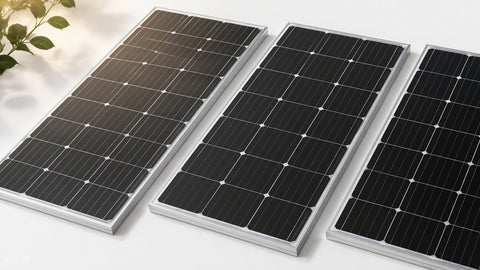
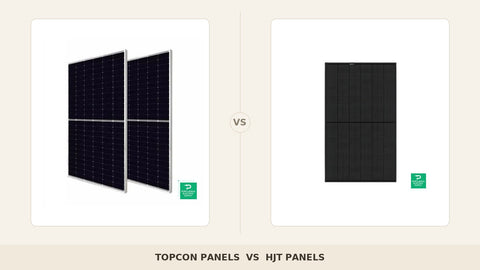
Not all 410W panels are identical. Efficiency, temperature coefficient, warranty terms, and degradation rate vary. Here is how three popular Tier 1 models compare at the 7.38kW system level.
| Specification | Aptos DNA-120-MF26-410W | Canadian Solar HiKu7 CS7L-410MS | JA Solar JAM72S30-410/MR |
|---|---|---|---|
| Cell Type | Mono PERC, half-cut | Mono TOPCon, half-cut | Mono PERC, half-cut |
| Efficiency | 20.8% | 21.4% | 20.5% |
| Dimensions | 1,722 × 1,134 × 35 mm | 1,722 × 1,134 × 30 mm | 1,722 × 1,134 × 35 mm |
| Weight | 21.5 kg | 21.0 kg | 22.0 kg |
| Temp Coefficient (Pmax) | -0.35%/°C | -0.29%/°C | -0.35%/°C |
| Max System Voltage | 1,500 VDC | 1,500 VDC | 1,500 VDC |
| Product Warranty | 25 years | 25 years | 25 years |
| Power Warranty (Year 25) | 85.0% | 87.4% | 85.0% |
| First-Year Degradation | 2.0% | 1.0% | 2.0% |
| Bifacial Gain | N/A (mono) | Up to 10% | N/A (mono) |
| Price per Watt (bulk) | $0.42 | $0.48 | $0.40 |
The Canadian Solar TOPCon panel commands a premium but pays it back in hot climates. At 95°F ambient (35°C), a cell temperature of 65°C is typical. The Aptos panel loses 12.25% output (0.35 × 35°C rise). The Canadian Solar loses 10.15% (0.29 × 35°C rise). On a 7.38kW system, that 2.1% difference is 155W — meaningful in Arizona, negligible in Seattle. I've spec'd Canadian Solar for Phoenix jobs and Aptos for Portland installs. The cost difference usually breaks even in year 8–10 in high-irradiance zones.
NEC 690.12: Rapid Shutdown Requirements
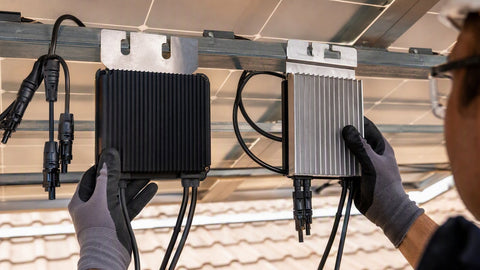
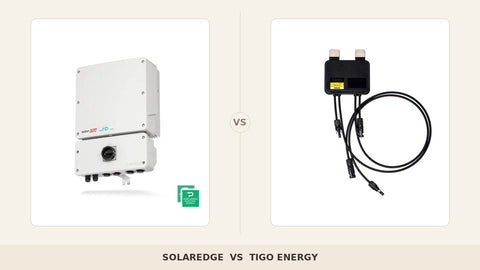
Since NEC 2017, all PV systems on buildings must include a rapid shutdown function that reduces voltage to under 30V within 30 seconds of shutdown initiation. For a 7.38kW system with a string inverter, this means either module-level rapid shutdown devices (TS4-RSD from Tigo, or SMA Sunny Boy with RSS transmitter) or a microinverter system where each panel operates independently. We stock rapid shutdown equipment compliant with 690.12(B)(2). Do not skip this — inspectors fail systems without it.
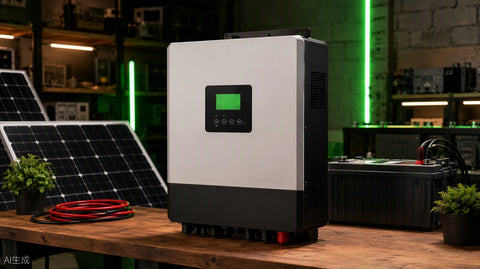
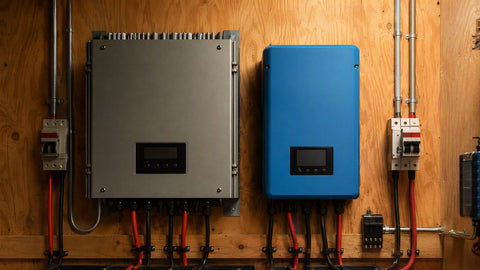
The inverter is where DC becomes AC. For a 7.38kW system, you have three topology choices:
- String inverter: One central inverter (7.6–8.0 kW rated). Cost-effective, proven, but subject to partial-shading losses. SMA Sunny Boy 7.7-US or SolarEdge HD-Wave 7600 are common choices.
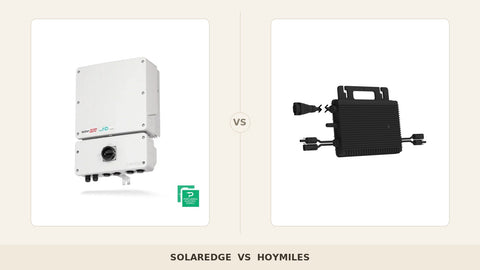
- Power optimizers + string inverter: Module-level MPPT with central inversion. SolarEdge is the dominant platform. Eliminates mismatch, enables panel-level monitoring, satisfies rapid shutdown.
- Microinverters: One inverter per panel. Enphase IQ8M is the standard for 410W modules. Full redundancy, best shading performance, highest cost per watt.
String sizing is governed by NEC 690.7 (voltage) and 690.8 (current). A 410W panel with 40.9V Vmp and 49.8V Voc (Aptos spec) strung 9 panels in series gives:
- Voc (cold): 9 × 49.8V × 1.12 (NEC 690.7 correction at -13°F) = 502V
- Vmp (STC): 9 × 40.9V = 368V
- Isc: 12.68A per string
A 7.6 kW string inverter with 600V max input handles two strings of 9 panels easily. The 502V cold Voc is under the 600V limit with margin. If you are in a very cold climate (Minnesota, North Dakota), verify with the site's record low temperature — the correction factor can hit 1.20, pushing Voc to 538V. Still safe, but closer to the limit.
| Inverter Type | Model Example | Rated AC Output | Max DC Input | Max Strings | Efficiency | Approx Cost |
|---|---|---|---|---|---|---|
| String (central) | SMA Sunny Boy 7.7-US | 7,700W | 11,550W | 2 | 97.5% | $1,850 |
| String + optimizers | SolarEdge SE7600H + P505 | 7,600W | 11,400W | 2 | 99.0% (DC optimizers) | $2,650 |
| Microinverters | Enphase IQ8M (×18) | 7,560W (combined) | 9,180W | 18 | 97.0% | $3,240 |
My recommendation depends on shading and roof complexity. Clean south-facing roof with no obstructions? String inverter saves $1,000+. Partial shading from a chimney or tree? Power optimizers or microinverters recover 8–15% annual production. Complex roof with east and west faces? Microinverters let each orientation perform independently. I installed a 7.38kW Enphase system in Vermont last fall with east, south, and west arrays — production was 12% higher than a string-inverter model predicted.
Bill of Materials: Complete 7.38kW System

This is a realistic BOM for a roof-mounted residential install using mid-tier components. Prices are August 2026 wholesale levels. Retail markup varies by installer.
| Component | Quantity | Unit Price | Extended | Notes |
|---|---|---|---|---|
| 410W Mono Solar Panel | 18 | $172 | $3,096 | Aptos or equivalent Tier 1 |
| String Inverter (7.6 kW) | 1 | $1,850 | $1,850 | SMA or Fronius |
| Racking & Mounting | 1 kit | $890 | $890 | IronRidge XR10, comp flashings |
| DC Disconnect | 1 | $145 | $145 | NEC 690.15 compliant |
| AC Disconnect | 1 | $98 | $98 | 30A fusible |
| PV Wire (10 AWG) | 500 ft | $0.42/ft | $210 | UL 4703, 600V rated |
| Conduit & Fittings | 1 lot | $180 | $180 | EMT, connectors, LB bodies |
| Grounding Hardware | 1 kit | $120 | $120 | WEEBs, lugs, GEC |
| Rapid Shutdown Devices | 18 | $18 | $324 | Tigo TS4-RSD or equal |
| Monitoring Hardware | 1 | $0 | $0 | Included with inverter |
| Permit & Interconnect | 1 | $450 | $450 | Varies by jurisdiction |
| Equipment Subtotal | $7,353 | |||
| Labor & Overhead (est.) | $3,500 | Varies by region | ||
| Total System Cost | $10,853 | Before ITC | ||
| Less 30% Federal ITC | -$3,256 | Sec. 25D credit | ||
| Net Cost | $7,597 |
At $7,597 net cost and 8,350 kWh/year production (U.S. average), the simple payback is:
$7,597 ÷ (8,350 kWh × $0.16/kWh average) = $7,597 ÷ $1,336 = 5.7 years
In high-rate states like California ($0.32/kWh), payback drops to 2.8 years. In low-rate states like Idaho ($0.10/kWh), it stretches to 9.1 years. Use our Solar ROI Calculator for your utility rate.
Step 1: Site Survey and Shading Analysis
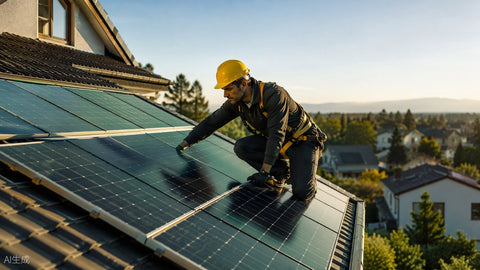
Measure the roof precisely. A 7.38kW system with 18 panels needs roughly 320 square feet of unobstructed south-facing roof at minimum. Each 410W panel is roughly 18.8 sq. ft. With spacing for clamp zones and fire setbacks, budget 18 sq. ft. per panel. Check rafter spacing — 24 inches on center is standard, but older homes may have 16 inches or irregular framing. We require a structural letter from a PE for any roof over 20 years old or with visible sag.
Step 2: Production Modeling
Run PVWatts with these inputs: system size 7.38 kW, module type standard, array type fixed roof-mount, tilt equal to latitude, azimuth 180° (south). The tool outputs annual production, monthly variability, and a performance graph. Compare this to the homeowner's last 12 electric bills. If the bills total 9,000 kWh and PVWatts predicts 8,350 kWh, the system will offset 93% of usage. That is the number the customer cares about.
Step 3: String Sizing per NEC 690.7
Record low temperature determines maximum string voltage. For Portland, OR, the design low is 9°F (-13°C). NEC Table 690.7(A) gives a correction factor of 1.12. A string of 9 Aptos panels: 9 × 49.8V × 1.12 = 502V. The SMA Sunny Boy 7.7 has a 600V max — safe with 98V margin. In Minneapolis, design low is -20°F (-29°C), factor 1.16: 9 × 49.8 × 1.16 = 520V. Still safe, but tighter. Always verify with the inverter spec sheet.
Step 4: Inverter and Racking Selection
For a simple south-facing roof, a string inverter on the garage wall is cheapest and most reliable. For a roof with a dormer that shades panels 10 a.m. to noon, power optimizers recover the lost production. For four roof planes facing different directions, microinverters are the only logical choice. I have never regretted spending an extra $800 on optimizers to eliminate a shading penalty that would have cost 400 kWh per year for 25 years.
Step 5: NEC Compliance Review
Rapid shutdown is the most common inspection failure. For string inverters, you need either module-level RSD units or a system-level transmitter. We use Tigo TS4-RSD on every string job — it adds $18 per panel but guarantees 690.12 compliance. Grounding: use WEEB washers under every rail bond and a continuous grounding electrode conductor to the service panel. Labeling: NEC 690.56 requires a directory showing all PV disconnects. We print laminated placards and mount them at the meter, main panel, and inverter.
Step 6: Permit and Install
Most jurisdictions require three permits: electrical, building (structural), and fire (setback verification). Submit a single-line diagram showing panel layout, string configuration, inverter location, and grounding path. After install, the inspector checks rapid shutdown function, grounding continuity, and labeling. Then the utility interconnects the net meter. Total timeline: 6–12 weeks from contract to PTO (permission to operate).
Solar production is not flat. June produces 2.5× what December produces at mid-latitudes. A 7.38kW system in Boston produces 950 kWh in July and 380 kWh in January. If you are sizing a battery to ride through winter outages, do not use summer numbers.
| Month | Phoenix (kWh) | Denver (kWh) | Miami (kWh) | Boston (kWh) | Seattle (kWh) |
|---|---|---|---|---|---|
| January | 820 | 620 | 680 | 380 | 280 |
| February | 880 | 710 | 740 | 470 | 360 |
| March | 1,020 | 880 | 860 | 620 | 490 |
| April | 1,080 | 950 | 890 | 720 | 580 |
| May | 1,120 | 1,020 | 920 | 820 | 640 |
| June | 1,140 | 1,080 | 860 | 920 | 680 |
| July | 1,100 | 1,060 | 860 | 950 | 720 |
| August | 1,050 | 990 | 860 | 880 | 680 |
| September | 980 | 890 | 800 | 760 | 580 |
| October | 920 | 780 | 780 | 610 | 440 |
| November | 820 | 620 | 680 | 420 | 290 |
| December | 780 | 560 | 640 | 350 | 240 |
For battery pairing, a 7.38kW system pairs well with 10–15 kWh of storage. The Enphase IQ Battery 5P (15 kWh) or Tesla Powerwall 3 (13.5 kWh) are common choices. In net-metering states, batteries are backup-only. In time-of-use states like California, batteries shift afternoon solar to evening peak rates, improving economics by 15–25%.
Our battery sizing calculator models outage duration, critical load wattage, and solar recharging to recommend the right storage capacity. For a 7.38kW system backing up a 1,500 sq. ft. home with gas heat, 10 kWh typically provides 12–18 hours of backup.
How many solar panels are in a 7.38kW system?
Eighteen panels at 410 watts each. Some installers use 20 × 370W panels or 16 × 460W panels to hit the same capacity. The physical footprint and electrical characteristics change with panel selection.
How much does a 7.38kW solar system cost?
$10,000–$13,000 before the 30% federal tax credit. Net cost after ITC: $7,000–$9,100. Add $8,000–$12,000 for a battery if desired. Use our Solar ROI Calculator for site-specific pricing.
How much power does a 7.38kW system produce per year?
6,900–11,850 kWh depending on location. Phoenix leads. Seattle trails. Most U.S. homes fall in the 7,500–9,500 kWh range.
What size inverter do I need for a 7.38kW system?
7.6–8.0 kW AC rating. The DC-to-AC ratio (7.38 kW DC ÷ 7.6 kW AC = 0.97) is conservative and avoids clipping losses on cold, clear days.
Will a 7.38kW system power my whole house?
It offsets 75–100% of typical usage depending on your efficiency and heating fuel. All-electric homes with heat pumps may need 10–12 kW. Gas-heated homes often achieve full offset at 7.38 kW.
How long is the payback period?
5–9 years nationally. California homeowners see 3–4 years. Pacific Northwest homeowners see 8–10. The 30% ITC and net metering rules are the biggest variables.
Do I need a permit?
Yes — electrical and building permits are standard. Fire setbacks vary by jurisdiction. Your installer should handle this. We provide permit-ready plans through our Pro Account program.
What battery size pairs with this system?
10–15 kWh covers most residential backup needs. For whole-home backup with electric heat, consider 20+ kWh or a load management system.
- Solar System Calculator
- Battery Sizing Calculator
- Inverter Sizing Calculator
- Solar ROI Calculator
- Solar Installation Guide
- Solar Maintenance Guide
- Solar Permitting Guide
- NEC Code Compliance Guide
- Grounding & Bonding Guide
- Solar Incentives by State
- JA Solar Brand Guide
- Canadian Solar Brand Guide
- 13kW Generator Guide
- Pro Account — Wholesale Pricing
Ready to Design Your 7.38kW System?
Panels, inverters, racking, and accessories in stock with contractor pricing. We ship nationwide and offer bulk project quotes.
Get a Quote