A 35 kW generator is the biggest machine most homes and small businesses will ever need, and the smallest one that behaves like commercial equipment. It will run a 4,000 sq ft house with two AC condensers and a well pump without blinking, or carry a small restaurant's walk-ins and POS through an outage. It also drinks fuel like a truck, needs a real concrete pad, and draws enough current — around 145 amps at 240V single-phase — that the electrical work is not a handyman project. We've sized, sold, and troubleshot units in this class for years at Portlandia Electric Supply; this guide is the conversation we have with buyers before the purchase order. For a broader look at the class, see The Complete Guide to 35 kW Generators, and browse live inventory under generators and standby generators.

Portable vs Stationary: Two Different Machines Wearing the Same Number
| Attribute | Stationary Standby 35 kW | Portable / Tow-Behind ~35 kW |
|---|---|---|
| Fuel | Natural gas or propane (some diesel) | Almost always diesel |
| Start | Automatic, ~10 seconds via ATS | Manual / key start, manual transfer |
| Installation | Permitted, pad-mounted, permanently wired | None (or a manual transfer inlet) |
| Typical price (unit) | $14,000–$22,000 installed $22k–$35k | $12,000–$20,000 |
| Noise | 63–70 dBA @ 23 ft (sound enclosure) | 72–80 dBA |
| Best for | Homes, small commercial, unattended backup | Job sites, events, ag, rental fleets |
The choice is really about attendance. If someone will always be there to wheel it out, hook it up, and start it, a towable diesel does the job and moves between properties. If the outage will happen at 3 AM while the family is asleep or the restaurant is closed, standby with an automatic transfer switch is the only honest answer. Most of our 35 kW residential buyers are protecting sump pumps, medical equipment, freezers, and home offices — loads that don't care what time it is.
Fuel: Natural Gas vs Propane vs Diesel at 35 kW
Fuel choice decides more than the engine — it decides your runtime autonomy, your maintenance schedule, and half your installation cost.
| Fuel | Full-Load Consumption (approx.) | Autonomy | Strengths | Watch-outs |
|---|---|---|---|---|
| Natural gas | ~450–550 ft³/hr | Unlimited (utility) | No refueling, clean, no tank | Needs adequate gas service — 5–7 in. w.c. at high flow; utility pressure can sag in disasters |
| Propane (LP) | ~4.5–5.5 gal/hr | Tank-limited: 500-gal tank ≈ 70–80 hr at 50% load | Stores indefinitely, works off-grid | Tank vaporization in deep cold; big tanks cost money |
| Diesel | ~2.8–3.5 gal/hr | Tank-limited; onboard day tanks 24–72 hr | Best fuel economy, best motor-starting punch, longest engine life | Fuel maintenance (polishing), gelling below ~10°F without additives, wet stacking at light loads |
Field notes: the natural-gas line is the one to verify before you order. A 35 kW NG unit at full throttle wants roughly 500 ft³/hr — we had a customer whose existing half-inch service and meter couldn't feed it, and the utility upgrade added six weeks and four figures to the project. Get the gas utility's written capacity confirmation early. For the full three-way fuel analysis, read natural gas vs propane vs diesel standby generators. Cold-climate diesel buyers should add a cold-weather kit at purchase, not after the first no-start in January.
Prime vs Standby: Read the Rating Before the Price
A "35 kW" label hides three different machines. Standby rating: full output during outages, limited annual hours, no overload allowance — that's what residential units are. Prime rating: unlimited hours, variable load, 10% overload for an hour in twelve — typically 5–10% fewer kW on the same engine. Continuous: 100% load, unlimited hours, lower still. Off-grid cabin running the set daily? You need prime-rated equipment or you'll be buying an engine rebuild on year three. Grid-backup in the suburbs? Standby rating is correct and cheaper. Our generator sizing guide and kW-to-amps calculator walk the numbers.
What 35 kW Actually Runs (Load Math)
Thirty-five kilowatts at 240V single-phase is 145.8 amps of generator capacity (35,000 ÷ 240). Here's a realistic residential load budget:
| Load | Running Watts | Starting Surge | Notes |
|---|---|---|---|
| Central AC, 4-ton | ~4,800 W | ~14,000 W (soft-start cuts to ~7,000) | The single biggest load in most homes |
| Second AC, 2.5-ton | ~3,000 W | ~9,000 W | Stagger starts via load management |
| Electric water heater | 4,500 W | — | Often load-shed first |
| Well pump, 1.5 hp | ~1,500 W | ~4,500 W | 240V motor; check LRA |
| Refrigerator + freezer | ~1,200 W | ~3,600 W | |
| Electric range / dryer | 5,000–6,000 W each | — | Candidates for load shedding |
| Lighting, outlets, network, furnace blower | 1,500–3,000 W | — |
Add the "always-on" loads and you're at 8–12 kW. A 35 kW set carries the whole list with both ACs started sequentially — which is exactly why load-management modules exist: they prevent the two compressors from starting simultaneously and let a smaller (cheaper) generator do the same job. If your honest need is 20–26 kW, don't oversize "for safety" — a chronically light-loaded diesel wet-stacks, and even NG units run happier at 40%+ load. Compare with 22 kW, 26 kW, and our whole-house sizing guide before committing.
Electrical Integration: ATS, Conductors, Grounding
At 145.8A full load (240V single-phase), the wiring is commercial-grade: per NEC 445.13, feeder conductors at 115% of nameplate ≈ 168A ampacity — that's 2/0 AWG copper (175A at 75°C per NEC 310.16) with a 175–200A OCPD per NEC 240.6, and a 200A service-rated ATS as the usual pairing. The ATS is not optional on a standby install; it's the code-required brain that isolates you from the grid (NEC 700/701/702 depending on load class) so you don't backfeed a lineman.
| Element | Rule | 35 kW @ 240V 1-ph Example |
|---|---|---|
| Full-load current | kW ÷ V | 35,000 ÷ 240 = 145.8 A |
| Feeder conductors | NEC 445.13: ≥115% FLA | 167.7 A → 2/0 AWG Cu (175A @ 75°C) |
| OCPD | NEC 240.6 standard sizes | 175 A or 200 A per design |
| ATS | ≥ service / generator FLA, service-rated if ahead of main | 200 A typical — see 200–225A transfer switches |
| Grounding | NEC 250; SDS if neutral switched | 4-pole ATS = separately derived; bond accordingly |
ATS depth: what is a transfer switch, the manual vs automatic ATS guide, ATS sizing chart, and our field-level transfer switch wiring guide. Inventory: transfer switches and automatic transfer switches.
Installation and Permitting Reality
Budget the project, not the box. A 35 kW standby install typically runs: unit $14k–$22k, ATS $1.5k–$3k, pad and set $1.5k–$3k, gas line or LP tank work $1k–$4k, electrical $3k–$6k, permits and inspection $300–$1,000. Setbacks matter — most jurisdictions want 5 ft from openings and property lines (check local amendments; some want more), and the unit needs 3 ft of service clearance on the access sides. Pull the permit. An unpermitted generator is a resale problem, an insurance problem, and occasionally a carbon-monoxide problem.
Maintenance, Warranty, and Service
| Interval | Tasks | DIY or Pro |
|---|---|---|
| Weekly (automatic) | Self-exercise 10–15 min; verify it ran via app or indicator | Automatic |
| Monthly | Visual leak check, enclosure clear of debris, battery terminals | Owner |
| Annual / 150 hr | Oil and filter, air filter, spark plugs (gaseous), valve-lash check per manual, battery load test | Pro recommended |
| 2–3 yr | Coolant service (liquid-cooled), battery replacement, ATS contact inspection, firmware updates | Pro |
Standard warranties in this class run 5 years parts on residential standby (labor coverage varies by brand — read the fine print), with extended warranties to 10 years worth buying if the unit protects medical or business-critical loads. The single most common failure we see is the starting battery — $150 part, dead at the worst possible moment. Put battery replacement on a 3-year calendar reminder. The generator maintenance guide has the full schedule, and parts live under maintenance kits and generator accessories.
Buying Checklist
| # | Item | Why |
|---|---|---|
| 1 | Load calculation in writing (running + starting kVA) | Right-sizes the machine; avoids chronic light loading |
| 2 | Fuel decision confirmed with utility/tank supplier in writing | NG capacity shortfalls are the #1 install delay |
| 3 | Standby vs prime rating matched to duty | Warranty validity |
| 4 | ATS sized and service-rated; pole count vs grounding scheme | Code compliance, no backfeed |
| 5 | Noise spec vs property-line distance (63–70 dBA typical) | Neighbor relations and HOA rules |
| 6 | Permits, setbacks, and HOA approval before ordering | Avoids the pad-poured-in-the-wrong-spot problem |
| 7 | Monitoring/app included; commissioning test witnessed | You want proof it transfers before the storm, not during |
The Brand Landscape at 35 kW
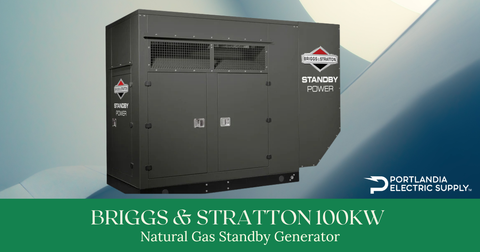
Four names dominate the residential/light-commercial 30–40 kW band, and they genuinely differ. Generac owns the volume game — the deepest dealer network, aggressive pricing, and a monitoring app customers actually use; the Generac catalog runs broad in this range. Cummins Quiet Connect units (like the RS36 36 kW family) trade on the commercial service network and quieter enclosures; see the Cummins brand guide. Kohler (now Rehlko) plays the premium card with strong enclosures and resale reputation — the Kohler/Rehlko guide covers it. Briggs & Stratton competes on value with perfectly serviceable equipment — see the Briggs & Stratton guide. For the head-to-heads: Generac vs Kohler, Generac vs Cummins, and Kohler vs Briggs & Stratton. Our honest take: at 35 kW, the installer and the local service bench matter more than the badge. A Generac with a great local dealer beats a Kohler with nobody to service it.
A Real Runtime Scenario
One of our Gulf Coast customers runs a 35 kW NG standby on a 3,800 sq ft house with a home office and a wife on refrigerated medication. Hurricane outage, 61 hours. The set carried both ACs (staggered by the load manager), kitchen, office, and networking without shedding anything. Total gas bill for the event: under $200. The pre-storm work that made it boring instead of dramatic: annual service two months prior, battery replaced on schedule at year three, and a witnessed transfer test at commissioning. Backup power is a product you buy once and a discipline you practice forever — the hardware is the easy half.
Propane Deep Dive: Vaporization Is the Spec Nobody Checks
If you're going LP at 35 kW, understand vaporization, because it's the failure mode that looks like a generator problem and is actually a tank problem. Liquid propane boils off to vapor inside the tank at a rate governed by tank size, fill level, and ambient temperature. A 35 kW engine at full load demands roughly 4.5–5.5 gal/hr of vapor withdrawal — a pace a 500-gallon tank at 40% fill sustains fine at 40°F and struggles to sustain at −10°F as the wetted surface area shrinks and the liquid chills itself below boiling. The symptom is a generator that runs beautifully in October and starves at full load in January. The fixes: size the tank for winter vaporization (your LP supplier has the charts — make them show you), keep winter fill above 40%, or plumb a vaporizer on high-demand installations. We've diagnosed this over the phone twice by asking one question: "what was the temperature when it stumbled?"
Noise, HOAs, and Placement Strategy
The 63–70 dBA spec is measured at 23 feet in free field; real yards aren't free field. Corner placement between two fences can add 3–6 dB of reflection, and low-frequency diesel rumble carries through soil into neighboring foundations in ways the dBA number doesn't capture. Practical placement rules we've learned the loud way: aim the exhaust and radiator discharge away from the neighbor's bedroom windows, even if it costs 20 extra feet of gas line; keep the unit off shared fence lines even when the setback allows it; and if the HOA has a quiet-hours rule, set the weekly exercise for mid-morning Tuesday, not 6 AM Saturday — that last one is a software setting and it has started more HOA wars than any decibel ever has.
The Exercise Schedule: Less Often, Under Load
Exercise philosophy at 35 kW has quietly changed. The old advice — run it weekly for 20 minutes — dates from an era of dumber controllers and is now understood to cause more harm than good on liquid-cooled sets that never reach full operating temperature on a short no-load spin. Modern practice: exercise weekly or biweekly per the manufacturer, keep the runs long enough to reach full temperature, and get real load on the unit monthly — either by transferring the house onto it for half an hour or with a load bank. Wet stacking isn't just a diesel problem at 30%+ sustained loading; gaseous engines running cold and unloaded build carbon too. The controller setting takes five minutes to change. The engine it saves is yours.
Insurance, Resale, and the Paperwork Upside
Two financial footnotes that rarely make the brochure. First, insurers: several homeowner carriers offer premium credits for permanently installed standby power with an ATS — especially where the protected loads include sump pumps, medical equipment, or pipe-freezing heat. Bring the permit, the inspection sign-off, and the commissioning record to your agent; "we bought a generator" without paperwork rarely moves the number. Second, resale: appraisers and buyers increasingly treat a permitted standby system as a line-item feature, and in outage-prone markets it shows up in listings explicitly. The unpermitted version of the same machine is a liability the inspector flags and the buyer discounts. Permits cost a few hundred dollars. The discount on a $700,000 house costs a lot more.
Three Jobs We've Actually Specced at 35 kW
Concrete examples beat abstractions. Job one: a hill-country home on a well, 3,600 sq ft, two ACs, and a home business that can't lose connectivity. Answer: 35 kW NG standby, 200A service-rated ATS, load management on the second condenser. It's ridden out a dozen outages including one 30-hour ice-storm event; total downtime for the business, zero. Job two: a small rural grocery — walk-in cooler, freezer bank, POS, and lights. Answer: 35 kW diesel with a 130-gallon base tank and a fuel contract, because the nearest gas line ended two miles away. The owner polishes fuel annually and load-banks every fall before storm season. Job three: a wedding venue in fire country where outages cluster on summer Saturdays — the worst possible timing. Answer: 35 kW LP on a 1,000-gallon tank, sized so a weekend event plus the commercial kitchen runs with headroom. Three properties, three different fuels, one constant: each was sized from measured loads, not from the panel label.
The Long View on 35 kW Ownership
Zoom out and the 35 kW decision is really a twenty-year infrastructure decision wearing an appliance's price tag. The gaseous engines in this class are automotive-derived V8s and inline-fours with expected lives measured in decades at standby duty — fifty to a hundred and fifty hours a year of exercise and outages barely breaks them in. What ages out first is everything around the engine: batteries every three to five years, controllers and displays as electronics generations roll, enclosure hardware in salt air, and the gas regulator or fuel system components on their own clocks. Budget a few hundred dollars a year for the slow grind of consumables on top of service, keep the paperwork from every visit, and the machine that protects the house during your kids' childhood will likely still be cranking when the grandkids visit. That longevity is also why the boring choices — the permitted pad, the right fuel, the local service bench — compound so heavily in this class. Small decisions, twenty years, one machine that starts.
And one last counter truth: the homeowners who love their 35 kW systems five years in are the ones who knew the fuel bill, the service schedule, and the exercise hum before they signed. Set expectations honestly at the kitchen table and the machine delivers exactly what was promised — which, in this business, is what five-star reviews are made of.
And a closing habit worth stealing from the best facility managers we work with: walk past the generator monthly with eyes open. Fuel stains, a spider nest in the louvers, a low coolant mark, a corroded battery terminal — every expensive failure we've responded to announced itself to a walk-by weeks earlier. Sixty seconds a month is the cheapest maintenance line item there is.
Final word from the counter: at 35 kW, buy the service relationship as deliberately as the engine. The machine will outlive the transaction by decades; make sure somebody answers the phone in year twelve.
Do that, and the 35 kW class is exactly what it should be: quiet insurance you only notice on the days it earns its keep.
Frequently Asked Questions
Will a 35 kW generator run my whole house?
For most homes up to ~4,000 sq ft with two AC systems, yes — with load management staggering the compressor starts. Homes with electric heat, EV chargers, and a pool may need load shedding or a larger unit.
How much natural gas does a 35 kW generator use?
Roughly 450–550 cubic feet per hour at full load, about half that at 25% load. Confirm your gas service and meter can deliver it — that's a utility question, and ask it before you order.
How long will a 500-gallon propane tank run a 35 kW generator?
A 500-gallon tank holds ~400 gallons usable. At half-load burn of roughly 2.5–3 gal/hr, expect 5–6 days of continuous run; at full load, about 3 days.
What size wire and transfer switch for a 35 kW generator?
Full load is ~146A at 240V single-phase. Per NEC 445.13 you size conductors at 115% (≈168A) — 2/0 AWG copper at 75°C — with a 200A service-rated ATS as the standard pairing.
Is diesel or natural gas better at 35 kW?
Natural gas for suburban standby (no refueling, clean, unlimited runtime). Diesel for rural/off-grid, long runtime autonomy, and heavy motor starting — with fuel maintenance and cold-weather care as the price.
How loud is a 35 kW standby generator?
About 63–70 dBA at 23 feet for a sound-attenuated residential package — conversation-plus, not whisper. Measure to the property line, not the unit.
Related: whole-home generator sizing 2026 · standby generators for the home · whole-house generator guide · runtime calculator · fuel consumption calculator · 30 kW generators · 48 kW generators · Generac · Cummins · Cummins RS36 36 kW