Understanding the 5000/120 Ratio: Definition, Calculation, and Real-World Applications
Five thousand watts on a 120-volt system — the amps math, the NEC wire and breaker sizing, and where this number shows up in real electrical work.

Search for "5000/120" and you'll land in one of two places: a math homework problem, or an electrical sizing question. In our world it's the second one. When someone tells us they have "a 5,000-watt something" — a generator, a heater bank, a solar inverter, a welder — the first calculation we run is 5,000 ÷ 120. That ratio tells you the current in amps, and current is what sizes wire, breakers, and every dollar of copper that follows. This guide walks the calculation, the code rules that attach to it, and the mistakes we see when people skip the division.
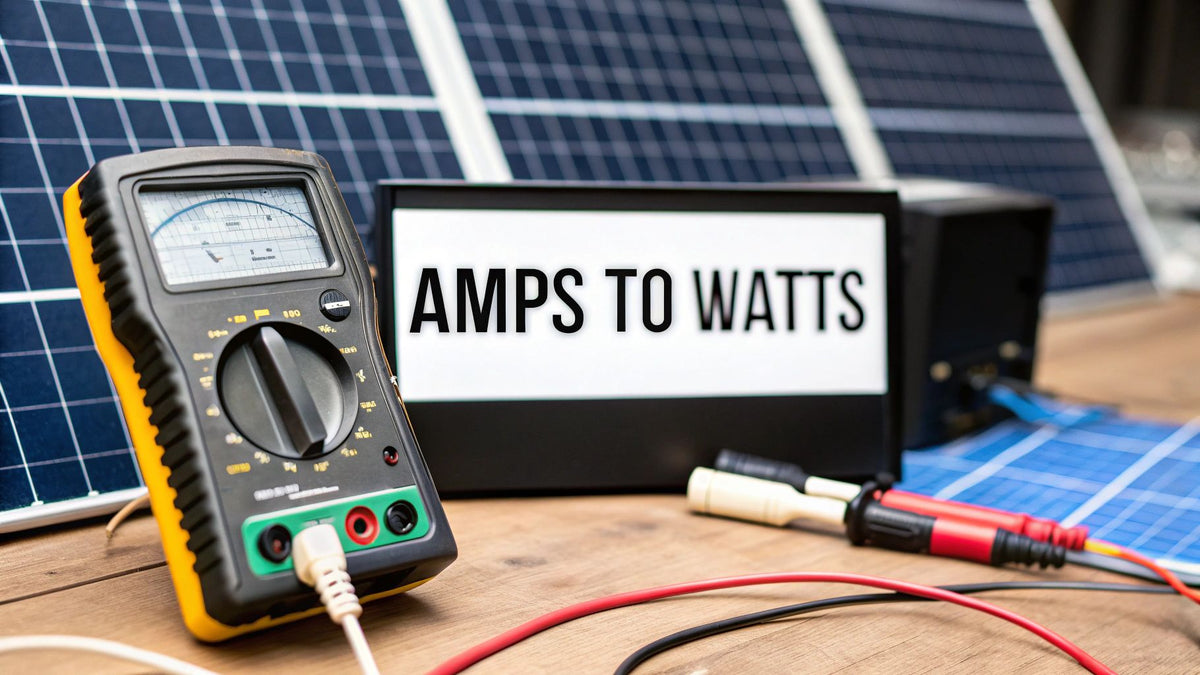
The relationship is Ohm's law in its power form, and it never changes:
The core formula
Amps = Watts ÷ Volts
5,000 watts ÷ 120 volts = 41.67 amps
The same 5,000 watts on 240 volts = 20.83 amps — half the current on the same load. That single fact drives most of the design decisions below.
I can't count how many times a customer has walked in planning to run a 5,000-watt load off a standard 20-amp receptacle. The math kills the plan in one step: 20 amps at 120 volts delivers only 2,400 watts, and a continuous load derates that to 1,920 watts. A 5 kW load on 120V needs a dedicated 50-amp circuit — the same class of circuit as an electric range. That's not a wall outlet; that's 6 AWG copper in conduit or 6/2 NM-B, a 50-amp two-pole... no, single-pole 50-amp breaker, and a NEMA 6-50 or 14-50 receptacle depending on whether neutral is needed.
This is the table our counter staff actually uses. Print it, laminate it, tape it to the truck visor.
| Watts | Amps @ 120V | Amps @ 240V | Amps @ 208V 3ph | Common Load at This Size |
|---|---|---|---|---|
| 1,000 W | 8.3 A | 4.2 A | 2.8 A | Space heater, microwave |
| 1,800 W | 15.0 A | 7.5 A | 5.0 A | Hair dryer, large window AC |
| 2,400 W | 20.0 A | 10.0 A | 6.7 A | Max on a 20 A branch circuit |
| 3,600 W | 30.0 A | 15.0 A | 10.0 A | RV shore power (TT-30) |
| 4,800 W | 40.0 A | 20.0 A | 13.3 A | Level 2 EV charger (small) |
| 5,000 W | 41.7 A | 20.8 A | 13.9 A | Water heater, 5 kW solar inverter, generator outlet |
| 7,200 W | 60.0 A | 30.0 A | 20.0 A | Large EV charger, small kiln |
| 9,600 W | 80.0 A | 40.0 A | 26.7 A | Electric range |
| 12,000 W | 100.0 A | 50.0 A | 33.3 A | Whole-shop panel feed |
Note the 240V column. Almost every load in the 5 kW class is available — or convertible — to 240V, and the moment you move to 240V the current halves, the wire size drops, and voltage drop problems shrink. Electric water heaters ship wired for 240V for exactly this reason. If you have a choice, take the higher voltage.
The National Electrical Code layers two rules on top of the raw division. First, NEC 210.20(A) and 215.3: if the load runs three hours or more — and heaters, water heaters, and EV chargers all count — the overcurrent device must be rated at 125% of the continuous load. Second, NEC 240.6 fixes the standard breaker sizes you can actually buy: 15, 20, 25, 30, 35, 40, 45, 50, 60, 70, 80, 90, 100 amps and up.
Run the numbers for 5,000 watts at 120V continuous: 41.67 A × 1.25 = 52.1 A. Round up to the next standard size — 60 amps. If the load is non-continuous (say, a generator output circuit), 41.67 A rounds to a 50-amp breaker. Then match the conductor from NEC 310.16:
| Circuit | Breaker (NEC 240.6) | Copper @ 75°C (NEC 310.16) | Ampacity | Typical Receptacle |
|---|---|---|---|---|
| 5 kW @ 120V, non-continuous | 50 A | 8 AWG (50 A)* | 50 A | NEMA 5-50 / 6-50 |
| 5 kW @ 120V, continuous | 60 A | 6 AWG | 65 A | Hardwired preferred |
| 5 kW @ 240V, continuous | 30 A | 10 AWG | 35 A | NEMA 6-30 / 14-30 |
| 5 kW @ 240V, non-continuous | 25 A | 10 AWG | 35 A | NEMA 6-30 |
*8 AWG copper at 75°C is rated 50 A; for a 50 A breaker with continuous loads nearby, many inspectors want 6 AWG anyway. When in doubt, pull the bigger wire — copper regret only goes one direction.
For the full ampacity table with derating, ambient correction, and conduit-fill math, see our NEC wire sizing and ampacity chart guide.
Portable and inverter generators
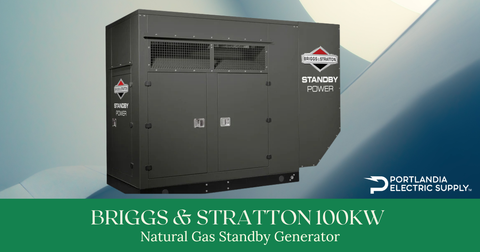
The 5,000-watt class is the workhorse of the portable generator market. A 5 kW unit typically offers a 120/240V 30-amp twist-lock (L14-30) — notice: 5,000 W ÷ 240 V = 20.8 A continuous, right under the 30 A receptacle with headroom. Run the same unit's 120V duplex outlets and you're limited to 15–20 A per receptacle no matter what the engine can make.
Solar inverters
A 5 kW grid-tie inverter at 240V outputs 20.8 A, landing on a 30 A breaker with the 125% continuous factor (20.8 × 1.25 = 26 A → 30 A). Our 5 kW inverter inventory and the 5 kW solar kit page both assume this math. Backfeed rules under NEC 705.12 then decide where in the panel that breaker can live.
Electric water heaters
The classic residential 4,500–5,500 W element runs on 240V: 4,500 W ÷ 240 V = 18.75 A continuous, × 1.25 = 23.4 A, so a 25 or 30 A two-pole breaker on 10 AWG. It's the single most common "5 kW class" circuit in American homes.
EV charging
A 40-amp Level 2 charger draws 9,600 W at 240V — nearly double our ratio. Charging at 5 kW (about 20 A) adds roughly 12–15 miles of range per hour, which covers most commuting overnight. Full cost breakdown in our EV charger installation cost guide.
Battery charging and off-grid
At 12 volts DC, 5,000 watts is 417 amps — welding-cable territory, 4/0 minimum, with serious fusing at the battery. This is why off-grid systems step up to 24V or 48V battery banks: the same 5 kW at 48V is only 104 A. Our battery bank sizing guide works through the DC side of this math.
At 41.7 amps, voltage drop stops being a footnote. On a 100-foot run of 6 AWG copper at 120V, a 41.7 A load drops about 4.2 volts — 3.5%, already past the NEC's 3% recommendation for branch circuits (210.19 Informational Note). The same load at 240V on the same wire drops the same absolute volts, but that's only 1.75% of the system voltage — comfortably inside limits. Double the voltage, halve the percentage pain.
| Run Length | Wire | Drop @ 120V / 41.7A | Drop @ 240V / 20.8A | Verdict |
|---|---|---|---|---|
| 50 ft | 6 AWG Cu | 2.1 V (1.7%) | 1.0 V (0.4%) | Both fine |
| 100 ft | 6 AWG Cu | 4.2 V (3.5%) | 2.1 V (0.9%) | 120V exceeds 3% |
| 100 ft | 4 AWG Cu | 2.6 V (2.2%) | 1.3 V (0.5%) | Upsize fixes 120V |
| 150 ft | 4 AWG Cu | 4.0 V (3.3%) | 2.0 V (0.8%) | 120V fails again |
Never "solve" a 5 kW load with an extension cord.
A 12-gauge cord at 41.7 amps is a fire waiting for a drafty garage. We've replaced the melted remains more than once — the cord doesn't fail loudly, it fails slowly, cooking insulation for months first. A 5 kW load gets a permanent, permitted circuit. Period.
How to Size Any Wattage: The Four-Step Procedure

Everything above generalizes. When a load lands on your counter — any wattage, any voltage — run this sequence:
Divide watts by volts
Get the raw current. Use the nameplate voltage, not a guess — a 120V-rated device on a nominal system is calculated at 120, a 240V device at 240.
Apply the 125% continuous factor if needed
Three hours or more of operation? Multiply by 1.25. NEC 210.20(A) for branch circuits, 215.3 for feeders.
Round up to a standard breaker
Use the NEC 240.6 list. 52.1 A becomes 60 A. Never round down, and never exceed the conductor's ampacity.
Select the conductor, then check voltage drop
NEC 310.16 for ampacity at your termination temperature (usually 75°C), then a drop calculation for any run over about 50 feet. Our NEC code compliance guide covers the termination-temperature trap that catches even experienced DIYers.
Related references from the counter
Plug confusion causes half the returns we process on generator and EV equipment. The NEMA designation system is logical once you decode it: the first number is the configuration family, the second is the amp rating, R is receptacle, P is plug. Here is the map for circuits anywhere near 5,000 watts:
| NEMA | Volts | Amps | Max Watts | Typical Use |
|---|---|---|---|---|
| 5-15 | 120 | 15 | 1,800 | Standard household outlet |
| 5-20 | 120 | 20 | 2,400 | Kitchen, garage, GFCI circuits |
| TT-30 | 120 | 30 | 3,600 | RV shore power |
| 5-50 | 120 | 50 | 6,000 | Rare; specialty 120V loads |
| 6-20 | 240 | 20 | 4,800 | Window AC, small tools |
| 6-30 | 240 | 30 | 7,200 | Dryers (older), welders |
| 14-30 | 120/240 | 30 | 7,200 | Modern dryers, generator L14-30 cousins |
| 14-50 | 120/240 | 50 | 12,000 | Ranges, EV chargers, RV 50A service |
| 6-50 | 240 | 50 | 12,000 | Welders, EV chargers (no neutral) |
| L14-30 | 120/240 | 30 | 7,200 | Generator twist-lock, transfer switches |
The trap: a 5,000-watt heater with a 5-15 plug. It doesn't exist legitimately — the plug itself caps the load at 1,800 W. If you see a "5,000 W" device with a household plug on a marketplace listing, walk away. The listing is lying about one or the other.
One more receptacle nuance worth knowing: the 14-50 has become the default "big outlet" in American garages because EV chargers standardized on it, and a 14-50R on a 50 A breaker legitimately serves anything up to 9,600 W continuous. If you're roughing in a new shop or garage today, a pair of 14-50Rs — one near the panel, one at the far wall — future-proofs you for welders, compressors, chargers, and generator inlet duty alike. We sell the boxes, covers, and 6/3 cable for exactly this rough-in weekly, and the customers who did it in 2019 are the ones not calling us in a panic now.
Solar designers live inside this ratio without calling it that. A 5 kW inverter fed by a 6.5 kW array — a 1.3 DC-to-AC ratio — clips a few percent of annual production at solar noon and harvests more energy the other twenty hours a day. That's deliberate oversizing, and it's standard practice. On the AC side, the inverter's 20.8 A continuous output at 240V is a continuous load by definition, so the backfeed breaker math runs 20.8 × 1.25 = 26 A, landing on 30 A every time. We've reviewed plan sets where the installer spec'd a 25 A breaker because "20.8 rounds to 25." It doesn't — 26 rounds to 30, and the inspector will red-tag it.
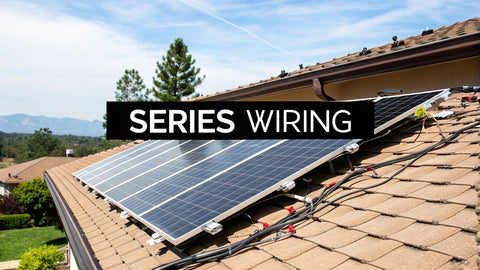
On the DC side the units change but the division doesn't. A 400-watt panel at a 40-volt Vmp runs 10 amps of Imp. String ten of them in series and the voltage stacks to 400V while current stays at 10 A — series adds volts, parallel adds amps, watts multiply either way. Ten strings in parallel into a 5 kW inverter is 100 A of DC, which is why hybrid inverters have multiple MPPT inputs: split the current, keep the wire sizes sane. Our charge controller sizing guide and inverter sizing calculator both run this math interactively.
Everything above assumes a resistive load with a power factor of 1.0 — heaters, water heater elements, incandescent light. Motors, compressors, and anything with a switching power supply draw apparent power (VA) greater than their real power (watts). A motor rated 5,000 W at 0.8 PF actually pulls 6,250 VA, and at 120V that's 52 amps — not 41.7. The wire, breaker, and generator all size to the VA, not the watts.
This is exactly why generator nameplates carry two numbers: kW and kVA. A "5 kW" generator with an 0.8 PF rating is a 6.25 kVA machine. Plug in 5 kW of resistive heaters and you're at the wall; plug in 5 kW of motor load and you're 25% past it. When customers ask why their 5 kW generator stalls on a load that "only measures 4,200 watts," power factor plus motor inrush is nearly always the answer. The fix list is short: measure inrush with a clamp meter that has a peak-hold function, stagger motor starts, and size the source to kVA, not kW.
Five kilowatts for one hour is 5 kilowatt-hours. At the 2026 national residential average of roughly 17 cents per kWh, running a 5 kW load costs about 85 cents an hour — $20.40 a day, $612 a month if it never shuts off. Continuous 5 kW loads are rare, but this math reframes purchases fast: a customer deciding between a $400 resistive heater bank and a $1,100 heat pump is really deciding between 5 kWh and roughly 1.7 kWh per hour of heat delivered, because heat pumps move heat at a coefficient of performance near 3. At 8 hours a day through a northern winter, that's the difference between $204 and $69 a month. The expensive box pays for itself in the first season.
The same 5 kWh framing drives battery decisions. A 5 kW load drains a 13.5 kWh battery in about 2.5 hours at usable depth of discharge — which is why whole-home backup planning starts from the load list, not the battery brochure. Run your own numbers with our battery sizing calculator, or compare storage hardware in the EG4 vs. Tesla Powerwall breakdown.
Commercial customers hit a wrinkle the moment three-phase service enters the picture. On a 208Y/120V system, 5,000 watts of balanced three-phase load doesn't draw 41.7 A — it draws 13.9 A per leg, because the three phases time-share the sine wave and the √3 factor (1.732) enters the denominator: 5,000 ÷ (208 × 1.732) = 13.9 A. Same watts, a third of the current per conductor. It's the strongest argument for three-phase service in any shop or small commercial building, and the reason commercial equipment defaults to three-phase above about 3 kW.
The trap we see quarterly: a customer measures 120V from a 208Y/120V panel's leg to neutral, buys "120V" equipment rated 5 kW, and connects it phase-to-phase where it sees 208V. Resistive loads tolerate it at reduced output — watts fall with the square of voltage, so the heater delivers about 3,750 W — but motors and electronics fail early. Match the nameplate voltage to the actual system voltage, measured with a meter, not assumed from the receptacle shape.
- Sizing to watts instead of VA. Motor and electronic loads draw apparent power above their watt rating. Multiply by 1.25 for power factor on anything with a motor or a switch-mode supply before you touch the breaker chart.
- Forgetting the continuous-load rule. A heater that runs all night is a continuous load even if the thermostat cycles it. The 125% factor applies to the design, not the duty cycle you hope for.
- Assuming the receptacle rating is the circuit rating. A 20 A receptacle on a 15 A breaker is still a 15 A circuit. Check the breaker, not the face.
- Ignoring ambient temperature. Attic and rooftop conduit runs derate conductor ampacity — at 104°F ambient, 6 AWG THHN copper loses meaningful capacity under NEC 310.15(B)(2). Phoenix attics and Minnesota garages are different planets for the same wire.
- Buying the generator before the load study. A clamp meter with peak-hold costs less than one percent of a wrong-sized portable generator. Measure first, buy once.
What is 5000 divided by 120?
41.67. In electrical terms, 5,000 watts ÷ 120 volts = 41.67 amps of current draw.
Can I run 5,000 watts on a regular outlet?
No. A standard 15 A / 120 V receptacle delivers 1,800 W maximum, and a 20 A circuit delivers 2,400 W (1,920 W continuous). A 5 kW load requires a dedicated 50–60 A circuit.
What size breaker do I need for 5,000 watts at 120V?
For a non-continuous load, 50 A. For a continuous load (three hours or more), apply the 125% rule: 41.67 × 1.25 = 52.1 A, which rounds up to a 60 A breaker per NEC 240.6.
What wire size for 5,000 watts at 120V?
8 AWG copper carries 50 A at 75°C for the non-continuous case; use 6 AWG (65 A) for the continuous 60 A circuit. Check voltage drop on any run longer than about 50 feet — you may need 4 AWG.
Is it better to run 5,000 watts at 240V?
Almost always, yes. Current halves to 20.8 A, a 30 A / 10 AWG circuit handles it, and voltage drop percentages quarter. Water heaters and larger appliances ship 240V for this reason.
How many amps does a 5,000-watt generator put out?
About 20.8 A at 240V (typically through an L14-30 twist-lock) or split across 120V duplex outlets at 15–20 A each. The 120V outlets can't deliver the full output individually — that's a receptacle limit, not an engine limit.
Need the circuit hardware?
Breakers, 6 AWG THHN, NEMA receptacles, transfer equipment — the counter stocks all of it. Bring us your load and run length and we'll size the whole circuit.
Shop Electrical Supplies