Briggs & Stratton 100kW Natural Gas Standby Generator (120/240V) — The Complete 2026 Commercial Power Guide
Model 080012 specs, NEC-compliant electrical design, fuel planning math, facility load coverage, and installed-cost reality — written from the supply side of the counter.

A 100kW standby generator is the dividing line between "big residential" and true commercial backup power. It's the size where the conversation stops being about keeping the fridge cold and starts being about keeping a business open: walk-in coolers, point-of-sale systems, server closets, life-safety circuits, and three-phase motor loads. The Briggs & Stratton 100kW (model 080012) is one of the most frequently quoted units in this class, and we've helped contractors and facility managers source, size, and ship more than a few of them.
I've stood on job sites where a 100kW unit was the difference between a grocery store riding out a four-day ice storm at full operation and a competitor across the street throwing away $40,000 of perishables. I've also seen the opposite mistake — a buyer who purchased on price alone, then discovered his gas service couldn't feed the unit at full load. This guide exists so you land in the first group. We cover the real specifications, the National Electrical Code (NEC) math for feeders and breakers, natural gas fuel planning, what a 100kW set actually covers in common facility types, and what the whole project costs installed in 2026.
Kilowatt classes are not interchangeable, and a 100kW set occupies a specific niche. Below roughly 60kW, you're usually looking at large estates, small offices, and light retail. Above 150kW you're in engineered territory — paralleling gear, dedicated switchgear rooms, and utility coordination on nearly every job. The 100kW class is the sweet spot for single-building commercial backup: one unit, one automatic transfer switch (ATS), one gas service upgrade, one concrete pad.
In our experience quoting this class, the typical buyer is one of four profiles. First, the small commercial owner — a restaurant, pharmacy, dental clinic, or neighborhood grocery that loses real revenue per hour of outage. Second, the property manager covering common areas, elevators, and fire pumps in a mid-size building. Third, the agricultural operator running well pumps, ventilation, and refrigeration where an outage is measured in livestock and product, not inconvenience. Fourth, the municipal or institutional buyer — a lift station, a firehouse, a small water treatment building — where code or insurance effectively mandates standby power.
If your load calculation lands under 70kW, an 80kW standby generator will usually do the job for meaningfully less money. If your peak demand pushes past 120kW, step up to the 125kW generator class rather than running a 100kW unit flat-out for days. Sizing discipline matters more than brand loyalty at this level.
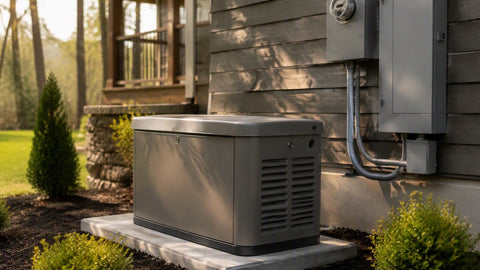
Here is the nameplate-level specification set for the 100kW Briggs & Stratton standby unit as shipped. The headline numbers: 100kW standby output at 125 kVA with a 0.8 power factor, driven by a PSI 5.7-liter turbo-charged V-8 running at the commercial-standard 1,800 RPM, fueled by natural gas.
| Specification | Details |
|---|---|
| Model Number | 080012 |
| Standby Power Rating | 100 kW / 125 kVA |
| Power Factor | 0.8 |
| Voltage | 120/240V |
| Phase | Three-Phase |
| Frequency | 60 Hz |
| Engine Manufacturer | PSI |
| Engine Configuration | V-8 |
| Engine Displacement | 5.7 Liters |
| Engine Type | Turbo-Charged, Liquid-Cooled |
| Operating Speed | 1,800 RPM |
| Fuel Type | Natural Gas |
| Sound Level | 81 dB(A) @ 7 Meters, No Load |
| Installation Type | Permanent Outdoor Standby |
| Operation | Fully Automatic |
Two details in that table deserve a second look. The 1,800 RPM operating speed is what separates commercial-grade sets from the 3,600 RPM air-cooled units sold for residential use — lower RPM means less wear per operating hour, quieter combustion, and an engine built for multi-day runs. And the PSI 5.7L V-8 is a purpose-built industrial gaseous engine, not a converted automotive block; parts support runs through industrial engine channels rather than the small-engine counter.
Sound at 81 dB(A) no-load is worth planning around: under load you'll add a few dB, and placement relative to property lines and bedroom windows matters. Most jurisdictions enforce a property-line limit (commonly 65–75 dB(A) at the lot line in commercial zones, stricter near residential), so we usually tell customers to sketch the pad location before they fall in love with a spot next to the electrical room.
This is the section most buying guides skip, and it's the section that decides whether your install passes inspection. At 240V three-phase, a 100kW set produces:
I = 100,000 W ÷ (240 V × 1.732) = 240.6 A full-load output current.
From there, NEC 445.13 requires the generator output conductors to have an ampacity of at least 115% of the nameplate current: 240.6 A × 1.15 = 276.7 A minimum conductor ampacity. NEC 240.6(A) standard overcurrent device sizes and Table 310.16 copper ampacities at 75°C give us the working design below.
| Design Element | Calculation / Code Reference | Result |
|---|---|---|
| Full-load current | 100,000 ÷ (240 × 1.732) | 240.6 A |
| Min. conductor ampacity | 240.6 A × 115% (NEC 445.13) | 276.7 A |
| Copper feeder size (75°C) | NEC Table 310.16 — 300 kcmil CU = 285 A | 300 kcmil per phase |
| Aluminum alternative (75°C) | NEC Table 310.16 — 400 kcmil AL = 285 A | 400 kcmil per phase |
| Standard OCPD size | NEC 240.6(A) — next standard above load | 250 A – 300 A frame |
| Equipment grounding conductor | NEC Table 250.122 (for 300 A OCPD) | 4 AWG copper |
| ATS rating | Must meet/exceed generator output & service | 300 A class |
Practical notes from the field: we recommend speccing the ATS at 300A even when the load-side math might justify 250A, because ATS pricing between the two frames is small compared with the cost of swapping one out later. Our 400A+ transfer switch inventory and the full automatic transfer switch lineup cover the common configurations, and our NEC wire sizing guide walks through the ampacity tables in more depth if you want to double-check the math with your electrician.
Permit reality check
A 100kW commercial installation is never a homeowner permit. Expect an engineered electrical permit, a mechanical/plumbing permit for the gas line, and in many jurisdictions a separate inspection for the concrete pad and anchoring. Your authority having jurisdiction (AHJ) may also require utility sign-off on the gas service upgrade before the generator permit is finalized. Budget four to eight weeks for the permit chain on a straightforward job.
Abstract kilowatts don't help a buyer. Buildings do. The coverage table below reflects the load profiles we see most often when customers call in asking "will a hundred cover my building?"
| Facility Type | Typical Load | 100kW Coverage |
|---|---|---|
| Retail store (~10,000 sq ft) | ≈40–70 kW | Full facility backup in most cases |
| Restaurant with full commercial kitchen | ≈50–80 kW | Full facility backup when properly sized |
| Medical or dental clinic | ≈30–60 kW | Full facility backup |
| Small manufacturing / machine shop | ≈60–95 kW | Full facility or critical loads |
| Large grocery (~25,000 sq ft) | ≈80–120 kW | Critical circuits prioritized |
| Mid-size office building (~20,000 sq ft) | ≈50–90 kW | Full facility backup |
The honest row in that table is the large grocery: at 80–120kW of demand, a single 100kW set can't carry everything during a peak summer afternoon with every compressor and HVAC stage running. That's where load-shedding strategy — dropping non-essential lighting banks or staggering compressor starts through the ATS controls — turns a marginal size into a workable one. A good controls contractor earns their fee on exactly this problem.
One sizing rule I give every commercial caller: run the load calculation at your worst month, not your average month. A restaurant that's 55kW in April can be 85kW in August with the walk-ins fighting 100°F ambient. Size for August, or accept that August outages mean partial operation.
Natural gas is the right fuel for most fixed commercial standby sets — no on-site storage, no refueling contracts, no fuel polishing. The catch is that a 100kW engine is a serious gas appliance, and the existing service to many buildings can't feed it at full load alongside the building's other gas equipment.
For planning purposes, gaseous-fueled standby engines in this class consume roughly 9–11 cubic feet of natural gas per kW-hour produced at full load, with part-load efficiency falling off below about 50% load. Using 10 ft³/kWh as a planning midpoint:
| Operating Point | Output | Est. NG Consumption | 8-Hour Run Total |
|---|---|---|---|
| 25% load | 25 kW | ≈300 ft³/hr | ≈2,400 ft³ (≈24 therms) |
| 50% load | 50 kW | ≈550 ft³/hr | ≈4,400 ft³ (≈44 therms) |
| 75% load | 75 kW | ≈800 ft³/hr | ≈6,400 ft³ (≈64 therms) |
| 100% load | 100 kW | ≈1,000 ft³/hr | ≈8,000 ft³ (≈80 therms) |
Those are planning figures for utility coordination and operating-cost estimates — confirm exact consumption against the unit's published fuel data before finalizing the gas service. The critical conversation is with your gas utility: a full-load draw around 1,000 ft³/hr (roughly 1,000,000 BTU/hr) usually means a dedicated meter run, upsized service line, and a pressure check at the generator connection point. I've seen more 100kW projects delayed by the gas service than by the generator itself, so start that conversation the week you order the unit, not the week it lands.
Operating cost perspective: at a commercial gas rate of $1.00–$1.40 per therm, a full-load 8-hour run costs roughly $80–$110 in fuel. Compare that with one day of lost revenue at a restaurant or a single spoiled inventory event, and the fuel math is never the reason a business skips standby power.
Installation Planning: Pad, Placement, and Sequence

A 100kW liquid-cooled set is a permanent piece of mechanical infrastructure. The installation sequence that keeps projects on schedule looks like this:
- Week 1–2: Load calculation finalized, generator ordered (lead times fluctuate — ask us for current availability on the Briggs & Stratton line and comparable commercial standby units), permit applications submitted, gas utility work order opened.
- Week 2–4: Pad poured. A 100kW-class unit with enclosure typically needs a reinforced concrete pad sized to the manufacturer's spec, with anchor bolts set per the drawing — not field-located.
- Week 3–5: Gas service upgrade completed and pressure-tested; electrical rough-in for the feeder run and ATS.
- Week 4–6: Unit set by crane or rigging crew, gas and electrical connections made, battery and block heater energized.
- Week 5–7: Startup commissioning: voltage and frequency verification under load bank or building load, transfer test, exercise schedule programmed, inspection sign-offs.
Placement details that bite people later: maintain the manufacturer's clearance on the exhaust side (hot discharge air recirculating into the intake is a silent output killer), keep the radiator discharge aimed away from building air intakes, and think about service access — a technician needs to open doors and pull the battery tray without moving a dumpster. If you're in snow country, a cold weather kit (battery warmer and oil warmer) is cheap insurance for reliable winter starts.
Buyers often anchor on the equipment price and get surprised by the project total. Here's the honest breakdown we walk customers through:
| Cost Component | Typical Range (2026) | Notes |
|---|---|---|
| 100kW generator unit | $28,000 – $40,000 | Varies by configuration and lead time |
| 300A-class ATS | $3,500 – $7,000 | Service-rated vs. switched-neutral affects price |
| Concrete pad & rigging | $4,000 – $9,000 | Site access drives rigging cost |
| Electrical labor & feeders | $8,000 – $18,000 | Long conduit runs push this up fast |
| Gas service upgrade & plumbing | $3,000 – $10,000 | Utility-side charges vary widely |
| Permits, engineering, commissioning | $2,500 – $6,000 | Includes load-bank test where specified |
| Project total | $49,000 – $90,000 | Typical turnkey range |
Against those numbers, weigh the outage exposure: the U.S. Department of Energy has long pegged commercial outage costs in the thousands of dollars per hour for retail and food service, and insurance rarely covers "we were closed." Most of our commercial buyers in this class report the unit paying for itself the first time it carries them through a multi-day event at full operation — and the second time is pure margin.
A standby generator fails you in exactly one way: not starting when called. The maintenance discipline that prevents it is boring and cheap compared to the asset it protects:
- Weekly exercise: the unit self-runs on schedule; verify it actually happened (remote monitoring through generator monitoring accessories removes the guesswork).
- Oil and filter: follow the engine schedule — typically annually or per run-hour interval, whichever comes first.
- Coolant: test concentration annually; a frozen block in January is a total loss event.
- Battery: load-test annually and replace proactively at 3–4 years. The number-one no-start cause we hear about is a $200 battery on a $40,000 asset.
- Annual professional service: a full PM with transfer test, connection torque check, and firmware updates keeps warranty coverage clean.
The 100kW rating assumes standard conditions — roughly 77°F (25°C) at sea level. Internal-combustion engines breathe air, and thin or hot air costs power. The widely used industry derate conventions are about 1% of output per 100 feet of elevation above sea level for naturally aspirated engines (turbo-charged engines like the 080012's PSI 5.7L hold rating much longer, typically to 1,500–3,000 feet before derating begins) and around 1% per 10°F above 77°F ambient once you exceed the rating temperature. Worked example: a naturally aspirated 100kW set installed at 5,000 feet in Denver on a 95°F day could be down to the mid-70s of usable kilowatts — enough to flip a "full coverage" design into a "partial coverage" surprise. The turbo-charged configuration on this unit is precisely why we recommend it for mountain-state customers: turbo engines recover much of that altitude loss by forcing intake air density back up. Confirm the exact derate curves against the factory specification sheet for your site elevation and design temperature before you commit to a size.
Buyers cross-shop this class constantly, so here's the candid counter talk. Against the Generac industrial line — which you can compare in our Generac collection — the Briggs 100kW competes on engine simplicity and dealer-network service, with the PSI gaseous engine being a known quantity among industrial service techs. Against Cummins, which you can browse in our Cummins generator lineup, the Briggs typically lands at a friendlier equipment price point while Cummins carries the deepest national service infrastructure. The deciding factors we see in practice are local dealer service strength (who actually answers the phone at 2 a.m. in your county), parts lead time, and total project cost rather than nameplate differences. All three brands will carry a 100kW commercial load; the ownership experience diverges on service, not on whether the lights stay on.
Where we steer buyers away from the 100kW Briggs specifically: sites requiring diesel fuel for code reasons, and sites above roughly 8,000 feet where even turbo-charged gaseous engines give up meaningful capacity. Everything else — restaurants, clinics, retail, offices, agriculture — is squarely in this unit's wheelhouse. One more sizing habit worth stealing from the pros: ask your electrician for a 30-day demand history from the utility rather than guessing from the panel schedule. Actual demand data beats nameplate addition every time, and I've watched it move a borderline project down a full generator class — saving the buyer fifteen grand and a bigger gas service he didn't need.
Commercial standby sets in this class typically ship with a limited warranty measured in years or run-hours, and the coverage that matters is labor-inclusive versus parts-only — read that line before you sign. More important than the paper warranty is the service channel: a 100kW unit is serviced by industrial generator technicians, not the small-engine shop that fixes lawn equipment. Before purchase, identify who within 50 miles of the site is authorized to service the unit and what their emergency response commitment is. We maintain parts sourcing across the generator accessories and service-parts categories, and we tell every commercial buyer the same thing: buy the generator your region can actually service. A cheaper unit with no local tech is the most expensive generator you'll ever own, the first time it sits silent through an outage waiting on a truck from three states away.
Can a 100kW generator run my whole commercial building?
For buildings up to roughly 20,000 square feet of office, retail, or clinic space with typical loads, yes — see the coverage table above. Large grocery, manufacturing with heavy motor loads, or multi-tenant buildings usually need load prioritization or a larger set. A proper load calculation answers this definitively; our generator sizing walkthrough explains the method.
How much natural gas does a 100kW generator use?
Plan on roughly 9–11 cubic feet per kW-hour at full load — around 1,000 ft³/hr (about 80 therms per 8-hour run) at full output. Part-load consumption drops but not proportionally; 50% load still burns more than half of full-load fuel.
What size transfer switch do I need for a 100kW generator?
At 240V three-phase the set produces about 241A full-load, so a 300A-class ATS is the standard pairing. If the generator feeds a whole service rather than selected loads, the ATS must be service-entrance rated and sized to the service, which can push you into the 400A+ switch class.
How long does a 100kW commercial generator installation take? From order to commissioned and inspected, plan on five to eight weeks for a straightforward job — permits and the gas utility's schedule are usually the pacing items, not the equipment itself. Complex sites with long feeder runs, utility transformer upgrades, or engineered anchoring requirements can stretch that to ten or twelve weeks, so order early in the season rather than waiting until after the first storm warning hits.
Is natural gas or diesel better at 100kW? Natural gas wins for most fixed commercial sites: unlimited runtime without refueling, lower maintenance, and no on-site fuel storage compliance burden. Diesel still wins where gas service is unavailable or where code (certain health-care and life-safety applications) favors stored fuel. This guide covers the natural gas configuration; if you're weighing both, talk to us about the trade-offs for your specific site.
What's the difference between a 100kW and 125kW standby set? About 60 amps of additional capacity at 240V three-phase — the difference between carrying a large grocery with load management and carrying it outright. If your load calc lands above 85kW sustained, the 125kW class is usually the more comfortable home.
Get a Real Quote on a 100kW Standby System
We stock and source commercial standby generators, transfer switches, and the accessories that make installs pass inspection the first time. Tell us your load profile and we'll match the right unit — no script-reading, just equipment people.
Browse 100kW Generators