Racking Systems for Solar Panels: A Buyer's Guide for Pros
Field-tested specs, load tables, and procurement math for roof-mount and ground-mount decisions that keep crews profitable and arrays standing for 25 years.
I have walked job sites where a racking choice made the difference between a six-hour install and a three-day nightmare. One crew showed up with rail-less clamps for a wavy, 40-year-old cedar-shake roof. They spent two days shimming. The other crew, on a clean comp-shingle roof, flew through a rail-less job in four hours flat. Same product, wrong site. That is the racking story in a nutshell: the hardware is only as good as the match between system, structure, and crew.
This guide cuts through catalog copy. We will cover load math you can take to the permit office, torque specs that keep arrays attached in 120 mph wind, freight realities that determine whether your BOM lands on time, and the NEC articles that inspectors actually check. We have pulled thousands of feet of 4/0 through EMT, sized ballast blocks for landfill caps, and argued with AHJs over ASCE 7 exposure categories. The tables below are built from the same reference data we use in our own design reviews.
The best racking system in the world is only as good as the crew installing it. I have seen brand-new IronRidge systems fail inspection because a helper torqued every lag bolt to the same setting regardless of rafter condition. I have seen ballasted systems slide on a membrane roof because the installer skipped the specified adhesive pads to save time. The hardware did not fail — the installation did.
NABCEP PV Installation Professional certification is the gold standard for solar installers, and for good reason. The exam covers not just electrical code but structural attachment, load paths, and manufacturer-specific installation requirements. A NABCEP-certified lead installer is significantly more likely to catch a racking mistake before it becomes a callback. For commercial projects, many AHJs now require a NABCEP-certified person of record on the permit.
Beyond certification, manufacturer-specific training is valuable. IronRidge, Unirac, and SnapNrack all offer installer training programs — some online, some hands-on at regional centers. These programs cover the specific quirks of each system: how the splice works, which clamps are compatible with which modules, and the exact torque sequence. A crew that has been through manufacturer training is typically 15–20% faster and has a lower callback rate. We require it for crews working on projects where we supply the racking.
| Certification | Focus | Typical Cost | Renewal |
|---|---|---|---|
| NABCEP PVIP | Full PV system design and install | $500–$700 exam | Every 3 years; 30 CEUs |
| NABCEP PVTS | Technical sales and design | $400–$600 exam | Every 3 years; 20 CEUs |
| IronRidge Certified Installer | IronRidge-specific systems | Free online | Annual refresh |
| OSHA 10/30 | Construction safety | $75–$200 | OSHA 30 does not expire |
I learned the hard way that racking delivery timing can make or break a project margin. We scheduled a 400 kW ground mount to start in late November in central Pennsylvania. The piles drove fine until the first freeze, then refusal rates jumped 40% and the crew was hand-digging half the embedments. What should have been a three-week racking phase stretched to seven. The general contractor ate the delay costs, but our relationship took a hit that cost us two referral jobs.
The lesson: plan racking installation in the shoulder seasons when possible. Spring (April–May) and early fall (September–October) offer the best soil conditions in northern climates and avoid the summer crew availability crunch. In the Southwest, summer heat creates its own problems — aluminum rails can reach 140°F surface temperature, making handling miserable and slowing torque work. We now track local weather patterns in our project management system and bake a two-week weather buffer into every ground-mount schedule.
Crew efficiency also varies by experience. A team that has installed 10+ projects with a single racking brand is typically 25–30% faster than a crew working with unfamiliar hardware. The time savings come from knowing exactly which bag contains the mid-clamp pack, how the rail splice works, and what the torque wrench setting should be without checking the manual. We standardize on two racking systems for 90% of our projects specifically to build this muscle memory.
Racking for Extreme Weather: Hurricanes, Hail, and Ice
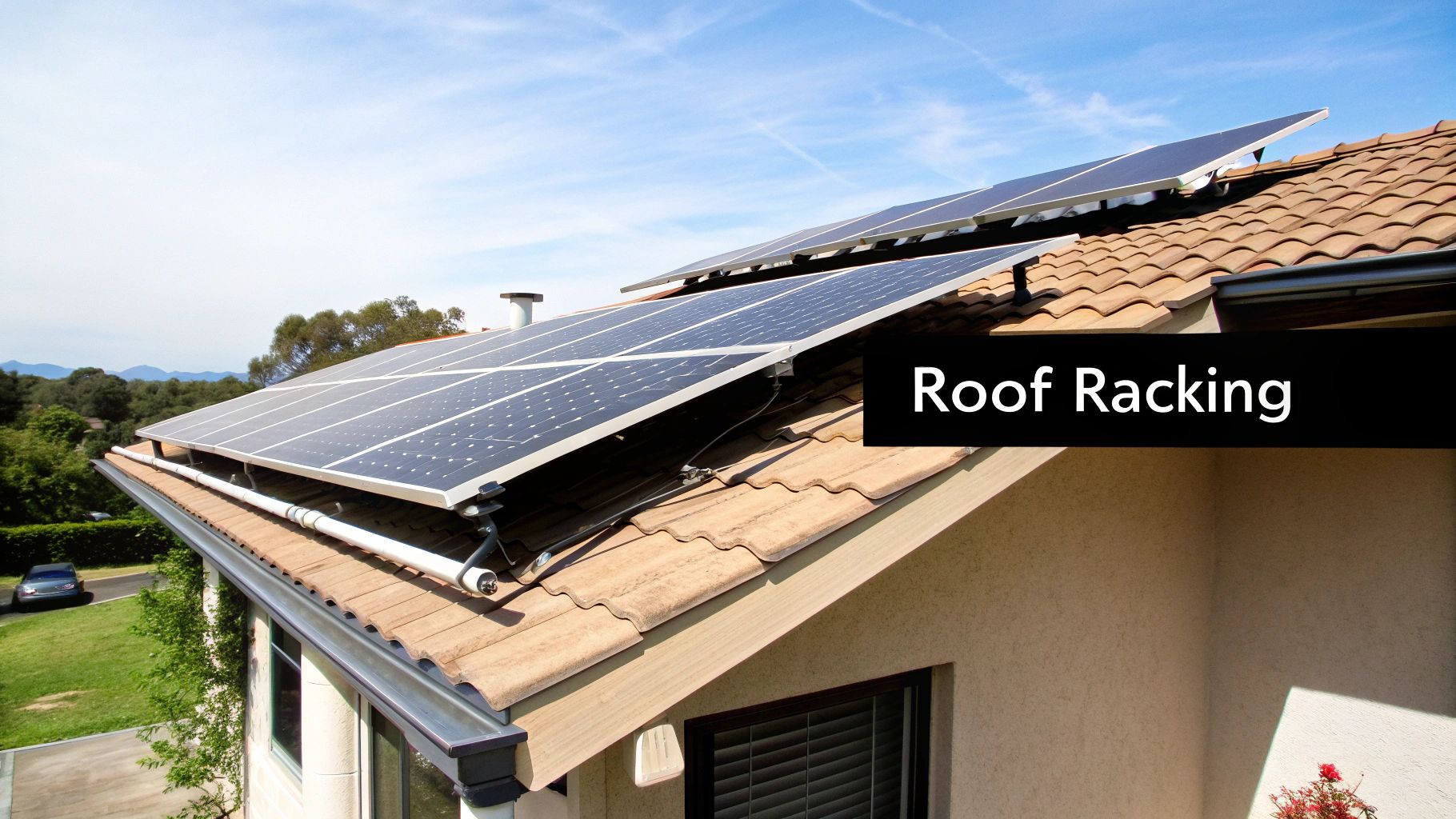
Standard racking is designed for standard weather. Extreme events require extreme thinking. After Hurricane Ian tore through Florida in 2022, we inspected several arrays that had survived and several that had not. The difference was rarely the module — it was the racking attachment and the quality of the structural engineering.
For hurricane-prone regions, the key upgrades are: shorter rail spans (reduce from 6 ft to 4 ft in high-uplift zones), additional attachment points per module, and structural screws instead of lag bolts where the manufacturer allows. Some jurisdictions in Florida now require pull-testing of roof attachments at 1.5x design load, which adds a day to the install but catches weak rafters before they fail.
Hail is a different threat. Most modules are rated for 25 mm hail at 23 m/s, but larger hail at higher velocities can crack glass and bend frames. The racking itself is rarely the failure point in hail — the module takes the hit — but a bent frame can stress clamps and create long-term loosening. After a significant hail event, every attachment point should be re-torqued and every module frame checked for deformation. Our warranty guide covers what hail damage typically is and is not covered under manufacturer policies.
Ice loading is the silent killer in northern climates. A 72-cell module with 1 inch of ice adds roughly 5.5 psf of extra dead load. That does not sound like much, but combined with a 35 psf snow load, it pushes many standard rail systems to their limit. In upstate New York and Vermont, we specify heavy-duty rails (XR-1000 or equivalent) and reduce spans by 20% compared to standard load zones. The extra material cost is roughly $0.02/W — trivial compared to an ice-collapse callback.
Foundation First: Roof-Mount vs. Ground-Mount
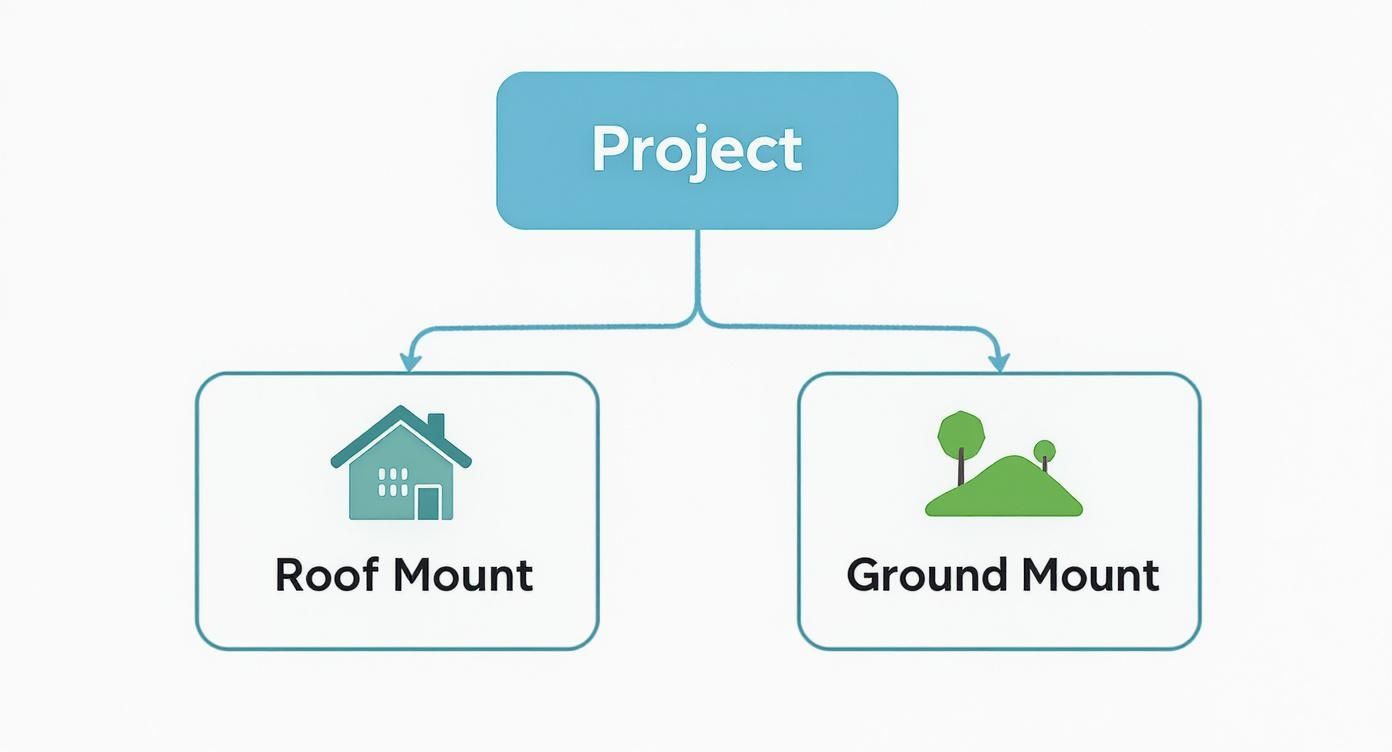
The first decision on any project is where the array lives. Roof mounts dominate residential and light commercial because they use existing structure. Ground mounts unlock scale but introduce foundation engineering, fencing, and often zoning battles. The numbers below are based on 2026 market data and typical labor rates for NABCEP-certified crews in the Mid-Atlantic.
| Metric | Residential Roof Mount | Commercial Roof Mount | Fixed-Tilt Ground | Single-Axis Tracker |
|---|---|---|---|---|
| Typical $/W installed | $2.80–$3.40 | $2.20–$2.80 | $2.00–$2.50 | $2.60–$3.20 |
| Racking $/W (material only) | $0.18–$0.28 | $0.15–$0.22 | $0.30–$0.45 | $0.55–$0.75 |
| Labor hours per kW | 0.8–1.2 | 0.5–0.9 | 1.5–2.5 | 2.0–3.0 |
| Foundation cost | Included in roof attach | Included in roof attach | $0.15–$0.30/W | $0.25–$0.40/W |
| Wind design basis | ASCE 7, 115–140 mph | ASCE 7, 115–140 mph | ASCE 7, 120–150 mph | ASCE 7, 120–150 mph |
| O&M access | Limited; ladder or lift | Walkable (ballasted) | Excellent | Good; motor drive service |
Trackers add 15–25% energy harvest but also moving parts, grease points, and a control system that needs firmware updates. We have seen tracker O&M contracts run $0.01–$0.02 per kWh annually. For a 1 MW tracker producing 1,800 MWh/yr, that is $18,000–$36,000 per year in maintenance. Factor it into your pro forma or you will be explaining a margin miss to your CFO.
For a deeper dive into rooftop installs, see our guide on how to install solar panels on a rooftop. If your project is warehouse-scale, our industrial solar panels breakdown covers structural load paths for large flat roofs.
Roof-Mount Racking: Rails, Rail-Less, and Attachment Math
On the roof, the game is about spreading load without creating leaks. Every penetration is a potential liability. Every missed rafter is a callback. The two dominant architectures are rail-based (IronRidge XR, Unirac RM) and rail-less (SnapNrack Ultra, Quick Mount PV).
| Feature | Rail-Based (IronRidge XR-100) | Rail-Less (SnapNrack Ultra) | Standing-Seam Clamp (S-5!) |
|---|---|---|---|
| Module attach per rail | Mid + end clamps every ~4 ft | Direct-to-rafter mount | Non-penetrating seam clamp |
| Adjustability | High; rails span imperfections | Moderate; roof must be flat | Low; seam spacing fixed |
| Parts count per kW | ~45–55 pieces | ~20–25 pieces | ~12–18 pieces |
| Install speed (resi) | Standard | Fast (~20% less labor) | Very fast on long seams |
| UL 2703 listing | Yes | Yes | Clamp only; racking partner |
| Best roof type | Comp shingle, tile, metal | New comp shingle, flat | Standing-seam metal only |
The attachment point is where roofs leak. On comp shingle, use a flashing that slides under the course above the bolt, with a butyl sealant bed. On tile, use a base and cap system (Quick Mount QB) that replaces a tile rather than drilling through it. On standing seam, an S-5! clamp at 2 ft on center with a specified clamping force is the gold standard — no holes, no leaks, no voided roof warranty.
Load path matters. A typical 72-cell module in a 50 psf snow zone creates a point load at each attachment. Spread across two rails with four L-feet, that is eight points. If your rafters are 24 inches on center and you miss one, the remaining seven carry 12.5% more load. On a marginal roof, that is the difference between passing and failing structural review. We have had PEs reject layouts for exactly this reason — one missed rafter in a row of twenty.
NEC 690.4(B) and Attachment Compliance
NEC 690.4(B) requires that mounting systems be listed and identified for the purpose. A racking system installed outside its listing — wrong roof type, wrong fastener, wrong spacing — voids the UL listing and the permit. Inspectors in jurisdictions following the 2023 NEC are increasingly checking listing documents against the actual install.
Ground-Mount Foundations: Piles, Ballast, and Geotech Reality
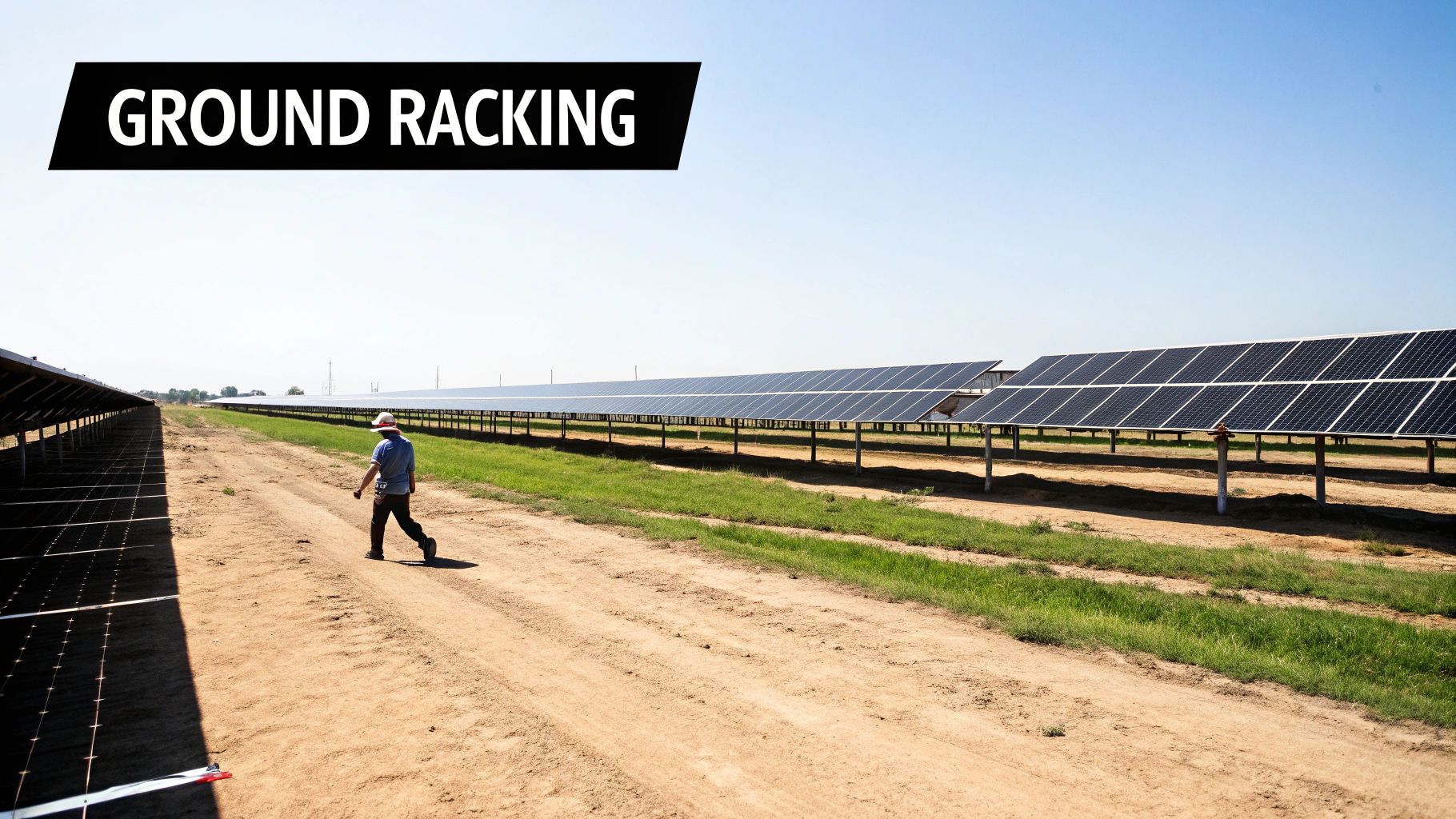
Ground mounts shift the engineering underground. Soil, not shingles, determines the foundation. A geotechnical report is non-negotiable for any ground-mount over a few dozen kilowatts, and most AHJs require it for commercial permits. The report gives you bearing capacity, soil classification per ASTM D2488, frost depth, and corrosion potential — all inputs for the foundation design.
| Foundation Type | Typical Soil | Embedment Depth | Cost per Post | Pros | Cons |
|---|---|---|---|---|---|
| Driven pile (W6x9) | Dense sand, stiff clay | 4–8 ft | $45–$85 | Fast, no concrete cure | Noise, vibration, refusal risk |
| Helical pile (2.875" dia) | Soft clay, loose fill | 6–15 ft | $80–$140 | Installs in poor soil, torque-verified | Higher cost, specialty crew |
| Ballasted (concrete block) | Rock, landfill, contaminated | N/A (surface) | $120–$220 per kW | No excavation, no soil contact | Heavy freight, large footprint |
| Poured concrete pier | All types (with formwork) | Below frost line | $60–$110 | High capacity, proven | Cure time, excavation, forms |
For driven piles, the refusal criteria matter. A pile driven to refusal at 4 feet in one spot and 7 feet in another tells you the soil is heterogeneous — which means your structural engineer needs to design for the worst case or specify pre-drilling. I have seen EPCs eat $15,000 in change orders because they assumed uniform soil across a 2-acre field. The geotech report would have flagged it on page three.
Corrosion is another sleeper issue. Galvanized steel piles in corrosive soil (resistivity <2,000 ohm-cm per ASTM G57) may need cathodic protection or a switch to aluminum. In coastal zones within a mile of salt water, even hot-dip galvanized hardware can show red rust in five years. We stock aluminum racking from IronRidge for exactly these sites.
If you are weighing tracker vs. fixed-tilt for a commercial ground mount, our tracker vs. fixed-tilt analysis breaks down the energy and O&M math.
Structural Loads: Wind, Snow, and the ASCE 7 Worksheet
Every racking system must survive the environmental loads at its site. ASCE 7-22 is the current reference standard, and most jurisdictions have adopted it or are transitioning. The critical inputs are basic wind speed (V), exposure category, roof zone (for roof mounts), and ground snow load (pg).
| Parameter | Source / Method | Typical PA Value | Typical AZ Value | Design Impact |
|---|---|---|---|---|
| Basic wind speed (V) | ASCE 7-22 Fig 26.5-1 | 110–120 mph | 115–130 mph | Uplift on modules; fastener tension |
| Exposure category | Site survey / terrain | B (suburban) | C (open) | Pressure coefficient +15% for C vs B |
| Ground snow load (pg) | ASCE 7-22 Fig 7.2-1 | 20–35 psf | 0–5 psf | Downward load on rails and posts |
| Seismic SDS | USGS / ASCE 7-22 Ch. 11 | 0.10–0.20g | 0.15–0.30g | Rarely controls solar; check if >0.30g |
| Module pressure (qp) | ASCE 7-22 Eq 30.3-1 | ~35–55 psf uplift | ~40–65 psf uplift | Rail span, clamp count, post depth |
Here is a quick sanity check you can run in the field. A 72-cell module measures roughly 2.2 m x 1.1 m = 2.42 m². At 50 psf uplift (0.35 psi), the total uplift force on one module is 2.42 m² x 0.35 psi x 6894.76 Pa/psi ≈ 5,840 Pa x 2.42 m² ≈ 14,100 N, or about 3,170 lbf. Divided across four clamps, each clamp sees roughly 790 lbf in tension. Your clamp and rail must be rated for that, with a safety factor.
Most rail systems publish allowable loads per span. IronRidge XR-100, for example, is rated at roughly 75 lbf/ft in uplift at a 6-foot span. Two rails supporting a 4.3-foot-wide module give you 2 x 6 ft x 75 lbf/ft = 900 lbf capacity. Against our 3,170 lbf example, that is insufficient — you need a shorter span, a stronger rail (XR-1000), or more rails. This is the math PEs run, and it is the math that gets arrays through inspection.
Procurement and Freight: The Hidden Cost Killers
Racking is bulky freight. A 20-foot aluminum rail ships by LTL or flatbed, and long rails often trigger oversize charges. On a 500 kW ground mount, you might have 200 rails at 20 ft each — 4,000 linear feet of aluminum. At roughly 1.5 lb/ft, that is 6,000 lb of rail alone, plus posts, hardware, and ballast.
Freight optimization is where a distributor earns its keep. Kitting — packaging all components for a specific array block in one crate — cuts on-site sorting time and reduces lost-part risk. We kit racking orders by roof face or tracker row so crews spend minutes, not hours, hunting for the right flashing pack.
Lead times vary seasonally. Q1 often sees 4–6 week delivery for domestic rail; Q3 can stretch to 8–10 weeks as project volume peaks. Ordering racking 8 weeks ahead of install is a safe rule. For tracker systems, 12–16 weeks is more realistic due to motor and control lead times.
If you need a full BOM reviewed for freight efficiency, our supply chain guide covers kitting strategies. For wire and conductor sizing that pairs with your racking layout, see the solar wire and cable guide.
Frequently Asked Questions
Can I mix racking brands on the same project?
No. Racking systems are tested and listed as integrated assemblies. Mixing rails from one brand with clamps from another voids the UL 2703 listing and the structural warranty. We have seen inspectors red-tag jobs for exactly this. Stick to one listed system per array.
What is the difference between UL 2703 and UL 1703?
UL 1703 covers the PV module itself — fire and electrical safety. UL 2703 covers the mounting system, including structural integrity, grounding continuity, and bonding. A UL 2703 system often has integrated bonding through the rail, which eliminates separate grounding lugs and saves labor.
How deep must ground-mount posts go?
Depth depends on soil bearing capacity, frost line, and overturning moment from wind. In Pennsylvania, frost depth is 36–42 inches; posts must extend below it. In Minnesota, 60 inches is common. The structural engineer calculates the exact embedment based on the geotech report and ASCE 7 loads. Do not guess.
Does rail-less racking save enough labor to justify it?
On a new, straight comp-shingle roof, rail-less can cut labor by 15–25%. On an older roof with waves or multiple planes, rail-based is often faster because the rail spans imperfections. Run a test section on your first job and time it. We have seen crews save $0.08/W in labor on rail-less; we have also seen them lose money when the roof demanded extra shimming.
What torque spec should I use on lag bolts?
Follow the racking manufacturer’s installation manual exactly. Typical 5/16" lag bolts into solid wood call for 150–200 in-lb; 3/8" lags run 200–250 in-lb. Over-torque splits the rafter. Under-torque backs out under thermal cycling. Use a calibrated torque wrench and check it annually on the first few jobs until your crew is consistent.
Ready to lock in your racking BOM?
Portlandia Electric Supply stocks IronRidge, Unirac, S-5!, and SnapNrack systems with NABCEP design support and freight-optimized kitting.
Related Resources:
- How to Install Solar Panels on a Rooftop
- Industrial Solar Panels Guide
- Tracker vs. Fixed-Tilt Analysis
- Supply Chain Disruption Management
- Solar Wire and Cable Guide
- IronRidge Racking
- Solar Panel Mounting Guide
- Solar System Calculator
- Solar Permitting Guide
- NEC Code Compliance Guide
- Pro Account — Wholesale Pricing
- PowerLink Network — Contractor Program
NEC Article 690 covers solar PV systems, and within it, Section 690.43 addresses equipment grounding. For roof-mounted systems, the racking itself must be grounded, and if the racking is listed to UL 2703, the bonding path may be integral to the rail. This eliminates the need for separate equipment grounding conductors (EGC) for each module, which was the old method and still creates a spaghetti mess on some older installs.
I inspected a 2018 install last month where the installer ran #10 copper EGCs to every single module clamp. It took them an extra four hours, and the resulting wire nest was a thermal nightmare. A modern UL 2703 rail with integrated bonding would have saved the labor and produced a cleaner, safer install. The bonding path through the rail is tested to carry fault current, and the listing covers the specific torque and hardware required.
Grounding electrode systems for ground-mounted arrays deserve attention too. NEC 690.47 requires a grounding electrode conductor (GEC) connected to the array frame, sized per Table 250.66. For a typical commercial ground mount, that means a #6 AWG copper conductor to a ground rod. In rocky soil where driving a rod is impractical, a ground ring or Ufer ground (concrete-encased electrode) may be required. Always confirm the grounding design with the AHJ before trenching — we have seen projects delayed two weeks over a grounding detail that could have been resolved in the plan review phase.
Commercial rooftop arrays must comply with fire setback requirements, which vary by jurisdiction but often follow the International Fire Code (IFC) or local amendments. The general rule: maintain a 3-foot perimeter around the array and a 4-foot access path from the roof edge to any point on the array. Some jurisdictions require 6-foot paths for buildings over a certain height.
These setbacks directly impact energy production. A 100,000 sq ft roof with 4-foot setbacks on all sides loses roughly 15–20% of usable array area. On a 1 MW design, that can mean 150–200 kW less installed capacity. The financial impact is real: at $2.50/W, 175 kW less is $437,500 less revenue-generating asset on the same roof. Designers should model setback scenarios early and present the tradeoffs to the client.
For ballasted systems on flat roofs, parapet height also matters. A 3-foot parapet provides wind shielding that can reduce uplift loads by 10–15% in some ASCE 7 calculations, which in turn allows wider rail spans or fewer attachment points. But the parapet cannot block firefighter access, and some AHJs require vertical access paths that cut through the array. Coordinate with the fire marshal during design, not after the array is laid out.
Most roof-mount racking is 6005-T5 or 6063-T6 aluminum for its strength-to-weight ratio and corrosion resistance. Ground mounts often use galvanized steel (G90 or G185 coating) for cost and stiffness. Within a mile of salt water, aluminum is the safer choice — even G185 steel can show red rust in 5–7 years in coastal environments.
The material choice affects freight costs too. Aluminum is roughly one-third the density of steel, so a 20-foot aluminum rail weighs about 10 lb, while a comparable steel rail might weigh 30 lb. On a 500 kW project with 200 rails, that is a 4,000 lb difference — enough to shift the shipment from LTL to parcel for some components, or to reduce the total truck count on a large job.
We stock both materials and can advise based on your site conditions. For a project on Cape Cod last year, we specified aluminum rails with stainless steel hardware to survive the salt air. The upfront material cost was 8% higher, but the expected service life doubled from 15 years to 30+ years. Over a 25-year PPA, that is a meaningful O&M savings.