Buying solar panels online has gone from a fringe move to the standard procurement path for contractors, off-grid builders, and a growing slice of homeowners. The catch: an online listing compresses a 25-year hardware decision into a product page, and the sellers who thrive in that environment range from excellent stocking distributors to brokers who've never touched a module. I've bought panels from both, and the difference shows up about eighteen months after the install — when a warranty claim either gets answered or doesn't. This guide covers how to read online listings like a professional buyer, what fair pricing looks like, how shipping and damage claims actually work, and how to match an online purchase to your installation plan.

The online solar buying landscape
Online solar sellers fall into four buckets, and identifying which one you're dealing with takes about ninety seconds:
- Stocking distributors with real warehouses. They hold inventory, publish datasheets, process RMAs domestically, and can tell you a pallet's ship date without calling anyone. This is who you want for most purchases.
- Manufacturer outlet stores. A few brands sell surplus, cosmetic-second, or previous-generation modules directly. Genuine deals exist here, with full factory warranty on graded product.
- Brokers and drop-shippers. A polished storefront, no warehouse, and your order forwarded to whoever has stock that week. Not automatically bad — but you must know your warranty path runs through them.
- Surplus and liquidation sellers. End-of-line and project-leftover modules at deep discounts. Fantastic for off-grid and DIY builds; verify warranty status in writing, because some surplus stock carries none.
A quick legitimacy test I use on any unfamiliar seller: call the number on the site and ask a technical question — say, whether a listed 450 W module's Voc stays under the 600 V limit on a 14-module string at your design temperature. A real solar distributor answers or finds someone who can. A pure broker forwards your call into the void. If you're comparing sources, our guide to buying direct from manufacturers explains how the channel above these sellers works.
Panel types and the specs that matter
Online listings bury you in model numbers. Strip them down to five lines and the comparison gets easy: technology, wattage, efficiency, temperature coefficient, and degradation schedule.
| Panel Type | Typical Wattage (Residential Format) | Typical Efficiency | Temp. Coefficient (Pmax) | Best Fit |
|---|---|---|---|---|
| Mono PERC | 400 – 440 W | 20.5% – 21.8% | −0.34 to −0.40 %/°C | Budget builds, ground mounts with room to spare |
| TOPCon | 430 – 470 W | 21.8% – 23.0% | −0.29 to −0.32 %/°C | Roof-constrained installs; best mainstream value today |
| HJT | 430 – 470 W | 22.0% – 23.2% | −0.24 to −0.26 %/°C | Hot climates; premium residential |
| Polycrystalline (legacy) | 250 – 340 W | 15% – 18% | −0.38 to −0.45 %/°C | Surplus-bin specials; fine for shops and pumps |
Two datasheet checks before any online purchase. First, temperature math: a 450 W TOPCon module at −0.30%/°C loses about 0.30 × 25 = 7.5% of rated output when the cell runs 25°C above the 25°C test condition — roughly 416 W of real hot-afternoon power. Second, degradation: a 30-year performance warranty promising 87.4% at year 30 beats a 25-year promise of 84.8% by about 2.6 points of lifetime production. Our 2026 efficiency buyer's guide tracks the current leaders, and the high-efficiency panels overview explains when premium efficiency actually pays back. If you're price-shopping older tech, the BlueSun panels review and affordable panels guide cover the value end of the market honestly.
What fair pricing looks like online
Price-per-watt is the only sane way to compare listings across wattages. Here's where the U.S. online market sits for new, warranted modules:
| Purchase Format | Typical $/W Range | Example: 450 W Module | What You're Paying For |
|---|---|---|---|
| Single module, shipped | $0.55 – $0.85 | $248 – $383 | Convenience; freight on a single 50 lb parcel is brutal |
| 4–10 modules | $0.45 – $0.65 | $203 – $293 each | Small-project reality; still parcel/LTL freight |
| Full pallet (31–36) | $0.35 – $0.50 | $158 – $225 each | The sweet spot for serious DIY and small contractors |
| Multi-pallet / truckload | $0.28 – $0.40 | $126 – $180 each | Contractor volume; ask for a quote, don't click "buy" |
Do the division on any listing before you trust it. A "great deal" at $299 for a 400 W panel is $0.75/W — retail-plus. The same seller at $189 for a 450 W panel is $0.42/W, which is honest pallet pricing. Our bulk purchasing guide and the live bulk sale listings show what volume pricing looks like when you're ready to step up.
Evaluating an online seller: the six-point check
- Physical address and warehouse. Map it. A distribution center in satellite view beats a suite number above a nail salon.
- Named brands with datasheets. "Tier 1 450W solar panel" without a manufacturer name is a red flag. Real sellers name Jinko, Canadian Solar, REC, Mission Solar, or whoever made the module, and link the datasheet.
- Warranty terms in writing. Product years, performance years, and who handles the claim. If the answer is "contact the manufacturer," you are the warranty department.
- Freight policy spelled out. Liftgate included? Residential delivery surcharge? Damage claim window? All three should be on the site before you order.
- Return policy for unopened pallets. Restocking fees of 15–25% are normal; "all sales final" on new product is not.
- Payment safety. Credit card or net terms. A seller who pushes wire-only payment for a first order is asking you to absorb all the risk.
Shipping, freight, and the damage-claim reality
Modules ship as glass — because that's what they are. A single panel goes parcel; anything from four modules up goes LTL freight on a pallet, and a full pallet goes as its own shipment. Budget the real numbers:
| Shipment Size | Typical Freight Cost (U.S. Continental) | Transit Time | Damage Risk Profile |
|---|---|---|---|
| 1–3 modules (parcel) | $80 – $250 | 3–7 days | Highest per-module risk; corners take the hits |
| 4–15 modules (LTL pallet) | $250 – $600 | 4–10 days | Moderate; inspect before signing |
| Full pallet (31–36) | $350 – $800 | 5–12 days | Lowest per-module risk; factory packaging intact |
| Multi-pallet truckload | Quoted per lane | Scheduled | Low; direct truck, no terminal transfers |
Field rules I enforce on every delivery, and you should too: photograph the pallet before the driver leaves, note any damage on the delivery receipt before signing, and open every module box within the seller's claim window — usually 5 to 15 days. A clean signature on the receipt is the freight company's get-out-of-jail-free card. I've eaten a $340 module because my guy signed "received in good condition" over a fork-tine hole you could see from the street. Never again.
Warranties and post-purchase support
Online purchases carry the same two warranties as any channel — product (typically 12–25 years) and performance (25–30 years) — but the claim path is what changes. Three questions to settle before checkout:
- Who files the claim? Strong distributors process RMAs with the factory for you. Weaker ones hand you a factory email address.
- Who pays freight on a replacement? Many warranties cover the module, not the shipping. On a single residential replacement, freight can exceed the panel's depreciated value.
- Is DIY installation covered? Some manufacturers require licensed-contractor installation for full coverage. If you're self-installing, confirm in writing — our DIY solar home guide covers the permit and inspection side of that decision.
For a deeper read on warranty language, see the solar panel warranty explainer — the difference between "linear" and "step" performance warranties is worth real money in year 20.
Matching the purchase to the installation plan
Buying hardware online and hiring labor separately — the "customer-sourced components" model — can save 15–30% against turnkey pricing, but only when the installer agrees to the arrangement before you order. Many won't warranty workmanship on owner-supplied equipment, and some won't touch it at all. Settle three things in writing: workmanship warranty terms on customer-supplied gear, who owns the interconnection application, and who handles permitting. Then order the hardware. Reversing that order is how garages fill up with orphaned pallets.
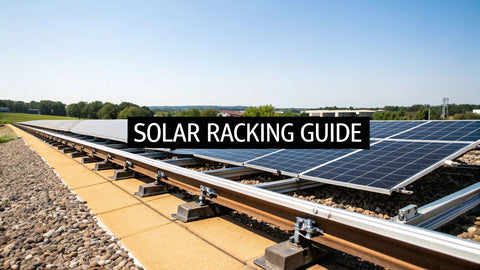
If you're still mapping the full system, our system components guide and installed cost breakdown will keep the hardware, racking, inverter, and labor line items straight before you spend a dollar.
Electrical compatibility: the check most online buyers skip
Modules don't work alone — they have to mate with an inverter's input window, and that's where online purchases go sideways. Before you buy, run the string-sizing math against your candidate inverter. The governing rule is NEC 690.7: your string's maximum open-circuit voltage, corrected for the coldest expected temperature, must stay below the inverter's maximum input rating (and below the 600 V limit for most residential systems; 1,000 V applies to many commercial designs).
Here's the correction math in table form, using a 450 W module with Voc = 41.0 V and a Voc temperature coefficient of −0.27%/°C:
| Design Low Temp | Correction Factor (NEC 690.7 Table) | Corrected Voc per Module | Max Modules on a 600 V String |
|---|---|---|---|
| 0°C / 32°F | 1.10 | 45.1 V | 13 (13 × 45.1 = 586.3 V) |
| −10°C / 14°F | 1.14 | 46.7 V | 12 (12 × 46.7 = 560.4 V) |
| −20°C / −4°F | 1.18 | 48.4 V | 12 (12 × 48.4 = 580.8 V) |
| −30°C / −22°F | 1.22 | 50.0 V | 11 (11 × 50.0 = 550.0 V) |
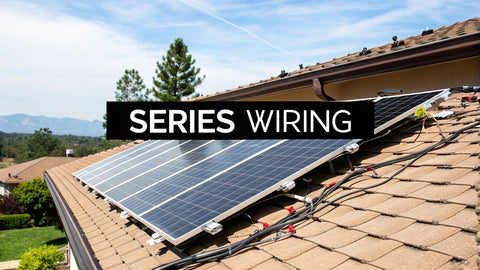
That table is why "12 panels on a string" is a climate answer, not a universal one. A buyer in Phoenix can hang 13 modules on a 600 V string; a buyer in Fargo stops at 11. If the online seller can't or won't confirm the module's Voc and temperature coefficient, you can't run this math — and you shouldn't buy. The series wiring guide walks the full string-design process, and the solar inverter overview covers matching inverters to array sizes once your strings are set.
The quote-comparison worksheet

When you have three tabs open from three sellers, score each offer on the same five lines:
- Delivered $/W. (Module price + freight + surcharges) ÷ total nameplate watts. Not list price — delivered.
- Warranty years, product and performance. Write both numbers down; "25-year warranty" in a headline often means 12 product + 25 performance.
- Claim path. Seller-managed RMA or factory-direct email? One is a service; the other is a hobby.
- Stock status. "Ships in 2–3 weeks" from a broker often means "we'll find some." Stocking distributors quote ship dates from their own racks.
- Return terms. Restocking percentage, who pays return freight, and the window. Fifteen percent restocking with a 30-day window is fair; "all sales final" is not.
A seller who wins four of five lines at a half-cent premium beats a seller who wins on price alone, every time. The half-cent buys you the claim path, and the claim path is the product's insurance policy.
Red flags in online listings
After fifteen years of buying modules on the internet, these are the tells that save you money:
- Stock photos with no datasheet link. Real sellers are proud of the spec sheet; it's their best sales tool.
- "Tier 1" with no brand name. Tier 1 describes manufacturers, not mystery panels. The current Tier 1 list is public — any seller claiming the status can name the brand.
- Prices 20%+ below the market band. Below-market modules are usually B-grade, gray-market, or phantom inventory. Each is a different flavor of bad.
- No freight quote process. A seller who can't quote LTL freight on a pallet doesn't ship pallets often. That's experience you don't want to fund.
- Reviews that mention nothing technical. Generic five-star reviews ("great product, fast shipping!") are cheap to buy. Look for reviews that mention model numbers, freight experience, and claim handling.
Regional and site considerations for online orders
Two site facts change what you should buy online. First, snow and wind loads: if your jurisdiction enforces a 5,400 Pa uplift or heavy-snow mechanical rating, filter listings by the mechanical load line on the datasheet, not the price. Second, salt mist and ammonia: coastal installs within roughly 500 meters of breaking surf and agricultural installs near livestock need IEC 61701 salt-mist and IEC 62716 ammonia certifications respectively. Neither certification costs much at the factory; both are expensive to retrofit after corrosion shows up in year four.
Delivery logistics also change by address type. Residential LTL delivery with liftgate service adds $75–$150 over commercial-dock pricing, and some carriers won't attempt tight residential streets with a 53-foot trailer at all. If your site can't take a full truck, tell the seller before you order — re-delivery and storage fees after a failed attempt are real money, and they're always the buyer's problem.
Post-purchase: monitoring and performance verification
The day your online-bought system goes live, establish a baseline. Note the array's nameplate (modules × watts), then compare the first clear-sky noon production against 75–85% of nameplate — a healthy grid-tied system lands in that band after temperature and inverter losses. Logging that number gives you the reference point every future troubleshooting session and warranty conversation will need. Most modern inverter platforms include monitoring apps; if yours doesn't, a $30 CT-clamp energy monitor on the solar breaker does the job. Module-level electronics (microinverters or optimizers) give you per-panel data that makes warranty claims nearly self-proving — a dead panel shows up as a dead bar on a chart, which is a much easier conversation than a voltmeter argument.
Financing an online hardware purchase
Paying for panels bought online works differently than financing a turnkey system. Installers bundle financing into the project; online buyers arrange their own. The realistic options, in order of typical cost:
- Cash or check. Zero cost of capital and often a 1–2% discount from distributors. For pallet-quantity purchases under $10,000, this is usually the right answer.
- Credit card. A 2.5–3% processing premium is common, but the purchase protection and chargeback rights on a first order from a new seller are worth more than the fee. I put every first-time-seller order on a card; established accounts get ACH.
- Home equity products. HELOC rates typically beat every solar-specific loan product for buyers with equity, and the interest may be deductible when the funds improve the home — confirm with your tax advisor, because the rules shifted with recent tax law changes.
- Specialty solar loans. Dealer-fee-heavy products that made turnkey solar expensive do exist for equipment-only purchases, but read the fee schedule: a 15% dealer fee baked into the loan principal can erase the entire savings of online procurement.
Whatever the source, compare the total financed cost — principal plus interest plus fees — against a turnkey quote for the same equipment before you commit. The honest comparison occasionally favors turnkey, and it's better to learn that before the pallet ships than after.
When turnkey beats buying online
This is a guide to buying online, and I'll still tell you when not to. Turnkey installation wins when your roof is complex (multiple planes, steep pitch, tile), when your jurisdiction's permitting is genuinely adversarial, when you have no appetite for managing a freight delivery and an installer relationship simultaneously, or when the turnkey quote is within about 15% of your self-procured total. The installer's single-point warranty — one company responsible for hardware, labor, roof penetrations, and production — has real economic value, and on complicated roofs it routinely exceeds the procurement savings. Buy online when the project is straightforward and you're organized; buy turnkey when the project is hard and your time is expensive.
Reading reviews and marketplace ratings without getting fooled
Review literacy is a core buying skill online. Weight reviews by specificity: a review that names the module model, the freight carrier, and how a problem was handled is worth fifty that say "great panels." Check the distribution of ratings, not the average — a seller with 4.7 stars and a visible cluster of one-star freight-damage reviews has a shipping problem the average hides. And check dates: a seller whose reviews stop eighteen months ago may have changed ownership, warehouse, or worse. Marketplace platforms add a layer of seller metrics (on-time ship rate, response time, defect rate); on those platforms, a 98% positive metric from a solar specialist beats a 99.5% metric from a general merchandise store that also sells phone cases. We've vetted enough sellers over the years to know that the ones who answer pre-sale questions within a business day are the same ones who answer warranty emails in year six.
Sales tax, permits, and the paperwork nobody warns you about
Two administrative details catch online buyers flat-footed. First, sales tax: post-Wayfair, most states require online sellers to collect sales tax, but not all sellers comply — and you may owe use tax on your return if they don't. Keep every invoice. Second, permits: your AHJ doesn't care where the panels came from, but the permit application will ask for equipment cut sheets with UL listings, and some online sellers are slow to provide them. Request datasheets, UL certificates, and installation manuals at the time of purchase, not when the inspector asks. On my first online pallet buy, I spent three weeks chasing a UL 61730 certificate the seller didn't have on file — the permit office wouldn't budge without it. Now that certificate request goes in the same email as the purchase order, every time.
A note on pallet storage before your install date
Hardware often arrives before the permit does. Store modules flat on their original pallet, indoors if possible, and never lean them against a wall face-down on concrete — the glass is tough, the backsheet is not. Keep the pallet banding intact until install day, keep connectors off the floor, and keep the boxes dry; a damp cardboard sleeve around an MC4 connector is a ground-fault troubleshooting session waiting to happen. If storage will run past 90 days, tell your installer the modules are on site so scheduling pressure doesn't push anyone into a rushed racking job.
Frequently asked questions
Is it safe to buy solar panels online?
Yes, from stocking distributors and manufacturer outlets with written warranty and freight policies. Verify a physical warehouse, named module brands with datasheets, and a damage-claim process before ordering. Avoid wire-only payment terms on a first purchase from any seller.
How much do solar panels cost online?
As of the current market, single modules run $0.55–$0.85 per watt delivered, small quantities $0.45–$0.65, and full pallets $0.35–$0.50. Multi-pallet contractor pricing dips to $0.28–$0.40 per watt. Always convert a listing to dollars per watt before comparing.
What happens if panels arrive damaged?
Document damage on the delivery receipt before signing, photograph everything, and file within the seller's claim window — typically 5 to 15 days. A clean signature on the receipt usually transfers the loss to you, so inspect before you sign.
Can I install online-purchased panels myself?
Physically yes; legally it depends on your jurisdiction. Most areas require permits and inspections regardless of who installs, and utilities require a licensed electrician for grid interconnection in many states. Check whether DIY installation affects the module manufacturer's warranty terms.
Do online panels qualify for the federal tax credit?
The IRS credit applies to qualifying equipment costs regardless of purchase channel, including online purchases — keep your invoices. The credit's availability and percentage depend on current federal law and when the system is placed in service, so confirm the rules in effect for your tax year.
How many panels fit on a pallet?
Residential-format modules (roughly 400–470 W) typically ship 31 to 36 per pallet depending on frame depth and packaging. A 31-module pallet of 450 W panels holds 13.95 kW of nameplate capacity.
Related resources
- Buy Solar Panels Direct from the Manufacturer
- Bulk Solar Panel Purchasing
- Affordable Solar Panels: Value Picks
- High-Efficiency Solar Panels
- Solar Panel Warranties, Explained
- Browse Monocrystalline Solar Panels
- Solar Power Solutions Collection
The online channel rewards buyers who do five minutes of arithmetic and punishes those who shop by headline price. Convert everything to dollars per watt, verify the warranty path in writing, photograph the delivery, and buy from sellers who answer technical questions. Do those four things and the internet is the cheapest legitimate module market in the country. None of this is complicated; it is just disciplined. The buyers who get burned online are almost never beaten by sophisticated fraud — they are beaten by skipping the same four steps I have listed throughout this guide: convert to dollars per watt, get the warranty path in writing, run the electrical compatibility math, and document the delivery. Spend the extra hour on those steps and your online purchase will perform like what it actually is: the same factory product the installers buy, at a price their quotes rarely match.