Every September, like clockwork, our transfer switch inventory starts moving faster. A named storm spins up in the Atlantic, and within 72 hours the phones shift from "what's your lead time" to "what do you have on the shelf." The transfer switch is the least glamorous component in a backup power system — no engine, no battery, no app — and it's the one that decides whether your generator actually powers anything when the grid drops. We've sold thousands of them and fielded the panicked calls when one was missing, undersized, or wired wrong. This guide is everything we've learned about what a transfer switch is, how the different types work, how to size one correctly, and what the NEC requires — written for the installer speccing a job and the project manager trying to understand the quote.
What a Transfer Switch Actually Does
A transfer switch is the traffic cop between two power sources: the utility grid and your backup source (a generator, or increasingly a battery/inverter system). Its job sounds simple — connect the building to one source or the other — but the critical part is the word or. The two sources must never meet. If generator power backfeeds onto utility lines, it can kill a lineworker restoring power down the street, and it will destroy your generator the instant the grid re-energizes out of phase. Every legitimate transfer scheme, from a $60 interlock kit to a $4,000 service-rated automatic switch, exists to make simultaneous connection mechanically or electrically impossible.
Beyond safety, the switch defines what your backup system can do. It determines which loads get power (whole house vs. selected circuits), how fast the transition happens (seconds vs. however long it takes you to walk to the garage), and whether the system exercises and monitors itself or sits forgotten until the night you need it. When a customer tells us "the generator didn't do anything during the outage," nine times out of ten the generator was fine — the transfer equipment was the missing or misapplied piece.
How the Switching Sequence Works
An automatic transfer switch (ATS) runs a choreographed sequence on every outage. Understanding it explains most of the specs you'll see on cut sheets:
| Step | What happens | Typical timing | Why it's there |
|---|---|---|---|
| 1. Utility sensing | ATS control board monitors utility voltage and frequency | Continuous | Ignores momentary blinks; triggers on sustained loss |
| 2. Outage confirmation | Utility below pickup threshold for the debounce delay | ~3–10 seconds | Prevents generator starts on grid blips |
| 3. Engine start signal | ATS signals the generator to crank | Immediate | — |
| 4. Warm-up / stabilization | Generator runs unloaded until voltage and frequency stabilize | ~5–15 seconds | Protects loads from raw startup power |
| 5. Transfer | Switch mechanism breaks utility, makes generator (break-before-make) | Fraction of a second | The two sources never overlap |
| 6. Utility return sensing | Grid voltage stable for the retransfer delay | ~5–30 minutes (adjustable) | Ride out short restorations without thrashing |
| 7. Retransfer & cooldown | Switch back to utility; generator runs unloaded, then stops | ~5–15 min cooldown | Extends engine life; prevents heat soak damage |
Total outage-to-backup time on a modern air-cooled standby system: roughly 10–30 seconds, most of it deliberate delay. The delays aren't sloppiness — each one exists because without it, something expensive breaks or something dangerous happens.
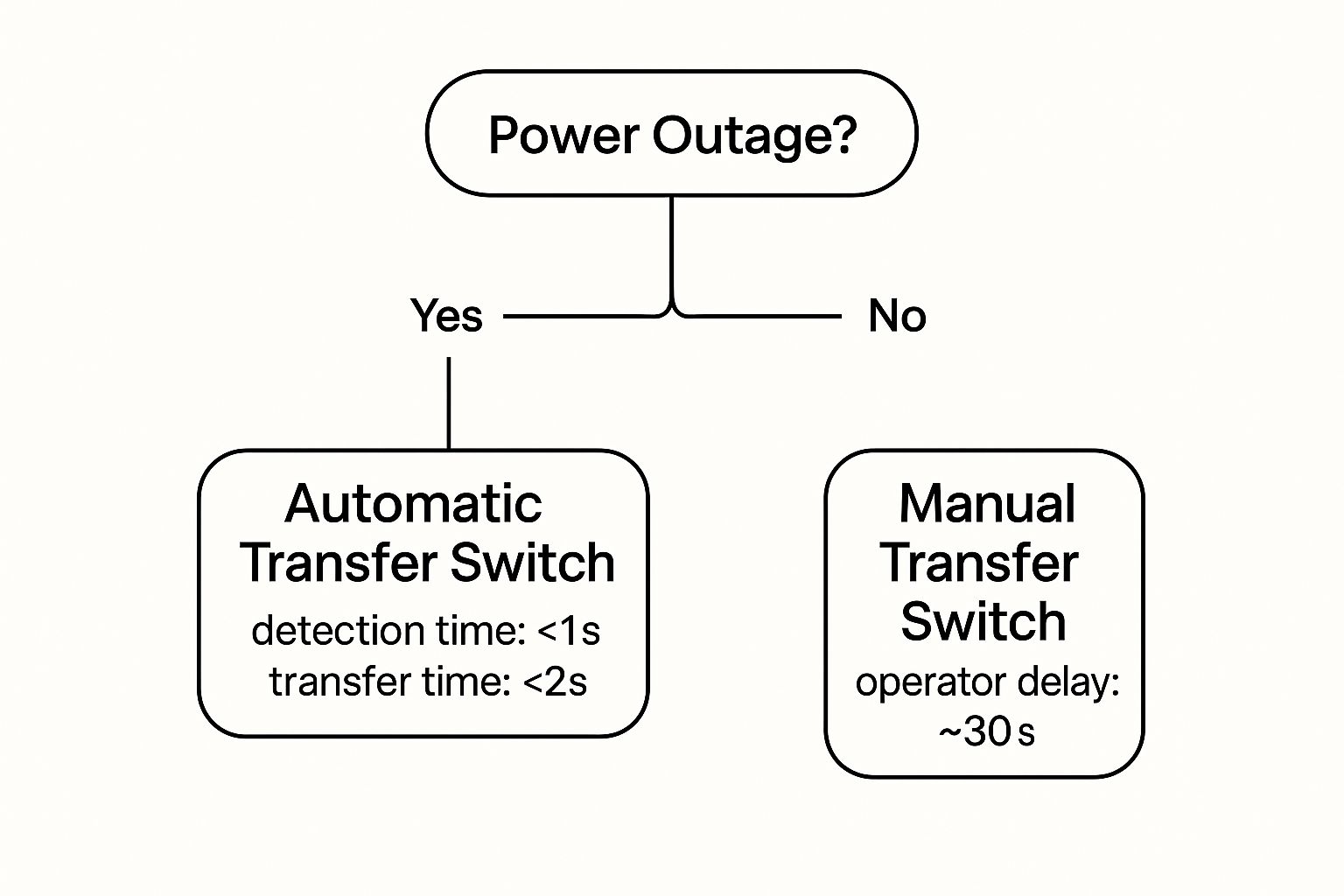
Manual vs. Automatic: The Real Trade-Offs
| Dimension | Manual transfer switch / interlock | Automatic transfer switch |
|---|---|---|
| Installed cost (typical 200A) | $400–1,500 | $1,800–4,500 |
| Response to outage | You walk out and flip it | 10–30 seconds, unattended |
| Generator pairing | Portable generators | Standby generators (permanent) |
| Works when nobody's home? | No | Yes — the whole point |
| Self-testing / exercise | No | Weekly exercise cycle standard |
| Load management | Your judgment at the panel | Smart modules can shed AC/pool/EV loads |
| Best for | Budget backup, job sites, well pumps | Homes with medical loads, second homes, anyone who's ever missed a flight because of an outage |
Our counter advice is consistent: if the backup need includes anything that can't wait for you to drive home — sump pumps in flood season, medical refrigeration, a pipe-freeze risk in a vacant house — manual isn't a real option no matter how attractive the price looks. If the generator is portable and the loads are chosen at the panel on the night of the storm, manual or an interlock is honest, code-legal equipment that we've installed on plenty of our own properties.
The Main Types, and When Each Is Right
| Type | What it is | Amperage classes | Right application |
|---|---|---|---|
| Service-rated ATS | Whole-service switch installed between meter and main panel, with its own service disconnect | 100A, 200A, 400A | Whole-home standby systems; the default for 18–26 kW air-cooled generators |
| Non-service-rated ATS (sub-panel style) | Switches a selected set of circuits fed from a subpanel | 50–200A, circuit-limited | Essential-loads-only backup; smaller generators |
| Interlock kit | Mechanical sliding plate on a listed panel preventing main + generator breaker both on | Panel-specific | Budget portable-generator backup; must be the listed kit for that panel |
| Manual transfer switch | Switch or small panel with cord inlet for a portable generator | 30–50A typical | Selected circuits, job sites, well pumps |
| Smart / load-management ATS | Service-rated ATS with load-shedding modules or integrated energy management | 200A typical | Pairing mid-size generators with big loads — lets a 22 kW unit carry a house with two ACs |
| 3-pole / 4-pole commercial ATS | Three-phase switching, switched or unswitched neutral | 100–1600A+ | Commercial services; neutral switching depends on grounding scheme (separately derived vs. not) |
Sizing: Match the Switch to the Service, Then to the Generator
The sizing rule for a whole-home service-rated ATS: the switch ampacity matches the service, not the generator. A 200A service gets a 200A ATS even with a 22 kW generator behind it, because the switch carries full utility current in normal operation. The generator side is handled by the generator's own breaker. The math that matters is generator output vs. the transfer circuit's overcurrent protection:
| Generator (air-cooled standby) | Output @ 240V 1φ | Generator breaker | Typical ATS pairing |
|---|---|---|---|
| 10 kW | 41.7A | 50A | 100–200A service-rated, or sub-panel ATS |
| 13–14 kW | 54–58A | 60–70A | 200A service-rated with load management |
| 18 kW | 75A | 80A | 200A service-rated |
| 22 kW | 91.7A | 100A | 200A service-rated (the most common pairing in America) |
| 24–26 kW | 100–108A | 110–125A | 200A service-rated with load management strongly advised |
The load-management row deserves emphasis. A 26 kW generator (our 26 kW guide covers the class) puts out about 108A, and a modern all-electric house can demand more than that with both ACs, the range, and the dryer running. Smart ATS platforms — Generac's load management modules, integrated energy managers like the one bundled with the Generac 26 kW Guardian with 200A SE ATS — shed and re-enable big loads automatically so a mid-size generator carries a big house without nuisance overloads. It's the difference between a $1,000 accessory and a $5,000 jump to liquid-cooled. Browse the pairings in 22 kW and 26 kW generators and transfer switches.
NEC Compliance: The Rules That Actually Get Inspected
- Article 702 governs optional standby systems (most homes). Capacity: the system must supply the loads it serves — 702.4 — and the transfer equipment must be listed for the purpose.
- Articles 700/701 apply where loads are emergency or legally required standby — commercial buildings, egress lighting, fire pumps. Different wiring methods, different test requirements (the 10-second start rule lives here), different everything. Know which article your building falls under before you spec.
- Anti-backfeed is absolute. However you transfer — ATS, manual switch, interlock — simultaneous connection of sources must be impossible. A "suicide cord" (male-to-male) isn't a shortcut; it's a felony waiting for a victim.
- Interlocks must be listed for that panel. A generic interlock on a panel it wasn't tested with fails inspection and, worse, might actually fail mechanically.
- Grounding and neutral switching: whether the ATS switches the neutral depends on where the generator's neutral is bonded (separately derived vs. non-separately-derived). Get this wrong and ground-fault sensing misbehaves in both directions. Our grounding and bonding guide walks the diagrams, and the NEC compliance guide covers the inspection side.
- Permits and inspection: transfer equipment is permit-required work in effectively every jurisdiction, and utilities increasingly require notification or approval for interconnected generation, even standby-only.
Installation: The Field Sequence
A service-rated 200A ATS install runs four to eight hours for a two-person crew with the generator already set. The sequence we train:
- Pre-work: pull the permit, schedule the utility disconnect (meter pull), verify the generator's set, pad, gas plumbing, and startup are complete. The ATS goes in after the generator runs, not before.
- Kill the service at the meter with the utility or under their procedure; verify absence of voltage live-dead-live.
- Mount the ATS between meter and main panel — service-rated units become the new service disconnect, so clearances and working space per NEC 110.26 apply.
- Re-route the service entrance conductors through the ATS; land the generator feeders on the generator lugs; torque everything to spec and witness-mark it.
- Run the control wiring between ATS and generator — the start circuit and sensing lines. This low-voltage run is where sloppy installs fail: keep it out of the power conduits.
- Configure load management if equipped: assign shed priorities, test each module.
- Commission: utility re-energizes, then the full test — kill the main, watch the sequence run (sense, start, stabilize, transfer), restore, watch retransfer and cooldown. Then set the weekly exercise cycle and hand the customer the one-page "what normal looks like" sheet.
Common Mistakes We See
- Sizing the ATS to the generator instead of the service — a 100A switch on a 200A service is a bottleneck and a failed inspection.
- Skipping load management on all-electric homes, then wondering why the generator overloads when both compressors start.
- Control wiring in the same conduit as power. Induced noise causes phantom starts and missed transfers.
- No exercise cycle set. A standby generator that never exercises is a machine that's quietly becoming unreliable. Weekly, unloaded or lightly loaded, per manufacturer schedule.
- Buying the ATS before confirming compatibility. Generators and ATSs are ecosystems — a Generac ATS talks to a Generac generator natively. Cross-brand works with the right control interface, but confirm it before the truck rolls, not on the driveway.
Why the Market Keeps Growing
Outage hours per customer in the US have trended up for two decades on weather intensity and grid aging, and the buyer profile has broadened: it's not just rural customers anymore. Remote work made a home outage a lost workday; electrification made an outage a cold house and a dead car; medical device prevalence made outages dangerous for a growing slice of households. On the supply side, air-cooled standby systems got good and cheap — a 22 kW Generac or Champion with a 200A service-rated ATS is a sub-$12,000 installed proposition in most markets, roughly half what it cost a decade ago in real terms. Batteries are carving into the short-outage end of the market — see storage options and the runtime calculator — but for multi-day events, nothing beats a generator with a gas line, and the transfer switch is what makes either one useful. The whole-home generator sizing guide and 22 kW overview complete the picture on the generation side.
Whole-Home vs. Essential Loads: The Decision Framework
The first fork in any backup design is scope. Whole-home (service-rated ATS) means zero decisions during an outage and a bigger generator to feed everything; essential-loads means a smaller generator and a sub-panel of chosen circuits — fridge, furnace blower, some lights, well pump, one receptacle circuit for the home office. The honest guidance: if the house has gas heat and cooking, essential-loads with a 10–14 kW generator covers real life comfortably and costs thousands less end to end. If the house is all-electric — heat pump, induction range, EV — whole-home with load management and 22–26 kW is the coherent answer, because "essential" stops being meaningful when the heat itself is electric. Mixed case that fools people: medical loads. Oxygen concentrators and refrigerated medication aren't negotiable, and the customer profile that includes them usually also includes mobility limits that make manual switching unrealistic — that's automatic, whole-home, no debate.
Maintenance and Testing: Keeping It Ready
A transfer switch is a spring-loaded machine that sits motionless for months and then must work perfectly at 2 a.m. in a storm. The maintenance is light but real: let the weekly exercise cycle run (it transfers nothing on most residential units — the exercise runs the engine; the switch itself is tested during commissioning and annual service); annually, have the transfer mechanism inspected, contacts checked for pitting, and control firmware updated on the smart units; and after every actual outage event, glance at the event log if your unit has one. The failure modes we see in the field are boring: a failed control board from a lightning surge (whole-home surge protection at the ATS is a $200 answer to a $1,200 problem), corroded lugs in coastal installs, and control-wire damage from rodents. Ten minutes a year of attention keeps the machine honest.
Transfer Switches in Solar-Plus-Storage Systems
One more modern wrinkle: in a solar-plus-storage home, the "transfer switch" is often invisible because it's a solid-state relay inside the hybrid inverter or battery cabinet. The engineering is the same — island detection, grid disconnect, local source pickup — but it happens in milliseconds instead of seconds, which is why computers and CPAP machines ride through battery transfers untouched. Where you still see discrete transfer hardware in solar jobs: generator integration as a third source (generator → ATS → hybrid inverter's generator input), and whole-home battery systems using a smart panel as the service-rated transfer layer. When a customer asks whether they need "a transfer switch" for their battery quote, the answer is usually "you already have one — it's inside the box on the wall." Verify the listing says so; some budget hybrids island the backup circuits only, which is an essential-loads topology wearing whole-home marketing.
Transfer Switch FAQs
What does a transfer switch do?
It connects your building to either the utility grid or your backup source — generator or battery — and guarantees the two never connect simultaneously. That isolation protects utility lineworkers from backfeed, protects your generator from grid re-energization, and determines which loads get backed up and how fast the switchover happens.
Do I need a transfer switch for a portable generator?
Legally, yes, in effectively every US jurisdiction — either a manual transfer switch or a listed interlock kit on your panel. Backfeeding through a dryer outlet with a male-to-male cord is illegal, uninsurable, and genuinely lethal to utility workers. A listed interlock kit plus a proper generator inlet box runs a few hundred dollars installed.
What size transfer switch do I need?
For whole-home backup, match the ATS to your service amperage — a 200A service gets a 200A service-rated ATS — regardless of generator size. The generator's output is handled by its own breaker (a 22 kW unit puts out 91.7A at 240V and carries a 100A breaker). For essential-loads-only backup, a sub-panel style ATS sized to those circuits works with smaller generators.
How much does a transfer switch cost installed?
Manual solutions (interlock + inlet) run $400–1,500 installed. A 200A service-rated automatic transfer switch runs $1,800–4,500 installed as part of a standby system, and is typically bundled with the generator. Commercial three-phase units start around $3,000 and climb with amperage and neutral-switching requirements.
Can a transfer switch work with a battery system instead of a generator?
Yes — modern hybrid inverter systems include integrated transfer capability that islands the home in milliseconds, faster than any mechanical ATS. Some premium battery systems include a 200A smart panel that functions as the transfer and load-management layer. The same isolation rules apply: the battery system must disconnect from the grid before powering the home alone.
What's the difference between service-rated and sub-panel transfer switches?
A service-rated ATS installs between the meter and your main panel, becomes the service disconnect, and switches the entire house. A sub-panel (non-service-rated) ATS switches only a selected set of circuits fed through it — cheaper and pairs with smaller generators, but only the chosen circuits have backup. Load-management modules blur the line by letting a service-rated switch intelligently shed big loads so a mid-size generator can carry the whole house.