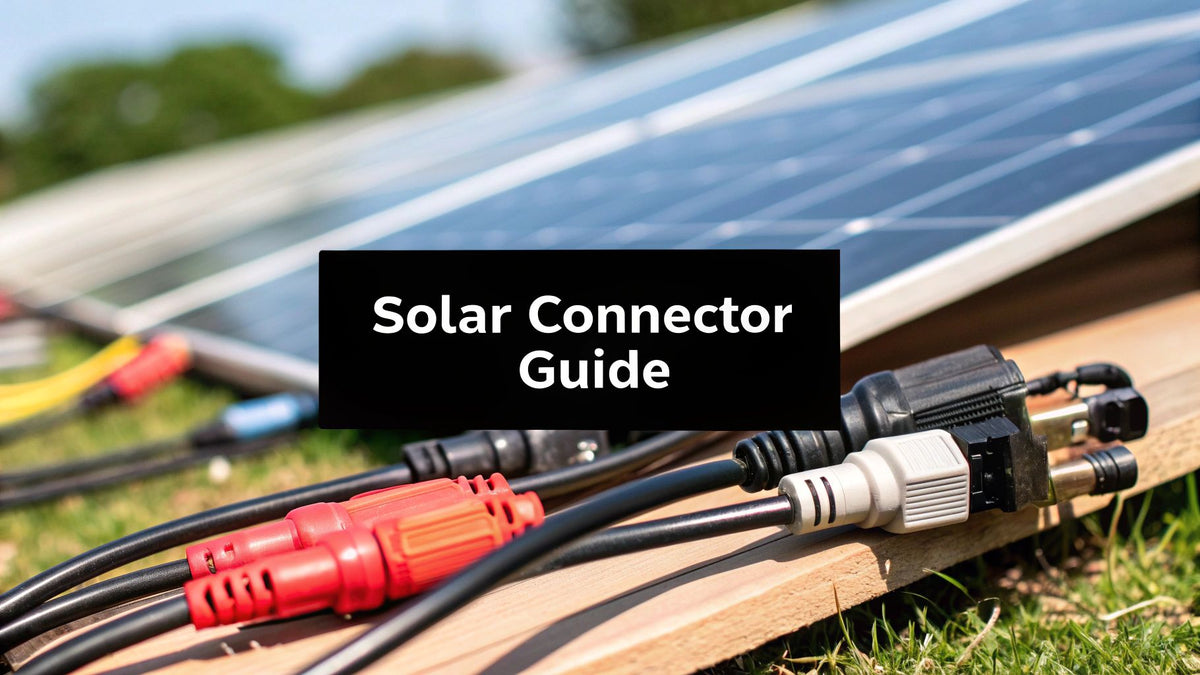
Twenty years into this trade, I can tell you exactly which component generates the most service tickets on a PV array, and it is not the inverter. It is the solar panel connector—the two-dollar plastic-and-copper handshake between every module and the system. While a few solar panel connectors types have come and gone, the MC4 connector is the undisputed U.S. industry standard, and for good reason: when it is genuine, correctly crimped, and correctly mated, it disappears into the array and works for decades.
This guide is the framework I use when I train installers and when our procurement team qualifies a new SKU: the connector families you will actually meet in the field, the compatibility rules the NEC enforces, the specialty hardware for parallel strings and fusing, and the installation and sourcing habits that keep callbacks at zero. No theory—just what passes inspection and survives weather.
Why Your Choice of Solar Connector Matters Now
Choosing a solar panel connector isn't a minor detail—it's a critical decision impacting project safety, performance, and profitability. A high-quality, properly installed connector ensures minimal power loss and maximum energy harvest for decades. A poor choice or incorrect installation, however, can lead to catastrophic failures like arc faults, a primary cause of solar-related fires. Given that the connector is the single most common failure point in a PV string, your selection and installation protocol must be flawless.
A solid grasp of harnessing solar energy effectively means appreciating every component, right down to these vital connection points. Getting it right ensures your project passes inspection the first time and operates reliably for its entire 25+ year lifespan.
The Financial and Safety Implications
Using subpar or incompatible connectors has severe consequences. Intermittent connections quietly reduce system output, leading to performance disputes and warranty claims. A faulty connection is also a leading cause of electrical fires in solar arrays. This is why standards like the National Electrical Code (NEC) are strict about mandating connector compatibility and proper installation techniques.
Critical Mistake: Cross-mating connectors from different manufacturers without a specific UL intermateability certificate is a direct violation of NEC 690.33 and a significant fire risk. This can void warranties and create massive liability.
Market Dominance and Project Standards
The solar industry’s standardization on the MC4 connector reflects a collective focus on safety and efficiency. The global solar connector market is projected to hit USD 1.82 billion by 2030, driven by the universal adoption of MC4 and its certified-compatible variants. This standardization simplifies procurement, streamlines training, and makes installations faster and less risky.
- For Installers: Your choice of solar panel connector types directly impacts your liability and reputation. Stick to genuine, UL-listed connectors from trusted manufacturers like Stäubli (the original MC4 inventor) or certified-compatible options from brands like Amphenol.
- For EPCs & Developers: Standardizing your Bill of Materials (BOM) on a single, high-quality connector brand mitigates field errors, streamlines procurement, and ensures compliance across your entire project portfolio.
Decoding the Most Common Solar Panel Connectors
For professionals in the field, understanding the key connector types is straightforward. While a few legacy options exist, one family of connectors has become the undisputed standard for its reliability, safety, and ease of use. This diagram shows where connectors fit into a complete solar energy system.
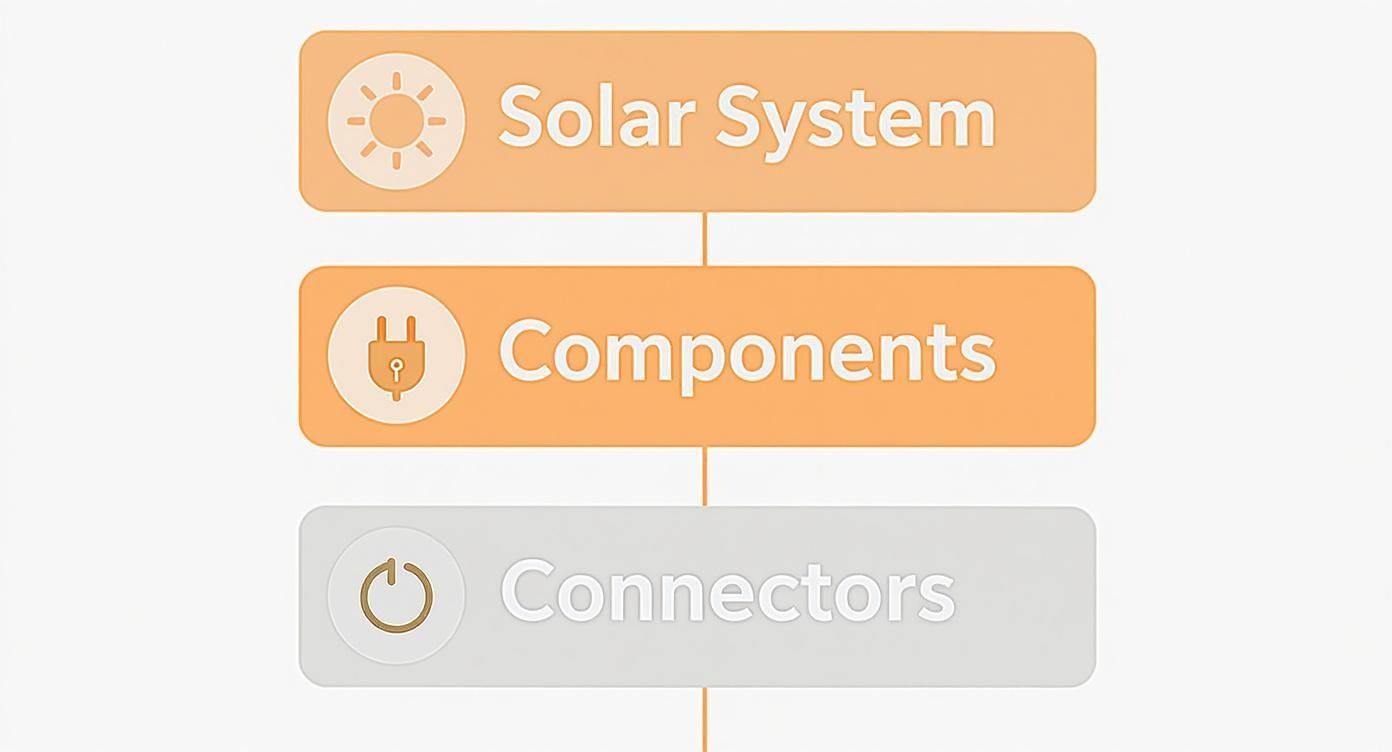
They are the critical link tying power-generating panels to the rest of the system. Without a solid connection, you're left with expensive, non-performing assets.
The MC4: The Undisputed Industry Standard
The MC4 connector, originally from Stäubli, is the default for virtually every modern solar installation. Its name is simple: "MC" for Multi-Contact and "4" for the 4 mm diameter contact pin. Its design is centered on safety and long-term field performance.
Key features of a genuine MC4 include:
- Secure Locking Mechanism: A positive lock clicks firmly into place, preventing accidental disconnection from vibration or wire tension. It requires a special tool for disconnection, a safety feature mandated by the NEC.
- Weatherproof Sealing: MC4s carry an IP67 or IP68 rating, meaning they are completely sealed against dust and can handle temporary water submersion. They are built to withstand decades of rain, snow, and UV exposure.
- High Voltage and Current Ratings: A standard MC4 is rated for up to 1500V DC and can handle currents of 30A or more, sufficient for today's high-power modules from brands like Canadian Solar, Trina, and Qcells.
Pro Tip for Installers: Counterfeit MC4 connectors are a massive risk, often using substandard materials that cause high resistance, overheating, and dangerous arc faults. Always source components from trusted distributors like PES Supply to ensure you're getting genuine, UL-listed parts.
Certified Compatible Connectors: Stäubli, Amphenol, and Tlian
While Stäubli invented the MC4, other top-tier manufacturers like Amphenol (H4 series) and Tlian (T4 series) produce connectors certified as "intermateable." These compatible versions are built to the same electrical and physical specifications, guaranteeing a safe connection. However, you must verify they are specifically listed and certified for intermating. Mating uncertified connectors from different brands is a major code violation and a serious fire hazard.
Legacy Connectors: The MC3
On systems installed before 2010, you might encounter the MC3 connector, the MC4's predecessor. It has a smaller 3 mm contact pin and lacks the secure locking mechanism of the MC4. MC3s are obsolete for new projects, with lower voltage ratings (typically 600V) and a less secure connection. You cannot connect an MC3 to an MC4. An adapter is required when integrating new panels into a legacy MC3 system.
Specialized Connectors: Anderson Power Products
In off-grid, portable, and battery-based systems, Anderson Power Products (APP) connectors are common. Unlike MC4s, which are "set it and forget it," Anderson plugs are designed for frequent connection and disconnection.
Key differentiators include:
- Genderless Design: The housings are identical; you flip one over to create a positive/negative pair, simplifying inventory and field assembly.
- High Current Capability: Certain Anderson connectors are rated for extremely high amperage, making them ideal for battery banks or portable power stations.
- No IP Rating: Standard APP connectors are not weatherproof and are unsuitable for exposed rooftop wiring. They are used inside combiner boxes, battery enclosures, or on portable equipment.
Meeting Connector Compatibility and NEC Standards
https://www.youtube.com/embed/niTL2o9EcEE
One of the most critical and common installation mistakes is connector incompatibility. This is not a best practice; it is a hard rule under the National Electrical Code (NEC). Failure to comply leads to failed inspections, project delays, and severe safety hazards.
The core issue is "cross-mating"—plugging together connectors from different brands. While they may appear to fit, microscopic differences in tolerances, materials, and seals create a high-resistance connection point that can overheat, arc, and cause a fire. NEC 690.33 is explicit: connectors must be of the same type from the same manufacturer or be officially listed and certified for intermating. No certificate means no connection.
As panel technology advances, connector designs evolve, making compatibility even more complex. Recent research on solar panel connector trends highlights these ongoing challenges in the field.
Guidance for Installers on the Jobsite
Onsite, the installer is responsible for verifying compatibility before making any connection.
Jobsite Connector Verification Checklist:
- Check for Markings: Authentic, UL-listed connectors have the manufacturer's name or logo stamped on the housing. If it's blank, stop.
- Consult the Spec Sheet: The solar panel's datasheet will specify the factory-installed connector brand.
- Document Everything: Take photos of connector markings and keep datasheets accessible for inspectors.
- Never Force a Connection: A proper, certified connection should click together smoothly and lock securely. If it requires force, something is wrong.
Strategies for EPCs and Developers
For EPCs and developers, preventing these issues starts with procurement. A smart sourcing strategy is your best defense against the risks of mismatched parts.
- Standardize Your Bill of Materials (BOM): Specify one trusted connector brand (e.g., Stäubli MC4) for all field-made connections and extension cables. This eliminates accidental cross-mating by installation crews.
- Vet Your Suppliers: Source components from authorized distributors like PES Supply to guarantee genuine, UL-listed products.
- Demand Documentation: If mixing brands is unavoidable, you must have the official UL certificate proving intermateability. A datasheet claim is insufficient for compliance.
This checklist ensures every connection is safe, compliant, and built to last.
Connector Specification and Compliance Checklist
| Verification Point | What to Check | Compliance Standard | Pro Tip |
|---|---|---|---|
| Manufacturer Identity | Is the brand name or logo clearly marked on both connectors? | NEC 690.33 | If it's not marked, it's not compliant. Do not use. |
| Series Compatibility | Are both connectors from the exact same product series (e.g., MC4 and MC4-Evo 2)? | Manufacturer Specs | Different series from the same brand are often not intermateable. |
| UL Listing | Does the connector have a UL mark (or equivalent NRTL)? | UL 6703 | Look for the official symbol. Counterfeits often have fake markings. |
| Intermateability Certificate | If mixing brands, do you have the official UL certificate? | NEC 690.33 | A verbal confirmation or datasheet claim is not enough. Get the certificate. |
| Voltage/Current Rating | Do the ratings meet or exceed the system's maximum voltage and current? | NEC 110.3(B) | Check against the inverter and string configuration specs. |
| Wire Gauge Compatibility | Is the connector rated for the specific PV wire gauge you're using? | Manufacturer Specs | Using the wrong size can lead to a poor crimp and high resistance. |
For a deeper dive, review our guide on solar wiring and connector best practices.
Using Specialty Connectors in Advanced Solar Designs

In complex commercial or high-power residential systems, specialty connectors are essential tools for optimizing performance, ensuring safety, and simplifying installation and maintenance. Knowing which component to use is what separates a good installation from a great one. Every component matters, from the panel's wiring access point covered in our guide on solar panel junction boxes, to the final homerun connection.
Branch Connectors for Parallel Stringing
The Branch Connector, commonly known as a Y-connector, allows installers to combine the output of two solar panel strings in parallel directly on the roof, often eliminating the need for a separate combiner box.
Common Use Cases:
- Complex Roof Layouts: On commercial roofs with numerous obstructions, Y-connectors are the cleanest way to tie small, disparate groups of panels into a single homerun, reducing wire and labor costs.
- Inverter Optimization: For string inverters with multiple MPPTs, a Y-connector lets you combine two smaller, matched strings into one MPPT input, maximizing the inverter's utilization.
- Cost and Time Savings: Eliminating a rooftop combiner box saves material and labor costs.
For Installers: When using Y-connectors, the strings being combined must be identical: same number of modules, same model, and same orientation. Mismatched strings will lead to significant power losses and potential back-feeding issues.
In-Line Fuse Holders for Overcurrent Protection
Safety is non-negotiable. The NEC requires that if you connect three or more strings in parallel, each string must have its own overcurrent protection device (OCPD), typically a fuse.
An in-line fuse holder is a rugged, weatherproof housing with MC4-compatible ends that holds a standard PV fuse. Installed on the positive lead of each solar string before the parallel connection point, this component protects each string from fault currents from other strings, preventing wire overheating and fire hazards.
Quick Disconnects for Safety and Service
Quick-disconnects are designed to improve safety for service technicians and first responders. While any MC4 can be disconnected with a tool, these are used at key interface points like combiner boxes or inverters for easier access.
Their most critical role is enabling rapid shutdown compliance (NEC 690.12). These systems de-energize rooftop conductors in an emergency. High-quality, listed connectors at these points are essential for reliable operation and firefighter safety.
Best Practices for Connector Installation and Failure Prevention
A solar array is only as strong as its weakest link—and that link is almost always a field-installed connector. The difference between a system that performs reliably for 25 years and one plagued by nuisance tripping and arc faults is the quality of every connection. For installers, mastering this process is your first line of defense against costly service calls and reputational damage.
Mastering Crimping and Torque Specifications
A bad crimp is a ticking time bomb, creating a high-resistance point that generates heat, reduces power output, and can eventually lead to meltdown or fire.
You must use a manufacturer-certified crimping tool calibrated for the specific pins and wire gauge. A proper tool applies precise, uniform pressure that cold-welds the pin to the wire, creating a solid, gas-tight bond. Equally critical is using a dedicated MC4 spanner wrench to tighten the back nut to the manufacturer's exact torque specification. This compresses the gasket to create a permanent weatherproof seal.
For Installers: Using pliers or a generic crimper is a direct path to failure. Over-tightening can strip threads or damage the seal, while under-tightening allows moisture ingress. There is no substitute for the correct tools and technique.
Effective Wire Management and Strain Relief
Proper wire management prevents long-term stress on connectors. Dangling wires are subjected to constant movement from wind and thermal cycling, which can break the seal and weaken the crimp.
Wire Management Essentials:
- Secure Cables: Use high-quality, UV-resistant zip ties or stainless-steel wire clips to fasten PV cables securely to module frames or racking.
- Create Drip Loops: Form a small downward loop in the wire before it enters a junction box to direct rainwater away from the connection point.
- Avoid Sharp Bends: Do not kink the cable at the connector exit, as this puts extreme strain on the wire and internal components.
Critical Mistakes to Avoid
The majority of connector failures stem from a few common, avoidable mistakes. Our guide on solar PV wire options explores how the right wire and connector pairing creates a durable system.
| Mistake | Consequence | Prevention Strategy |
|---|---|---|
| Using Improper Tools | Faulty crimps, high resistance, damaged housings. | Use only manufacturer-specified crimp and spanner tools. |
| Cross-Mating Brands | Code violation (NEC 690.33), poor seal, arcing. | Standardize on a single, UL-listed connector brand for all field connections. |
| Poor Weather Sealing | Water ingress, corrosion, ground faults. | Torque connector nuts to spec and never leave caps off, even temporarily. |
| Ignoring Strain Relief | Damaged connections from wire movement. | Secure all cables properly and create drip loops. |
How to Streamline Connector Procurement and Logistics
For procurement managers and EPC project managers, the logistics of sourcing solar panel connectors are as vital as their technical specifications. A poor procurement strategy leads to project delays, budget overruns, and catastrophic failures from counterfeit parts. With the photovoltaic connector market expected to hit USD 2.08 billion by 2030, a rock-solid sourcing strategy is non-negotiable. For more on this trend, see the drivers behind this market growth.
Supplier Selection and Authenticity Verification
Partnering with the right suppliers is your primary defense against project risk. With counterfeit connectors being a top cause of system failure, supply chain verification is mandatory.
- Stick with Authorized Distributors: Work exclusively with distributors who have direct relationships with manufacturers like Stäubli and Amphenol to guarantee genuine, UL-listed products.
- Require Documentation: Demand UL certificates and manufacturer datasheets for every batch of connectors.
- Inspect on Arrival: Train receiving teams to identify red flags of counterfeit products, such as missing brand markings, flimsy plastic, or poor-quality molding.
Using modern supplier onboarding portals can help formalize this process, ensuring all vendors meet your quality and compliance standards from day one.
Optimizing Cost and Logistics
A great supply partner adds value beyond shipping boxes. Services like bundled freight, project kitting, and access to bulk container pricing can significantly reduce your landed cost per watt and streamline job site operations.
For Procurement Managers & EPCs: At PES Supply, we solve these operational headaches. We provide genuine, compliant connectors from top brands, backed by services built for commercial solar. Our project kitting, bundled freight, and massive in-stock inventory ensure you get the right parts, at the right price, exactly when you need them. We provide the real-world inventory, logistics, and compliance support to keep your projects on track and profitable.
Ready to streamline your procurement process? Request a Bulk Quote from our team to see how we can reduce your costs and simplify logistics.
MC4 vs. MC4-Evo 2 vs. Amphenol H4 vs. Tlian T4: The Working Comparison
Walk any distributor's connector shelf and four families dominate. They all look similar at arm's length, which is exactly the problem—similar is not intermateable. Here is the comparison table my purchasing team uses when qualifying hardware for a BOM. The values are the typical published ranges for genuine product in each family; always confirm the exact rating on the datasheet for the specific SKU you are buying:
| Connector Family | Manufacturer | Typical Voltage Class | Typical Current Class | Wire Range | Field Note |
|---|---|---|---|---|---|
| MC4 (classic) | Stäbli | 1000 V DC | ≈30 A class | 14–10 AWG (2.5–6 mm²) | The 20-year residential/commercial workhorse |
| MC4-Evo 2 | Stäbli | 1500 V DC | 30–45+ A class | 14–8 AWG (2.5–10 mm²) | Utility-scale default; wider wire range |
| H4 | Amphenol | 1000–1500 V DC | ≈30–45 A class | 14–8 AWG | Carries documented UL intermateability with MC4 lines |
| T4 | Tlian | 1000–1500 V DC | ≈30–45 A class | 14–10 AWG | Certified-compatible alternative; verify the UL file |
| MC3 (legacy) | Stäbli (obsolete) | ≈600 V DC | ≈20 A class | 14–12 AWG | Pre-2010 systems only; never mate to MC4 |
The rule that never bends: "certified intermateable" applies to a specific pair of products covered by a specific UL test file. H4-to-MC4 intermateability, for example, exists only where the certificate says it does. A crate of look-alike connectors with no certificate is a crate of future arc faults. Keep the paperwork in the project closeout package.
Connector Ampacity and NEC 690.8: Sizing the Whole Connection
Designers obsess over conductor ampacity and then bolt on whatever connector came on the module lead. Flip that habit. The connector is a current-carrying component in the circuit, and NEC 690.8's continuous-duty math applies to the entire path: string Isc × 1.25 × 1.25 = Isc × 1.56 is the floor your conductor, connector, and fuse must all clear. Run the numbers before the hardware order, not after the failure:
| String Isc (Module Datasheet) | NEC 690.8 Adjusted (×1.56) | Minimum Connector Current Rating | Typical Hardware Class |
|---|---|---|---|
| 10 A | 15.6 A | ≥20 A | Any genuine MC4 class |
| 13 A | 20.3 A | ≥25 A | Standard MC4 on 12 AWG |
| 15 A | 23.4 A | ≥30 A | MC4 on 10 AWG / Evo-class |
| 18 A | 28.1 A | ≥30 A | Evo-class on 10 AWG, verified datasheet |
| 20 A | 31.2 A | ≥40 A | Large-contact Evo/H4 class on 8 AWG |
High-current modules—the 500 W+ class with Isc pushing 18–20 A—are where this bites. A connector rated exactly at the adjusted current has zero margin for the hot afternoon when everything on the roof runs above nameplate. Buy the headroom. The conductor side of this math is covered step-by-step in our NEC wire sizing guide and the ampacity chart.
Field Notes: Connector Lessons Paid For in Sweat
- The clone crate. A supply house once substituted "MC4-equivalent" connectors on our PO without asking. Six months after commissioning, we had thermal images of connectors running 30°C over their neighbors. Every one was the clone. We replaced 400 of them under warranty—our labor, their parts. Now the PO states the manufacturer by name, and receiving rejects anything else.
- The mismatch nobody photographed. On a repower job, a night crew mated Evo 2 leads to classic MC4 extensions because "they clicked." They did click. They also failed the tug test the next morning, all 60 of them, and we re-terminated before energization. The five-second tug test is now step zero of every commissioning checklist I write.
- The fuse holder that saved the roof. A ground mount took a direct short on one string last spring. The in-line fuse on that string opened in milliseconds and the other five strings never noticed. Without it, the combined fault current of five strings would have found the weak point in the sixth. Three-or-more-strings means OCPD on every string—NEC 690.9 is not a suggestion.
For the termination side of the craft—crimps, glands, torque, and tug tests—our solar cable connector guide walks the full procedure, and the pro guide to solar cables and connectors covers conductor pairing. Stock genuine connector kits, PV wire, and fuse holders from the cables and accessories collection, and size every run in the wire size calculator before the order goes in.
Common Questions from the Field
These are the most frequent questions we get from installers and project managers on the job. Here are direct, no-fluff answers.
Can I Connect MC4 Connectors from Different Brands?
No, unless they are explicitly UL-listed and certified for intermating. This practice, known as cross-mating, is a violation of NEC 690.33. Even if connectors seem to click together, microscopic tolerance differences can create a high-resistance connection, leading to heat buildup and a significant arc fault and fire hazard. Always use the same brand or a certified compatible pair.
What Is an IP Rating on a Solar Connector and Why Should I Care?
The IP (Ingress Protection) rating defines a connector's resistance to dust and water. For solar applications, you must use connectors rated IP67 or IP68. An IP67 rating means the connector is dust-tight and can be submerged in 1 meter of water for 30 minutes. IP68 is even more robust. This is essential for long-term reliability, preventing moisture intrusion that causes corrosion and electrical failures.
Do I Really Need Special Tools to Install These Connectors?
Yes, absolutely. Using manufacturer-specified tools is non-negotiable for creating a secure, reliable connection that will last 25+ years. You need a specialized crimping tool calibrated for the specific connector pin to ensure a perfect electrical and mechanical bond. You also need a spanner wrench to tighten the housing to the correct torque, which creates the weatherproof seal. Using pliers is the fastest way to create a future failure point.
How Long Should a Quality Solar Connector Last in the Field?
A genuine, UL-listed connector that is correctly crimped, fully mated, and properly sealed should outlive the modules around it—25 years or more is the design life, and Tier-1 manufacturers test their hardware through thousands of thermal cycles and damp-heat hours to prove it. The failures I see in the field are almost never age-related; they are installation-related. A five-year-old connector that fails was almost always crimped with the wrong die, left with a loose gland, or cross-mated on day one.
When Does NEC Require a Fuse on Each String?
Per NEC 690.9, overcurrent protection is required for each string when three or more strings are connected in parallel. Two strings in parallel generally cannot generate enough fault current to exceed the module's series fuse rating, so fusing may not be required—but verify against the module datasheet's maximum series fuse value. The moment a third string joins the parallel group, every string gets its own fuse or breaker, typically in an in-line fuse holder or combiner box rated for DC PV service.
At PES Supply, we understand that the smallest components have the largest impact on project success and safety. We stock genuine, UL-listed solar connectors from the brands you trust, so you can build systems that are compliant, bankable, and built to perform.
Request a Quote and let our experts help you source the right components for your next installation, delivered on time and on budget.
Related Resources:
- Best Solar Panels 2026 — Buyer's Guide
- EG4 vs Tesla Powerwall
- Qcells vs Trina vs JA
- Solar Inverter Buyer's Guide
- Solar Battery Buyer's Guide
- 5kW Solar Kit
- 10kW Solar + Battery Kit
- Off-Grid Cabin Kit
- EG4 Batteries
- Qcells Solar Panels
- Trina Solar
- JA Solar
- REC Solar
- Mission Solar
- Sol-Ark Inverters
- SolarEdge Inverters
- Generac PWRcell
Calculate how much storage you need with our battery sizing calculator.
Use our free solar system calculator to size your array.
Check out our Solar Panel Comparison Tool. Check out our Inverter Sizing Calculator.
Calculate your solar payback and 25-year savings with our Solar ROI Calculator. Follow our complete DIY solar installation guide for step-by-step instructions. Keep your system running at peak performance with our Solar Maintenance Guide.
Related Resources
- Solar System Calculator
- Battery Sizing Calculator
- Solar Panel Comparison Tool
- Inverter Sizing Calculator
- Solar ROI Calculator
- Solar Installation Guide
- Solar Maintenance Guide
- Solar Permitting Guide
- Battery Installation Guide
- NEC Code Compliance Guide
- Solar Panel Mounting Guide
- Grounding & Bonding Guide
- Solar Incentives by State
- Pro Account — Wholesale Pricing
- PowerLink Network — Contractor Program