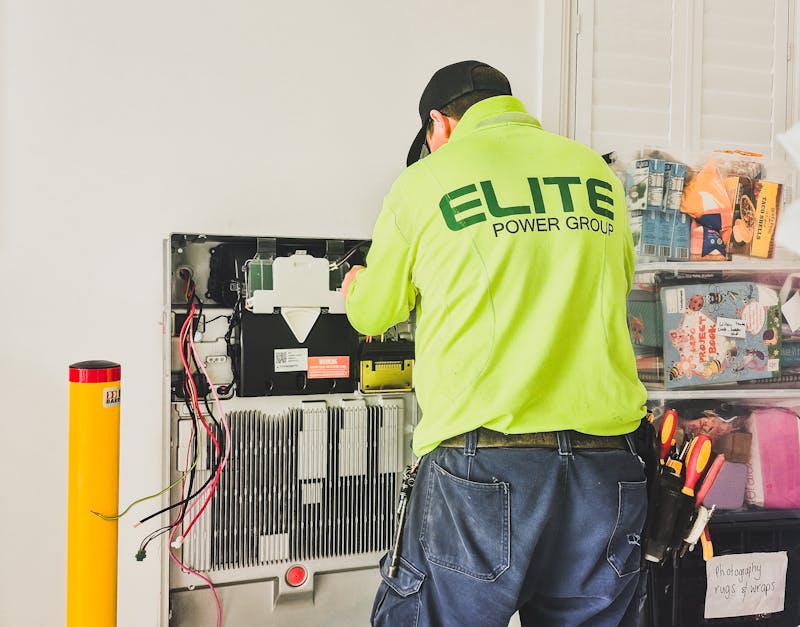
The EG4 WallMount Indoor Battery has become one of the most-asked-about products in our warehouse, and the questions are always the same: what does it actually power, how does it install indoors legally, and what does it pair with. This guide answers all three with the spec sheet in one hand and the code book in the other. We have sold and supported enough of these units to know where installations go smoothly and where they hit inspection trouble — the difference is almost always planning, not product.

One caveat up front, because specs matter: all figures below are drawn from the manufacturer's published documentation at the time of writing. Battery product lines get revised, so verify against the current datasheet before design sign-off. Current units are stocked in our EG4 batteries category.
What the WallMount Indoor Battery Is
The WallMount Indoor is a self-contained lithium iron phosphate (LFP) energy storage unit built around a 51.2 V nominal battery bank with an integrated battery management system, designed specifically for indoor wall mounting in residential and light commercial spaces. It is a battery, not an inverter — it stores DC energy and delivers it through a DC connection to a compatible hybrid inverter, which handles AC conversion, grid interaction, and solar input. That architecture distinction drives every design decision in this guide: you are specifying a battery subsystem, and the inverter pairing determines what the system can actually do.
The LFP chemistry choice is the foundation of the indoor rating. Compared with nickel-manganese-cobalt chemistries, LFP cells have a significantly higher thermal runaway onset temperature, no cobalt-driven oxygen release during failure, and a long, flat cycle-life curve. That is why LFP is the chemistry we recommend for any indoor or attached-garage installation, and it is why this product class has largely displaced older chemistries in the residential storage market.
Published Specifications
The numbers that matter for design work, from the manufacturer's published documentation:
| Specification | Published value | Design note |
|---|---|---|
| Nominal energy | 14.3 kWh | Usable fraction depends on configured DoD limits |
| Nominal voltage | 51.2 V | Standard 48 V-class hybrid inverter bus |
| Cell capacity | 280 Ah | 51.2 V × 280 Ah = 14,336 Wh ≈ 14.3 kWh — the math checks |
| Chemistry | LiFePO4 (LFP) | Thermally stable, cobalt-free |
| Cycle life | Published at 8,000 cycles class | To defined end-of-life capacity; see current datasheet |
| Continuous discharge | 200 A class BMS | 51.2 V × 200 A ≈ 10.2 kW theoretical bus limit |
| Certifications | UL 1973, UL 9540A test data | The two documents your AHJ will ask for |
| Warranty | 10-year class | Verify terms and throughput limits on current warranty sheet |
| Form factor | Indoor wall-mount enclosure | Substantial weight — verify wall structure per the mounting section below |
Two of those rows deserve emphasis. The 280 Ah cell figure is worth verifying arithmetically against any quote you receive — 51.2 × 280 = 14,336 Wh, so a "14.3 kWh" claim is internally consistent. And the UL 9540A line is the one your inspector cares about most: it is the thermal runaway fire propagation test method, and having the report available smooths the indoor ESS conversation with nearly every AHJ we work with.
What It Actually Powers: Runtime Math
Runtime questions get answered with arithmetic, not adjectives. Assume 95% usable energy (13.6 kWh from the 14.3 kWh nominal) and a 92% round-trip inverter efficiency on the AC side, so delivered AC energy per discharge is roughly 13.6 × 0.92 ≈ 12.5 kWh:
| Continuous AC load | Approximate runtime on one unit | Real-world equivalent |
|---|---|---|
| 400 W | ~31 hours | Refrigerator, internet, lights, device charging — the "essentials" panel |
| 1,000 W | ~12.5 hours | Essentials plus a chest freezer and a window fan |
| 2,000 W | ~6.2 hours | Essentials plus well pump cycling and microwave use |
| 3,500 W | ~3.6 hours | Adding a window AC unit or electric water heater cycling |
| 5,000 W | ~2.5 hours | Near-whole-home loads including some HVAC |
Check the math the way we do on the phone with customers: 12.5 kWh ÷ 1,000 W = 12.5 hours. Now the honest part — residential loads are not continuous. A refrigerator draws 150 W while running but cycles at a 30–50% duty. Real backup runtime on mixed household loads routinely beats the table. The discipline that matters is surge: a 1 HP well pump that runs at 1,500 W can demand 4,000+ W to start, and that surge hits the inverter, not the battery nameplate. Size the inverter for surge; size the battery bank for hours. Our battery backup runtime calculator article walks through this with your own load list.
Recharging from solar
Pairing with a hybrid inverter and solar array, a full recharge from 20% state of charge requires about 11.4 kWh of delivered DC energy. The recharge-time table at typical array sizes, assuming 4.5 peak sun hours and 90% charge-path efficiency:
| Solar array size | Daily harvest (4.5 PSH) | Time to replace 11.4 kWh | Comment |
|---|---|---|---|
| 3 kW | ~12.2 kWh | ~1 day | Marginal in winter or cloudy stretches |
| 5 kW | ~20.3 kWh | ~0.6 day (a good sun day) | Comfortable daily-cycle pairing |
| 8 kW | ~32.4 kWh | ~0.4 day | Supports two-unit banks with headroom |
For the array side of that pairing, the solar system size calculator and our grid-tied solar systems category are the right next clicks.
Indoor Installation: The Code Framework
Indoor residential energy storage is governed by NFPA 855 and the IRC energy-storage provisions, adopted with local amendments. The headline rules that shape every indoor WallMount layout:
Installation Guide: Mounting, Ventilation, and Clearances
Ventilation clearances and codes
Ventilation clearances and airflow
| Requirement area | Typical adopted rule | Practical consequence |
|---|---|---|
| Individual ESS unit size | 20 kWh maximum per unit | The 14.3 kWh WallMount fits with margin |
| Aggregate per location | 40 kWh per indoor location | Two units per location; more requires spacing or additional locations |
| Spacing between units | 3 ft between ESS units (unless large-scale fire testing supports less) | Plan wall space before ordering the second battery |
| Approved locations | Attached garages, exterior walls, utility rooms per listing; not sleeping rooms | Garage and exterior-wall installs are the path of least resistance |
| Vehicle impact protection | Required in garages where vehicle paths exist | Bollards or barriers — cheap insurance, often required |
| Clearances | Per manufacturer installation manual | Service clearance and ventilation space are inspection items |
Your AHJ's adopted code year controls, and amendments vary — our NEC code compliance guide covers how to frame the pre-permit conversation. The two documents to have in the permit package every time: the UL 1973 listing and the UL 9540A report summary. Inspectors who see those two documents in the submittal stop asking the hard questions, because the documents already answered them.
System Integration: Inverter Pairing
The WallMount communicates over CAN with compatible hybrid inverters — closed-loop communication lets the battery BMS report state of charge, set charge/discharge limits dynamically, and protect the cells far more precisely than voltage-based open-loop setups. Pairings we see work well in the field include EG4's own hybrid line and the EG4 FlexBOSS21, along with Sol-Ark and other 48 V hybrid platforms listed as compatible in the current documentation. Verify the firmware compatibility list before committing to an inverter — the list grows, but it is a list.
Design the inverter for the load profile, then size the battery bank for the hours. A single WallMount's 200 A-class BMS limits continuous bus power to roughly 10 kW; most hybrid inverters in the 8–12 kW class pair cleanly with one unit, while larger inverters or heavy surge profiles argue for two batteries in parallel so the BMS limits stack. Undersizing the battery side of a big inverter is the most common design error we troubleshoot — the inverter can ask for more current than one battery will deliver, and the BMS will protect itself by disconnecting at the worst possible moment.
Mounting and Installation Practice
Wall-mounting a unit in the 280-pound class is structural work. The practice that passes inspection and stays on the wall: mount to solid structure — masonry, concrete, or multiple studs with the manufacturer's specified bracket and fastener schedule; never to drywall over a single stud pair. Maintain the manual's clearances at sides, top, and front for airflow and service access. Route conduit per the conduit selection guide for the run type, and land DC conductors with a torque wrench at the specified values — loose DC terminations are the leading cause of the heat damage we see on returned equipment. Ground and bond per NEC 250 and the manual; the grounding and bonding guide covers the article references.
I will say the quiet part plainly: if the wall is questionable, put the unit on the floor stand option or pick a different wall. A battery that weighs as much as two adults does not get a second chance to fall.
Monitoring, Maintenance, and Service Life
Performance Metrics and Operating Range
Operating temperature range
Day-to-day ownership is light work: keep the monitoring app connected and firmware current, verify ventilation paths stay clear, inspect terminals annually for torque and corrosion, and watch state-of-charge behavior for drift. LFP's flat voltage curve means state of charge is estimated by coulomb counting, and periodic full charge cycles let the BMS recalibrate — the app typically prompts for this. Operating temperature discipline matters more than any other habit: charge acceptance drops at low cell temperature, and sustained operation at the hot end of the range accelerates calendar aging. Indoor mounting solves most of this by itself, which is half the point of the product.
One habit worth stealing from commercial operators: screenshot the monitoring dashboard on the first of each month and keep the folder. Twelve months of screenshots is a service history, and service histories are what make warranty conversations short and friendly. When we help customers with claims, the ones with documented history get resolutions in days; the ones reconstructing from memory get questionnaires.
How It Stacks Up: The Comparison Buyers Ask For

Nominal voltage options
| Product | Nominal energy | Chemistry | Architecture | Best fit |
|---|---|---|---|---|
| EG4 WallMount Indoor | 14.3 kWh | LFP | DC battery for hybrid inverter | Value-driven indoor installs, modular expansion |
| Tesla Powerwall 2 | 13.5 kWh | NMC | Integrated AC battery with built-in inverter | Retrofit AC-coupled installs |
| LG RESU 10H Prime | 9.6 kWh class | NMC | High-voltage DC battery | Compact premium installs |
| Fortress eFlex Max | 5.4 kWh | LFP | 48 V server-rack style | Small banks, expandable racks |
The pattern in that table: the WallMount's value case is dollars per stored kilowatt-hour with indoor-rated LFP chemistry, at the cost of requiring a separate hybrid inverter. The AC-coupled integrated units cost more per kWh but simplify retrofit wiring. We stock both architectures because the right answer depends on whether the project already includes a hybrid inverter decision. The EG4 vs Tesla Powerwall comparison page goes deeper on that specific matchup.
Depth of Discharge, Efficiency, and the Degradation Curve
Depth of discharge (DoD) and efficiencies
Charge/discharge rates (C-rate)
Three numbers determine how much of the nameplate you actually get to use over a decade. Depth of discharge first: LFP tolerates deep cycling far better than lead-acid, and most owners configure 90–95% usable DoD with a small reserve held back for cell protection and emergency headroom. Round-trip efficiency second: published figures for LFP battery-plus-hybrid-inverter paths run roughly 90–95% — meaning for every 10 kWh of solar you push in, 9–9.5 kWh comes back out. That loss is not wasted money if the stored energy would otherwise have been curtailed or exported at a low rate, which is the actual economic comparison that matters.
Cycle life and calendar life
Degradation is the third number, and the honest framing is a curve, not a cliff. LFP cells lose capacity gradually with cycles and calendar time, with the fastest decline typically in the first portion of life and a long, shallow tail afterward. A bank sized so that year-one capacity covers the daily load with 20% margin still covers the essential loads comfortably at year ten — which is exactly how to specify. Oversize the bank slightly at purchase; the degradation curve consumes the margin instead of your comfort.
Use Cases by Segment
Residential backup is the volume application: one or two units on a garage wall behind a hybrid inverter, carrying an essentials subpanel through outages and arbitraging time-of-use rates the rest of the year. The economics work best where TOU spreads are wide or export compensation is low — stored solar used at night beats exported solar credited at wholesale.
Off-grid and cabin systems pair the bank with a generator as the bridge for multi-day weather. The generator runs at efficient load to recharge the bank instead of idling at 15% load all night; fuel consumption on that pattern routinely drops by half compared with generator-only designs. Our off-grid battery sizing guide runs that math in detail, and the off-grid cabin kit page shows the packaged version of the architecture.
Light commercial — small offices, retail back-of-house, telecom and network closets — uses the same hardware for ride-through and peak shaving. The constraint to watch is the aggregate kWh-per-location fire-code limit; commercial occupancies have their own thresholds, and larger commercial storage belongs in purpose-built cabinets. We steer those projects toward the commercial classes in batteries and energy storage rather than stacking residential units past their intended envelope.
Warranty, Service, and Total Cost of Ownership
The published warranty on this product class runs ten years with throughput and end-of-life capacity conditions — read the actual warranty sheet, because the conditions define the real coverage. Total cost of ownership math for a typical two-unit residential install: hardware plus inverter share plus installation, divided by warranted throughput, lands the cost per stored kWh well below the retail electricity price in high-rate markets and comfortably below generator operating cost for outage protection once fuel, maintenance, and oil changes are honestly counted. The comparison that surprises customers most is against a standby generator's ten-year fuel bill — the battery wins on operating cost even before incentives, while the generator still wins on unlimited-duration outages. Many homes rationally end up with both, which is why we sell both.
The Pre-Purchase Checklist
Before the order, walk this list. It is the same list we run on the phone with buyers, and it catches every common mistake we see:
System Integration: Inverters, Solar, and UPS Compatibility
Inverter compatibility and sequencing
| Checkpoint | What to confirm | Why it matters |
|---|---|---|
| Inverter compatibility | Exact inverter model on the current published compatibility list, firmware version noted | Closed-loop CAN control requires a matched pair |
| Load and surge audit | Continuous kW and worst-case surge of the backed-up panel | Sets inverter size and battery count |
| Wall structure | Masonry or verified stud layout at the mounting location | 280 lb-class unit; no drywall-only mounts |
| Code pre-check | AHJ adopted code year, location approval, aggregate kWh plan | Indoor ESS rules vary locally |
| Solar pairing | Array size vs. daily harvest for recharge, or generator integration plan | A battery without a recharge path is a one-cycle asset |
| Expansion plan | Wall space and conduit for a future second unit | Retrofit spacing costs more than planning |
Buyers who complete those six rows before ordering essentially never call us with install-day surprises. Buyers who skip the wall-structure row occasionally call us with a different kind of surprise entirely.
Thermal Management and Operating Environment
EG4 Wall Mount Indoor Battery: Core Concept
LFP cells are forgiving, but they are not indifferent to temperature. Charging is restricted at low cell temperatures — the BMS throttles or blocks charge current to prevent lithium plating, which is permanent damage — and sustained high temperatures accelerate calendar aging even at partial state of charge. The indoor mounting concept earns its keep here: conditioned or semi-conditioned spaces hold the battery in the comfortable middle of its operating envelope year-round, which is why indoor units typically outlast identical cells baking in an outdoor cabinet in a hot climate. If the installation wall shares space with a water heater or sits in direct afternoon sun through a garage window, pick a different wall. Small decisions at mounting time compound over a ten-year service life.
What This Battery Is Not
Three clarifications prevent most mis-buys. First, it is not a UPS in the seamless-transfer sense — the paired hybrid inverter switches fast, but if your application is a server rack that cannot tolerate a brief transfer window, verify the transfer specification of the complete system, not the battery alone. Second, it is not a whole-home battery by itself for most homes: one unit carries an essentials panel beautifully, but central air conditioning, electric ranges, and EV charging together will outrun a single unit's BMS limits. Whole-home designs start at two units and a serious load audit. Third, it is not a maintenance-free decoration — it is electrical equipment that deserves the annual inspection habit described above. Set expectations on those three points and the product delivers exactly what it promises; skip them and the first support call writes itself.
Troubleshooting the Common Calls
The support calls we actually field, in order of frequency: communication faults between battery and inverter (reseat the CAN cable, verify the inverter's battery profile selection, update firmware on both ends); charge-limit alarms in cold conditions (normal BMS protection — warm the space or accept reduced winter charge rates); breaker trips on the inverter DC input (check polarity before anything else — reverse polarity on connection is the classic first-install error); and state-of-charge drift (run a full charge cycle to recalibrate). Genuine hardware failures on LFP banks are rare; configuration and wiring issues are not. Ninety percent of the "bad battery" calls we take end with a settings screen, not a warranty claim.
Frequently Asked Questions
How much power can the EG4 WallMount Indoor Battery deliver?
The integrated 200 A-class BMS on a 51.2 V bus supports roughly 10 kW of continuous DC throughput per unit. Actual AC output is set by the paired hybrid inverter — size the inverter for your load surges and the battery count for your runtime goal.
Is it legal to install this battery indoors?
Yes, within the NFPA 855 / IRC framework: individual units up to 20 kWh, aggregate limits per location, required spacing and clearances, approved locations such as garages and exterior walls, and vehicle-impact protection where needed. The UL 1973 listing and UL 9540A test data are the documents your AHJ will want in the permit package.
How long will one unit run my home?
On delivered AC energy of roughly 12.5 kWh per discharge: about 31 hours at a 400 W essentials load, 12.5 hours at 1,000 W, or 2.5 hours at 5,000 W. Real household duty cycles stretch those numbers. Use the runtime calculator to model your actual load list.
Can I add more units later?
Yes — parallel expansion is a core design feature, subject to the aggregate kWh limits per location in the adopted fire code and the 3-foot spacing rule. Two units per indoor location is the common configuration; plan wall space and conduit for the second unit during the first install.
Which inverters are compatible?
EG4's hybrid line including the FlexBOSS series, plus other 48 V hybrid platforms on the current compatibility list, communicate over CAN for closed-loop control. Verify the published compatibility list and firmware requirements before purchase.
What maintenance does an LFP wall battery need?
Keep firmware current, keep ventilation paths clear, re-torque and inspect connections annually, and allow periodic full charges so the BMS can recalibrate state of charge. There is no electrolyte maintenance, no equalization schedule, and no ventilation gas management as with lead-acid.