Samlex America has been building power conversion equipment since 1991, and in a market crowded with brands that come and go, that longevity matters. They started in DC-AC inverters for the marine and RV markets, expanded into DC-DC converters, battery chargers, and power supplies, and today supply everything from a 100W portable inverter for a truck cab to a 3,000W pure-sine inverter/charger for an off-grid cabin. We've sold their products for years across solar, marine, RV, and industrial channels, and the feedback pattern is consistent: Samlex equipment tends to keep working long after the price-shopper's no-name unit has gone back for warranty. This guide covers what they actually make, how the product lines compare, where each one fits, and the specs that matter when you're matching a Samlex unit to a real load.

The Samlex America Product Landscape
Samlex organizes its catalog into four major divisions: DC-AC inverters, DC-DC converters, battery chargers, and AC-DC power supplies. Within inverters, the split is between modified-sine (quasi-sine) units for resistive loads and pure-sine units for anything with a motor, a transformer, or sensitive electronics. The distinction is not marketing — it's physics. A modified-sine waveform is a stepped approximation of a sine wave, and while it works fine for a toaster or an incandescent bulb, it can overheat the transformer in a refrigerator, confuse the power supply in a TV, or damage the speed controller in a variable-speed tool. We've replaced enough customer units to have a rule: if the load has a cord and a motor, or a cord and a board, it's pure-sine or nothing.
Samlex Inverter Lineup: Specs and Selection
| Series | Type | Power Range | Input Voltage | Peak Efficiency | Best Application |
|---|---|---|---|---|---|
| SAM Series | Modified sine | 100W–2,000W | 12V / 24V | ~85–90% | Basic resistive loads, budget mobile power |
| PST Series | Pure sine | 100W–2,000W | 12V / 24V / 48V | ~87–92% | Sensitive electronics, audio/video, medical devices |
| SA Series | Pure sine (high-surge) | 1,000W–3,000W | 12V / 24V | ~88–90% | Motor loads, power tools, pumps, compressors |
| EVO Series | Inverter/charger | 2,200W–4,000W | 12V / 24V | ~90–93% | Off-grid cabins, RVs, marine, backup power systems |
| SEC Series | Inverter/charger (stackable) | 1,200W–2,400W | 24V / 48V | ~90–92% | Scalable off-grid and grid-tie with battery backup |
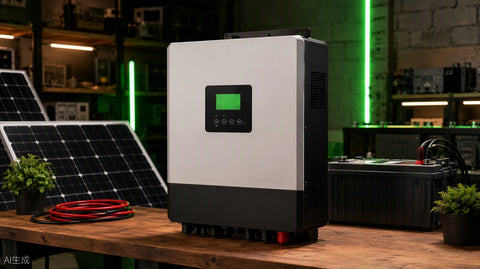
The PST-2000-12 is probably the single unit we sell most often to solar installers doing small off-grid builds. It's a 2,000W pure-sine inverter with a 4,000W surge rating, dual GFCI outlets, and a hardwire terminal block for permanent installation. At 90% peak efficiency and under 5% THD, it runs refrigerators, microwaves, and well pumps without the waveform issues that kill modified-sine units. The 12V input means it pairs naturally with a single 12V battery bank or a series-parallel configuration of standard 12V deep-cycle batteries — the kind every installer has on their truck.
For larger systems, the EVO-2224 is a 2,200W inverter combined with a 70A battery charger and a 30A transfer switch, all in one chassis. It's the unit we recommend for RVs and off-grid cabins where the owner wants shore-power charging when plugged in, inverter power when off-grid, and automatic transfer between the two without manual switching. The charger is a three-stage unit — bulk, absorption, float — which is the minimum for not destroying an expensive battery bank. We've seen cheap inverter/chargers cook AGM batteries in 18 months because their float voltage was 0.4V too high; the EVO's temperature-compensated charging avoids that.
DC-DC Converters: The Unsung Workhorses
Not every power conversion problem is AC. Modern vehicles, boats, and industrial equipment run mixed DC voltages: a 24V starter battery, a 12V house bank, a 48V solar array, and a 5V USB bus all on the same platform. Samlex's DC-DC converter line — the IDC, IDC-U, and STEP series — bridges those voltages with isolated and non-isolated topologies.
| Series | Topology | Voltage Conversion | Current Range | Isolation | Common Use |
|---|---|---|---|---|---|
| IDC Series | Buck (step-down) | 24V → 12V; 48V → 12V | 6A–40A | Yes (galvanic) | Truck/RV house systems from 24V chassis |
| IDC-U Series | Buck with USB | 24V/48V → 12V + 5V USB | 6A–20A + 2.1A USB | Yes | Work trucks needing 12V accessories + USB charging |
| STEP Series | Buck/boost | Various (e.g., 12V → 24V) | 5A–15A | Yes | Stepping voltage up for 24V loads from 12V banks |
The IDC-360A-24 is a workhorse we've sold by the pallet: 24V input, 12V output, 30A continuous, fully isolated. It takes the 24V from a truck's alternator system and drops it cleanly to 12V for radios, lighting, and inverters without creating ground loops or noise. Isolation matters — if your 12V radio shares a ground with the 24V starter and the starter draws 800A, the voltage drop on the ground bus can reset the radio every time the engine cranks. An isolated converter breaks that path. It's a $150 part that prevents a $1,500 headache.
Battery Chargers: The Three-Stage Standard
Samlex builds battery chargers in the SEC, SEC-UL, and BC series, ranging from 6A portable units to 100A+ industrial chargers. The technology is straightforward — a transformer-isolated AC-DC supply with microcontroller-managed charging profiles — but the details matter enormously for battery life.
| Series | Output Current | Battery Types | Charging Profile | Key Feature |
|---|---|---|---|---|
| SEC Series | 6A–40A | AGM, Gel, Flooded, LiFePO₄ | 3-stage (bulk/absorption/float) | Temperature compensation; selectable battery type |
| SEC-UL Series | 10A–30A | AGM, Gel, Flooded | 3-stage with equalization | UL 1236 listed for marine and RV |
| BC Series | 6A–15A | AGM, Gel, Flooded | 2-stage or 3-stage | Compact, portable, budget-friendly |
The SEC-1240A is the unit we pair with mid-size off-grid systems: 40A at 12V, which is roughly 550W of charging power — enough for a 400W solar array's worth of daily production or a small generator's output. It supports AGM, gel, flooded, and lithium iron phosphate (LiFePO₄) chemistries, selectable by dip switch. The lithium profile is critical — LiFePO₄ cells have a narrow voltage window, and charging them with a lead-acid profile will overcharge and damage the BMS. We've had customers try to save $80 by using an old lead-acid charger on a new lithium bank; the result was a $2,400 battery replacement and a very educational conversation.
Temperature compensation is the other non-negotiable. A battery at 50°F needs a higher charge voltage than the same battery at 90°F — roughly 0.028V per °C for lead-acid. Without compensation, a charger set for 77°F will undercharge in winter (sulfation, capacity loss) and overcharge in summer (gassing, water loss, thermal runaway). The SEC series includes a remote temperature sensor port; we include the sensor in every quote because the $15 part prevents the $600 failure.
Where Samlex Fits in the Competitive Landscape
Samlex does not compete at the bottom of the inverter market against no-name Amazon brands, and they don't compete at the very top against Victron, OutBack, or Schneider Electric's XW Pro line for large grid-interactive systems. Their position is the reliable middle: better build quality and support than the bargain brands, simpler and more affordable than the premium European stack. That positioning is deliberate and, for a large slice of the market, exactly right.
| Brand / Series | Price Tier | Best For | Samlex Advantage | Samlex Limitation |
|---|---|---|---|---|
| Samlex PST/EVO | Mid-range | RV, marine, small off-grid, mobile | Reliability, warranty, North American support | No grid-tie; limited to ~4 kW per unit |
| Victron MultiPlus | Premium | Large off-grid, grid-tie battery backup, ESS | Victron has grid-tie, VRM monitoring, larger power range | Higher cost; steeper learning curve |
| Renogy Inverters | Budget | Entry-level solar, price-sensitive buyers | Samlex has better surge ratings, longer warranty | Renogy is cheaper upfront |
| Xantrex (Schneider) | Premium | Large residential, commercial backup | Xantrex has higher power and grid-interactive features | Samlex is simpler to install and troubleshoot |
| Go Power (Dometic) | Mid-range | RV and marine | Comparable quality; Samlex has broader converter line | Go Power has stronger RV OEM relationships |
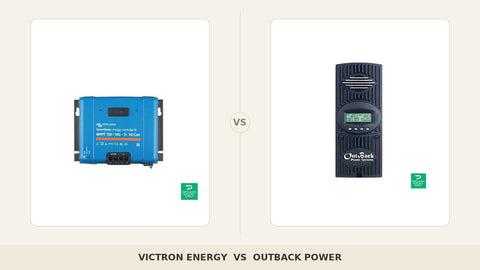
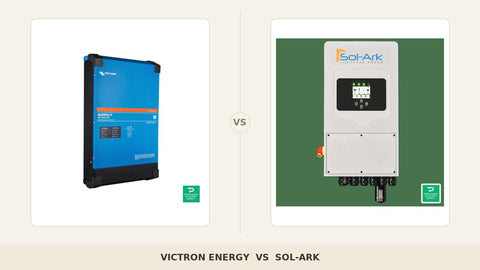
We've installed Victron stacks for customers who want every bell and whistle — ESS integration, VRM remote monitoring, generator auto-start, the works. And we've installed Samlex PST inverters for customers who want a fridge, some lights, and a pump to work without drama for the next decade. Both are valid choices; the mistake is putting a Victron budget on a Samlex need, or vice versa. Our inverter picks guide breaks down the full competitive set, and our hybrid inverter overview covers the grid-interactive side where Samlex does not play.
Real-World Application: Sizing a Samlex System for an Off-Grid Cabin

Here's a project we quoted last winter: a 600 sq ft cabin in northern Michigan, used on weekends year-round and for a week at a time in summer. Loads: a 12VDC fridge (2.5A @ 12V, 60W running), LED lighting (40W), a ½ hp well pump (750W running, 1,800W starting), a propane furnace with a 6A blower (720W), a microwave (1,200W, 10 min/day), and a laptop/phone charging station (80W). Total running load if everything cycled at once: roughly 1,850W. Largest single surge: the well pump at 1,800W.
Our specification: a PST-2000-12 pure-sine inverter (2,000W continuous, 4,000W surge) feeding a 12V battery bank of four 6V Trojan T-105RE golf-cart batteries in series-parallel for 450Ah @ 12V. Charging from a 400W solar array through a 40A MPPT controller, with a Samlex SEC-1240A battery charger as backup for generator or shore-power charging. The math: 450Ah × 12V = 5,400Wh of storage. At 50% depth of discharge (conservative for lead-acid longevity), that's 2,700Wh usable. The daily load profile averages 3,200Wh in winter (furnace running) and 1,800Wh in summer. Winter requires either more solar, a generator run every few days, or a larger battery bank — which is exactly what we told the customer. He chose to add a second string of T-105s for 900Ah total. The system has been running for two years without a single service call.
The point of the story: Samlex equipment is the easy part. The hard part is honest load accounting, realistic depth-of-discharge planning, and telling the customer the truth about winter. We've seen installers spec a 1,000W modified-sine inverter for that same load profile, ignore the 1,800W pump surge, and quote a single 100Ah battery. That system fails on day one, and the customer blames the inverter. It's never the inverter's fault when the math was wrong at the design stage.
Samlex Quality, Warranty, and Support
Samlex inverters carry a 2-year warranty for consumer use and a 1-year warranty for commercial applications. That seems short compared to some competitors, but in practice, Samlex's warranty support is responsive and pragmatic — they replace failed units quickly without the runaround that some brands put customers through. The failure rate we see in the field is low; most returns are installation errors (reverse polarity, overvoltage input, undersized wiring) rather than manufacturing defects.
Build quality is what you'd expect from a Canadian manufacturer with ISO 9001 certification: conformal-coated circuit boards for moisture resistance, anodized aluminum enclosures, and conservative thermal design. The PST series runs warm but not hot at rated load, and the cooling fans are thermostatically controlled rather than always-on — a small detail that reduces noise and dust ingestion in RV and marine installations.
One criticism we've heard: Samlex's documentation is functional but not generous. If you're a first-time inverter buyer expecting a 40-page illustrated manual, you'll be disappointed. The manuals cover safety, wiring, and specs adequately, but they assume some electrical literacy. If you need hand-holding, budget for a professional install or buy through a dealer who provides support — which is exactly what we do.
How to Select the Right Samlex Product
- List every load with running watts and starting watts. Don't guess — measure with a Kill-A-Watt or clamp meter, or read the nameplate. Motors need 3–7× running current at start.
- Total the running watts and identify the largest starting surge. The inverter's continuous rating must exceed the running total, and its surge rating must exceed the largest single motor start.
- Choose modified-sine only for resistive loads (heaters, toasters, incandescent bulbs). Everything else gets pure-sine. The price delta is small; the protection is large.
- Match input voltage to your battery bank. 12V for small systems and automotive; 24V for medium systems; 48V for large systems where wire sizing matters.
- Size the battery charger at 10–20% of battery Ah capacity. A 200Ah bank charges efficiently with a 20–40A charger. Too small and charging takes forever; too large and you stress the batteries.
- Include a temperature sensor for every charger. This is non-negotiable for battery longevity, especially in climates with seasonal temperature swings.
- Verify wiring size against the inverter's peak current. A 2,000W inverter at 12V draws roughly 185A at full load — that requires 4/0 AWG cable for runs under 10 feet, and larger for longer runs. Undersized wiring causes voltage drop, overheating, and inverter shutdown.
Our battery sizing guide runs the storage math, and our NEC wire sizing guide has the conductor tables. Between those two and an honest load list, you can spec a Samlex system that works on paper and in the field.
Frequently Asked Questions
What is the difference between Samlex modified-sine and pure-sine inverters?
Modified-sine inverters output a stepped waveform suitable for resistive loads like heaters and simple lights. Pure-sine inverters output a smooth sine wave identical to grid power, safe for motors, transformers, and sensitive electronics. For anything with a cord and a motor or circuit board, pure-sine is the correct choice.
Can a Samlex inverter run a refrigerator?
Yes, provided it is a pure-sine model (PST or SA series) with sufficient surge capacity. A typical refrigerator draws 100–200W running but needs 800–1,200W at compressor start. A PST-1500-12 or larger handles this comfortably.
How efficient are Samlex inverters?
Samlex pure-sine inverters operate at 87–92% peak efficiency, with no-load draws of 0.5–2A depending on model. Modified-sine units are slightly less efficient. Efficiency matters because lost watts become heat in the inverter, and lost amp-hours reduce battery runtime.
Can I use a Samlex battery charger with lithium batteries?
The SEC series includes a LiFePO₄ charging profile selectable by dip switch. Do not use a lead-acid charger profile on lithium batteries — the voltage and charging algorithm are different, and mismatch will damage the battery management system.
What wire size do I need for a 2,000W Samlex inverter?
At 12V, a 2,000W inverter draws approximately 185A at full load. NEC 310.16 requires 4/0 AWG copper for continuous loads under 195A at 75°C. Use 4/0 or larger, with properly crimped ring terminals and a fuse or breaker rated for the wire size within 18 inches of the battery.
Does Samlex make grid-tie inverters?
No. Samlex specializes in off-grid, mobile, and backup power conversion. For grid-tie or hybrid systems, see our hybrid inverter guide or the inverter picks for grid-interactive options.
How long is the Samlex warranty?
Samlex inverters carry a 2-year warranty for consumer use and 1 year for commercial applications. Warranty service is handled through authorized dealers and distributors, including Portlandia Electric Supply.
Are Samlex inverters suitable for marine use?
Many Samlex models are marine-rated or conformally coated for moisture resistance, but they are not all ignition-protected. For gasoline-engine boats, verify the specific model meets ABYC or USCG ignition-protection standards, or mount the inverter in a ventilated, non-engine compartment.
Related Products & Resources
- Off-grid cabin kits — complete power systems including Samlex-compatible components
- Solar inverters — full inverter catalog
- Solar inverter top picks for 2025
- Hybrid inverter overview — grid-interactive options
- Battery sizing guide
- Battery maintenance and longevity guide
- NEC wire sizing and ampacity charts
- Battery storage
- Home battery bank sizing guide
- Complete solar kits
- Can solar panels power a whole house?
- EV chargers
Samlex America isn't the flashiest brand on the market, and that's exactly the point. They build power conversion equipment that works, keeps working, and doesn't require a firmware update to stay compatible. For RVers, boaters, off-grid homesteaders, and mobile tradespeople, that reliability is worth more than any feature list. We've sold enough of their product line to know the return rate, and we've handled enough warranty claims to know the support quality. Both are solid. If your project needs an inverter, converter, or charger in the 100W–4,000W range, Samlex belongs on the shortlist — not because it does everything, but because it does what it promises, and it keeps doing it year after year.
Samlex America: Company History and Market Position
Samlex America was founded in 1991 in Vancouver, Canada, and has grown into one of North America's most established power conversion manufacturers. Unlike brands that chase the lowest possible price point, Samlex built its reputation on marine and RV markets where failure means being stranded miles from shore or stuck in a remote campsite with dead batteries. That heritage shows in their design priorities: conformal-coated circuit boards resist salt spray and humidity, anodized aluminum enclosures survive years of vibration, and conservative thermal ratings mean the inverter you buy can actually run at rated load in a hot engine compartment.
The company operates manufacturing facilities in Asia with North American headquarters and distribution centers in Vancouver and Ferndale, Washington. This dual-continent presence matters for warranty and support. When a unit fails, replacement parts ship from Washington state, not from overseas. We've had warranty replacements arrive in three business days — fast enough that the customer's off-grid cabin didn't need a backup generator rental.
Samlex's product range has expanded steadily. The early focus was marine DC-AC inverters; today the catalog spans pure-sine inverters to 3,000W, DC-DC converters to 40A, battery chargers to 100A, and AC-DC power supplies for industrial and medical applications. They are not the biggest brand in any single category, but they are one of the few that competes credibly across all of them. For distributors like us, that breadth is valuable: a single SKU range covers RV, marine, solar, truck, and industrial channels without forcing us to manage relationships with half a dozen specialized suppliers.
Installation Best Practices for Samlex Inverters
The most common installation error we see with Samlex inverters is undersized wiring. Customers buy a 2,000W unit, connect it with 8 AWG jumper cables because that's what they have in the garage, and then wonder why the inverter shuts down under load. The math is simple: at 12V input, a 2,000W inverter draws approximately 185A at full load, and surge currents can hit 300A+ for milliseconds. NEC Table 310.16 rates 4/0 AWG copper at 195A at 75°C — and that's for continuous duty. For short runs under 10 feet, 4/0 is the minimum; for longer runs, you need larger cable or a higher system voltage.
Fusing is equally critical. The battery-to-inverter cable must have an overcurrent protective device within 18 inches of the battery terminal, sized to protect the cable. A 4/0 AWG cable with 90°C insulation is rated for 230A; a 250A fuse or breaker is appropriate. Without this protection, a short circuit in the inverter or cable can dump thousands of amps from the battery, turning the wiring into a heating element. We've seen melted battery terminals from installations that skipped the fuse to save $30. The fuse costs less than the deductible on your insurance claim.
Grounding follows NEC 250. The inverter chassis must be bonded to the vehicle or vessel ground, and in off-grid installations, a grounding electrode system is required. Samlex inverters have a dedicated ground lug; use it. Floating grounds create noise in audio equipment, erratic behavior in electronics, and in wet environments, they create a shock hazard. Our grounding and bonding guide covers the full NEC requirements.
Ventilation matters. Samlex inverters list a maximum ambient operating temperature — typically 104°F (40°C) for continuous duty. In an RV engine compartment or a shed in Arizona, ambient plus solar gain can exceed this. Mount the inverter in a ventilated space, keep clearance around the cooling fins, and if the install location routinely hits 120°F, derate the inverter by 20% or upsize. Heat is the silent killer of power electronics.