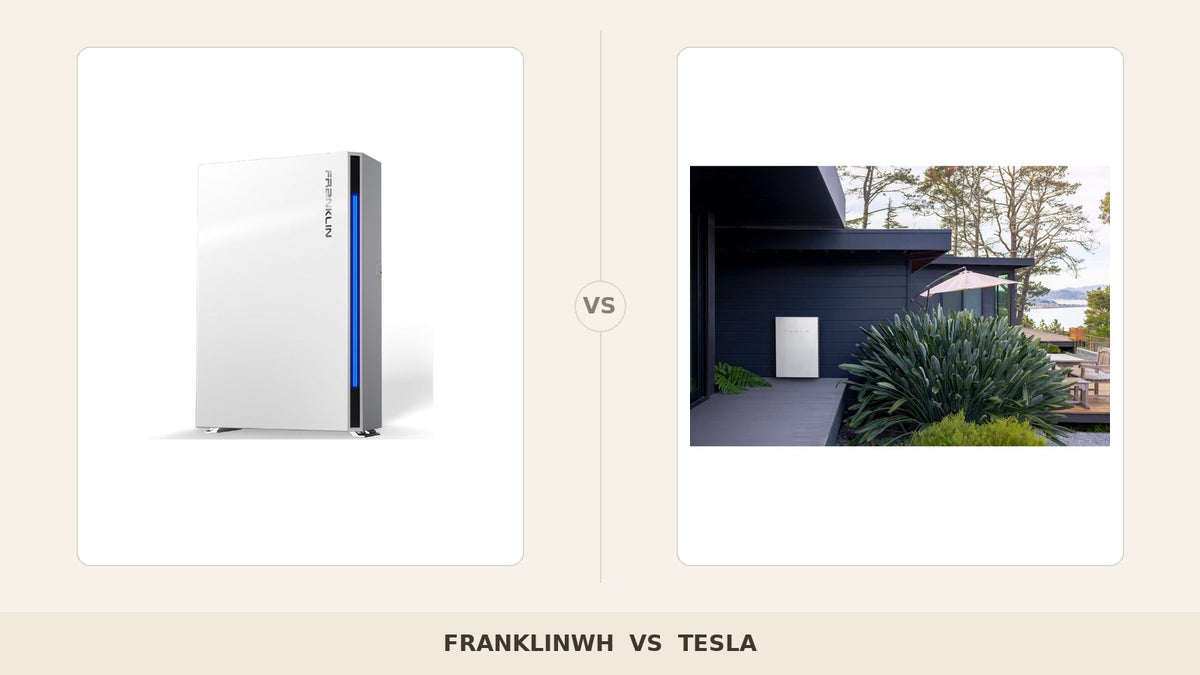
FranklinWH vs Tesla Powerwall 3 (2026): Whole-Home Batteries Compared by People Who Install Them
Capacity, output, chemistry, warranty, generator integration, and real install labor — the two most requested whole-home batteries in North America, measured against each other on the things that actually decide a purchase.
We sell and stage both of these systems, so we have no reason to crown a winner before you know your own load profile. What we can do is tell you what we see on real jobs. We've hung both of these units on garage walls, and the differences that matter rarely show up on the glossy spec sheets. They show up at 7 p.m. on commissioning day, when the transfer equipment needs to play nice with a 200-amp service and the homeowner wants the AC compressor to start without a flicker.
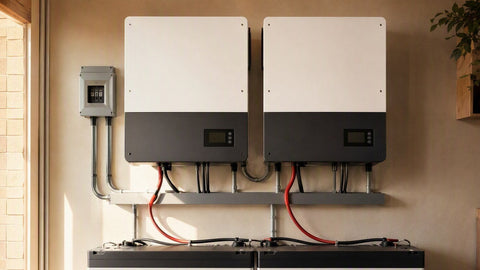
The Tesla Powerwall 3 and the FranklinWH aPower 2 are both lithium iron phosphate (LFP) whole-home batteries in the 13.5–15 kWh class. Both are UL 9540 listed. Both promise full-home backup through a single wall-mounted box plus a smart electrical gateway. But they take different design philosophies: Tesla built the Powerwall 3 around an integrated hybrid inverter, while FranklinWH built the aPower 2 around an inverter-agnostic AC-coupled architecture with the aGate controller doing the traffic-cop work. That single fork in the road drives almost every other difference in this comparison.
Below we walk through verified specs, real installed-cost math, runtime examples with actual load numbers, NEC and NFPA code considerations, warranty fine print, and the generator-integration question that decides more of these sales than any datasheet line item.
Spec-for-Spec: Powerwall 3 vs aPower 2


Start with the numbers both manufacturers publish. We pulled these from the current datasheets and listing documents — where the two brands measure differently, we note it, because apples-to-oranges specs are how homeowners get burned.
| Specification | Tesla Powerwall 3 | FranklinWH aPower 2 | Field Note |
|---|---|---|---|
| Usable capacity (per unit) | 13.5 kWh | 15 kWh | FranklinWH wins single-box energy by ~11% |
| Continuous power output | 11.5 kW | 10 kW | Tesla wins on paper; both start most 4-ton ACs with soft-start |
| Peak / surge capability | Higher surge for motor starts (published surge ratings vary by firmware) | Strong motor-start surge; rated for heavy compressor loads | Verify against your exact condenser's LRA |
| Chemistry | LFP (lithium iron phosphate) | LFP (lithium iron phosphate) | Both moved to LFP — better cycle life, no cobalt, lower thermal risk |
| Solar integration | Integrated hybrid inverter with multiple MPPT inputs | Inverter-agnostic; AC-couples to any existing solar inverter | Biggest architectural difference — see retrofit section |
| Round-trip efficiency | High (Tesla publishes up to ~97.5% solar-to-home in DC-coupled mode) | AC-coupled path trades a few points of efficiency for flexibility | AC coupling costs roughly 3–5% versus DC coupling |
| Scalability | Stacks up to 4 units (54 kWh) plus expansion packs | Scales to 15 units through aGate (up to 225 kWh) | FranklinWH scales further for estates and light commercial |
| Warranty | 10 years, unlimited cycles, 70% retention | 15 years on aPower 2, 60% retention | FranklinWH's 15-year term is a genuine differentiator |
| Listing | UL 9540 / UL 9540A test data | UL 9540 / UL 9540A test data | Both pass AHJ review; NFPA 855 spacing rules apply to both |
| Operating temperature | -4°F to 122°F (-20°C to 50°C) | -4°F to 122°F (-20°C to 50°C) | Both handle unconditioned garages in most US climates |
One honest note before we move on: specs drift with firmware. Tesla in particular has a habit of raising published continuous output via software updates on the same hardware. We quote what the datasheet says on the day we price a job, and we recommend you do the same. A promise of a future firmware bump is not a spec.
Neither of these is a DIY box you bolt up on a Saturday. Both require a licensed installer, a permit, a utility interconnection agreement under NEC 705, and in most jurisdictions an AHJ inspection against NFPA 855 clearances. So the honest comparison is installed cost per usable kWh, not box price.
Here's the cost stack we build when we quote a typical single-battery whole-home job. Ranges reflect what we see across US markets in 2026; your labor rates, panel condition, and trenching distance move the number.
| Cost Line Item | Typical Range (USD) | Notes |
|---|---|---|
| Battery unit (PW3 or aPower 2) | $8,500–$11,000 | Equipment only, before gateway/controller |
| Gateway / smart controller (Backup Gateway 2 or aGate) | $1,500–$2,500 | Required for whole-home backup; this is the transfer brain |
| Electrical labor + materials (wire, conduit, breakers, disconnects) | $2,500–$5,500 | 200A service work, 60A+ feeders, potential panel modifications |
| Permits, engineering, utility interconnection fees | $500–$1,500 | Varies wildly by AHJ and utility territory |
| Optional: main panel upgrade (if needed) | $2,000–$4,500 | Older 100A services or full panels trigger this |
| Typical single-battery total | $13,000–$21,000 installed | Before any incentives; two-battery jobs scale sub-linearly |
On incentives: the federal 30% residential clean energy credit under IRC Section 25D was terminated for property placed in service after December 31, 2025. As of 2026, the money on the table is state-level (like California's SGIP for eligible customers), utility demand-response programs, and virtual power plant (VPP) enrollment payments. Both Tesla and FranklinWH support VPP participation in most active territories. Check your state and utility before you budget — do not let any salesperson amortize a federal credit that no longer exists into your quote.
Budget trap we see constantly
A "$9,000 battery" quote that excludes the gateway, the 200-amp transfer work, and the panel mods is not a quote — it's a down payment on a change order. Always ask for the all-in installed number with the transfer equipment itemized. If the number doesn't include a gateway/aGate line and a labor line for the service-side work, it isn't comparable to a quote that does.
This is where field experience matters more than brochures. Runtime is not a battery spec — it's a load spec. The same 15 kWh aPower 2 runs a efficient ranch house overnight or dies in two hours behind a 5-ton heat pump. Here's the math we run on every design, using NEC 220-style load thinking applied to backup duty.
Formula: Runtime (hours) = usable kWh × inverter efficiency ÷ average load (kW). At 90% round-trip efficiency, a 13.5 kWh Powerwall 3 delivers about 12.1 kWh to your loads; a 15 kWh aPower 2 delivers about 13.5 kWh.
| Load Scenario | Average Draw | PW3 (12.1 kWh delivered) | aPower 2 (13.5 kWh delivered) |
|---|---|---|---|
| Critical loads only: fridge, lights, internet, furnace blower, a few outlets | 0.6 kW | ~20 hours | ~22.5 hours |
| Critical loads + efficient 3-ton heat pump (soft-started, cycling 50%) | 1.8 kW | ~6.7 hours | ~7.5 hours |
| Whole home, normal evening use, no HVAC | 1.2 kW | ~10 hours | ~11 hours |
| Whole home + 4-ton AC running hard on a July afternoon | 4.5 kW | ~2.7 hours | ~3 hours |
| EV charging at 7.7 kW from battery (don't) | 7.7 kW | ~1.6 hours | ~1.75 hours |
Two field notes on that table. First, we've watched a single Powerwall carry a well-managed 2,400 sq ft home through a 14-hour outage — but the homeowner had the water heater and range locked out and treated the AC like a scarce resource. Second, with solar recharging during daylight, runtime math changes completely: a battery plus a 8–10 kW array in decent sun becomes effectively indefinite for most loads, because you're refilling the tank faster than you drain it most days. That's the real reason to pair storage with PV, and it's why our battery sizing calculator asks about your array size before it answers anything.
For a deeper walkthrough of matching kWh to your actual panel schedule, our home battery bank sizing guide and the battery backup runtime calculator run the same arithmetic with your numbers.
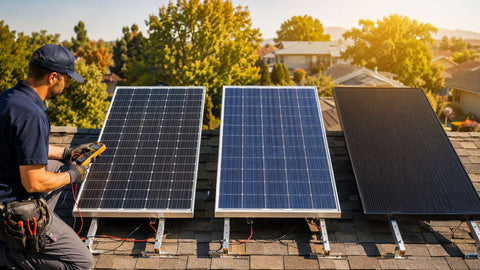
This is the section that actually decides most purchases. If you already have solar, the FranklinWH aPower 2 is usually the cleaner retrofit. It AC-couples to whatever inverter you already own — Enphase micros, SolarEdge, SMA, string, whatever — because it doesn't care where the AC power comes from. The aGate sits between your service and your loads and manages everything. We have retrofitted aPower units behind decade-old string inverters without touching the roof, and that saves real money and real warranty headaches.
The Powerwall 3, by contrast, is a hybrid inverter with a battery bolted to it. In a new solar-plus-storage build, that's elegant: one box does PV inversion, storage, and grid interaction, with up to six MPPT inputs and 20 kW of DC solar capacity. Fewer boxes on the wall, one efficiency chain, one monitoring app. But in a retrofit, you're either AC-coupling the PW3 alongside your existing inverter (which works, but gives up some of the integration you paid for) or you're ripping out functioning inverter hardware to consolidate — and we've seen that math rarely pencil.
Real job example — retrofit decision
- Scenario: 2019 SolarEdge 7.6 kW system, homeowner wants backup after two ice-storm outages.
- FranklinWH path: aPower 2 + aGate, AC-coupled, SolarEdge untouched, 2-day install, existing warranties intact.
- Powerwall 3 path: AC-couple behind the SolarEdge, or replace the inverter and re-permit the array. More labor, more risk, marginal gain.
- Outcome: The customer went aPower 2. The deciding factor wasn't brand loyalty — it was not re-engineering a working roof.
New construction flips the logic. If the roof and the battery are being designed together, the Powerwall 3's integrated inverter removes a whole layer of equipment and wiring. One 60-amp feeder from the PW3 to the gateway, PV strings landing straight on the battery, clean wall. Our Tesla Powerwall collection moves steadily for exactly this use case, and the older Powerwall 2 still shows up in service calls often enough that we keep support notes on it.
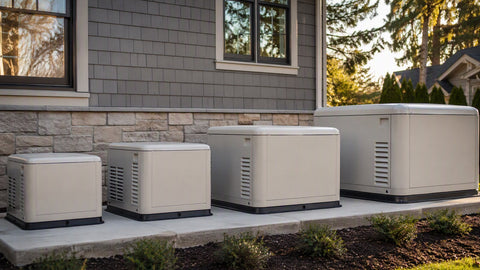
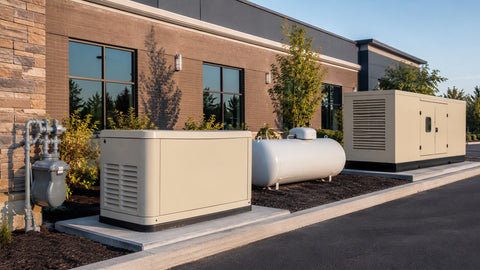
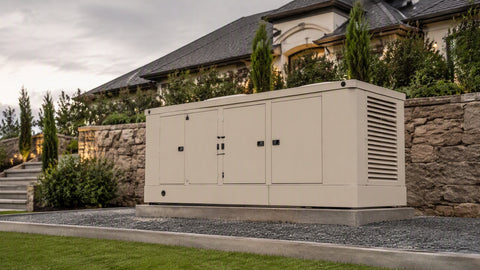
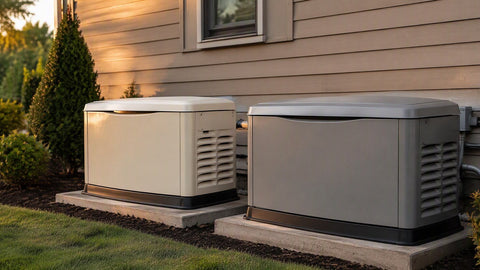
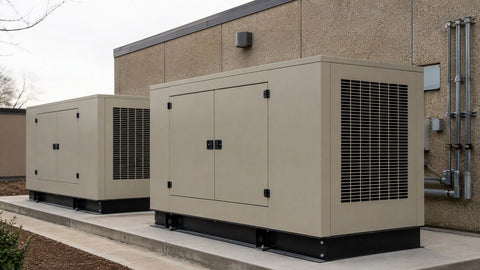
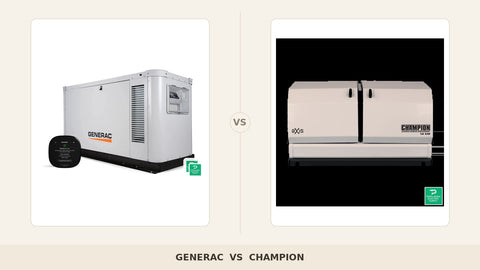
Here's the thing nobody puts in the headline: a meaningful share of whole-home battery buyers already own a standby generator, and they want the battery to cooperate with it, not replace it. FranklinWH built the aGate specifically for this. It manages a generator as a first-class citizen — auto-starting it when batteries run low during extended outages, charging the batteries from generator output, and blending sources. If you have a 22 kW Generac or Kohler on a pad already, the aGate treats it as a teammate.
Tesla's ecosystem historically treated generators as an awkward guest. Powerwall systems can work with generators — there are supported configurations — but the integration is less native, and we've seen more commissioning friction on generator-plus-Powerwall jobs than on generator-plus-FranklinWH jobs. If generator harmony is your priority, that's a real point for FranklinWH, not a marketing point.
Both systems handle load control through smart panels or load-shed accessories (Tesla via the Backup Gateway's load management, FranklinWH via aGate smart circuits). Both can be configured to keep a 200-amp service from overloading the battery by automatically shedding the water heater, range, or EV charger during outages. We've programmed load-shed priorities on both platforms; FranklinWH's smart-circuit interface is the one our installers mention unprompted. For more on how transfer equipment interacts with backup power, see our guides on automatic transfer switches and the NEC wire sizing guide for generator and solar feeders.
Both systems sail through permitting in most jurisdictions because both carry UL 9540 listings with UL 9540A thermal runaway test data — the two documents your AHJ actually asks for. The code items that trip up installations are the same for both brands:
| Code / Standard | What It Governs | Practical Impact on Your Install |
|---|---|---|
| NEC 706 (Energy Storage Systems) | ESS installation, disconnects, signage | Requires a readily accessible ESS disconnect; affects where the unit can hang |
| NEC 705 (Interconnected Power Sources) | Grid interconnection, busbar loading (120% rule) | May force a panel derate or upgrade if your busbar is maxed |
| NFPA 855 | ESS spacing and location | 3-ft separation between units and from doors/windows in many adoptions; garage installs need bollard/protection planning |
| UL 9540 / 9540A | System-level safety listing + fire test data | Both PW3 and aPower 2 comply; no AHJ advantage either way |
| NEC 310.16 ampacity / 240.6 breaker sizes | Feeder wire and OCPD sizing | Typical battery feeders run 60A–100A; expect 6 AWG to 3 AWG copper THHN in EMT/PVC depending on configuration |
One practical note from the field: the 120% rule (NEC 705.12) kills more single-battery designs than any other single code section. A battery feeding 60 amps back through a 200-amp busbar usually fits; stacked batteries plus a big solar backfeed on an older 100-amp panel often don't. Budget the panel conversation before you fall in love with a unit count. Our NEC code compliance guide covers the busbar math in plain language.
A battery is a 10–15 year appliance. The warranty terms deserve a slow read:
- Tesla Powerwall 3: 10 years, unlimited cycles, warrantied to retain 70% of original capacity. Tesla's warranty is backed by a large company with a mixed-but-improving service network. Unlimited cycling matters if you plan to arbitrage time-of-use rates daily.
- FranklinWH aPower 2: 15 years — one of the longest terms in residential storage — warrantied to 60% capacity retention. The longer calendar coverage is real value if you plan to own the home past year 10.
Both use LFP cells, which is why both can offer these terms — LFP routinely delivers 6,000+ cycles to 80% in lab conditions, far beyond what a daily-cycled home battery will see in a decade. For care and feeding, our guide on extending solar battery life applies to both, and the 20–80 battery rule explains why partial-state-of-charge operation is your friend.
Choose the Tesla Powerwall 3 if...
You're building new solar-plus-storage from scratch and want one integrated box. You value Tesla's monitoring app, VPP programs, and the brand's installer density. You're stacking up to four units and want a single-vendor ecosystem. Your roof is going on at the same time as the battery.
Choose the FranklinWH aPower 2 if...
You have existing solar you want to keep. You own a standby generator and want native integration. You want 15 kWh in a single box and up to 15 boxes in a system. The 15-year warranty matters to you. You want inverter-agnostic flexibility because your roof hardware is complicated or old.
Consider a third path if...
Your budget is tighter than either brand allows, or your loads are smaller. Value platforms have closed most of the gap — our EG4 vs Tesla Powerwall comparison covers the budget end honestly, and the solar battery buyer's guide maps the whole field. For partial-home backup, a 10 kWh-class battery or a 10 kW solar battery kit often pencils better than a premium 13.5 kWh unit at half utilization.
What we tell our own customers, regardless of brand: size the loads first, then the battery, then the brand. Every bad storage experience we've been called in to fix started with someone buying a brand before they did the math. Our storage sizing walkthrough and the Generac PWRcell cost guide (if you want a third quote to compare) are the two reads we'd pair with this one.
Frequently Asked Questions
Is FranklinWH better than Tesla Powerwall 3?
Neither is universally better — they win different jobs. The aPower 2 wins on capacity per box (15 vs 13.5 kWh), warranty length (15 vs 10 years), generator integration, and retrofit flexibility. The Powerwall 3 wins on continuous output (11.5 vs 10 kW), integrated PV inverter simplicity for new builds, and ecosystem polish. Your existing equipment decides more than the spec sheet does.
Which is cheaper installed?
All-in installed pricing for a single-battery whole-home system typically lands between $13,000 and $21,000 for either brand, with the spread driven more by your panel condition, transfer equipment, and labor market than by box price. Get itemized quotes with the gateway/aGate and service work broken out — that's the only comparison that means anything.
Do both work with existing solar?
Yes, but differently. The aPower 2 is inverter-agnostic and AC-couples to any existing system without touching it. The Powerwall 3 can AC-couple to existing solar too, but its integrated hybrid inverter is wasted in that role — it's optimized for new builds where PV strings land directly on the battery.
Which works better with a standby generator?
FranklinWH. The aGate controller manages a generator natively — auto-start, battery charging from generator, source blending. Powerwall-plus-generator configurations exist and function, but the integration is less seamless and commissioning takes more care. If a generator is already on a pad at your house, weight this heavily.
How long do these batteries last?
Both use LFP chemistry rated for thousands of cycles. Tesla warranties 10 years to 70% retention with unlimited cycling; FranklinWH warranties 15 years to 60%. In practice, either should outlive its warranty in a typical daily-cycling home. Expect 12–18 years of useful service before capacity fade becomes noticeable in daily operation.
Can I install either one myself?
No. Both are 300+ lb high-voltage systems requiring a licensed electrician, permits, utility interconnection under NEC 705, and AHJ inspection. Beyond legality, improper ESS installation voids warranties and creates genuine fire and shock hazards. Budget professional installation from day one — it's 30–40% of the job cost for a reason.
Get a real quote, not a brochure number
We design and stage complete storage systems — battery, gateway, transfer gear, and the load math to back it up.
Size your systemRelated reading
Sources & standards: manufacturer datasheets for Powerwall 3 and FranklinWH aPower 2; UL 9540/9540A listing documents; NEC 2023 Articles 705, 706, 310.16, 240.6; NFPA 855. Specs verified against published documentation as of early 2026 — confirm current datasheet revisions before purchase, as firmware and ratings change.