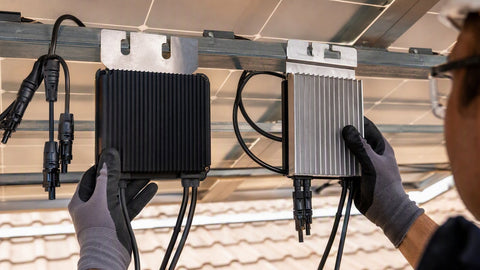
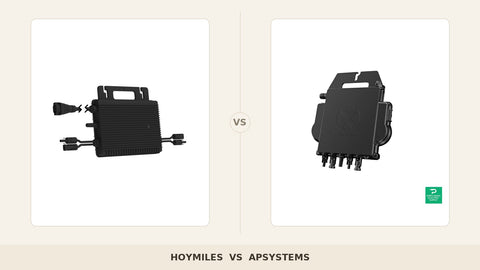
Enphase and APSystems are the two microinverter names our contractors actually argue about. Not because the others don't exist, but because these two have earned real field track records: Enphase with the IQ8 series, two decades of module-level electronics, and the deepest installer ecosystem in North America; APSystems with the DS3 family, aggressive pricing, dual-module architectures, and a reputation for quietly over-delivering on spec. We stock both, we've swapped failed units of both under warranty, and this is the head-to-head we give crews who ask which pallet to load.
The one-paragraph verdict: Enphase is the ecosystem play — grid-forming IQ8 silicon, battery integration, the best monitoring in residential solar, and a price to match. APSystems is the value-engineering play — near-parity performance, dual and quad module options that cut device count, and per-watt pricing that makes competitive bids winnable. The right answer depends on the roof, the budget, and whether storage is in the customer's five-year plan.
Sizing and Module Matching: Getting the Pairing Right
The most expensive mistake we see with either brand is a lazy pairing: a high-wattage module clipped against a microinverter's output ceiling, throwing away harvest the customer paid for, or an oversized micro on a small panel burning budget for headroom that never gets used. The discipline is simple. Match the module's real-world output — nameplate minus temperature and soiling losses, call it 75–85% on a hot afternoon — to the micro's continuous rating, and confirm the module's voltage and current windows sit inside the micro's input envelope across your climate's coldest morning and hottest afternoon. Both Enphase and APSystems publish compatibility tools; use them, and keep the screenshots in the job file for the inspector and the warranty file.
| Module Class | Suggested Enphase Pairing | Suggested APSystems Pairing | Field Note |
|---|---|---|---|
| 400–430W residential | IQ8+ / IQ8M class | DS3 / DS3-L (2 modules per unit) | The volume pairing; both brands' sweet spot |
| 440–470W high-power residential | IQ8A / IQ8H class | DS3 high-current variant | Check max input current — modern panels push 14A+ |
| 500W+ commercial-format | IQ8H class where listed | QT2 quad class | QT2 economics shine here |
| Mixed orientations on one run | Singles keep every panel independent | Duals OK if paired panels share orientation | Never pair east + south on one dual input |
One crew habit worth stealing: label the trunk run map on the racking rail with a paint marker before the micros go on — device serial to module position, left to right, row by row. Scanning at commissioning is faster, the digital array map matches the physical roof without a ladder, and five years later the service tech standing on that roof thanks the original installer by name. We have watched a fifteen-minute labeling habit save a two-hour diagnostic visit. Do it on every job, both brands, no exceptions.
Commissioning and Communications: PLC vs Zigbee
Enphase moves data over power-line communications to the IQ Gateway; APSystems uses Zigbee radios to the ECU. In practice both work, and both have one failure mode worth planning around. PLC is immune to Wi-Fi interference but can struggle on electrically noisy services or very long feeder runs — rare, but we've chased it twice on agricultural shops with big VFDs. Zigbee is simple and robust on normal residential roofs but has range limits on sprawling estates or metal-heavy structures; an ECU placed in the garage instead of the basement fixes most complaints before they happen. Commissioning time is comparable: scan serials, build the array map in the app, verify every device reports, done. Budget 30–60 minutes for a 20-module roof on either platform, and don't skip the array-map verification — a mismapped roof makes every future service call harder.
Grid profiles deserve a sentence: both brands ship with the current UL 1741 SB / IEEE 1547 ride-through settings per region, and both let the installer select the correct utility profile at commissioning. Picking the wrong profile is a top-three cause of nuisance tripping in the first week. Slow down at that screen. And confirm the gateway has hardwired or strong Wi-Fi backhaul before you leave — a gateway that can't phone home turns every future monitoring question into a truck roll, and truck rolls are where microinverter margins go to die.
The Commercial and Small-Business Angle
Above residential scale, the calculus shifts. APSystems' quad architecture was practically built for small commercial roofs — a 100-module warehouse job is 25 QT2-class devices instead of 100 singles, and the BOM math gets lopsided fast. Enphase counters with its commercial line and the same monitoring depth that makes portfolio owners happy. For true commercial work, though, also price the string-inverter alternative before defaulting to module-level electronics: our commercial solar inverters and string inverters categories exist because three-phase string gear still wins plenty of flat-roof bids on cost. Micros earn their premium where shade, monitoring granularity, or NEC 690.12 simplicity justify it — on a big open commercial roof, run both numbers.
Head-to-Head Specification Table
| Specification | Enphase IQ8 Series | APSystems DS3 Series |
|---|---|---|
| Architecture | One microinverter per module (IQ8/IQ8+/IQ8M/IQ8A/IQ8H classes) | Dual-module (DS3, DS3-L) and quad-module (QT2 class) options reduce device count |
| Continuous output class | ~240–384 VA depending on model | DS3: ~600–800 VA class per dual unit; QT2: ~2,000 W class per quad |
| CEC / peak efficiency class | ~97% class peak | ~96.5–97% class peak |
| Grid-forming capability | Yes — IQ8 forms a microgrid with IQ System Controller + batteries, sunlight-only backup capable | No native grid-forming in DS3 line; backup requires separate storage/inverter solution |
| Module compatibility window | Matched power classes per model; wide modern module support including high-current panels | Wide; dual input handles mixed orientations on one unit |
| Monitoring | Enlighten — per-module production, per-device health, consumption CTs, battery integration | ECU/EMA platform — solid per-module data, improving rapidly |
| Communications | Power-line carrier to IQ Gateway | Zigbee to ECU gateway |
| Warranty | 25-year limited warranty class on current microinverters | 25-year class available (verify registration and regional terms) |
| Rapid shutdown compliance | Integrated, NEC 690.12 module-level compliant | Integrated, NEC 690.12 module-level compliant (dual units cover two modules) |
| Price per watt class | Premium | Value-to-mid; typically 15–30% under Enphase on comparable systems |
The Architecture Argument: Singles vs Duals vs Quads
Enphase puts one microinverter under one module. APSystems' DS3 puts one microinverter under two modules, and the QT2 class under four. Do the device-count math on a 24-module roof: twenty-four IQ8s versus twelve DS3s versus six QT2s. Fewer devices means fewer trunk cable connections, fewer mounting bolts torqued, fewer serial numbers to scan at commissioning, and — statistically — fewer components that can ever fail. On labor, a dual-unit roof lands noticeably faster; our crews consistently shave 30–60 minutes of roof time on a 20-module job with duals.
The counter-argument is failure blast radius. When a single-module microinverter dies, you lose one panel's production until the swap. When a dual dies, you lose two; a quad, four. In twenty years of aggregate data the absolute failure rates are low on both brands — we're talking a handful of swaps per hundred systems — but the math matters for service promises. Enphase also wins a subtler point: one device per module means per-module MPPT granularity is absolute, with zero electrical interaction between adjacent panels. Dual units run independent MPPT inputs, so the practical shading difference is smaller than marketing claims on both sides suggest, but on truly pathological shade — vent pipes, dormers, two orientations sharing a unit — the single-module approach keeps every watt accountable to its own panel.
Trunk cable deserves a mention because it's real money. Enphase's Q Cable and APSystems' bus cable both run the length of the array, but dual/quad architectures halve or quarter the drop count. On a big roof that's a coil of cable, a bag of connectors, and an hour of labor back in your pocket. Price the whole BOM — microinverters, trunk cable, racking hardware, PV wire — not just the device sticker.
Grid-Forming: The Feature That Actually Separates Them
This is the section that matters most for customers planning storage. Enphase IQ8 microinverters are grid-forming devices: with an IQ System Controller and IQ batteries, the system forms its own microgrid when the utility drops, and in sunlight-only backup configurations the roof can keep producing during an outage without a battery at all — a party trick no other residential microinverter line matches. For a customer who says "I want batteries eventually," installing IQ8 today means the storage retrofit later is an AC-coupled afternoon, not a redesign.
APSystems DS3 units are grid-following: superb at turning DC into grid-synchronized AC, offline the moment the grid disappears, same as every traditional microinverter. Backup with an APSystems roof means adding a separate hybrid inverter or AC-coupled battery system — which works fine, and we sell plenty of exactly that pairing — but it's a second architecture decision rather than a native path. If storage is a when, not an if, that's a real advantage for Enphase. If the customer just wants the cheapest reliable kWh from the roof, the DS3's grid-following simplicity is a virtue, not a limitation: fewer modes, fewer edge cases, fewer firmware personalities.
Performance in the Field: Heat, Shade, and Harvest
Spec-sheet efficiency within half a point is noise; field harvest is signal. Across our install base, same-roof comparisons show Enphase and APSystems within 1–2% annual harvest of each other when both are properly matched to the modules — the differences that matter are thermal behavior and low-light wake-up. Both lines handle roof temperatures that would cook a string inverter's capacitors, because microinverters spread the heat load across many small devices with big thermal margins. Enphase publishes strong high-temperature derating curves; APSystems' DS3 has earned a similar reputation in desert installs we've supported in the Southwest.
Shade handling is effectively a draw at the device level — both do per-input MPPT with modern algorithms — and system design dominates: right-size the micro to the module, respect the voltage windows on cold mornings, and don't let a sales rep pair a 550W panel with an undersized micro because the sticker price looked good. Our solar system size calculator and inverter sizing calculator keep those matches honest, and the panel wiring basics article covers the string-vs-micro decision for customers still choosing architectures.
Device Count, Labor, and Cost Math
| Line Item (24-module, ~10 kW roof) | Enphase IQ8 (24 units) | APSystems DS3 (12 dual units) | APSystems QT2 (6 quad units) |
|---|---|---|---|
| Devices to mount + scan | 24 | 12 | 6 |
| Trunk cable drops | 24 | 12 | 6 |
| Roof labor delta vs baseline | Baseline | −30 to −60 min | −60 to −90 min |
| Hardware cost class | Premium | 15–30% below Enphase | Lowest per-watt of the three |
| Failure blast radius per device | 1 module | 2 modules | 4 modules |
| Backup/storage path | Native grid-forming ecosystem | Separate hybrid/AC-coupled storage | Separate hybrid/AC-coupled storage |
Monitoring and Fleet Management
Enlighten is the monitoring platform everyone else is chasing: per-module production history going back years, per-device health flags, consumption metering with CTs, battery integration, and a homeowner app that customers actually open. For a contractor running a fleet, the installer portal's alert routing and fleet-wide status views have saved us more truck rolls than any other single software tool we use. APSystems' ECU/EMA platform delivers the essentials — per-module data, alarms, production reports — and has improved faster over the last three years than any competitor's software we've watched. The honest gap today is polish and ecosystem depth, not fundamentals. If your customer is the type who checks production daily, Enlighten is worth real money. If they want to know it's working and otherwise be left alone, the ECU platform covers the job at a lower system price.
Reliability, Warranty, and Support Reality
| Factor | Enphase | APSystems |
|---|---|---|
| Warranty term class | 25-year limited (current IQ8 line) | 25-year class available — verify registration terms |
| Field failure experience (our logs) | Low; early-generation issues long since resolved | Low; DS3 generation notably solid |
| RMA process | Mature portal, advance replacement common | Responsive; verify advance-replacement policy per region |
| Installer training ecosystem | Deepest in the industry — certification programs, design tools | Growing; solid documentation, smaller training footprint |
| Bankability / company scale | US-listed, multi-billion revenue, 20+ years | Global, strong APAC/LatAm presence, growing US share |
Both companies honor warranties without a fight in our experience — the difference is process maturity. Enphase's RMA portal and advance-replacement logistics are the benchmark. APSystems has been responsive on every claim we've filed, with the caveat that their US support apparatus is younger. Neither is a reason to lose sleep; both are reasons to register products and photograph serials at commissioning, which your crew should be doing anyway.
Code compliance is a wash where it matters: both lines satisfy NEC 690.12 rapid shutdown at the module level, both carry the listings inspectors expect, and the AC side of either install still runs through the same rules — NEC 310.16 conductor sizing from our NEC wire sizing guide, disconnect and OCPD requirements in the NEC 690 disconnect guide, grounding per the grounding and bonding guide, and a service SPD we recommend on every job.
AC Side Math: Trunk Circuits, Breakers, and Wire
Module-level electronics simplify the DC side to nearly nothing and move all the interesting math to the AC trunk. The rules we apply on every design: continuous output of all micros on a branch, multiplied by 1.25 for NEC continuous-load treatment, lands you at the required conductor ampacity and breaker size; the sum of backfed breakers in the panel has to satisfy the 120% rule of NEC 705.12 or you downsize the main or use a supply-side tap. A worked example from a real job: twelve DS3 duals on one branch at ~7.7 kVA total continuous is about 32A at 240V; times 1.25 is 40A — so a 40A two-pole breaker and 8 AWG copper THHN in the homerun, derated per NEC 310.16 and conduit-fill adjusted. The same roof with twenty-four IQ8-class units at ~8.9 kVA total lands at about 46A — a 50A breaker and 6 AWG. Device count literally changes the wire size on the quote. Our conduit fill chart and conduit types guide cover the raceway side of that run, and the solar wire and cable guide settles PV-wire-versus-THHN questions before the supply house does.
A Roof-Time Story Worth the Read
Last summer we ran two near-identical 22-module roofs on the same street, two weeks apart — one IQ8, one DS3 — same crew lead, different installers. The Enphase roof took a touch over six hours of combined roof labor; the APSystems roof finished in five. The difference wasn't skill, it was arithmetic: eleven duals versus twenty-two singles is eleven fewer devices to mount, torque, plug, and scan. The DS3 homeowner paid meaningfully less. The IQ8 homeowner got grid-forming storage readiness and the prettier app. Both systems passed inspection on the first visit, both are producing within a percent of model a year later, and both customers would hire the crew again. That's this comparison in miniature: there is no wrong answer between these two brands, only a wrong answer for a specific roof, budget, and storage plan.
Choose Enphase IQ8 If
- Storage is in the customer's five-year plan — grid-forming IQ8 plus IQ batteries is the cleanest retrofit path in residential solar.
- The roof is complex: multiple orientations, heavy shade, or a customer who wants per-panel accountability forever.
- Monitoring quality and homeowner app polish are selling points, not afterthoughts.
- Your crew is already Enphase-certified and the RMA/training ecosystem is part of your service model.
Choose APSystems DS3/QT2 If
- Bid competitiveness decides the job — 15–30% hardware savings wins price-sensitive customers without a quality sacrifice.
- The roof is simple and sunny: dual and quad units cut device count, labor, and trunk cable cost.
- The project is grid-tied with no storage roadmap, where grid-forming capability would be paid for and never used.
- You're building multi-kW commercial-adjacent residential where QT2's per-device output slashes device counts.
We quote both platforms weekly and stand behind either. Build the BOM from live stock at Enphase and APSystems, cross-shop against Hoymiles if you want a third bid, and round out the design with solar panels, solar kits, and the panel kits buyer's guide. For a wider look at inverter choices across architectures, see our top solar inverters roundup.
Frequently Asked Questions
Is APSystems as reliable as Enphase?
Current-generation hardware says yes. Our field logs show DS3-series failure rates in the same low band as IQ8 — single-digit swaps per hundred systems. Enphase carries a longer corporate track record and a more mature RMA machine; APSystems has been responsive on every claim we've filed. For warranty peace of mind, both offer 25-year-class coverage — verify registration requirements on the APSystems side.
Which is better for shaded roofs?
Both do per-input MPPT and handle shade far better than any string inverter. Enphase's one-device-per-module architecture gives absolute per-panel independence; APSystems duals keep independent inputs per module. On truly difficult roofs — multiple orientations on one trunk run — Enphase's granularity has a slight edge. On ordinary vent-pipe-and-chimney shade, the harvest difference is within a percent.
Can APSystems do backup power like Enphase?
Not natively. IQ8 microinverters are grid-forming and integrate with Enphase's battery ecosystem for outage operation, including sunlight-only backup configurations. DS3 units are grid-following and go dark with the grid; backup requires adding a separate hybrid inverter or AC-coupled battery system. It works well — it's just an additional architecture, not a native path.
How much cheaper is APSystems, really?
On a comparable residential system, expect roughly 15–30% lower microinverter hardware cost, amplified by reduced device count: half the units on duals, a quarter on quads, plus savings in trunk cable drops and roof labor. Total system-level savings typically land in the high hundreds to low thousands of dollars on a 10 kW roof.
Do both meet rapid shutdown requirements?
Yes. Both lines provide module-level rapid shutdown compliant with NEC 690.12. An APSystems dual unit covers its two modules with one device; Enphase covers one module per device. Inspectors in our service areas accept both without comment.
Which monitoring platform is better?
Enlighten is deeper: per-module history, per-device health, consumption metering, battery integration, and the best homeowner app in the category. APSystems' ECU/EMA platform covers production monitoring and alarms competently and has improved rapidly. Data-hungry customers and fleet operators get more from Enlighten; set-and-forget customers are well served by either.
Sources & Standards
- Enphase IQ8-series datasheets and Enlighten platform documentation
- APSystems DS3/QT2 datasheets and ECU/EMA documentation
- NEC 2023 Articles 690 (including 690.12 rapid shutdown), 705, and 310.16
- UL 1741 SA/SB certification listings for both product lines
- Portlandia Electric Supply install records, RMA logs, and crew time studies, 2022–2026