EG4 vs Pylontech 2026: Budget 48V Rack Batteries Compared
The two value leaders of the 48V server-rack world: capacity per module, $/kWh, cycle ratings, inverter protocol compatibility, expansion rules, and real bank-build math for 10–40 kWh systems.
If you have priced a 48V rack battery in the last five years, you have priced these two. Pylontech essentially created the product category — the US2000 was the rack module that made lithium storage modular, and the Pylontech CAN protocol became the de-facto language that half the inverter industry now speaks. EG4 took the same form factor, added capacity per module, and attacked the price point hard enough to reset what the market considers “budget.” We have commissioned banks of both on hybrids from EG4, Sol-Ark, Victron, and Schneider, and both have earned their reputations: Pylontech for compatibility breadth, EG4 for dollars per stored kWh.
This shootout covers the current lines — Pylontech's US3000C and US5000 against EG4's LifePower4 and LL series — with the math shown: $/kWh, lifetime cost per cycled kWh, discharge current stacking, and what a 20 kWh bank costs each way. Inventory lives in Pylontech and EG4 batteries, with the server-rack category and 48V batteries for the full field. Size the bank first with the bank sizing guide.
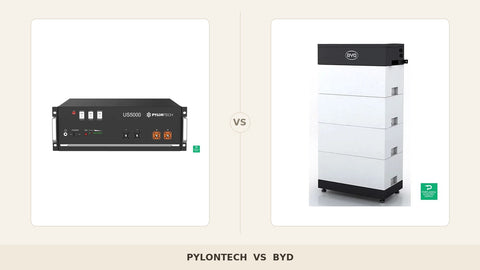
Pylontech US3000C is the workhorse: 48V nominal, 74Ah, 3.55 kWh per module, 95% depth-of-discharge rating, 6,000-cycle class, and the broadest third-party inverter compatibility list in the category — because Pylontech wrote the protocol the others adopted. The US5000 steps to 100Ah and 4.8 kWh in a taller chassis for denser racks.
EG4's rack modules — LifePower4 and the LL series — pack 51.2V, 100Ah, 5.12 kWh into the standard rack slot with 6,000+ cycle ratings at 80% DoD, onboard breakers, and (on the LL series) low-temperature charge cutoff with heated variants. Per rack slot, EG4 carries 7–44% more kWh than the Pylontech modules — which matters when the cabinet has eight slots and the load calc wants 40 kWh.
Class-level specs — confirm the exact SKU datasheet. The 95% DoD on Pylontech narrows EG4's usable-capacity advantage: 3.55 × 0.95 = 3.37 kWh vs 5.12 × 0.80 = 4.10 kWh usable per module.
| Spec | EG4 LifePower4 / LL | Pylontech US3000C | Pylontech US5000 |
|---|---|---|---|
| Nominal voltage | 51.2V | 48V class | 48V class |
| Capacity | 100Ah / 5.12 kWh | 74Ah / 3.55 kWh | 100Ah / 4.8 kWh |
| DoD rating | 80% class | 95% class | 95% class |
| Cycle rating | 6,000+ class | 6,000+ class | 6,000+ class |
| Continuous discharge | 100A class | ~74A class (module-limited) | 100A class |
| Max parallel (mfr. guidance) | 16 class | 16 class | 16 class |
| Protocol | Pylontech-compatible CAN + native EG4 closed-loop | Pylontech CAN (the reference standard) | Pylontech CAN |
| Street price class | $1,000–$1,300 | $900–$1,100 | $1,300–$1,500 |
Day-one $/kWh favors EG4 by 10–25%; lifetime cost per cycled kWh favors EG4 by ~13–15%. Both crush any lead-acid alternative.
| Module | Street class | Usable kWh (rated DoD) | $/usable kWh | Lifetime throughput @ 6,000 cycles | Cost per cycled kWh |
|---|---|---|---|---|---|
| EG4 5.12 kWh | $1,000–$1,300 | 4.10 kWh | $244–$317 | ≈ 24,600 kWh | ≈ $0.0095 |
| Pylontech US3000C | $900–$1,100 | 3.37 kWh | $267–$326 | ≈ 20,200 kWh | ≈ $0.0108 |
| Pylontech US5000 | $1,300–$1,500 | 4.56 kWh | $285–$329 | ≈ 27,400 kWh | ≈ $0.0110 |
The pattern across every row: EG4 is cheaper, Pylontech is not far behind, and both deliver stored kWh at around a penny per cycle — a number that was science fiction when the US2000 launched. Where the price gap compounds is bank size: at 20 kWh the EG4 path saves $600–$1,200; at 40 kWh, $1,200–$2,400. Nobody buys one module, so nobody should compare module prices.
This section is why Pylontech still wins quotes. The Pylontech CAN protocol is the reference implementation: Victron, Sol-Ark, Deye, Growatt, Schneider (via gateway class solutions), and dozens of value hybrids list Pylontech by name in their battery menus. Select “Pylontech” in the inverter, plug in the CAN cable, and closed-loop operation — BMS-controlled charge voltage, current limits, and SOC — just works. In fifteen years of category history, Pylontech has logged more closed-loop operating hours across more inverter brands than anyone.
EG4 speaks the same protocol plus its own native closed-loop with EG4 inverters — where the integration is arguably tighter than anything Pylontech offers outside its own ecosystem. The practical guidance from our commissioning bench: EG4 inverter → EG4 batteries. Victron or Sol-Ark inverter → either brand works; Pylontech is the zero-drama pick, EG4 is the cheaper pick with a settings checklist. With Growatt and Deye-class value hybrids, both brands behave. Browse the inverter side in hybrid inverters and 48V inverters, including the FlexBOSS21 and Sol-Ark 8K.
Continuous discharge per module caps what the bank can feed the inverter. This is where smaller modules quietly force bigger banks:
Amps at 48V nominal: W ÷ 48. Always stack modules for the inverter's surge, not just its continuous rating — compressor starts are where thin banks fault.
| Inverter draw | EG4 5.12 kWh modules needed (100A class each) | Pylontech US3000C modules needed (~74A class each) |
|---|---|---|
| 5 kW continuous (~104A @ 48V) | 2 modules | 2 modules |
| 8 kW continuous (~167A) | 2 modules | 3 modules |
| 12 kW continuous (~250A) | 3 modules | 4 modules |
| 12 kW + 2x surge headroom | 4 modules (comfort margin) | 5–6 modules |
That last row is the one that bites in the field. A 12 kW hybrid with a 4-ton compressor behind it wants 400A-class battery discharge capability for clean starts. On EG4 that is four modules; on US3000Cs that is five or six — which erases Pylontech's per-module price advantage in exactly the systems big enough to matter. We learned this on a 2024 service call where a three-module US3000C bank kept faulting at compressor start; the fix was modules four and five, not a different inverter.
The Pylontech path's 95% DoD partially closes the usable-capacity gap — but needs five modules to do it. Price the bank, not the module.
| Line item | EG4 path | Pylontech path (US5000) |
|---|---|---|
| Modules for ~20 kWh nameplate | 4 × 5.12 = 20.48 kWh | 4 × 4.8 = 19.2 kWh (+1 module to match) |
| Usable @ rated DoD | 16.4 kWh | 18.2 kWh (5 × 3.64) |
| Module cost class | $4,000–$5,200 | $6,500–$7,500 (5 modules) |
| Rack + cables + busbar | $400–$700 | $450–$750 |
| Bank total class | $4,400–$5,900 | $6,950–$8,250 |
| Discharge capability | 400A class | 500A class |
Runtime reality check on that 20 kWh-class bank: at a 1.5 kW overnight average, ~11–12 hours of autonomy either way. The runtime calculator and the battery-count guide translate your loads into module counts. And for charging sources, the charge controller sizing guide and MPPT vs PWM explainer cover DC-coupled designs.
Both lines share LFP's cardinal rule: no charging below freezing without damage risk, so BMS charge cutoffs near 0°C are standard. EG4's LL heated variants add self-warming — a genuine advantage for unheated installs in cold climates, and a feature Pylontech addresses through enclosure and install practice rather than heated modules at this price tier. Both brands publish 0–45°C class charge windows and wider discharge windows.
Heat is the quieter killer. Both chemistries age faster above 35°C sustained; both brands' rack modules assume indoor or conditioned-enclosure installation. Our standard note on every quote: a $200 insulation-and-ventilation plan for the battery room returns more lifespan than any brand upgrade. The longevity guide and 20–80 rule are the operating manual for either bank.
Pylontech's warranty runs to the 10-year class on current lines through authorized channels, backed by a global company with a decade-plus track record — the US2000 fleets from 2017 are the proof of concept. EG4's rack lines carry 5–10-year class coverage depending on product and registration, with Signature Solar's channel providing deep documentation and an enormous peer community. Our claim experience: Pylontech's process is formal and reliable; EG4's is faster on straightforward hardware issues. Register either brand at commissioning and archive the settings screenshots — undocumented claims are slow claims with any manufacturer.
Rack slots are finite and cabinets cost money, so kWh per slot is a real spec. EG4's 5.12 kWh per 3U-class slot leads the value category; the US3000C's 3.55 kWh per slot trails it by 44%, and the US5000's 4.8 kWh (in a taller chassis) splits the difference. Concretely: a 40 kWh bank is eight EG4 modules in one tall cabinet, or twelve US3000Cs needing a second rack, second set of busbars, and second row of wall space. On garage walls where the rack shares space with a water heater and a decade of camping gear, that footprint difference settles arguments by itself.
Weight runs with capacity: EG4 modules land around 100 lb class each, Pylontech's US3000C around 70 lb class. Two-person lifts either way; the EG4 path concentrates the lift count into fewer, heavier units. Our crews prefer fewer modules per bank for a reason that has nothing to do with electricity: every module is two more terminal connections to torque, label, and re-check at the one-year service.
Pylontech's decade of firmware history shows: the BMS behavior is conservative, predictable, and thoroughly documented — charge-end voltages, balancing windows, and fault codes mean the same thing on a 2018 US2000 and a 2026 US3000C. EG4's firmware cadence is faster-moving, which delivers features quickly and occasionally requires an update pass after inverter firmware changes. Neither posture is a defect; they are different engineering cultures, and owners should know which one they are buying into.
On monitoring: both brands report through the inverter's platform in closed-loop mode, which is where you will actually watch the system. EG4 adds its own app ecosystem and a community toolchain (Solar Assistant integrations are common in our installs) that exposes per-module cell data. Pylontech exposes the essentials cleanly and leaves the rest alone. If you want to obsess over cell-group voltages, the EG4 path feeds the hobby; if you want a green checkmark and silence, both deliver, with Pylontech's decade of protocol stability the quieter ride.
Storage TCO is modules plus everything around them. On a 20 kWh-class bank over ten years of daily cycling:
Throughput = usable kWh × 6,000 cycles over the bank. Even fully loaded, both deliver stored energy under 12 cents per kWh — cheaper than most grid peak rates.
| Cost element | EG4 path | Pylontech path (US5000 ×5) |
|---|---|---|
| Modules + rack + cables | $4,400–$5,900 | $6,950–$8,250 |
| Install labor (pro, class) | $800–$1,500 | $900–$1,600 |
| Replacement/service events (class) | $0–$600 | $0–$600 |
| 10-year total | $5,200–$8,000 | $7,850–$10,450 |
| Lifetime throughput | ≈ 98 MWh (4 modules) | ≈ 91 MWh (5 modules) |
| Storage cost per kWh delivered | ≈ $0.053–$0.082 | ≈ $0.086–$0.115 |
That final row is the number to remember from this entire shootout: at fully-loaded ownership costs, both brands store a kWh for less than a dime. Against a $0.30+ peak utility rate, either bank is an arbitrage machine with a backup-power side hustle. The EG4-versus-Pylontech decision moves the total by ~25%; the decision to install storage at all moves your bill by far more. Buy whichever the inverter menu lists first, from whoever has shelf stock, and put the savings toward one more module. Field experience across a decade of rack batteries says the extra module outperforms the extra brand loyalty every single time.
After the specs and the field notes, the decision compresses into a short scoreboard. Price per usable kWh: EG4 by 10–25%. Capacity per rack slot: EG4 by up to 44% versus US3000C. Third-party closed-loop certainty: Pylontech, decisively — a decade of protocol history is not marketing, it is commissioning hours you do not spend. Depth-of-discharge discipline: Pylontech's 95% DoD rating versus EG4's 80% class narrows the usable-capacity gap and reflects a conservative operating envelope some engineers simply prefer. Cold-climate charging: EG4's heated LL variants, where Pylontech's answer at this tier is enclosure design. Warranty formality: Pylontech's process is older and more procedural; EG4's is faster on simple hardware claims. Expansion cost per added kWh: EG4, and it compounds over the life of a growing system.
Add the rows and the honest conclusion repeats the opening: two safe picks, different shapes of value. The forum argument about which is “better” is permanently unresolvable because the contestants are optimizing for different buyers — and both are succeeding. Our buying guidance to our own customers distills to one sentence: pick the battery your inverter already speaks to, size the bank for the surge you actually have, and spend whatever is left on one more module. Everything else in this category is preference wearing a spec sheet.
Three recurring service calls account for most of the pain in this category, and none of them are brand-specific. First: undersized discharge current. The bank meets the kWh target but not the inverter's surge draw, so compressor starts fault the system. The fix is more modules — price that into the design, as the table above shows. Second: comms drift after firmware updates. An inverter update resets the battery profile to defaults and the closed-loop silently reverts to open-loop voltage charging. Check the battery menu after every inverter firmware update, on either brand, forever. Third: open-loop habits on closed-loop hardware. Owners who never select the battery profile run their premium LFP bank on generic voltage setpoints and wonder why SOC reads wrong. The cable and the menu selection are the whole point of these products.
Avoid those three and both brands deliver the boring reliability that makes storage invisible — which is the highest compliment an electrical system can earn. The NEC side of a clean install is covered in our disconnect and overcurrent guide and the wire sizing guide; get those right and the battery brand becomes the least interesting decision on the job.
Choose EG4 for maximum kWh per dollar, EG4-inverter pairings, heated-module cold-climate installs, and dense racks where 5.12 kWh per slot matters. The EG4 ecosystem makes the whole stack one-stop.
Choose Pylontech for third-party inverter projects where closed-loop certainty outranks price, for 95% DoD usable-capacity discipline, and for the comfort of the category's longest field history. The Pylontech line remains the protocol reference for a reason.
The honest bottom line: these are the two safest picks in budget 48V storage, and the gap between them is narrower than the forum wars suggest. Price the full bank — modules, discharge current for your inverter's surge, rack, and cables — and buy from whoever has stock when your build window opens. For whole-home appliance alternatives, see EG4 vs Tesla Powerwall; for bigger formats, the 10 kWh and 15 kWh bank classes.
Is EG4 better than Pylontech?
On price per kWh, yes — EG4 rack modules run 10–25% cheaper per usable kWh and pack more capacity per rack slot (5.12 kWh vs 3.55–4.8 kWh). On third-party inverter compatibility, Pylontech holds the edge: its CAN protocol is the industry reference that Victron, Sol-Ark, Growatt, and others implement natively. With EG4 inverters, EG4 batteries integrate tightest; with other premium inverters, Pylontech is the zero-drama choice.
How many Pylontech US3000C batteries equal one EG4 module?
On nameplate: one EG4 5.12 kWh module ≈ 1.44 US3000C modules (3.55 kWh each). On usable capacity at rated DoD: EG4's 4.10 kWh (80% DoD) ≈ 1.22 US3000C modules at 95% DoD (3.37 kWh usable). On discharge current: EG4's 100A class ≈ 1.35 US3000C modules at ~74A each.
Do EG4 batteries work with Victron and Sol-Ark inverters?
Yes — EG4 modules support the Pylontech-compatible CAN profile that Victron and Sol-Ark implement, enabling closed-loop communication with BMS-controlled charging. The pairing may take a firmware update and settings verification during commissioning; Pylontech's own modules are the reference implementation for those platforms and typically connect with zero configuration.
What is the lifespan of these 48V rack batteries?
Both lines carry 6,000+ cycle ratings at deep depth of discharge — roughly 15–20 years of daily cycling — and typically degrade gradually rather than failing outright. Calendar life, temperature control (avoid sustained 35°C+), and staying within the 20–80% SOC band for daily use determine real lifespan more than brand choice.
Can I mix EG4 and Pylontech in the same battery bank?
Never. Different brands, capacities, discharge curves, and BMS firmware families must not share a parallel DC bus — imbalance and current-sharing stress will shorten the life of both and void warranty coverage. Expansion means adding matched modules of the same model and similar age.
Which is better for off-grid?
EG4 for most off-grid builds: more kWh per rack slot, heated LL variants for cold-climate charging, aggressive pricing that buys more autonomy per dollar, and native closed-loop with the EG4 hybrids that dominate value off-grid designs. Pylontech suits off-grid builds centered on Victron or other premium third-party systems where its protocol depth simplifies commissioning.
How big a bank do I need for overnight backup?
Measure your overnight consumption — most efficient homes draw 8–15 kWh between sundown and sunup. Divide by usable capacity per module (4.10 kWh for EG4 at 80% DoD; 3.37 kWh for US3000C at 95% DoD), then add 20% headroom for load growth. A 12 kWh overnight need lands at four EG4 modules or five US3000Cs — and remember the discharge-current floor may push the count higher on big inverters.
PES Supply stocks both value leaders at wholesale: Pylontech, EG4 batteries, all LiFePO4, and the server-rack category. Our design desk verifies inverter comms compatibility free with every bank quote — send us your inverter model and overnight load profile, and we return a module count, a discharge-current check, and a priced bill of materials for both brands so the comparison lands on your actual numbers rather than ours.