Battle Born vs Victron 2026: Drop-In vs Ecosystem 12V Lithium
Two opposite philosophies of 12V lithium — sealed drop-in simplicity versus a fully networked energy system. Here's which philosophy fits your build, with the real numbers.
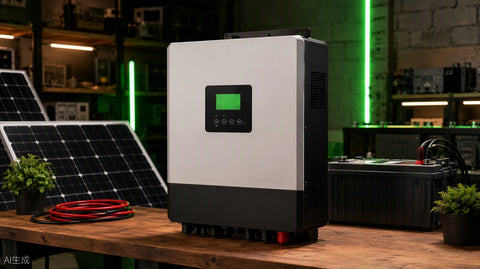
This is the most interesting matchup in 12V lithium, because it isn't really a battery comparison — it's an architecture comparison. Battle Born sells you a battery: a sealed, self-contained 12.8V 100Ah LiFePO4 drop-in with its own internal BMS, a 10-year warranty, and zero configuration. Victron Energy sells you a system: lithium cells that report to an external BMS, which talks to your inverter-charger, your solar controllers, your monitoring hub, and your phone — one networked organism where every component knows what every other component is doing. We stock the full Victron Energy line (including the deep catalog) and we've been a Battle Born dealer for years, so we've built it both ways. The right answer depends entirely on what you're building.
Let me frame it the way we do at the counter. If your system is "some panels, a controller, two batteries, an inverter" — a van, a travel trailer, a fishing boat — Battle Born's drop-in philosophy is engineered precisely for you. If your system is "lithium bank, inverter-charger, multiple charge sources, monitoring, maybe a generator, maybe shore power, growing over time" — a full-time rig, an off-grid home, a serious marine install — Victron's ecosystem philosophy starts paying compound interest. Both are premium products. They just define premium differently.
| Specification | Battle Born BB10012 | Victron Smart LiFePO4 12.8V/100Ah |
|---|---|---|
| Energy / nominal voltage | 1.28 kWh @ 12.8V | 1.28 kWh @ 12.8V |
| BMS architecture | Internal, self-contained, no configuration | External required (Lynx Smart BMS / VE.Bus BMS class) |
| Continuous discharge | 100A (200A surge, 30 s) | 100A class (200A peak, short) |
| Rated cycle life | 3,000–5,000 @ 80–100% DOD | ≈ 2,500 @ 80% DOD; ≈ 5,000 @ 50% DOD |
| Monitoring / comms | None on classic SKUs | Full — Bluetooth + VE.Bus/VE.Can integration via BMS and Cerbo GX |
| Series / parallel | 4S / parallel unlimited | Series to 48V / parallel supported via BMS |
| Low-temp charge protection | Internal cutoff −4°C | BMS-managed cutoff + charge-source coordination |
| Warranty | 10 years, US support | 5 years class, global dealer network |
| Street price, battery only | ≈ $800–$900 | ≈ $1,100–$1,300 — plus BMS hardware ($400–$700) |
| Weight | ≈ 31 lb | ≈ 33 lb class |
The line that shocks people: the Victron battery alone costs more than the Battle Born, and then you still have to buy the BMS. A two-battery Victron bank with a Lynx Smart BMS runs roughly $3,000–$3,300 versus $1,700 for two Battle Borns. That's a 75–90% premium, and we will not pretend it's small. The rest of this article is about when that premium is the best money in your build — and when it's genuinely wasted.
| Metric (per 1.28 kWh unit) | Battle Born BB10012 | Victron Smart 100Ah (incl. BMS share) |
|---|---|---|
| Effective system price | $850 | ≈ $1,500 amortized (battery + BMS share on 2-pack) |
| Rated cycles @ 80% DOD | ≈ 3,500 (mid) | ≈ 2,500 |
| Lifetime energy @ 80% DOD | ≈ 3,584 kWh | ≈ 2,560 kWh |
| Cost per lifetime kWh @ 80% DOD | ≈ $0.237 | ≈ $0.586 |
| Same bank cycled at 50% DOD | ≈ 4,500 cycles est. | ≈ 5,000 cycles rated |
| Cost per lifetime kWh @ 50% DOD | ≈ $0.263 | ≈ $0.417 |
| Warranty period | 10 yr | 5 yr class |
On pure dollars-per-kWh, Victron loses this table decisively — even with its gentler-cycling advantage at 50% DOD. Nobody should buy Victron lithium expecting a cost-per-kWh bargain. So why do we sell pallets of it, and why do the most sophisticated builds we support run it end to end? Because battery cost-per-kWh is the wrong metric for a whole energy system. The Victron premium buys system-level behavior that prevents failures, saves fuel, and catches problems early — and those savings live in a different column.
1. Coordinated charging. In a Victron system, the BMS doesn't just protect the battery — it instructs the chargers. Battery approaching full? The Lynx BMS tells the MPPT controllers and the MultiPlus inverter-charger to taper, then stop. Cold morning? Charge sources are held off until the pack warms — not just disconnected at the battery terminal, but coordinated at every source. With drop-in batteries, every charge source is an independent agent guessing at battery state through voltage. We've diagnosed dozens of "mystery undercharge" cases on drop-in banks where a solar controller and a converter disagreed about what full meant. In a networked system that failure mode doesn't exist.
2. Remote everything. A Cerbo GX hub plus Victron's VRM portal gives you state of charge, solar yield, inverter load, tank temps, and alarm history for your rig from anywhere on earth. For full-timers and fleet operators (we support a rental RV fleet running exactly this stack), remote visibility isn't a luxury — it's how you catch a failing alternator charger before it strands a customer in Moab. Battle Born plus third-party monitors can approximate this, but you're assembling it yourself from a shunt, a display, and hope.
3. Generator and shore integration. The MultiPlus/Quattro inverter-chargers blend inverter power with shore or generator input seamlessly — running your AC on a 30A pedestal plus battery boost, or throttling generator charging to the exact load that keeps a small generator in its efficient band. If your build includes a generator (many of our customers pair one with lithium for endurance — see our backup power lineup), Victron's handling of it is the best in the industry, full stop.
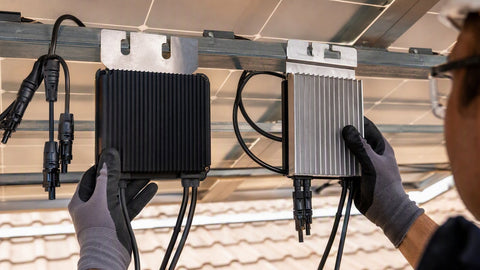
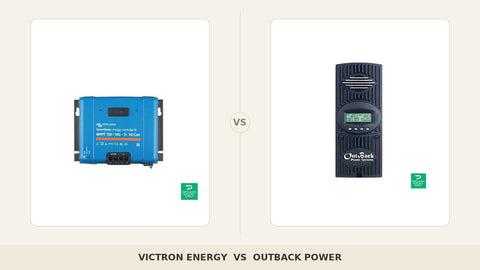
4. Components that are genuinely best-in-class on their own. The Victron MPPT controllers — like the SmartSolar 250/60 and 250/100 — and the Phoenix inverter line win on standalone merit. Buying into the battery ecosystem means your whole electrical room speaks one language.
Simplicity is a reliability feature. Every wire in a Victron system is also a failure point — BMS comms cables, VE.Bus terminators, firmware versions. Battle Born's internal BMS cannot be misconfigured because there is nothing to configure. For a weekend RVer who wants to drop batteries in and go fishing, that is worth more than every feature in the Victron catalog combined. We've commissioned Battle Born rigs in a parking lot in under an hour, charging included.
The warranty is double, and domestic. Ten years with US phone support versus a five-year-class warranty administered through a dealer network. On a purchase you expect to own for a decade-plus, that's not nothing — it's arguably the strongest single line in this comparison.
The ecosystem tax is avoidable. A Battle Born bank works perfectly with any quality lithium-capable gear — including Victron's own controllers and inverter-chargers. Plenty of our builds run Battle Born batteries under Victron MPPTs (controller lineup) with a SmartShunt doing the monitoring. You lose the BMS-level integration; you keep most of the visibility and all of the drop-in simplicity, at two-thirds the price of full Victron lithium. That hybrid build is honestly our most-recommended premium configuration for non-full-timers.
The BMS amortization is the whole Victron economics story, so run it at three bank sizes instead of arguing in the abstract:
| Bank Size | Battle Born Total | Victron Total (batteries + BMS share) | Victron Premium |
|---|---|---|---|
| 2 × 100Ah (2.56 kWh) | ≈ $1,700 | ≈ $2,400 + $550 BMS ≈ $2,950 | +74% |
| 4 × 100Ah (5.12 kWh) | ≈ $3,400 | ≈ $4,800 + $550 ≈ $5,350 | +57% |
| 6 × 100Ah (7.68 kWh) | ≈ $5,100 | ≈ $7,200 + $700 (larger BMS class) ≈ $7,900 | +55% |
| Same kWh as 48V rackmount packs | ≈ $1,600–$2,200 per 5.12 kWh module — beats both | See storage lineup | |
Two conclusions: the Victron premium compresses as banks grow but never disappears, and above 5 kWh the honest third option — purpose-built 48V rackmount lithium — undercuts both contenders on cost while beating both on per-cell balancing and comms. Twelve-volt drop-ins of any brand are the right tool below ~5 kWh and in mobile form factors; above that, at least price the rackmount path before committing.
Day one with Battle Born: unbox, cable to the busbar with equal lengths, torque terminals, program your charger to the LiFePO4 profile, and watch the bank take a full charge. Elapsed time for a competent DIYer: about two hours including the coffee. There's no software, no pairing, no firmware — which also means there's nothing to misconfigure, a virtue we don't appreciate until we've spent an afternoon debugging comms terminators.
Day one with full Victron lithium: mount and cable the packs, wire the BMS and its contactor/loads-charge buses, land the VE.Bus or VE.Can runs, terminate the network correctly (the classic first-timer error — an unterminated bus gives you ghost faults), update firmware across every device, then configure charge parameters through the GX console. Elapsed time: a long day, or a half-day for someone who's done it before. The payoff starts immediately and never stops: from that evening on, every charge source obeys the battery, every alarm reaches your phone, and the VRM portal logs everything for the life of the system. Customers who've lived with both describe it the same way: Battle Born is an appliance; Victron is an employee. Choose the coworker you actually want.
Support and the long haul. Battle Born: one company, one phone number, ten years. Victron: a global dealer network with five-year-class battery coverage and an ecosystem whose individual components — controllers, inverter-chargers, monitors — are supported essentially forever, with firmware updates still landing for decade-old hardware. Both models work; they just answer "who do I call?" differently. If that answer needs to be "a human in Nevada," that's your sign. If it can be "my distributor, the VRM portal, and a very deep knowledge base," the ecosystem path opens up.
The ownership experience diverges the day after install. Victron's world is software-rich: VRM dashboards, per-device firmware updates (still landing for hardware a decade old — genuinely unusual in this industry), remote configuration, and an app ecosystem third parties build on. Battle Born's world is deliberately software-free: the battery's job is to disappear, and it does. Which texture suits you is temperament, not spec. We have customers who check VRM before their email every morning, and customers who haven't thought about their battery bank since the day we commissioned it; both groups are happy, and each would be miserable on the other's system.
Mistakes we see on each path. Victron-side: unterminated comms buses, stale firmware at commissioning, and the classic — buying the batteries and BMS but skimping on the GX device, which is where most of the system's value lives. Battle Born-side: assuming "drop-in" means "no configuration" — the battery is ready, but your chargers still need LiFePO4 profiles, and a shunt still needs installing if you want to know your state of charge. Both mistakes are cheap to avoid and expensive to debug in the field. Ten minutes with the manuals, or one call to our desk, prevents both.
The used-market footnote. Premium brands hold value: Battle Borns resell at 50–60% of new after years of use, and Victron gear moves fast on the secondary market. Value-tier batteries have thinner resale liquidity — worth remembering if your rig is a stepping stone rather than a forever build.
A note on alternator charging, since it decides more of these builds than people expect. Modern smart alternators don't play nicely with any lithium bank without a DC-DC charger — that's brand-independent physics. Where the ecosystems differ is that Victron's DC-DC (Orion) line integrates into the same network and obeys the same BMS limits, while a Battle Born build picks any quality third-party DC-DC and sets it manually. Same outcome; one is networked, one is configured. Budget about $300–$500 for that device on either path and never let anyone talk you into a bare solenoid on a modern vehicle — that's how alternators die in Idaho.
Cold-weather footnote for both: neither classic model self-heats, so sub-freezing charge protection means "blocked until warm," not "handled." Four-season builds should insulate the compartment, add thermostatic pads, or spec a self-heating value-tier pack — the cutoff protects the cells, but it also quietly cancels your January solar harvest if the box never warms.
The weekender trailer: A couple with a 26-foot travel trailer, 400W of roof solar, a single 2,000W inverter for the coffee maker and microwave, and forty nights a year. We spec'd two Battle Borns, a Victron 100/30 MPPT, and a SmartShunt. Total battery-side cost: about $2,100. Three years in, they've never opened an app and never called us. The ecosystem would have been a thousand-dollar ornament on this build.
The full-time fifth wheel: A family living on the road, 1,200W of solar, MultiPlus 12/3000, alternator charging, a small generator for cloudy stretches, and a Starlink habit that never sleeps. Full Victron lithium with Lynx BMS and Cerbo GX — about $5,600 battery-side. The BMS coordinates four charge sources daily, the VRM portal caught a failing DC-DC charger from 800 miles away, and the generator auto-run logic keeps the bank above 30% without anyone touching a switch. On this build, Battle Borns would have worked electrically and failed operationally — nobody was home to babysit the guesswork.
The hybrid we'd sell our brother: A van build with ambitions but a budget: two Battle Borns now, Victron SmartSolar and SmartShunt for visibility, and a pre-wired plan for a MultiPlus later. If the rig goes full-time, the Victron infrastructure is already in place and only the batteries stay Battle Born — which is fine, because the chargers don't care. Ecosystem thinking applied to the charge gear, drop-in pragmatism on the storage. It's the build we do most often, and the one with the fewest regrets on record.
| Build Profile | Our Recommendation | Why |
|---|---|---|
| Weekend RV / trailer, 1–2 batteries, simple loads | Battle Born | Simplicity + warranty; ecosystem features go unused |
| Full-time van/RV, inverter-charger, alternator + solar + shore | Victron ecosystem | Coordinated charging earns its keep daily |
| Marine house bank with generator and shore power | Victron ecosystem | Multi-source blending is the killer feature |
| Off-grid cabin, stationary | Neither 12V — go 48V rackmount (storage lineup) | Per-kWh economics favor 48V above ~5 kWh |
| Budget-conscious premium build | Battle Born + Victron MPPT + SmartShunt | 80% of the visibility, 60% of the price |
| Fleet / rental / remote-monitored rigs | Victron end-to-end | VRM remote monitoring pays for itself in prevented strandings |
Whichever architecture you choose, the fundamentals don't change: program LiFePO4 charge profiles (14.2–14.6V absorb, 13.6V float, equalize off), never charge below freezing, cycle shallow when you can (the 20–80 rule roughly doubles service life), and size the bank with 25% headroom using the bank sizing guide or the sizing calculator. Cross-shopping? The LiFePO4 collection spans every tier from EG4 value packs to this premium matchup, and the buyer's guide covers the whole chemistry landscape.
Battle Born is the best battery in this comparison. Victron is the best system. If your electrical needs fit in one sentence, buy the battery. If they fit in a diagram, buy the system. And if you're not sure which one you are — you're probably the battery, and you can grow into the ecosystem later; Victron's charge gear doesn't care whose cells it feeds.
Can I use Victron lithium batteries without the external BMS? No — this is the hard rule. Victron Smart LiFePO4 packs have no internal protection; the external BMS (Lynx Smart BMS or VE.Bus BMS class) is mandatory and does cell monitoring, balancing, and charge-source control. Anyone selling you "just the cells" is setting you up for an expensive failure.
Can Battle Born batteries integrate with a Cerbo GX? Partially. The Cerbo reads a shunt, controllers, and inverter-chargers natively, so you get system-level monitoring — but it cannot see inside the battery; there's no data port to read. For most users, shunt-based system monitoring is enough.
Is Victron worth it for a small two-battery van build? Usually not. The BMS hardware amortizes worst on small banks — a $500 BMS across two batteries adds ~$250 per pack. Above four batteries (or any MultiPlus-based build), the math improves sharply. Small vans are Battle Born's home turf.
Which system is easier to install? Battle Born by a wide margin: drop in, cable with equal lengths to a busbar, program the charger, done. Victron requires BMS wiring, comms cabling, VE.Bus configuration, and firmware setup — a full day for an experienced DIYer, or professional commissioning. The payoff is a system that manages itself thereafter.
What happens when a Victron BMS fails versus an internal BMS? A failed internal BMS bricks one battery. A failed external BMS can protect-shutdown the whole bank — the counterargument is that the BMS is a replaceable, serviceable component while a bricked drop-in is a warranty claim. Carry the risk profile that matches your tolerance; both brands' failure rates in our records are low.
Do both brands support 48V builds? Yes, both series to 48V (4S). But if you're planning 48V from day one above 5 kWh, compare purpose-built 48V rackmount packs before committing — one BMS, per-cell balancing, better per-kWh pricing, and cleaner comms than any series-string of 12V drops.
Sources: manufacturer datasheets and warranty documents (Dragonfly Energy, Victron Energy), NEC 2023 Article 706 context, PES Supply commissioning and fleet-support records 2023–2026. Ready to design the whole system? Get a free quote — we'll spec batteries, charging, and monitoring as one architecture.