450W vs 550W Solar Panels 2026: Residential vs Large-Format
The wattage question is really a format question — roof layout math, crew ergonomics, string design, and dollars per installed watt, from a distributor that ships both classes by the pallet.
Every week a homeowner or small contractor calls us with the same puzzle: "550-watt panels cost less per watt than 450s — why wouldn't I just buy the bigger ones?" Sometimes they should. Sometimes the 550s literally will not fit between the roof vents, and the "cheaper" panel ends up costing an extra day of labor and a racking redesign. We ship both classes by the truckload — 450W residential panels and 550W large-format panels — so we have no dog in this fight. What we have is layout math, freight bills, and a lot of feedback from the crews who actually carry these things up ladders. Here's the whole decision, with numbers.
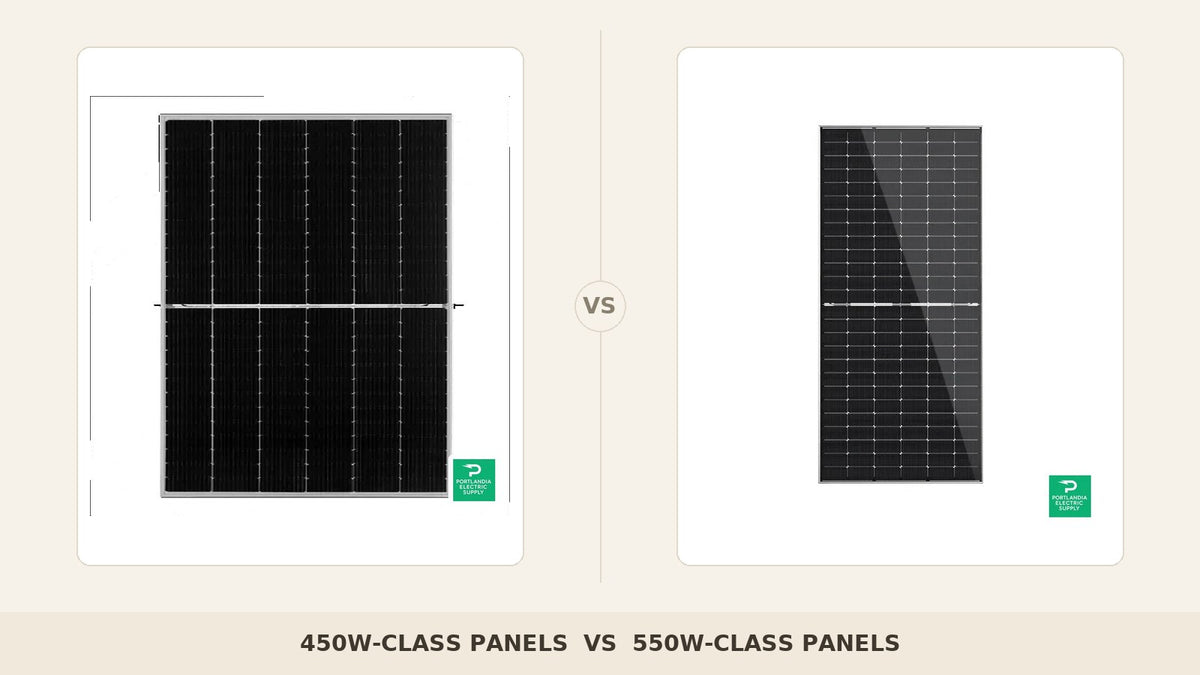
One thing to get straight up front: neither number is a hard class boundary. "450W class" means residential-format modules running roughly 430–470W on a ~1.9 × 1.1m frame; "550W class" means large-format modules running 530–580W+ on a ~2.2–2.4m frame. The 460–549W middle band exists too, and the 550–709W band stretches into commercial territory. Compare format, not the printed wattage.
| Specification | 450W-Class Panels | 550W-Class Panels | Why It Matters in the Field |
|---|---|---|---|
| Typical wattage range | 430–470W | 530–580W | Same cell tech at both sizes; watts scale with area |
| Module efficiency | ~21.0–22.5% | ~21.0–22.8% | Efficiency is a wash — you are buying area, not magic |
| Dimensions | ~1.9–2.0m × 1.1m (75–79″ × 44″) | ~2.2–2.4m × 1.1–1.3m (87–95″ × 44–51″) | The 550 is 15–25% longer — that's the whole story on roofs |
| Weight | 21–24 kg (46–53 lb) | 26–32 kg (57–71 lb) | OSHA one-person carry comfort ends around 23 kg |
| Cell format | 108–120 half-cut cells (182mm) | 132–144 half-cut cells (182/210mm) | Same cells, more of them per frame |
| Voc (typical, STC) | ~37–41V | ~49–53V | Changes string counts — see inverter math below |
| Imp (typical, STC) | ~11–13A | ~13–14A | Both fine on 15–20A residential MPPT inputs |
| Target market | Pitched residential roofs | Commercial flat roofs, ground mounts, carports | Racking ecosystems are built around each format |
Read that table carefully and the "debate" collapses: a 550W panel is not a better panel; it is a bigger panel. Efficiency — the only number that measures quality of the silicon — is essentially identical. You're choosing a tile size for your roof, the way a tile setter chooses 12×24s versus 6×6s. Bigger tiles cover open floors faster and cheaper; smaller tiles fit around toilets. Roofs with plumbing vents, skylights, hips, and fire-code setbacks are nothing but toilets.
NEC 690.12 rapid shutdown and most fire codes (IFC 605.11) require 3-ft ridge setbacks and 18-inch pathways on residential roofs. Add plumbing vents and skylights and a typical American gable face gives you rectangular "usable zones" — and those zones have fixed dimensions. Here's the arithmetic we run at the counter for a real 28-ft × 14-ft roof face with one 3-ft ridge setback and two vents:
| Layout Step | 450W Class (1.94m × 1.13m) | 550W Class (2.28m × 1.13m) |
|---|---|---|
| Usable zone after setbacks | ≈ 24 ft × 11 ft (288 in × 132 in) example zone | |
| Panels per row (portrait, 288″ run ÷ width+gap) | 288 ÷ 46.5 ≈ 6 panels | 288 ÷ 46.5 ≈ 6 panels |
| Rows that fit (132″ height ÷ length+gap) | 132 ÷ 78.4 = 1 portrait row; a 2nd needs 157″ — but landscape/mixed rows recover the zone | 132 ÷ 91.7 ≈ 1 row only |
| Realistic fit, this face | 6–12 panels (2,700–5,400W) with mixed portrait/landscape workarounds | 6 panels (3,300W) — one row, no workaround possible |
| Watts per square foot installed | ≈ 17.2 W/ft² (both, identical efficiency) | ≈ 17.2 W/ft² |
The punchline surprises people: watts per square foot are identical because efficiency is identical. The 550 doesn't harvest more sun per roof area — it just fails to fit in more places. On the example face above, a crew can usually wiggle 8–10 of the 450s into a mixed portrait/landscape layout where the 2.28m module physically cannot turn the corner past the vent. We've redesigned more "550W bargains" into 450W layouts than we can remember, and the homeowner almost always ends up with more total kW on the roof with the smaller panel.
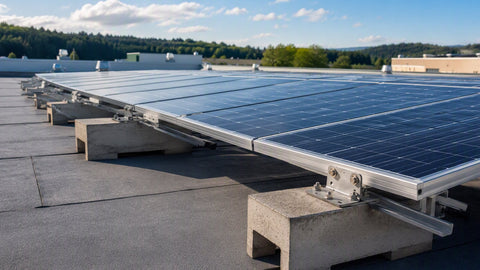
Where does the 550 earn its keep? Flat commercial roofs with ballasted racking, ground mounts, and carports — anywhere the array is a clean rectangle with no obstructions. There, fewer modules means fewer clamps, fewer microinverters or optimizers, fewer homeruns, and 15–25% faster install times. Our commercial panel collection and utility-scale lineup lean heavily on the big formats for exactly that reason.
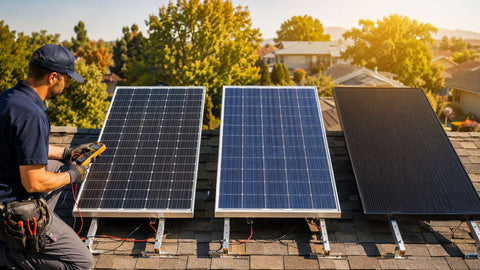
Here's a number no datasheet prints: on a two-story comp shingle roof, a 23 kg panel goes up a ladder in one person's hands. A 30 kg panel goes up in two, or one tired person starts making mistakes by panel fifteen. Large-format modules run 26–32 kg and nearly 2.4m long — in any wind they're a sail. We've watched three-person residential crews slow from 14 panels/day to 9 when a customer insisted on 550s "to save money." The 35 cents/watt they saved on modules got eaten by an extra day of labor at $850. On a flat commercial roof with a materials lift, that calculus flips completely — the big panel is cheaper to install and cheaper to buy.
| Install Factor | 450W Class | 550W Class |
|---|---|---|
| One-person carry on ladder | Yes (21–24 kg) | No — two-person or lift |
| Panels per kW | ≈ 2.2 | ≈ 1.8 |
| Typical residential install pace (2-person crew) | 12–16 panels/day | 8–11 panels/day |
| Ballasted flat-roof pace (3-person + lift) | 18–22/day | 22–28/day |
| Racking parts per kW (mid+end clamps) | ≈ 8.9 clamps/kW | ≈ 7.3 clamps/kW |
| Freight & breakage risk | Standard pallet, low breakage | Oversize pallet, higher LTL claims rate |
The 550's higher Voc (~50V vs ~38V) changes string arithmetic. On a 600V residential string inverter, cold-corrected Voc determines max modules per string. Using NEC 690.7 with a −0.27%/°C Voc coefficient and a −10°C design low (correction factor ≈ 1.11):
| String Design Value | 450W Class (Voc 41V) | 550W Class (Voc 51V) |
|---|---|---|
| Cold-corrected Voc | 41 × 1.11 ≈ 45.5V | 51 × 1.11 ≈ 56.6V |
| Max modules per 600V string | 600 ÷ 45.5 ≈ 13 | 600 ÷ 56.6 ≈ 10 |
| Max string power | 13 × 450 = 5,850W | 10 × 550 = 5,500W |
| Min string for 240V MPPT (startup ~200V) | 5–6 modules | 4–5 modules |
| 7kW system → strings | 16 panels → 2 strings of 8 | 13 panels → awkward 7+6 or 2 inverters inputs |
Neither is "better" — but the 450's lower voltage gives more flexible string counts on residential MPPT windows, and its module count divides evenly into more system sizes. Pair either class with the right inverter from our solar inverter lineup or go module-level with microinverters and skip string math entirely. Our inverter sizing calculator does the cold-voltage correction for you.
| Cost Component (8kW system) | 18 × 450W (8.1kW) | 15 × 550W (8.25kW) |
|---|---|---|
| Module cost @ typical distributor $/W | 8,100W × $0.34 ≈ $2,754 | 8,250W × $0.30 ≈ $2,475 |
| Racking + clamps | ≈ $1,050 | ≈ $930 |
| Labor (residential pitched roof) | ≈ $2,100 | ≈ $2,600 (slower pace, 2-person carries) |
| Electrical BOS (same either way) | ≈ $1,800 | ≈ $1,800 |
| Total installed, residential roof | ≈ $7,704 | ≈ $7,805 |
| Same modules on flat commercial/ground mount | ≈ $7,400 | ≈ $6,900 — big format wins here |
That's the whole article in one row: on a pitched residential roof the cheaper-per-watt panel frequently costs more installed; on open commercial and ground-mount sites it saves real money. Check live pricing on the 450W class, 500W class, and 550W class pages — and if you want the residential-format panels we recommend most, the monocrystalline, n-type, and half-cut collections are sorted by format. A solid 450W-class example we stock is the Sunevo SE5-54H 450W. For full-system shopping, start with the panel kits buyer's guide or run your roof through the system size calculator — and our Best Solar Panels 2026 shortlist ranks both classes. Mounting questions go to the racking systems guide.
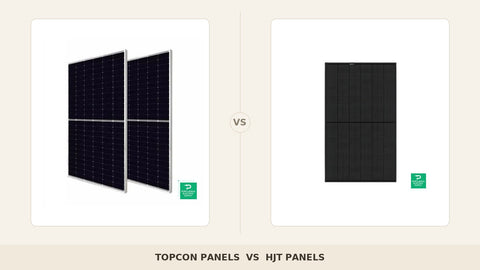
Format isn't the only axis. Both size classes ship in three cell flavors, and the flavor matters more than the frame. Standard mono PERC is the value baseline (~21% efficiency). N-type TOPCon adds roughly a point of efficiency, a better temperature coefficient (about −0.29%/°C vs −0.35%/°C for PERC), and lower first-year degradation — on a hot roof that's worth 2–3% more annual energy from the same sticker wattage. HJT pushes further on tempco and bifaciality at a price premium. Browse the n-type collection, HJT panels, and PERC panels to see live inventory in both formats, and check all-black options if the roof is street-visible — the all-black aesthetic runs about $0.03–0.05/W more and is the single most-requested residential upgrade we sell.
Our standing advice: on a hot-climate roof (anything south of the Mason-Dixon line, or any dark comp shingle), pay the small premium for TOPCon in whichever format fits. On a cool-climate roof or a ground mount with cheap land, PERC value panels in the biggest format that lays out cleanly will win the $/kWh contest every time.
| Site Type | Winning Class | Deciding Factor |
|---|---|---|
| Pitched comp-shingle, vents/skylights | 450W | Layout survival around obstructions; one-person carries |
| Large simple gable or hip, minimal vents | Either — price shop both | Layout fits both; compare installed $/W quotes |
| Flat commercial, ballasted racking | 550W | Fewer modules, fewer clamps, lift equipment on site |
| Ground mount, open field | 550W | Racking rows are long and clean; labor is fast |
| Carport / canopy | 550W | Long spans match the module format; fewer purlins |
| Small residential, <5kW, shaded edges | 450W + microinverters | Module-level electronics matter more than format |
| Off-grid cabin / RV roof | Neither — 200–400W compact class | See portable and 300–399W classes |
Notice what's not a deciding factor anywhere in that matrix: the wattage printed on the label. Efficiency per square foot is a tie, cell tech is available in both formats, and reliability data (PVEL scorecards, degradation rates) tracks manufacturer quality, not frame size. Pick the manufacturer first — our Best Solar Panels 2026 ranking does that homework — then pick the format that fits the rectangle you're covering.
Pitched residential roof with vents, skylights, or a complex hip/valley geometry: 450W class, full stop — you'll fit more kW and install it faster. Simple large gable, flat commercial roof, ground mount, or carport with a lift: 550W class and enjoy the cheaper $/W and faster racking. Between the two sits the honest answer we give at the counter: measure your usable roof zones first, then pick the biggest module that lays out cleanly at 100% coverage. The wattage on the sticker is the last thing that matters, not the first.
Panel class changes logistics, and logistics change real cost — especially for DIY buyers paying LTL freight. The 450W class ships on standard pallets that ride any liftgate truck and fit through a residential gate. Large-format 550W pallets are oversize: heavier per position, more prone to frame flex damage in transit, and more likely to draw a freight claim. Our claims data runs roughly double the damage rate on large-format residential deliveries versus standard pallets. For a contractor with a dock and a forklift, irrelevant. For a homeowner taking delivery at the curb, it's a real line item — budget the liftgate, inspect before signing, and photograph everything. This is also where buying from a solar-specialty distributor matters: we pack, strap, and insure these shipments for a living, and a $0.02/W "deal" from a general marketplace evaporates the first time a pallet arrives with corner crush.
What about the 500W middle class? It exists, and it's quietly excellent for residential: roughly 2.1m frames, 24–26 kg, one-person-manageable for most installers, and it bridges the string-count awkwardness both edges can hit. Check the 500W collection and the 460–549W band when you quote — several of our best-selling residential panels live there, and the per-watt pricing often undercuts the 450 class on identical cell tech. The class boundaries in this article are guides, not walls; measure your roof, then shop every format that fits.
Both classes carry the modern n-type warranty structure — 25-year product, 30-year performance, roughly 1% first-year degradation and about 0.40% per year after that. Over a 25-year horizon that means a 450W panel is delivering about 405W and a 550W panel about 495W; the ratio never changes, because the curves are the same. What does differ is replacement logistics: if a panel fails in year 14, the 450W residential format will almost certainly still be in production in some compatible SKU, while large-format commercial lines turn over faster. Mixing a replacement into an old string is easier in the residential class. It's a small point — until it's your roof and your insurance claim.
Also worth printing because the forums get it wrong constantly: bigger panels are not more fragile. Both classes test to the same IEC mechanical-load sequences, and dual-glass large-format variants are arguably tougher. The failure modes that actually hit both classes — snail trails, connector fatigue, PID in badly grounded strings — are manufacturer-quality issues, not format issues. Buy the brand's reliability record first (our 2026 rankings weight exactly that), then the format that fits the roof, then the best price inside those constraints.
One last money note for larger buyers: per-watt pricing drops meaningfully at pallet quantities, and both classes appear in our pallet bundle deals when manufacturers clear a production run. A 31–36-piece pallet of 450s puts 14–16kW on your truck at pricing the big installers enjoy; large-format pallets run 17–20kW. If your project plus a neighbor's (or your next phase) can absorb a pallet, it's the single biggest discount lever in residential solar — bigger than any wattage-class debate in this article. Just confirm format before you commit: a pallet of 550s you can't fit between the vents is a monument to optimism.
And the used-panel question, since it comes up constantly: second-life and surplus panels can be legitimate for off-grid shops and ground mounts, but for a permitted, warranted, code-inspected rooftop, new Tier-1 modules in either class at 2026 pricing are cheap enough that used rarely pencils once you count missing warranties and unknown degradation. Spend the difference; keep the warranty.
Can I use 550W panels on my house? Physically yes, if the roof has unobstructed rectangular zones at least ~2.4m long and the structure handles the point loads — but at 26–32 kg and 2.2–2.4m they slow residential crews, complicate fire-setback layouts, and often reduce total kW you can fit. Most residential installers standardize on the 450W class for good reason.
Are 550W panels more efficient than 450W panels? No. Both classes run ~21–22.8% module efficiency using the same half-cut mono PERC/TOPCon cells. The 550 simply has more cell area per frame. Watts per square foot of roof is identical, which is why roof fit — not wattage — decides the winner.
How many 450W vs 550W panels for a 10kW system? About 22 of the 450s (9.9kW) or 18 of the 550s (9.9kW). The 450 layout uses roughly 10% more clamps and labor-hours on a pitched roof but fits around obstructions; the 550 layout is faster on open commercial or ground-mount sites.
Do bigger panels have more problems with wind or snow load? Same ratings, different physics. Both classes are typically rated 5400 Pa snow / 2400–4000 Pa wind, but the 550's larger sail area transfers more force per clamp to the racking and roof attachments on uplift. On high-wind-zone roofs we sometimes spec the smaller format purely to keep attachment counts reasonable.
Is the 450W class being discontinued in favor of bigger formats? No — the residential channel has standardized on ~430–470W because it matches roof geometry and one-person carry limits. The large formats grow in commercial; both classes are healthy, current-production product lines with full warranties.
Can I mix 450W and 550W panels in one system? On separate MPPT inputs or with module-level electronics, yes. In the same series string, never — the string current is limited by the weaker module and the mismatched Vmp wastes power on both. Mixed-format retrofits are common when expanding an existing array; just land the new format on its own inverter input.
How much roof do I need for 10kW in each class? About 560–580 sq ft of unshaded roof either way (efficiency is a wash) — the difference is how that area must be shaped. The 450s tolerate L-shaped and interrupted zones; the 550s need clean rectangles roughly 8 ft × 4 ft per panel including gaps and setbacks.
Sources: manufacturer datasheets (residential and large-format classes), NEC 2023 690.7/690.12, IFC 605.11, PEL/PVEL module reliability data, and PES Supply install-crew feedback. Ready to price your project? Get a free system quote — both classes, contractor pricing.