Charging an EV from solar panels is the most satisfying loop in residential energy: sunshine hits the roof, and the car drives on it. It's also a design problem with real math — charging loads are big, intermittent sunshine doesn't match charging schedules, and the difference between a system sized on a napkin and one sized on your actual driving data is several thousand dollars. I've designed dozens of solar-plus-EV setups, and the successful ones all start the same way: with the car's numbers, not the roof's. This guide covers the full design arc — loads, PV sizing, storage, smart charging, rates, and installation — with the arithmetic shown.
Start with the car: EV charging load math
Everything downstream depends on how much energy your driving actually consumes. The core conversion: EVs use roughly 0.25–0.35 kWh per mile depending on vehicle and driving style. Multiply by your real annual mileage:
| Annual Miles | Efficiency (kWh/mi) | Annual EV Energy (kWh) | Average Daily kWh |
|---|---|---|---|
| 8,000 | 0.28 | 2,240 | 6.1 |
| 12,000 | 0.30 | 3,600 | 9.9 |
| 15,000 | 0.30 | 4,500 | 12.3 |
| 20,000 | 0.33 | 6,600 | 18.1 |
Hold that daily number against a solar system's output: a 1 kW array produces roughly 3.5–5.5 kWh per day depending on your sun hours. Covering a 12,000-mile/year EV (9.9 kWh/day) takes about 2–2.8 kW of dedicated PV capacity on average — before accounting for the fact that most charging happens at night. That timing mismatch is the actual engineering problem, and it has three solutions: charge at midday (work from home or workplace charging), shift solar energy with a battery, or let the grid arbitrage it via net metering. Most homes use some blend of all three.
Sizing the PV system for house plus car
Add the EV load to your household baseline and size the combined system in one pass. The formula from our DIY solar guide applies directly: array kW = annual kWh target ÷ (peak sun hours × 365 × 0.80). A home using 10,000 kWh/year plus a 3,600 kWh EV at 4.5 sun hours needs 13,600 ÷ 1,314 ≈ 10.3 kW. Already have solar? The retrofit question is whether your existing inverter and service can absorb an expansion, or whether the EV belongs on a separate sub-array with its own inverter. Either works; the electrical panel capacity usually decides. Our system cost guide puts dollar figures on the expansion path.
Charging levels and the circuit math (NEC 625)
The EVSE (charger) is a continuous load under NEC 625, which means the 125% rule governs every circuit decision:
| Charging Level | EVSE Output | Required Circuit (×1.25, NEC 240.6 sizes) | Wire (Cu, 75°C) | Miles of Range per Hour (typical) |
|---|---|---|---|---|
| Level 1 | 12 A @ 120 V (1.4 kW) | 15 A standard outlet | 14 AWG | 3 – 5 |
| Level 2 (entry) | 24 A @ 240 V (5.8 kW) | 30 A breaker | 10 AWG | 12 – 18 |
| Level 2 (common) | 40 A @ 240 V (9.6 kW) | 50 A breaker | 8 AWG | 20 – 30 |
| Level 2 (max AC) | 48 A @ 240 V (11.5 kW) | 60 A breaker | 6 AWG | 25 – 37 |
Verify the math on the common case: 40 A continuous × 1.25 = 50 A — a standard breaker class, on 8 AWG copper good for 50 A at 75°C per Table 310.16. For most drivers, 24–40 A is the sweet spot; 48 A only pays for itself on big-battery vehicles with long daily drives. Our EV charger breaker size chart covers the full range, and the installation requirements guide handles permits and load calculations.
The timing problem: matching sunshine to charging
Option 1: Midday charging
The cheapest solar-EV integration is behavioral: charge while the array produces. Smart EVSEs with solar-aware modes (some read your inverter or a CT clamp on the mains) can throttle charging to track excess solar — charging at 1.5 kW of surplus instead of pulling 9.6 kW from the grid. If you're home days, this alone can push solar fraction of charging above 70%.
Option 2: Battery buffering
A home battery stores midday surplus and releases it to the evening charge session. The sizing logic: you don't need to store a full charge — just the difference between solar hours and charging hours. For a 10 kWh daily EV load, an 8–13 kWh battery (one Powerwall-class unit) covers most of the gap. Battery round-trip efficiency (~90%) and the battery's own cost-per-kWh-shifted should be compared against simply exporting to the grid — in strong net-metering territories the grid is the cheaper battery; in TOU or low-export-rate territories, physical storage wins. See the Enphase vs. Powerwall comparison and FranklinWH vs. Powerwall for current hardware, plus our home battery systems overview.
Option 3: Let the rate plan do it
Under 1:1 net metering, exporting at noon and importing at midnight is nearly free arbitrage. Under TOU rates with peak windows of 4–9 PM, the same pattern can pay 2–3× the off-peak rate at export and buy back cheap at night — occasionally better than 1:1. Under avoided-cost export rates (a few cents per kWh), exporting to charge later is a money-loser and storage or midday charging becomes mandatory. Pull your utility's actual solar tariff before designing anything; the rate schedule is the design document.
| Rate Structure | Export Value | Best EV Charging Strategy | Does Storage Pay? |
|---|---|---|---|
| 1:1 Net metering | Full retail | Charge anytime; grid is your battery | Rarely, on economics alone |
| TOU with solar-friendly peaks | Peak-rate credits | Export at peak, charge off-peak after midnight | Sometimes — model the spread |
| Low/avoided-cost export | $0.02 – $0.05/kWh | Maximize self-consumption: midday charging or storage | Usually yes |
| EV-specific TOU | Varies | Dedicated EV meter/schedule with super-off-peak rates | Case by case |
Solar carports and the two-birds structure
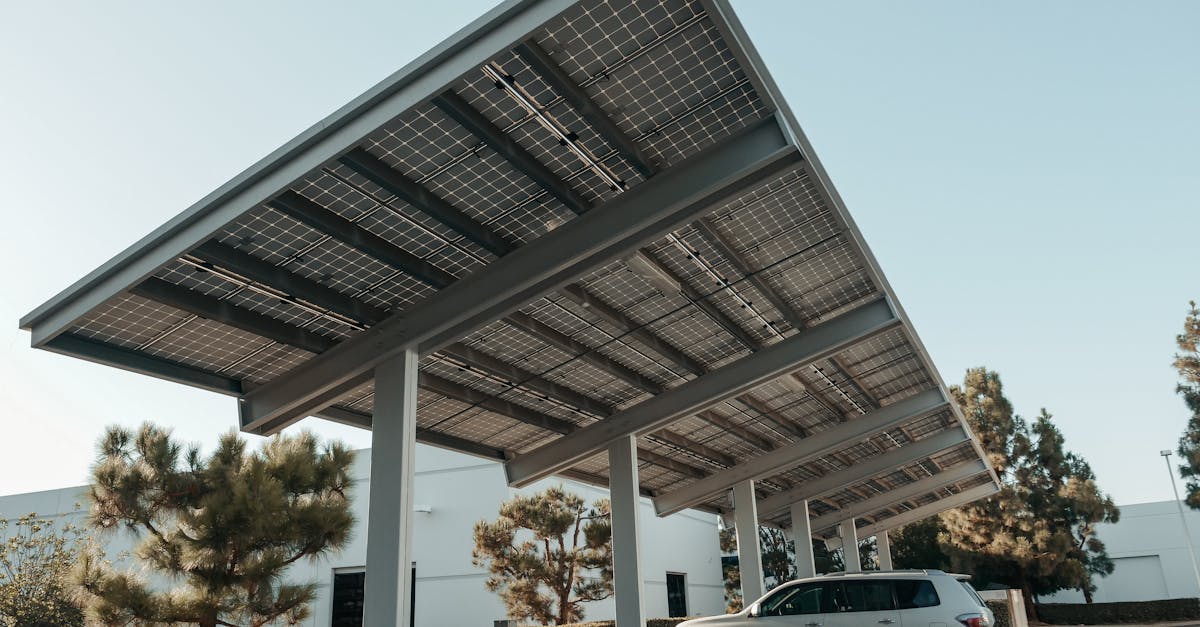
If the roof is full, shaded, or facing the wrong way, a solar carport puts the array where the car lives. The economics: carport structure adds roughly 30–60% per watt over rooftop racking, but you get shade for the vehicle (real value in hot climates — a cooler cabin is less AC load), a clean south-facing surface you fully control, and no roof-penetration or re-roof conflicts. A two-car carport typically hosts 5–8 kW, conveniently close to the EV-covering number for a high-mileage household. For commercial versions of the same idea, our commercial EV installation guide covers the bigger canvas.
Hardware selection: EVSE, inverter, and monitoring
Choose the EVSE on four axes: connector (NACS is now the North American standard adopted across brands; J1772 persists on many non-Tesla vehicles — adapters solve most gaps), amperage matched to your panel capacity, smart features (solar-aware charging, scheduling, utility demand-response compatibility), and UL listing. On the solar side, hybrid inverters that manage PV, battery, and EV charging from one platform simplify the energy choreography — the hybrid inverter roundup and hybrid inverter guide compare the current field. Monitoring should unify house, solar, battery, and EV in one dashboard; chasing data across four apps is how anomalies go unnoticed for months.
Permits, inspection, and utility coordination
Solar-plus-EV projects pull two permits' worth of attention: the PV permit (structural, electrical, fire) and the EVSE circuit. Most AHJs handle the EVSE circuit as a simple electrical permit — load calculation, breaker, wire, GFCI where required — while the PV side follows its normal path. The utility conversation has two questions: does your service size support the added continuous load (a 48 A EVSE plus a big array on a 100 A service is a load-calculation problem), and does your interconnection agreement change when you add storage or expand PV? File early, answer completely, and wait for PTO before operating new generation. The NEC 625 and solar integration update covers the current code landscape.
Costs and payback: the honest numbers
A representative residential solar-plus-EV build: adding 3 kW of PV for the EV at $2.50–$3.50/W turnkey runs $7,500–$10,500; the Level 2 EVSE plus circuit installation adds $800–$2,500. Against gasoline, the EV itself saves most households $1,200–$2,000/year in fuel at 12,000 miles; powering those miles with your own solar instead of grid power saves another $200–$600/year depending on rates. Stack current federal, state, and utility incentives — our EV charging incentives guide tracks them — and the incremental solar-for-EV spend typically pays back in 5–9 years, then produces free fuel for the remaining life of the array. Few home improvements come with a 15-year fuel contract attached.
Future-proofing: V2H, V2G, and bidirectional readiness
Grid Interaction, TOU and Standards
Bidirectional charging — the EV as a home battery (V2H) or grid resource (V2G) — is transitioning from pilot to product. The hardware chain (vehicle, bidirectional EVSE, interconnection approval) is converging on standards, and utilities are standing up V2G tariffs. You can't fully future-proof, but you can leave the door open: conduit and panel capacity sized beyond today's EVSE, a load-management-capable panel, and an inverter platform with an ecosystem roadmap. When your next vehicle can power your house through an outage, you'll want the wiring to already be there.
Panel capacity and the load-calculation gate
The most common project killer isn't the roof — it's the service panel. A 48 A EVSE on a 60 A breaker, added to an all-electric house on a 100 A service, fails the dwelling load calculation. Before hardware shopping, run or commission the NEC 220 load calc. If it fails, the exits are: a service upgrade to 200 A ($2,000–$5,000 typical), a lower-amperage EVSE (24 A on a 30 A breaker satisfies most real driving), or a load-management device that pauses EV charging when the house peaks — code-recognized and usually the cheapest fix by far. The table of typical trade-offs:
| Constraint | Option | Typical Cost | Trade-off |
|---|---|---|---|
| 100 A service, moderate loads | 24–32 A EVSE | $0 (setting) – $1,500 install | Slower charging; fine under ~40 miles/day |
| 100 A service, heavy loads | Load-management device | $500 – $1,500 + install | Charging pauses during house peaks; invisible to most drivers |
| Full electrification plans | 200 A service upgrade | $2,000 – $5,000 | One-time cost; enables heat pump, induction, second EV |
| Two-EV household | Power-sharing EVSE pair | One circuit, split output | Cars share a 50 A circuit overnight; both full by morning |
For two-EV homes, power-sharing is the underused answer: two vehicles almost never need full current simultaneously overnight, and sharing one 50 A circuit halves the electrical work. I've set up several of these; not one owner has woken to an uncharged car yet.
Multi-EV households and future load growth

Household EV count is the fastest-growing variable in residential energy design. The planning rule: size solar for the EVs you'll own in three years, not this one, because array expansions cost more per watt than building capacity once. Electrical design follows the same logic — conduit and panel space for a second EVSE circuit installed during the first install costs maybe $150 in materials; retrofitting it costs a day of labor. This is the same reserve-capacity discipline that pays off in commercial design, applied at 240 volts.
Winter, heat, and seasonal performance
Both halves of the system have seasons. PV production swings with sun hours and snow cover — December can deliver half of June's energy. EV efficiency drops in cold weather too: cabin heat, battery conditioning, and cold-soaked chemistry can raise consumption 15–30% in hard winters. The compound effect means a system sized "exactly right" on annual averages runs a winter deficit and a summer surplus — which is fine under net metering and worth knowing in advance under TOU. In cold climates, preconditioning the car while plugged in (heating the cabin and battery on grid or solar power before departure) preserves range and battery health simultaneously; it's the single highest-value habit a cold-climate EV driver can adopt.
Resilience design: house and car through outages
Solar-plus-EV resilience comes in three tiers. Tier 1: a standard grid-tied array with a critical-loads battery — the house rides through outages on stored solar; the EV charges only when grid returns. Tier 2: battery plus smart panel or load control, letting the EV charge from surplus during extended outages without draining the reserve. Tier 3: V2H-capable EV integrated as a second battery — the car's 60–100 kWh dwarfs a 13 kWh home battery and can carry a house for days with load discipline. The design decisions that preserve these options cost little at build time: a backup-capable hybrid inverter, a critical-loads subpanel, and conduit capacity for a future bidirectional EVSE. Retrofitting any of them later costs real money. If outages are part of your motivation, also review the whole-house generator comparison — solar-plus-storage and standby generators solve overlapping but distinct problems, and some homes rationally want both.
Design mistakes I see repeatedly
Sizing and Design Considerations
Five patterns account for most underperforming solar-EV systems. Sizing from the brochure: using the EPA kWh/mile figure instead of the car's real logged consumption — roof data beats brochure data every time. Ignoring the rate plan: a beautifully engineered self-consumption system on a 1:1 net-metering tariff is a battery nobody needed. Undersized conduit: the 1-inch conduit that fits today's 8 AWG won't fit tomorrow's 4 AWG for the second EV; pull the bigger raceway. EVSE without load management on a marginal service: works until the heat pump, dryer, and charger coincide, then trips the main — usually during a dinner party, in my experience. Monitoring fragmentation: four apps, no alerts, and a failed microinverter discovered at true-up. Every one of these is free to avoid at design time and annoying to fix after.
Off-grid and workshop EV charging
A related question I get from off-grid builders: can a standalone array charge an EV with no grid at all? Yes, with caveats. The EVSE needs a stable 240 V source, so the inverter stack must be sized for the continuous charging load — a 32 A charge session is 7.7 kW for hours, which demands a serious inverter and a battery bank that can carry the session when clouds pass. The workable pattern: charge midday directly from array surplus (the battery smooths transients), keep the EVSE at a modest amperage, and treat the car as the dump load your charge controller would otherwise waste. Systems built around quality off-grid inverter-chargers — the class covered in our Sol-Ark and Victron guides — handle this well. It's a legitimate design for cabins, farms, and job sites where the grid doesn't reach but the work truck still needs to.
Workplace and destination charging: the other half of the map
Home charging covers most miles for most drivers, but the solar-EV equation extends beyond your driveway. Workplace charging converts your employer's daytime solar surplus into your commute fuel — if your workplace offers it, charging there flips your home system's timing problem entirely, letting your home array serve your house. Destination charging (retail, municipal lots) increasingly runs on canopy PV, which is the commercial-scale version of the carport logic. For property owners reading this from the other side — adding charging to a building you own — the load, demand-charge, and networking questions scale up considerably; the commercial installation guide and installation cost analysis cover that jump, and our ChargePoint brand guide explains the networked-hardware landscape.
Keeping the system honest: commissioning and first-year checks
After PTO, verify four things in the first month. Charge at full configured rate once and confirm the EVSE delivers nameplate current without voltage sag beyond ~3% (sag points at undersized wire or a weak service). Run one midday solar-tracking session and watch the EVSE throttle with the array — this validates the CT placement and the logic before you rely on it. Check the monitoring against a known day: a clear-day production curve should be a smooth arc, and the house-plus-EV consumption curve should show the charge session where you scheduled it. Then set alerts — production below threshold, EVSE faults, battery reserve breaches — because a system you don't watch will fail quietly. I still review my own monitoring weekly; the one time I got lazy, a failed CT clamp had my "solar charging" quietly pulling from the grid for five weeks.
Maintenance across the combined system
Maintenance schedules and best practices
Solar-plus-EV hardware is low-maintenance, but "low" isn't "none." Quarterly: glance at the production curve, verify the EVSE's scheduled sessions ran, and check the charging cable for abrasion at the handle (the wear point on every unit). Annually: re-torque the EVSE circuit lugs (continuous 40 A loads loosen connections over years — this is the single most skipped maintenance item in residential EV), inspect roof attachments and flashing, and review your utility's tariff for changes — rate schedules drift, and a schedule change can quietly invalidate the charging strategy you set two years ago. Batteries need nothing but temperature sanity; LFP home batteries prefer shaded, temperate mounting locations, and the garage wall you chose in the design phase is where that decision pays or costs for a decade. Keep every firmware update current on the inverter and EVSE — in the networked era, firmware is where features, fixes, and security patches all arrive.
When the numbers favor waiting (rare, but real)
Solar-plus-EV is a strong default, but three situations justify sequencing instead of bundling. If your roof needs replacement within five years, do the roof first — array removal and re-setting eats the economics. If your utility's solar tariff is under active regulatory review, a few months of clarity can be worth more than a few months of production. And if you're ninety days from replacing the vehicle, design for the next car's charge rate and connector rather than today's. Outside those cases, waiting is usually just procrastination wearing a spreadsheet costume: every month of delay is a month of gasoline and retail-rate electricity that didn't need to be purchased.
The household energy flywheel
Step back from the components and a pattern emerges: solar makes electricity cheap, cheap electricity makes EVs cheaper to run, the EV's battery makes storage abundant, and storage makes solar more valuable. Each asset raises the return on the others — which is why households that buy one piece of this stack tend to own all of it within five years. Design every piece with the next one in mind: the panel with spare breaker spaces, the inverter with battery readiness, the conduit with pull room, the monitoring with an open platform. The cheapest capacity is the capacity you install before you need it, and in residential electrification, you will need it. The households that look smartest in hindsight are never the ones who predicted the technology curve perfectly; they are the ones who left themselves room. Spare conduit, spare breaker spaces, spare panel capacity, spare roof — these cost almost nothing during construction and everything afterward. Build the room, and the future upgrades install themselves in an afternoon.
Frequently asked questions
How many solar panels do I need to charge an EV?
Take your daily EV energy need (annual miles × kWh/mile ÷ 365) and divide by daily production per panel — roughly 1.6–2.4 kWh per 450 W panel depending on sun hours. A 12,000-mile/year driver needs about 5–8 panels (2–2.8 kW) dedicated to the car, before timing losses.
Can I charge my EV directly from solar panels without a battery?
Storage and Smart Charging
On‑Site vs Grid‑Tied, Community Solar & V2G Pilots
Yes, if you charge during solar hours — a grid-tied array without storage feeds the house and the EVSE pulls from the combined supply. Solar-aware smart chargers throttle the EV to track surplus production. Without midday charging or a battery, the energy still flows through the grid via net metering or TOU arbitrage rather than directly.
Is it cheaper to charge an EV with solar than from the grid?
Once the system is built, solar energy costs effectively $0.05–$0.08/kWh on a levelized basis — below most residential grid rates and far below public fast charging. The comparison that matters for new builds is solar's levelized cost against your utility rate; solar wins in most of the country, decisively in high-rate states.
Do I need a special charger to use solar power for my EV?
Solar Technologies for EV Charging
Not strictly — any EVSE charges from the house supply, which solar feeds. But a smart EVSE with solar-tracking or scheduling features (CT-clamp sensing or inverter integration) materially raises the share of charging powered directly by your array rather than the grid.
What size breaker do I need for a Level 2 EV charger?
The EVSE is a continuous load: multiply its output amperage by 1.25 and round up to a standard size. Common pairings: 24 A EVSE → 30 A breaker; 40 A EVSE → 50 A breaker; 48 A EVSE → 60 A breaker. Wire sizing follows the breaker per NEC Table 310.16 at 75°C.
Can my EV power my house during an outage?
With bidirectional-capable hardware, yes — vehicle-to-home (V2H) systems use the EV's battery (typically 60–100 kWh, dwarfing most home batteries) to run a house for days. It requires a compatible vehicle, a bidirectional EVSE, and utility approval. The ecosystem is young but moving fast; wiring for it now is cheap insurance.
Related resources
- EV Charging Station Equipment Guide
- EV Charger Installation Requirements
- Level 2 EV Charger Buyer's Guide
- EV Charger Circuit Breaker Size Chart
- EV Charging Station Incentives
- Home Battery Backup Systems
- EV Charging Infrastructure Solutions
Measure the car first, let the rate plan pick the strategy, and size the circuit by the book. Do those three things and your roof will be putting miles on your car within a month of PTO — and for a couple of decades after. Every sunny day becomes fuel in the tank, every commute runs on yesterday's weather, and the system quietly pays you back in the most satisfying currency there is: miles you never had to buy. That is the whole thesis of this guide, and it only gets truer every single year you own the system, rain or shine — mostly shine.