SMA Sunny Boy 3.8 Smart Energy (SBSE3.8-US-50): The Complete Homeowner's and Installer's Guide
Germany's residential inverter benchmark, re-engineered as a hybrid: specs, breaker math, array sizing, battery readiness, and the monitoring ecosystem explained.

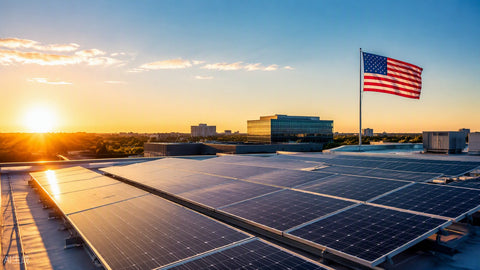
The Sunny Boy name has been bolted to American garage walls for over two decades, and the SMA Sunny Boy 3.8 Smart Energy (SBSE3.8-US-50) is the current expression of that lineage: a 3.8kW hybrid string inverter sized for small-to-medium residential arrays, with the battery-ready architecture and grid-support functions that 2026 interconnection rules increasingly demand. If you're designing a 4–7kW rooftop system and want equipment your electrician, your inspector, and your utility have all seen before, this inverter belongs on the shortlist. This guide walks through the real specs, the NEC math for the AC connection, how much array it can drive, what "Smart Energy" actually does, and where it fits against microinverter and rival string options.
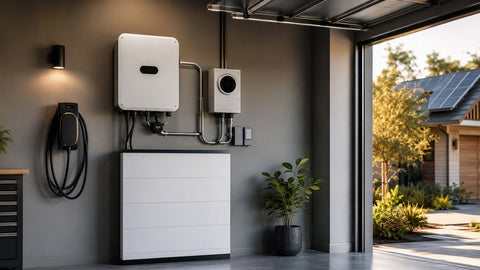
The SBSE3.8-US-50 converts the DC power from your roof array into grid-synchronous 120/240V split-phase AC for your home — the job every string inverter does — but its "Smart Energy" designation marks it as a hybrid-class machine: the architecture is designed to pair with battery storage and to serve as the traffic controller between solar, storage, household loads, and the utility grid. That hybrid design is the meaningful difference from the classic grid-tie-only Sunny Boy line (like the SB3.0-1SP-US-41 series): you can install solar-only today and add storage later without replacing the inverter, which is increasingly the right way to phase a residential budget.
Within the Sunny Boy Smart Energy family, the 3.8kW model is the entry point, with 4.8kW, 5.8kW, and 7.7kW siblings sharing the same platform and feature set. Choosing between them is a pure sizing exercise — the software, monitoring, and battery paths are identical — so the decision reduces to your array size and panel headroom. A household that expects to electrify should price the jump to the 5.8 or 7.7 at quote time; the incremental hardware cost is modest against the avoided future swap.
SMA's depth in this category matters for boring-but-critical reasons: parts availability ten years from now, firmware that keeps pace with utility rule changes, and a U.S. support operation that answers the phone. Our SMA brand guide covers the full product family from this 3.8kW residential unit up to the 150kW+ commercial Sunny Highpower line.
| Specification | Value | Design Consequence |
|---|---|---|
| Model | SBSE3.8-US-50 (Sunny Boy 3.8 Smart Energy) | Hybrid/battery-ready residential string inverter |
| Rated AC output | 3.8 kW @ 120/240 V split-phase | Matches small-to-medium arrays on standard residential services |
| Peak efficiency | Up to 97.5% | Top-tier for the residential string class |
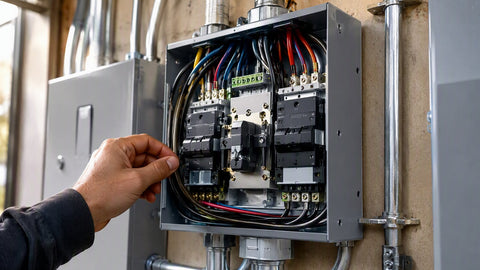
| AC connection | Backfed breaker in main panel | 20A 2-pole breaker per NEC math below |
| Communications | Integrated Wi-Fi; Sunny Portal monitoring | No separate monitoring hardware for most installs |
| Enclosure | Outdoor-rated | Garage, exterior wall, or carport mounting all acceptable |
| Grid functions | IEEE 1547 / Rule 21 smart-inverter capable | Satisfies current utility interconnection requirements |
| Storage path | Hybrid architecture, battery-ready | Add storage later without inverter replacement |
Every residential solar interconnection lives or dies by three calculations. Here they are worked for the SBSE3.8-US-50:
| Design Step | Calculation | Result |
|---|---|---|
| Rated output current | 3,800 W ÷ 240 V | 15.83 A |
| Continuous-load factor (NEC 690.8(B)) | 15.83 A × 1.25 | 19.79 A |
| Overcurrent device (NEC 240.6) | Next standard size | 20 A, 2-pole breaker |
| Conductor (NEC 310.16, 75°C Cu) | ≥ 19.79 A | 12 AWG copper (25 A) |
| Panel busbar check (NEC 705.12, 120% rule) | 200 A bus × 1.2 − 200 A main | 40 A max backfeed — 20 A passes easily |
| Panel busbar check (100 A panel) | 100 A × 1.2 − 100 A main | 20 A max backfeed — passes, but with zero headroom |
Two practical notes on that table. First, the panel-busbar rows are the ones that decide real projects: on a 100A service panel, the 120% rule leaves exactly 20A of backfeed headroom — enough for this inverter and nothing more. If the homeowner later wants a second inverter, a battery with grid sell-back, or an EV charger managed through the same panel, you'll be having the main-panel-upgrade conversation. I raise it at the kitchen table on day one, not at rough-in. Second, keep the inverter-to-panel run short where the design allows; voltage rise on long 12 AWG runs can push the inverter into its overvoltage trip window on high-production afternoons, a maddening intermittent fault that a one-size-up conductor run prevents for a few dollars. Our NEC code compliance guide walks the full interconnection checklist, and the inverter sizing calculator does the breaker arithmetic automatically.
Inverter AC rating and array DC size are deliberately mismatched — the DC/AC ratio — because panels rarely produce nameplate power. Heat, soiling, wiring losses, and non-ideal sun angles all tax real production, so a modestly oversized array fills the inverter's capacity across more hours of the year. For the Sunny Boy 3.8, the sensible design window:
| Array Size (DC) | DC/AC Ratio | Annual Production (1,400 kWh/kWp region) | Fit |
|---|---|---|---|
| 4.0 kW (10 × 400W) | 1.05 | ~5,600 kWh | Shade-prone or suboptimal roofs; never clips |
| 4.8 kW (12 × 400W) | 1.26 | ~6,700 kWh | The sweet spot for most homes |
| 5.5 kW (14 × 400W) | 1.45 | ~7,700 kWh | Good on unshaded roofs; minor summer clipping |
| 6.5 kW (16 × 400W) | 1.71 | ~9,000 kWh | Aggressive; expect meaningful summer-afternoon clipping |
The clipping question deserves honesty: an oversized array wastes nothing in the morning, evening, winter, and cloudy hours — it only flattens the very peak of perfect summer afternoons. At a 1.26 ratio the annual loss is typically under 1%, which is why most designers land there. Push past 1.4 and you should model the clip loss against your rate plan; on time-of-use rates where afternoon power is most valuable, clipping costs more than the kWh math suggests. Our solar system calculator and system installation cost guide help size the array before you size the inverter.
Smart Energy Features in Daily Life

The feature set that justifies the "Smart Energy" badge breaks into three practical groups:
- Monitoring without extra hardware. Integrated Wi-Fi connects the inverter to Sunny Portal, SMA's free monitoring platform, giving production history, daily yield, and fault alerts from any phone. SMA Smart Connected adds automated fault detection — if the inverter develops a problem, SMA's system can flag it before you notice a dip in production.
- Battery readiness. The hybrid architecture accepts storage integration without replacing the inverter — the phase-two upgrade path for homeowners who install solar now and add backup when budget or rates justify it.
- Grid-support functions. IEEE 1547 / Rule 21 capability (volt-VAR, frequency response, anti-islanding) is configured at commissioning to match your utility's interconnection sheet — increasingly mandatory for permission to operate.
Remote diagnostics deserve a specific mention: a large share of inverter service issues — tripped GFCI self-tests, grid-voltage excursions, communication dropouts — resolve through the portal without a truck roll. When your installer can see the fault log remotely, you get a fix scheduled with the right parts instead of a diagnostic visit followed by a second visit.
The portal data also changes household behavior in measurable ways. Families who watch their production curve start running the dishwasher and laundry at solar noon, shifting consumption into the hours when their own roof is the cheapest power source. On utilities with unfavorable export rates, that self-consumption shift is worth more than any hardware upgrade — 10–20% of bill savings in studies of monitored households comes from behavior the monitoring itself induces. Give everyone in the house the app login; the teenager who can see the array's live output becomes the household's unpaid energy manager.
| Criterion | SMA Sunny Boy 3.8 SE | Microinverter System | Budget String Inverter |
|---|---|---|---|
| Architecture | Single wall-mount hybrid string | One unit per panel on the roof | Single wall-mount, grid-tie only |
| Efficiency | Up to 97.5% | ~97% class | 96–97% typical |
| Battery path | Hybrid-ready, no replacement needed | AC-coupled battery addition | Often requires inverter replacement |
| Shade handling | Good (string-level MPPT) | Best (panel-level) | Good (string-level MPPT) |
| Rooftop electronics | None | One device per panel | None |
| Service access | Ground-level swap, minutes | Roof access required | Ground-level swap |
| Best fit | Unshaded/simple roofs, battery-later buyers | Complex or heavily shaded roofs | Tightest budgets, solar-only forever |
The honest tradeoff table above is why we recommend string and micro in different situations rather than declaring a universal winner. Our microinverters vs. string inverters guide goes deep on that decision, the Enphase brand guide profiles the leading micro ecosystem, and best hybrid inverter brands of 2025 cross-shops this Sunny Boy against Sol-Ark, GoodWe, and Sungrow hybrids. For category fundamentals, what a solar inverter does and string inverter basics are the starting points, with current market pricing in the solar inverter price guide.
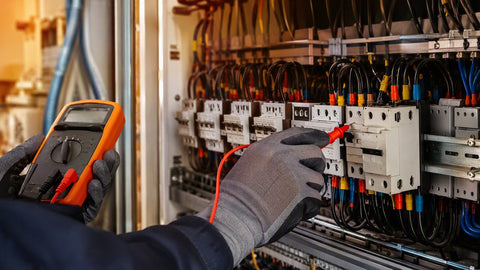
A quality Sunny Boy install is unglamorous: the unit mounts level on a structurally sound wall within its clearance envelope, conduit runs are strapped and sealed, the DC strings land with polarity verified twice, and the AC side terminates on its dedicated 20A 2-pole breaker with a proper backfeed label. The commissioning sequence matters more than the hardware: verify open-circuit string voltage against the design before closing the DC switch, confirm the grid profile matches the utility's requirements sheet, connect Wi-Fi and verify the portal sees production, then walk the homeowner through the monitoring app before the truck leaves. A system whose owner can read its dashboard generates half the anxiety calls of one whose owner cannot.
Placement details that pay over time: keep the unit out of direct afternoon sun where possible (every degree of ambient heat is a fraction of a percent of efficiency and lifespan), maintain the specified clearances for convection cooling, and if mounting in a garage, keep it clear of the car door swing — the single most common residential inverter injury is a door ding, not an electrical fault.
One more decision belongs at install time: the Wi-Fi network. Inverters outlive routers, and the homeowner who changes ISPs in year four will orphan the monitoring unless someone documents the reconnection procedure. We tape a card inside the disconnect with the portal URL, the network name the unit was joined to, and the recommissioning steps — it has saved dozens of confused phone calls over the years.
Every first-time solar buyer eventually asks: "So during a blackout, my panels keep the house running, right?" With a grid-tie-only configuration, the honest answer is no — and understanding why prevents the most common disappointment in residential solar. Standard interconnection rules require any grid-connected inverter to shut down within fractions of a second when utility power fails. That anti-islanding behavior protects the line workers repairing the fault your outage came from; a rooftop array backfeeding a "dead" line is a genuine electrocution hazard, and the requirement is not negotiable.
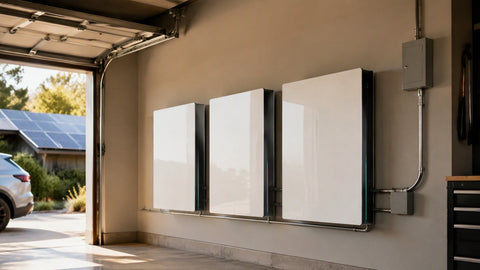
The Smart Energy architecture is the bridge past that disappointment. Because the SBSE3.8 is hybrid-designed, adding storage gives the system a legal, listed pathway to island: the inverter disconnects from the failed grid and forms its own stable 120/240V microgrid for the house, powered by the battery overnight and the array by day. Without storage, solar production is useless in an outage no matter how sunny the day. With storage, the same hardware becomes a whole-home resilience system. Buyers who know they want outage protection should plan the battery phase from day one — conduit paths, panel space, and wall real estate are all cheaper to provision at solar install time than to retrofit.
The 3.8kW class fits a specific household profile: modest current usage with room to grow. Before locking the design, run the five-year question. An EV adds roughly 2,500–4,000kWh of annual consumption; a heat-pump conversion adds 3,000–6,000kWh depending on climate; a hot tub adds 2,000kWh or more. The table below frames how those additions interact with a 4.8kW array on this inverter:
| Household Scenario | Annual Consumption | 4.8kW Array Output (~6,700 kWh) | Verdict |
|---|---|---|---|
| Efficient 2-bed home, gas heat | 6,000–7,500 kWh | ~6,700 kWh | Near full offset — ideal fit |
| Average 3-bed home | 9,000–11,000 kWh | ~6,700 kWh | 60–75% offset; consider larger array/inverter class |
| Home + one EV | 11,500–15,000 kWh | ~6,700 kWh | Partial offset; plan expansion or second system |
| All-electric conversion | 14,000–20,000 kWh | ~6,700 kWh | Under-sized; step up to 7.7kW-class inverter and larger array |
There is no shame in the 3.8kW class — it is precisely right for smaller homes, ADUs, workshops, and phased builds. The mistake is sizing to today's bill when the electrification plan is already on the calendar. If your roadmap includes an EV and a heat pump, say so at design time; moving up a size class now costs far less than a second inverter later.
Residential inverters are the hardest-working electronics in the house — they run at thousands of watts in thermal cycling environments every day the sun shines. What fails in the field, in rough order of frequency: cooling fans and filters in dusty environments, surge-damaged communications boards after lightning seasons, GFCI nuisance trips from array insulation faults, and — rarely — power-stage components. SMA's design philosophy attacks the list directly: conformal-coated boards, generous heatsinking, and a communications architecture that isolates faults rather than cascading them.
Register the product at commissioning, keep the monitoring connected (SMA Smart Connected's automated fault detection only works when the unit can phone home), and put the exterior enclosure on the annual gutter-cleaning walk: clear spider webs and lint from the heatsink fins, check the conduit seals, confirm the labels are still legible. Five minutes a year is the entire maintenance program, and it is the difference between a 10-year inverter and a 20-year one.
Warranty terms on this class typically run a decade with extension options, and the fine print that matters is the claims process: who diagnoses, who ships the replacement, and who pays the labor to swap it. Keep your commissioning paperwork, the serial photo, and the portal history — claims move at the speed of your documentation, and a complete production record turns a warranty conversation from an argument into a form.
What size breaker does the Sunny Boy 3.8 need?
Per NEC math: 3,800W ÷ 240V = 15.83A, times the 1.25 continuous factor = 19.79A, so a 20A 2-pole breaker with 12 AWG copper conductors. On a 200A panel the 120% rule leaves 40A of backfeed headroom, so it fits comfortably; on a 100A panel it consumes the entire 20A allowance.
How many solar panels can I connect to it?
The practical design window is 4–5.5kW DC — ten to fourteen 400W-class panels. The 4.8kW array (12 panels, a 1.26 DC/AC ratio) is the sweet spot for most homes, capturing strong off-peak production with under 1% annual clipping loss.
Can I add a battery later?
Yes — that's the point of the Smart Energy hybrid architecture. The inverter is designed for storage integration, so you can install solar-only now and add a battery when rates, outages, or budget justify it, without replacing the inverter.
Does it work with my utility's interconnection rules?
The unit carries IEEE 1547 / Rule 21 smart-inverter capability — volt-VAR, frequency response, anti-islanding — configured at commissioning to your utility's requirements sheet. That listing satisfies current interconnection standards across U.S. jurisdictions.
How much power will a Sunny Boy 3.8 system produce per year?
Paired with a 4.8kW array, expect roughly 6,700kWh per year in a 1,400 kWh/kWp climate (Mid-Atlantic average), ranging from about 5,300kWh in the Pacific Northwest to 8,400kWh in the desert Southwest.
Is a string inverter or microinverters better for my roof?
Simple, unshaded roofs favor the string inverter: fewer rooftop devices, ground-level service, and hybrid battery readiness. Heavy shading or complex multi-facet roofs favor microinverters' panel-level optimization. Our comparison guide walks the decision with production data.
Does the Sunny Boy 3.8 work during a power outage?
Not on its own — anti-islanding rules require any grid-tied inverter to shut down when the grid fails, protecting line workers. Pairing it with battery storage unlocks the hybrid islanding mode: the inverter forms its own stable microgrid and keeps the house powered from the battery and array.
Designing a residential system? We stock the Sunny Boy 3.8 Smart Energy alongside the larger Sunny Boy 4.8 and the full SMA residential line. Browse the 5kW-class inverter collection for direct peers, check the solar inverter buyer's guide, or call 866-607-3636 for design help.