The US residential microinverter market — dominated by Enphase for a decade and contested by APsystems — has a genuinely different kind of entrant. Mango Power, the energy storage brand that built its name on modular portable power and home batteries, has launched a modular microinverter platform for US residential solar: a 320W panel-level unit (640W dual-panel variant) whose power conversion module can be field-swapped in about 15 minutes without removing the solar panel. This guide covers what the platform is, the full specifications, the NEC-checked branch circuit math, the battery integration story, an honest head-to-head against Enphase IQ8 and APsystems DS3, and the due-diligence questions installers should ask before specifying any new platform.

Last updated May 2026 · Based on Mango Power launch data and US residential market analysis.
Quick Answer
Mango Power's modular microinverter is a panel-level DC-to-AC conversion system engineered for US residential rooftops, carrying UL 1741 / UL 1741 SA listing and IEEE 1547 compliance for utility interconnection. Its differentiator is architectural: instead of a sealed unit that requires panel removal to service, the Mango design separates the power conversion module, communication module, and connection interface into field-replaceable components. Native integration with Mango Power E and Union battery systems makes it a vertically integrated solar-plus-storage platform competing directly with the Enphase IQ ecosystem.
Key Takeaways
- New market entry: the first significant new microinverter platform launch targeting US residential since the APsystems DS3 series.
- Modular architecture: field-replaceable power modules cut service labor dramatically versus sealed units.
- Panel-level MPPT: independent per-panel maximum power point tracking eliminates string shading losses.
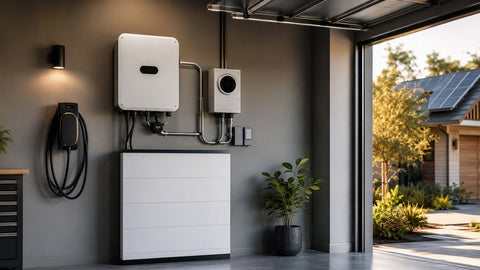
- Storage integration: native DC-coupled compatibility with Mango Power E (3.5 kWh base, stackable to 14+ kWh) and Union (6–24+ kWh) battery systems.
- US certified: UL 1741 SA and IEEE 1547 — required for permission-to-operate in essentially all US markets.
- The open question: service network depth and long-term parts availability — the right due-diligence focus for any new entrant.
Who Is Mango Power?
Mango Power is a global energy storage and power electronics company founded in 2021 in Shenzhen, China, with North American operations and active US distribution through Amazon, direct channels, and wholesale partners. The company first gained recognition with the Mango Power E — a 3.5 kWh modular home battery launched in 2022 that earned strong reviews for stackable architecture and fast charging — followed by the Union platform targeting whole-home backup at higher capacity. You will find the current lineup in our Mango Power collection.
The microinverter launch is the logical completion of that stack: closing the loop from panel to battery to home loads inside one ecosystem. The strategy mirrors Enphase's own evolution from pure microinverter maker to integrated energy platform — the difference is that Mango Power started with storage and added solar conversion, while Enphase did the reverse.
What "Modular Microinverter" Actually Means
A standard microinverter is a sealed power electronics box mounted behind each solar panel. It converts that panel's DC to grid-synchronous AC with its own MPPT, which is why microinverter systems shrug off the shading and mismatch that hobble string systems — each panel performs independently, and one shaded module never drags its neighbors.
Microinverters' weakness has always been service. When a sealed unit fails, the technician must remove the panel above it — typically 45–90 minutes of labor per event, including safe handling and re-setting glass — plus the roof-penetration risk that comes with disturbing racking hardware on an aging roof. Over a 25-year system life with two to four replacement events per array, that labor line adds up.
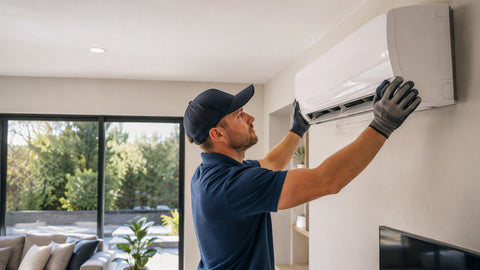
Mango Power's design attacks exactly that cost. The microinverter splits into replaceable functional modules: the power conversion module, the communication module, and the connection interface. A fault gets pinpointed by panel-level monitoring, the technician accesses the unit from the mounting bracket, releases the failed module, and slides in a replacement — typically under 15 minutes, panel untouched, roof undisturbed. For installers running O&M contracts, that is not a convenience feature; it is a fundamentally different service cost structure.
Mango Power Microinverter: Key Specifications
| Specification | Value / Detail |
|---|---|
| AC Output Power | 320W per unit (single panel); dual-module variant 640W (dual panel) |
| DC Input Range | 22–60V DC — compatible with 60-cell and 72-cell panels, 350–500W class |
| Peak Efficiency | 97.5% (CEC weighted efficiency: 96.8%) |
| MPPT Range | Per-panel independent MPPT — 22–48V operating range |
| Output Voltage | 120/240V AC, 60 Hz (US grid standard) |
| Communication | Proprietary PLC (Power Line Communication) + Wi-Fi gateway; Mango Power app |
| Operating Temperature | -40°C to +65°C |
| Ingress Protection | IP67 — fully weatherproof for outdoor rooftop installation |
| Certifications | UL 1741, UL 1741 SA, IEEE 1547, FCC Part 15 |
| Warranty | 12 years standard; 25-year extended warranty available |
| Modular Service | Power conversion module field-replaceable without panel removal |
| Battery Integration | Native with Mango Power E and Union; third-party AC-coupled compatible |
Two spec lines deserve comment from a design standpoint. The 22–60V DC input window covers the current residential module population — 350–500W class panels across 60-cell and 72-cell formats — which means the platform pairs with mainstream inventory rather than demanding a specific module. And the 640W dual-panel variant halves per-watt hardware cost on unshaded roof planes where panel-level independence buys less.
Branch Circuit Design: NEC 690.8 Math for the 320W Unit
Microinverter branch circuits have their own sizing rules, and I still see them misapplied. NEC 690.8 treats microinverter output as continuous current, so conductors and breakers carry 125% of rated output, and NEC 240.6 standard sizes cap how many units share a branch. The checked math for the 320W unit on a 240V branch:
| Design Step | Calculation | Result |
|---|---|---|
| AC output current per unit | 320W ÷ 240V | 1.33A |
| Continuous-current design value (×1.25) | 1.33A × 1.25 | 1.67A per unit |
| Max continuous on 20A breaker | 20A × 0.8 | 16A |
| Units per 20A branch | 16A ÷ 1.67A | 9.6 → 9 units max |
| Branch conductor, 75°C termination | NEC Table 310.16 | 12 AWG Cu (25A) ✓ |
| Dual 640W variant, units per 20A branch | 16A ÷ (640÷240×1.25) | 16 ÷ 3.33 → 4 units (8 panels) |
So a 24-panel residential array with single-module units lands on three 20A branch circuits — plan your attic runs and panel spaces accordingly. Cross-check with the NEC wire sizing guide and ampacity chart, and remember the breaker backfeed rules under NEC 705.12 when the combiner lands in the main panel. Rapid shutdown per NEC 690.12 is native to microinverter architecture — panel-level AC shutdown satisfies module-level requirements without add-on electronics, which remains one of the format's quiet code advantages.
The Modular Service Advantage, Costed Out
Here is the arithmetic that makes O&M-focused installers pay attention, using typical residential service labor rates:
| Service Event | Sealed Microinverter | Mango Modular |
|---|---|---|
| Diagnosis (remote monitoring) | Same — panel-level alerts | Same — panel-level alerts |
| Site labor per replacement | 45–90 min (panel removal + re-set) | ≈15 min (module swap) |
| Roof/racking disturbance | Yes — clamps, possible penetrations | No |
| Typical labor cost @ $120/hr | $90–$180 | ≈$30 |
| 2–4 events over 25 years | $180–$720 per array | ≈$60–$120 per array |
Multiply those deltas across an O&M portfolio of a few hundred systems and the modular architecture stops looking like a product feature and starts looking like a business model. I have said for years that the residential industry's next margin frontier is service efficiency on the aging installed base — this is the first microinverter designed unambiguously for that frontier, and I suspect it will not be the last once the incumbents finish studying it.
Solar + Storage: The Mango Battery Integration
| Battery System | Capacity | Integration Type | Best Application |
|---|---|---|---|
| Mango Power E | 3.5 kWh base; stackable to 14+ kWh | Native DC-coupled via Mango Power microinverter | Moderate backup needs; modular expansion over time |
| Mango Power Union | 6 kWh to 24+ kWh stackable | Native with whole-home backup capability | Whole-home backup; high-consumption households |
| Third-Party AC Storage | Any AC-coupled battery (Powerwall, Sonnen, etc.) | AC-coupled — standard grid interface | Customers with existing non-Mango battery preferences |
The vertical integration story deserves a sober read. Native integration means the microinverter and battery share a design language, monitoring stack, and support channel — one app, one warranty conversation, one phone number. Enphase proved customers value that. The counterweight is ecosystem maturity: Enphase's IQ Battery line, installer training infrastructure, and monitoring platform have a decade of refinement that a 2026 entrant cannot replicate on day one. Buyers should weigh today's integration polish against the direction of travel — and against their installer's own familiarity, because a great platform installed by an untrained crew is a mediocre system.
Mango Power vs. Enphase IQ8 vs. APsystems DS3
| Attribute | Mango Power | Enphase IQ8 | APsystems DS3 |
|---|---|---|---|
| Modular Serviceability | Yes — field-replaceable modules without panel removal | No — sealed unit requires panel removal for replacement | No — sealed unit; dual-panel design reduces unit count |
| Peak Efficiency | 97.5% | 97.5% | 96.7% |
| Grid-Forming (Backup Without Grid) | With battery — via Mango Power E/Union system | Yes — IQ8 grid-forming capability built in | No — grid-tied only without separate battery inverter |
| Native Battery Integration | Mango Power E and Union — native DC-coupled | Enphase IQ Battery — native; other AC-coupled | AC-coupled third-party only |
| Standard Warranty | 12 years (25-year extended available) | 25 years standard | 10 years (25-year extended available) |
| US Service Network | Growing — newer entrant; verify regional coverage | Excellent — industry-leading US service network | Good — established US distribution and support |
| Monitoring App | Mango Power app — panel-level real-time data | Enphase Enlighten — industry benchmark | APsystems EMA — panel-level data |
| Price Position | Competitive — targeting below Enphase IQ8 | Premium pricing — market leader | Value pricing — typically 15–20% below Enphase |
Three honest observations on that comparison. First, the IQ8's grid-forming capability — solar producing during outages when paired with storage — remains the benchmark feature set, and any challenger comparison should acknowledge it. Second, Enphase's 25-year standard warranty versus Mango's 12-year standard is a real gap; ask what Mango's extended warranty costs with labor included before comparing lifetime economics. Third, APsystems' dual-module value proposition competes most directly with Mango's 640W variant, and in price-sensitive unshaded applications that head-to-head usually decides on distributor pricing and installer preference rather than specs.
Browse the alternatives in our microinverter category, including the Enphase, APsystems, and Hoymiles lines, before locking a platform decision.
Installer's Evaluation Guide: Five Questions Before You Specify

- Regional service network: who services Mango Power in your market, and what is the contractual response commitment?
- Spare module inventory: what are replacement power-module stock levels at your nearest distribution point, and the lead time when stock is out?
- Firmware policy: how are over-the-air updates delivered, and what is the track record on UL 1741 SA compliance maintenance after utility rule changes?
- Integration architecture: is the battery coupling DC or AC for your application, and what are the round-trip efficiency implications for self-consumption versus backup?
- Extended warranty terms: what does 25-year coverage cost per unit, and does it include labor or hardware only?
These are the same questions I would ask of any platform new to my approved equipment list, and they are not hostile — they are how good new entrants earn specifications. Mango Power's answers will improve as the network matures; the modular hardware concept deserves that maturation time.
US Residential Microinverter Market Context
The market Mango is entering is large and structurally shifting in its favor. The US installed approximately 8.7 GW of residential solar in 2023, with microinverters and DC optimizers accounting for the majority of residential architecture — a direct consequence of complex, multi-orientation, partially shaded real-world rooftops. Enphase holds an estimated 60–70% of the US residential microinverter share, with APsystems, SolarEdge (via optimizers), and Hoymiles dividing most of the remainder.
Two structural shifts create the opening. Storage attachment rates in residential solar climbed from under 15% in 2021 to over 35% in 2025 in key markets — demand is moving toward integrated solar-plus-storage platforms rather than component-by-component purchases. And installer awareness of O&M economics is rising as installed bases age into their service years. A modular, service-optimized microinverter with native battery integration is precisely positioned for both shifts; whether Mango Power converts that positioning into share depends on the execution questions in the evaluation guide above.
Platform Selection Workflow
Use this decision sequence when evaluating Mango Power against incumbents for a specific project — print it, because it maps cleanly onto the questions customers actually ask:
- Is the roof shaded, multi-orientation, or complex? No → a string inverter with optimizers may serve better. Yes → microinverter architecture confirmed; continue.
- Does the customer want storage now or within three years? Yes → prioritize platforms with native battery integration (Enphase IQ8 + IQ Battery, or Mango Power + E/Union). No → all microinverter platforms remain eligible.
- Will you hold an O&M contract on this system? Yes → Mango's modular service economics weigh heavily in its favor. No → warranty length and network maturity weigh more heavily; Enphase's 25-year standard leads there.
- Is Mango's service network confirmed in your region with acceptable parts lead time? Yes → Mango is a viable specification. No or uncertain → default to the incumbent platforms until the network matures in your territory.
How the Modular Swap Actually Works on the Roof
- Identify the fault via panel-level monitoring — the app names the unit.
- De-energize safely: open the branch breaker, verify absence of voltage, follow lockout/tagout.
- Access from the bracket — side or rear; the panel stays put.
- Swap the module — release, remove, seat the replacement.
- Re-energize and verify production in monitoring; log serials for warranty.
Panel Pairing and System Design Notes
The 22–60V input window pairs cleanly with today's 400W-class residential modules — browse the 400–459W category for current stock, and cross-check module Voc at cold temperature against the 60V input ceiling using the same NEC 690.7 correction discipline applied to string systems: a 50V-class module at a 1.14 cold factor sits at 57V, inside the window with margin; verify your exact bin. The inverter sizing calculator and inverter guide support architecture selection, and our wiring basics article contrasts micro and string layouts for homeowners still choosing.
One layout note from the field: on mixed-shade roofs, place the dual 640W units on the clean, unshaded planes and single units on the compromised sections. You keep per-panel independence exactly where it pays and halve hardware cost where it does not — the kind of design judgment that separates a good microinverter layout from a parts-list install.
The Bottom Line
Mango Power's modular microinverter is the most interesting new residential power electronics launch in years — not because it out-specs the incumbents on paper, but because it attacks the industry's real pain point: service labor over 25-year asset lives, where a sealed-unit replacement burns an hour of skilled labor and a modular swap burns fifteen minutes. The 12-year standard warranty and maturing service network are the honest counterweights, and they deserve to be weighed rather than waved away. For installers with O&M portfolios and homeowners prioritizing integrated storage, it deserves a serious look alongside the Enphase and APsystems defaults. For everyone, the evaluation guide above is the right next step — and our team can quote Mango Power, Enphase, and APsystems BOMs side by side. Contact us for project pricing.
Monitoring and the Homeowner Experience
Microinverter platforms live or die on their monitoring stack, because panel-level data is the feature homeowners actually touch. Mango Power's app extends its existing storage monitoring to solar production: per-panel output, fault alerts, and battery state in one interface. The panel-level fault pinpointing is what makes the modular service model work — the technician arrives knowing which unit and which roof section, not searching. For homeowners, the practical advice is universal across platforms: look at the monitoring monthly. The customers who catch a dead microinverter in week one are the ones who look; the ones who discover it at true-up time funded a year of lost production.
What This Launch Means for the Incumbents
Realistically, a 2026 entrant does not dethrone a 60–70% share incumbent — but it does not need to. The residential microinverter market is large enough that a few points of share is a substantial business, and new entrants historically force feature responses that benefit everyone: the APsystems DS3's arrival pushed pricing discipline into the dual-module segment, and modular serviceability is exactly the kind of feature incumbents can be expected to study. For buyers, competition in this category is unambiguously good — more platforms competing on service economics, storage integration, and warranty terms means better long-run value on every roof, whichever logo lands on it.
Case Pattern: The Shade-Heavy Retrofit
The project profile where this platform gets specified first: an existing home with a complex roof — dormers, a mature oak on the south side, a chimney shading the west plane until 2 PM — and an owner who wants battery backup within the next couple of years and has opinions about app simplicity. String architecture is a poor fit; the shade pattern is a daily mismatch generator. Among micro options, the decision runs through the workflow above: storage intent points toward natively integrated platforms, and if the installing company holds the O&M contract, the modular service math closes the argument. That is a narrower profile than "every house," but in mature residential markets it describes a lot of roofs.
Procurement and Pricing Notes
As a newly launched platform, Mango Power microinverter pricing moves with channel stocking levels — early-adopter pricing and launch promotions are common in a platform's first year, and volume pricing for installer partners is worth negotiating at the distributor level. Pairing economics matter too: a combined microinverter-plus-battery package from one ecosystem usually prices better than the same components bought separately, and it certainly supports better. We stock the Mango Power line alongside the full microinverter category and can quote matched BOMs — panels from the 400–459W class, racking, the micro platform of your choice, and storage — as a single freight-consolidated shipment from Louisville.
Grid Functions and Code Compliance Notes
Two compliance details matter for permit packages. First, UL 1741 SA grid-support functions — voltage and frequency ride-through, volt-var and frequency-watt response — are what California Rule 21 and a growing list of state interconnection rules demand; the Mango platform carries the listing, but the utility's interconnection application will ask for the certificate version, so pull the current document before submittal rather than after a rejection. Second, rapid shutdown: NEC 690.12 module-level shutdown is inherent to microinverter architecture since each panel's AC output dies with its unit — no add-on transmitters or receivers, no extra rooftop electronics to fail. On inspection day that simplicity reads well, and inspectors who have fought with finicky add-on RSD systems notice.
Frequently Asked Questions
- What makes Mango Power's microinverter different from Enphase?
- Modular, field-replaceable power modules — ~15-minute swaps without panel removal versus 45–90 minutes for sealed units. Enphase counters with a 25-year standard warranty and a mature service network.
- Is it certified for US installation?
- Yes — UL 1741 / UL 1741 SA and IEEE 1547. Verify the certification version against your utility's current interconnection rules.
- Does it work with any panel brand?
- Any panel within the 22–60V DC input window — mainstream 350–500W residential modules. Check cold-corrected Voc against the 60V ceiling.
- How many units share a branch circuit?
- Up to 9 single 320W units per 20A/240V branch (1.33A × 1.25 = 1.67A per unit; 16A continuous max), or 4 dual 640W units, on 12 AWG copper.
- Does it work with batteries?
- Yes — native integration with Mango Power E (3.5 kWh, stackable to 14+ kWh) and Union (6–24+ kWh) systems.
- What warranty does it carry?
- Twelve years standard; extended options are available — confirm current pricing and whether labor is included before comparing lifetime economics.
- Should installers specify it on large projects yet?
- With due diligence: verify regional service coverage, spare-module inventory and lead times, firmware update policy, and extended warranty terms first — then specify with confidence.