Shopping for solar panels means sorting through a wall of acronyms: mono, poly, PERC, TOPCon, HJT, half-cut, bifacial, thin-film. Each label describes a real difference in how the panel is built, how much power it produces per square foot, how it handles heat, and what it costs per watt. This guide breaks down every major solar panel type on the market, with real efficiency numbers, cost-per-watt math, degradation rates, and temperature behavior, so you can match the right technology to your roof, budget, and climate.

I've pulled panels off pallets and set them on racking for years, and the single most common mistake I see is buyers choosing a panel type based on a datasheet headline instead of the actual constraints of their project — roof area, shade, heat, and budget per watt. The "best" panel is the one that fits those constraints, not the one with the highest lab efficiency.
The Big Three: Monocrystalline, Polycrystalline, and Thin-Film
Every solar panel sold today falls into one of three silicon families. The differences start at the ingot.
Monocrystalline (mono)
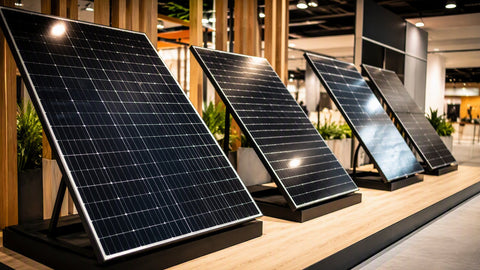
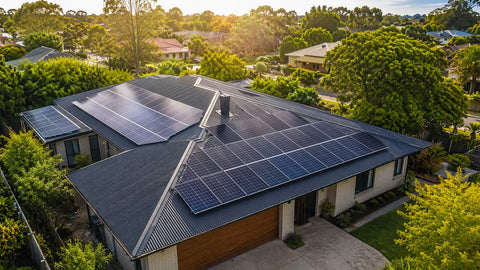
Monocrystalline cells are cut from a single, continuous silicon crystal grown by the Czochralski process. Because the crystal lattice is unbroken, electrons move more freely, which is why mono cells reach the highest commercial efficiencies — typically 20% to 23% in mainstream residential modules, with premium N-type products pushing past 23%. Mono panels are recognizable by their uniform dark black cells and (on older formats) clipped corners. They dominate the residential market and are what you will find in nearly every panel in our monocrystalline solar panels collection.
Polycrystalline (poly)
Polycrystalline cells are cast from melted silicon fragments that solidify into many small crystals. The crystal boundaries impede electron flow, capping efficiency around 15% to 17%. Poly panels have a distinctive blue, speckled appearance. They were the budget workhorse of the 2010s, but the price gap with mono has collapsed — mono wafers are now cheaper to produce at scale — and poly has largely disappeared from new residential product lines. You still encounter poly on older installations and in some value-tier imports.
Thin-film
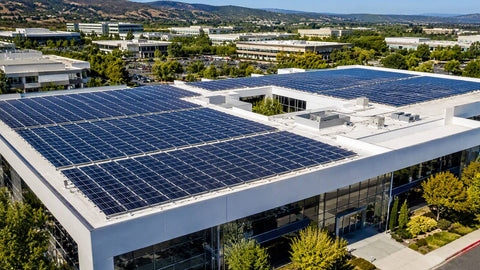
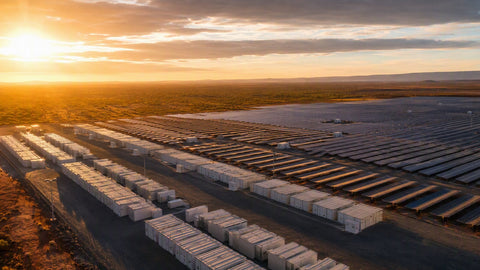
Thin-film panels deposit a photovoltaic layer only a few microns thick onto glass, metal, or flexible substrates. The three commercial chemistries are amorphous silicon (a-Si), cadmium telluride (CdTe), and copper indium gallium selenide (CIGS). Efficiencies run 10% to 19% depending on chemistry, with CdTe (First Solar) leading utility-scale deployments. Thin-film excels in high-heat environments and on weight-limited or curved surfaces, and it's the default for large desert utility plants. See our thin-film solar panels for portable and specialty applications.
Efficiency and Cost Comparison: Real Numbers
The table below compares the major panel technologies on the numbers that actually drive a purchase: module efficiency, typical cost per watt, watts produced per square foot, and temperature coefficient. Cost-per-watt figures are representative wholesale/panel-only ranges, not installed system prices.
| Panel Type | Typical Module Efficiency | Panel Cost per Watt | Watts per Sq Ft (approx.) | Temp Coefficient (%/°C) | Best Use Case |
|---|---|---|---|---|---|
| Monocrystalline PERC (P-type) | 20.0% – 21.5% | $0.30 – $0.45 | 18.6 – 20.0 | -0.35 | General residential, budget-premium balance |
| Monocrystalline TOPCon (N-type) | 21.5% – 23.0% | $0.35 – $0.50 | 20.0 – 21.4 | -0.30 | Space-constrained roofs, hot climates |
| Monocrystalline HJT (N-type) | 21.8% – 23.2% | $0.40 – $0.60 | 20.3 – 21.6 | -0.26 | Premium residential, maximum heat tolerance |
| Polycrystalline | 15.0% – 17.0% | $0.25 – $0.35 | 14.0 – 15.8 | -0.40 | Legacy systems, tight budgets, ample roof area |
| Thin-film CdTe | 17.0% – 19.0% | $0.30 – $0.40 | 15.8 – 17.7 | -0.25 | Utility scale, extreme heat |
| Thin-film a-Si / CIGS | 10.0% – 14.0% | $0.40 – $0.70 | 9.3 – 13.0 | -0.21 | Flexible, curved, weight-limited surfaces |
The watts-per-square-foot column comes from a straightforward conversion. A square meter is 10.764 square feet, so a panel at 21% efficiency under the 1,000 W/m² standard test condition produces 210 W/m², which is 210 ÷ 10.764 = 19.5 W/ft². On a roof with 400 ft² of usable, unshaded area, that means:
| Panel Technology | W/ft² | System Size on 400 ft² | Panels Needed (per format) |
|---|---|---|---|
| Poly (15.8 W/ft²) | 15.8 | 400 × 15.8 = 6,320 W (6.3 kW) | 19 × 330 W |
| Mono PERC (19.5 W/ft²) | 19.5 | 400 × 19.5 = 7,800 W (7.8 kW) | 18 × 430 W |
| N-type TOPCon (21.0 W/ft²) | 21.0 | 400 × 21.0 = 8,400 W (8.4 kW) | 19 × 450 W |
| Thin-film a-Si (11.0 W/ft²) | 11.0 | 400 × 11.0 = 4,400 W (4.4 kW) | 22 × 200 W |
That is the core argument for high-efficiency mono on a typical house: the same roof yields 33% more nameplate power with N-type TOPCon than with polycrystalline (8,400 ÷ 6,320 = 1.33). If your roof is small relative to your energy use, efficiency is not a luxury — it is the whole design.
Cell Architecture Upgrades: PERC, Half-Cut, Bifacial, TOPCon, and HJT
Within the monocrystalline family, four architectural improvements define the current market. They stack — a modern premium panel is often an N-type TOPCon, half-cut, bifacial, dual-glass module all at once.
PERC (Passivated Emitter Rear Cell)
PERC adds a dielectric passivation layer on the back of the cell that reflects unabsorbed light back through the silicon for a second chance at capture, and reduces rear-surface electron recombination. The gain is roughly 1 percentage point of absolute efficiency over standard mono for a negligible cost increase, which is why PERC became the default P-type architecture. Our PERC solar panels cover the mainstream value tier.
Half-cut cells
A half-cut module slices standard cells in half with a laser and wires the halves in two parallel strings. Halving the cell quarters the resistive (I²R) loss — cutting current in half drops resistive loss to one quarter — which gains 5 to 10 watts on a typical 60-cell-equivalent format. Half-cut also improves shade tolerance because the two halves operate semi-independently. Browse half-cut solar panels for current formats.
Bifacial
Bifacial cells absorb light from both faces. Mounted over a reflective surface — white membrane roofing, light gravel, snow — the rear side adds 5% to 30% extra energy depending on albedo and mounting height. Bifacial pairs naturally with dual-glass construction and is the standard for ground mounts and commercial flat roofs. See our bifacial solar panels and dual-glass solar panels.
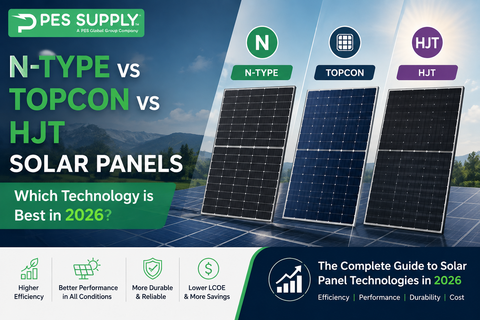
N-type: TOPCon and HJT
Conventional cells are P-type: silicon doped with boron. N-type cells use phosphorus doping, which eliminates boron-oxygen light-induced degradation (LID) and supports higher carrier lifetimes. The two commercial N-type architectures are TOPCon (Tunnel Oxide Passivated Contact) and HJT (Heterojunction, an amorphous-crystalline silicon sandwich). TOPCon offers the best cost-per-efficiency and now leads new manufacturing capacity; HJT offers the best temperature coefficient (-0.26%/°C) and lowest degradation. Explore N-type solar panels and HJT solar panels.
| Architecture | Efficiency Gain vs. Standard Mono | First-Year Degradation | Annual Degradation After Year 1 | 25-Year Output (of nameplate) |
|---|---|---|---|---|
| Standard mono (P-type) | Baseline | 2.5% | 0.55%/yr | ≈ 84.3% |
| Mono PERC (P-type) | +1.0 pt | 2.0% | 0.55%/yr | ≈ 84.8% |
| N-type TOPCon | +1.5 to +2.0 pts | 1.0% | 0.40%/yr | ≈ 89.4% |
| N-type HJT | +1.8 to +2.2 pts | 1.0% | 0.25%/yr | ≈ 93.0% |
The arithmetic on degradation is worth doing. Year-25 output = (100% − first-year loss) × (1 − annual rate)²⁴. For TOPCon: 99.0 × 0.996²⁴ ≈ 99.0 × 0.9083 ≈ 89.9% (the table uses 0.40%/yr compounding from year 2, a standard warranty-sheet figure). Over 25 years on an 8 kW system producing 12,000 kWh in year one, a TOPCon array at 89.4% versus a standard mono at 84.3% retains an extra 5.1 percentage points — roughly 12,000 × 0.051 ≈ 612 kWh in year 25 alone, and several thousand kWh cumulatively across the system's life.
Temperature Coefficient: Why Hot Climates Change the Answer
Panel ratings are measured at a 25°C cell temperature. On a summer afternoon, rooftop cells routinely run 35°C above ambient — a 95°F (35°C) day means cells near 70°C, or 45°C above rating. Multiply that by the temperature coefficient:
| Technology | Coefficient | Loss at 70°C Cell Temp (45°C rise) | 400 W Panel Real Output |
|---|---|---|---|
| Polycrystalline | -0.40%/°C | 45 × 0.40 = 18.0% | 400 × 0.82 = 328 W |
| Mono PERC | -0.35%/°C | 45 × 0.35 = 15.8% | 400 × 0.842 = 337 W |
| TOPCon | -0.30%/°C | 45 × 0.30 = 13.5% | 400 × 0.865 = 346 W |
| HJT | -0.26%/°C | 45 × 0.26 = 11.7% | 400 × 0.883 = 353 W |
| Thin-film a-Si | -0.21%/°C | 45 × 0.21 = 9.5% | (scales similarly) |
On a Phoenix roof in July, an HJT panel holds an 18-watt advantage per panel over poly at peak heat — across 20 panels, that is 360 W of real capacity, every hot afternoon, for decades. I always walk customers in hot climates through this table before they fixate on nameplate watts, because a cooler-running panel with a lower rating can out-produce a hotter-running one when it matters most — at summer peak, exactly when the utility wants its money.
Which Type Should You Choose? A Decision Framework
Small roof, high usage → N-type mono (TOPCon or HJT)
When roof area is your binding constraint, buy watts per square foot. A 430–450 W N-type panel like the SunEvo SE5-54H 450 W or the Silfab Elite 370 W N-type TOPCon all-black maximizes production on limited area, and the all-black format keeps curb appeal.
Ample roof, tight budget → P-type mono PERC
Mainstream mono PERC panels in the 400–459 W range deliver the lowest cost per watt for most residential projects. Check pricing by sorting our solar panel collection by price.
Ground mount or flat commercial roof → bifacial dual-glass
With reflective ground cover and elevated racking, bifacial gain is free energy. Pair with proper racking systems to raise module height and tilt for rear-side capture.
Off-grid cabin, RV, boat → portable thin-film or small mono
Weight and form factor beat raw efficiency. Flexible thin-film and portable solar panels integrate with the kind of off-grid cabin kits and battery systems covered in our off-grid cabin kit guide.
Extreme desert heat → HJT or CdTe thin-film
The lowest temperature coefficients win where cell temperatures are brutal. This is why CdTe dominates utility projects in the American Southwest.
Buying Checklist: Beyond the Cell Type
Panel type is the first filter, not the last. Before you buy, verify:
- Full datasheet ratings: Pmax, Voc, Isc, Vmp, Imp, NOCT, and the exact temperature coefficients — all under STC, and check Pmax at NOCT for a realistic field number.
- Warranty structure: product warranty (12–25 years), performance warranty (25–30 years, with the degradation schedule in writing), and who actually services the claim.
- Certifications: UL 61730 listing for the US market, IEC 61215/61730 internationally, and PID and salt-mist ratings for coastal installs.
- Mechanical load ratings: 5,400 Pa snow / 2,400 Pa wind is a solid residential baseline; check your local requirements.
- System fit: match panel Voc strings to your inverter's MPPT window — our solar inverter buyer's guide and inverter sizing calculator walk the math.
One more from the field: I tell every first-time buyer to order one spare panel. Shipping damage, a cracked corner during handling, a future warranty replacement where the model is discontinued — a spare on a shelf in the garage has saved more than one of my customers a week of downtime.
Ready to size a system? Run your roof through our solar system calculator, compare current models on our best solar panels of 2026 list, or call Portlandia Electric Supply and we'll spec the array with you — we stock residential, commercial, and USA-made solar panels, plus complete solar kits for DIY and contractor installs. If you're wondering whether solar can cover your whole load, read can solar panels power a whole house next.
Reading a Datasheet: STC, NOCT, and the Numbers That Matter
Every panel datasheet lists two test conditions, and knowing the difference keeps you from over-promising yourself. STC (Standard Test Conditions) is the lab: 1,000 W/m² irradiance, 25°C cell temperature, AM1.5 spectrum. NOCT (Nominal Operating Cell Temperature) is closer to the field: 800 W/m², 20°C ambient, wind at 1 m/s — which puts the cells around 45°C. A 450 W panel at STC typically rates around 335–340 W at NOCT. That 25% haircut is normal physics, not a defect, and any production estimate built on STC numbers alone is inflated by roughly a quarter.
Here is a worked example of the full derate chain for one 450 W N-type panel on a real roof:
| Derate Step | Factor | Running Total (W) |
|---|---|---|
| STC nameplate | — | 450 |
| Heat (cell at 55°C, coefficient -0.30%/°C: 30°C × 0.30% = 9.0% loss) | 0.910 | 450 × 0.910 = 409.5 |
| Irradiance below STC (typical midday average 900 W/m²) | 0.900 | 409.5 × 0.900 = 368.6 |
| Soiling (dust, pollen) | 0.970 | 368.6 × 0.970 = 357.5 |
| Wiring + mismatch losses | 0.980 | 357.5 × 0.980 = 350.4 |
| Inverter efficiency | 0.970 | 350.4 × 0.970 = 339.9 |
Net: 450 × 0.910 × 0.900 × 0.970 × 0.980 × 0.970 ≈ 340 W AC delivered at a typical summer midday — a 0.755 combined derate. Multiply 340 W by your peak sun hours and you have honest daily production per panel. This is the arithmetic I run on the back of every quote I review, and it's why two proposals with identical panel counts can promise wildly different kWh.
Cost-per-Watt Economics at the System Level

Panel cost is only 12–18% of an installed residential system, but panel choice moves the whole budget. Higher-efficiency panels mean fewer panels, fewer racking clamps, fewer roof penetrations, and less labor per watt — which is why premium panels can pencil out even at a price premium per watt.
| Design Choice (10 kW target) | Panels Required | Panel Cost @ $/W | Racking + Install Labor Impact |
|---|---|---|---|
| 330 W poly | 10,000 ÷ 330 = 31 panels | 31 × 330 × $0.30 = $3,069 | 31 clamps zones, 31 attachments — highest labor |
| 430 W mono PERC | 10,000 ÷ 430 = 24 panels | 24 × 430 × $0.38 = $3,921 | 23% fewer attachments than poly design |
| 450 W N-type TOPCon | 10,000 ÷ 450 = 23 panels | 23 × 450 × $0.45 = $4,657 | Fewest penetrations; best roof density |
The premium panels cost $1,588 more than poly at the panel line ($4,657 − $3,069), but eliminate 8 panels' worth of racking, clamps, wiring home runs, and labor — commonly $60–$100 per panel of installed balance-of-system — recovering $480–$800 of the gap before the first kilowatt-hour. The remaining premium buys the degradation and heat advantages tabulated earlier, which pay out over 25 years. Check current per-watt pricing across our 300–399 W, 400–459 W, and 460–549 W tiers to run this math with live numbers.
Mounting Context Changes the Answer
The same panel behaves differently depending on how it's mounted, and the mounting often selects the panel type:
- Flush roof mount: hottest running condition (limited airflow under the module), so temperature coefficient matters most — favor N-type. Bifacial gain is negligible.
- Tilted ground mount: cooler operation, room for bifacial gain over light gravel or ground cover fabric, and no weight constraint — large-format commercial panels win on cost per watt. Pair with proper racking or a ground-mount kit like the PES 24-panel ground mount kit.
- Flat commercial roof (ballasted): bifacial over white membrane is the standard play; our solar ballast blocks article covers the ballast side.
- Trackers: bifacial plus tracking is the utility-scale standard; single-axis tracking adds roughly 25–35% annual energy versus fixed tilt.
- Portable/RV/marine: weight and flex matter more than efficiency — thin-film and portable panels.
The Manufacturer Landscape and What "Tier 1" Really Means
"Tier 1" is a BloombergNEF bankability rating — a measure of the manufacturer's financial health, not panel quality. A Tier 1 badge tells you the warranty is likely backed by a solvent company; it does not tell you the panel is good. Quality lives in the datasheet and in independent testing like the PVEL scorecard. The brands we stock across Jinko, LONGi, Trina, Canadian Solar, Qcells, REC, Silfab, and Mission Solar all publish full degradation schedules and carry current UL listings — verify any model you're quoted against its actual datasheet regardless of brand tier.
For buyers who prioritize domestic content — including projects chasing domestic-content incentives — our USA-made solar panels collection concentrates qualifying models in one place.
Degradation Over 25 Years: The Full Compounding Table
Degradation compounds quietly. Here is year-by-year output for an 8 kW array under three warranty schedules, assuming 12,000 kWh of year-one production:
| Year | Standard Mono (2.5% yr 1, then 0.55%/yr) | TOPCon (1.0% yr 1, then 0.40%/yr) | HJT (1.0% yr 1, then 0.25%/yr) |
|---|---|---|---|
| 1 | 12,000 kWh | 12,000 kWh | 12,000 kWh |
| 5 | ≈ 11,440 kWh | ≈ 11,690 kWh | ≈ 11,760 kWh |
| 10 | ≈ 11,130 kWh | ≈ 11,450 kWh | ≈ 11,620 kWh |
| 15 | ≈ 10,820 kWh | ≈ 11,220 kWh | ≈ 11,470 kWh |
| 20 | ≈ 10,530 kWh | ≈ 11,000 kWh | ≈ 11,330 kWh |
| 25 | ≈ 10,240 kWh (85.3%) | ≈ 10,780 kWh (89.8%) | ≈ 11,190 kWh (93.3%) |
| 25-year cumulative | ≈ 278,000 kWh | ≈ 284,000 kWh | ≈ 289,000 kWh |
The 11,000 kWh lifetime gap between standard mono and HJT, at $0.16/kWh, is about $1,760 — usually more than the upfront premium difference between the tiers on an 8 kW system. That is why I tell customers the efficiency conversation is really a 25-year energy conversation wearing a one-day price tag.
Myths Worth Killing Before You Buy
- "All panels are the same, buy the cheapest." The tables above say otherwise: efficiency density, temperature behavior, and degradation differ by enough to move 25-year value by thousands of dollars.
- "More watts per panel is always better." A 600 W commercial panel on a small residential roof can force bad layouts and leave usable area stranded. Match panel format to roof geometry.
- "Panels need constant cleaning." In most climates, rain handles it; soiling losses run 2–5% annually. Clean only when monitoring shows a persistent, unexplained drop.
- "Thin-film is dead." CdTe powers a large share of US utility solar, and flexible thin-film remains the only answer for curved and weight-critical surfaces.
- "You can't mix panel types." You can — on separate MPPT inputs or separate strings with matched electricals. Never mix within a single series string.
Pairing Panels With the Rest of the System
Panel type decisions ripple into the inverter and storage choices. High-power commercial panels push string currents that favor string inverters with wide MPPT windows — our string inverters and inverter sizing calculator cover the matching. Complex roofs with mixed panel orientations favor microinverters or optimizers. And if storage is in the plan, a hybrid inverter from the hybrid inverter collection keeps the battery add-on simple later; the solar battery buyer's guide and battery sizing guide cover that side of the design. Off-grid projects should start from the home battery bank sizing guide instead of the panel aisle.
Whatever type you land on, buy from stock that lists the full datasheet publicly — every panel we sell at Portlandia Electric Supply does — and keep one spare module on hand. Panel technology is mature; the winners are chosen by matching the technology's strengths to your roof, not by chasing spec-sheet headlines.
A Worked Sizing Example, Start to Finish
Put it all together with a real scenario: a 2,200 ft² all-electric home in a 4.8 peak-sun-hour region using 14,600 kWh per year, with 420 ft² of unshaded south-facing roof.
Step 1 — required system size: 14,600 ÷ (4.8 × 365 × 0.8 system efficiency) = 14,600 ÷ 1,401.6 = 10.4 kW. Step 2 — check roof capacity by panel type: at 21.0 W/ft² (N-type), 420 ft² supports 8.8 kW — not enough; at 19.5 W/ft² (mono PERC), 8.2 kW — also short. The options: use a second east or west roof plane (produces roughly 80–85% of south per watt), add a ground mount, or trim consumption. This is the exact situation where panel type selection stops being academic: choosing 23%-efficiency panels over 20%-efficiency panels recovers 420 × (21.4 − 18.6) = about 1.2 kW of extra capacity on the same roof. Step 3 — panel count: 10,400 ÷ 450 = 24 N-type panels across two planes, versus 10,400 ÷ 400 = 26 mid-tier panels. Step 4 — verify the inverter: a 10 kW string inverter or a microinverter per panel both work; check string Voc against the tables earlier in this article.
Notice what never came up in that sizing exercise: the brand name on the panel. Efficiency class, roof geometry, and degradation schedule did all the work. That's the right order of operations.
End of Life and Recycling: The Last 10% of the Story
Panels are 75–80% glass and aluminum by weight, both readily recyclable, plus silicon, copper, and silver worth recovering. The US recycling infrastructure is still maturing, but take-back programs through manufacturers and specialty recyclers are expanding, and several states now regulate panel disposal as electronic or universal waste. When you decommission or warranty-replace a panel, ask the manufacturer or your installer about certified recycling rather than landfilling — a failed panel under warranty usually ships back to the manufacturer anyway. Designing for end of life starts at purchase: buy from manufacturers with published recycling programs, keep your model numbers and purchase records, and remember that a panel removed in a reroof at year 15 typically retains 88–93% of its nameplate output — resale into off-grid, agricultural, and DIY markets is common and legitimate. The secondary market is also why buying recognized brands with documented datasheets pays off twice: once in performance, once in residual value.
Whichever panel type you choose, the fundamentals don't change: verified datasheets, honest production math, quality mounting, and a supplier who answers the phone. Portlandia Electric Supply stocks every technology discussed in this guide — mono PERC, N-type TOPCon, HJT, bifacial, and thin-film — with per-watt pricing published openly. Bring us your roof dimensions and your last twelve months of kWh usage, and we'll spec two or three competing designs so you can compare them line by line before spending a dollar.
Frequently Asked Questions
Are monocrystalline solar panels worth the extra cost?
For most homes, yes. Mono panels cost only $0.05–$0.15 more per watt than legacy poly while producing 20–30% more power per square foot. On a space-limited roof, that density is the difference between covering your usage and not. Poly only makes sense where roof area is abundant and budget is the overriding constraint.
How long do solar panels actually last?
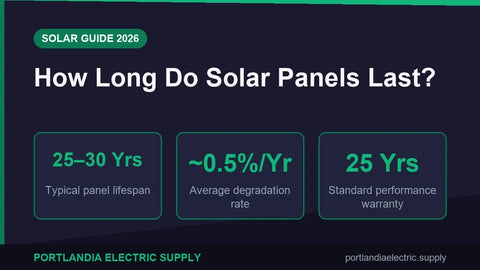
Panels don't die at the warranty line — they fade. Standard mono warranties guarantee roughly 84% of nameplate output at year 25; N-type TOPCon guarantees around 87–89%, and HJT up to 92–93%. Real-world arrays routinely operate 30+ years, with output declining along the degradation curve rather than failing outright.
Do solar panels work in cloudy or cold climates?
Yes — and cold actually helps. Silicon cells run more efficiently at low temperature, so a crisp, sunny 30°F day often produces more power per hour than a hot 100°F day. Clouds cut irradiance, but diffuse light still generates 10–25% of rated output. Annual production is what matters; check your region's peak-sun-hour map before sizing.
What is the difference between PERC, TOPCon, and HJT?
All three are monocrystalline cell architectures. PERC adds a rear passivation layer to P-type cells for about +1 efficiency point at minimal cost. TOPCon and HJT are N-type designs: TOPCon adds a tunnel-oxide contact layer and leads on cost-per-efficiency, while HJT sandwiches amorphous silicon layers for the best temperature coefficient and lowest degradation, at a price premium.
Are bifacial panels worth it on a shingle roof?
Generally no. Bifacial gain requires light reaching the rear face — reflective white surfaces, elevated racking, or ground mounts with clearance. On a flush-mounted asphalt shingle roof the rear sees almost nothing, so pay for bifacial only on ground mounts, carports, flat white-membrane roofs, and trackers.
How many solar panels do I need for my house?
Divide your annual kWh usage by the local production per watt (annual kWh ÷ peak-sun-hours ÷ 365 ÷ 0.8 system losses, roughly). A home using 12,000 kWh/year in a 4.5-sun region needs about 12,000 ÷ (4.5 × 365 × 0.8) ≈ 9.1 kW, or twenty 450 W panels. Our system calculator automates this.