The inverter is the smallest line item on a solar quote that can sink the entire project. It is 8–12% of a typical system budget, yet it governs every watt the array ever delivers, carries the shortest warranty of any major component, and generates the majority of service calls over a system's life. Get the inverter decision right and nobody notices for twenty years. Get it wrong and you will meet your service truck regularly. This guide breaks down what solar inverters actually cost in the current market, why the spread between a $1,400 hybrid and a $7,000 one is usually justified, and how installers, EPCs, and project owners should budget, compare, and procure.
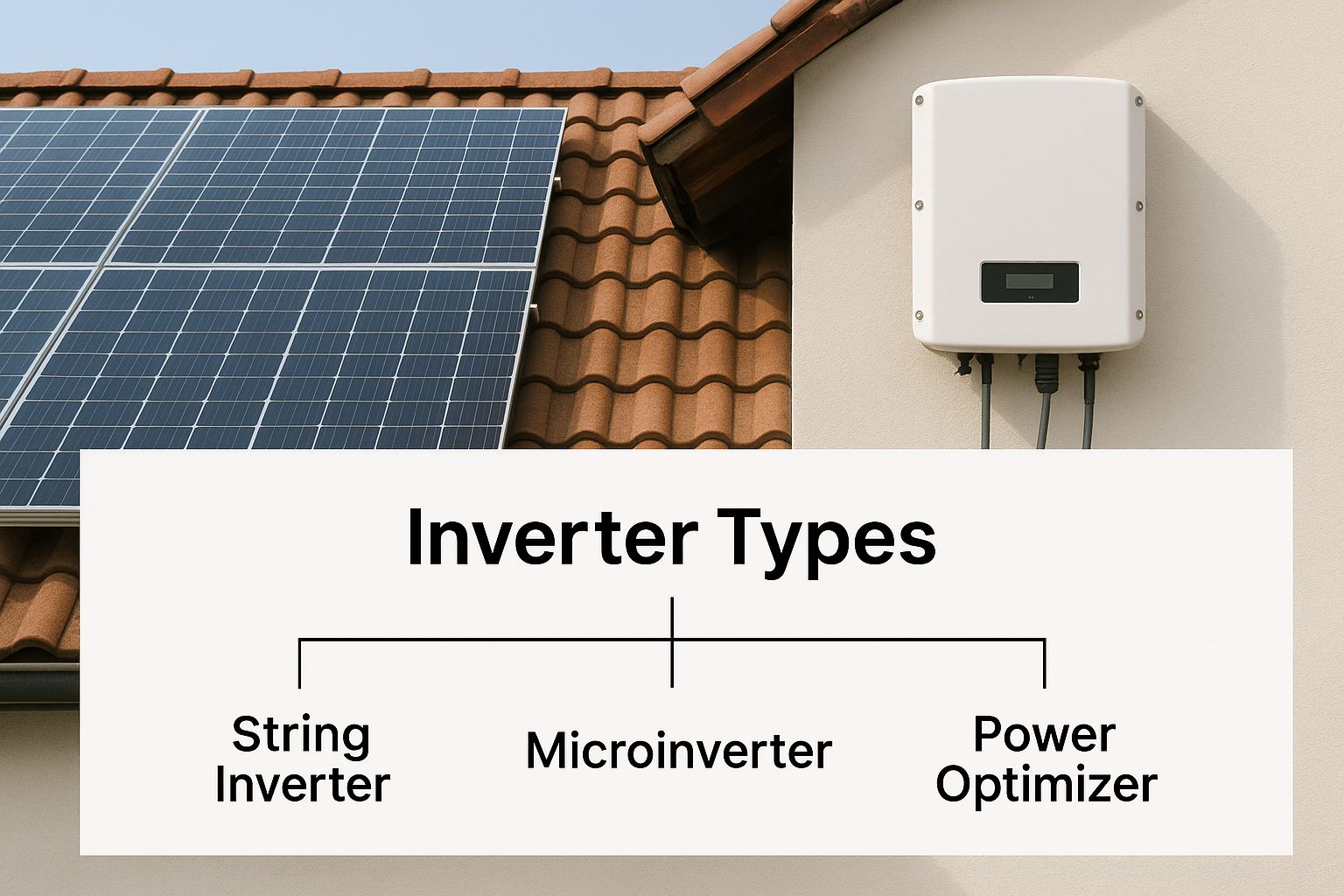
We sell inverters across every architecture — string, micro, and hybrid — through our solar inverter catalog, and we field the warranty calls when they fail. Both perspectives shape what follows.
The Big Picture: Where Inverter Prices Sit in the Current Market
Solar module prices have fallen so far that the inverter's share of total system cost has quietly grown. When panels cost $2.50/watt, the inverter was a footnote. With modules from JA Solar, Trina, and Qcells trading well under $0.30/watt at the distributor level, the power electronics now represent a meaningful slice of the BOM — and the slice where quality differences still matter. Silicon carbide and GaN switching devices have pushed residential string inverter efficiency to 97.5–99% while holding prices flat, and the hybrid segment has collapsed in price as EG4 and peers forced the legacy brands to respond.
Street pricing moves with volume, region, and relationship, but the ranges below reflect what we see across thousands of units of annual throughput:
| Inverter Class | Typical Size | Unit Price Range (Street) | $/Watt Equivalent | Typical Warranty |
|---|---|---|---|---|
| Residential string inverter | 3.8–11.4 kW | $1,000–$2,500 | $0.12–$0.28/W | 10–12 years (extendable to 20–25) |
| Microinverters | 240–480 VA each | $140–$260 per unit | $0.45–$0.70/W | 25 years |
| Residential hybrid / battery-ready | 5–15 kW | $1,400–$7,000 | $0.18–$0.55/W | 10 years |
| Commercial string (three-phase) | 50–125 kW | $4,000–$9,000 | $0.05–$0.09/W | 5–10 years |
| Central inverter (utility) | 1–5 MW blocks | Project-priced | $0.03–$0.06/W | 5 years + service agreements |
Those ranges are honest but slippery, because $/W compresses as size grows — a 3.8kW string inverter at $1,400 is $0.37/W while its 11.4kW sibling at $2,200 is $0.19/W. Compare within a size class or the numbers lie to you.
How Inverter Technology Impacts Your Budget
String Inverters: The Workhorse
A string inverter takes series-wired module strings at 300–1,000 VDC (1,500 V on commercial gear) and converts the whole array centrally. Lowest cost per watt, one box to service, and mature reliability — modern units from the major brands run 10+ years between failures in clean installations. The tradeoffs are real: module-level shading hits the whole string (mitigated by multiple MPPT inputs), no module-level monitoring without add-on optimizers, and a single point of failure. For unshaded roofs and ground mounts with uniform orientation, the string inverter remains the rational default. Units like the SolarEdge SE3800H (which pairs with optimizers for module-level MPPT) and the value lines in our string inverter collection bracket the segment.
Microinverters for Complex Projects
One small inverter per module, mounted at the racking, converting DC to AC at the panel. You pay $0.45–$0.70/W — two to three times string pricing — and in return you get module-level MPPT (shade on one panel costs you one panel), module-level monitoring, no high-voltage DC on the roof, built-in rapid shutdown compliance, and a 25-year warranty that matches the modules. On complex roofs with multiple planes, dormers, and shade intrusions, micros routinely pay for themselves in recovered production. On a clean south-facing rectangle, they are a premium you do not need to pay. Browse our microinverter lineup for current per-unit pricing.
Hybrid Inverters: The Fastest-Moving Segment
Hybrids merge the solar inverter, battery inverter-charger, transfer switch, and often dual MPPTs and generator input into one enclosure. This is where the price war lives. Five years ago a battery-capable residential inverter was a $6,000+ proposition; today the EG4 FlexBOSS21 class delivers 16kW of hybrid capability for around $2,000, and premium units like the Sol-Ark SA-8K-48 hold the top of the market with heavier surge capacity and deeper integration. If there is any chance the project adds batteries within the inverter's lifetime — and with storage prices where they are, there usually is — buying the hybrid now costs far less than retrofitting later. See our hybrid inverter collection for the current field.
Feature and Cost Comparison: String vs. Micro vs. Hybrid
| Factor | String | Microinverter | Hybrid |
|---|---|---|---|
| Installed cost premium (residential) | Baseline | +$0.15–$0.35/W | +$0.10–$0.25/W vs string, minus future retrofit cost |
| Module-level MPPT | No (per-string MPPT) | Yes | No (per-string MPPT) |
| Module-level monitoring | With optimizers only | Native | String-level |
| Battery integration | AC-coupled retrofit | AC-coupled retrofit | Native DC-coupled |
| Rapid shutdown (NEC 690.12) | Needs module-level devices | Inherent | Needs module-level devices |
| Single point of failure | Yes | No — one module drops, rest produce | Yes |
| Warranty | 10–12 yrs (extendable) | 25 yrs | 10 yrs |
| Best application | Clean roofs, ground mounts, commercial | Complex/shaded residential roofs | Any storage-certain or off-grid project |
Key Factors That Drive Inverter Costs
System Capacity and Power Rating
Power rating is the obvious driver, but sizing discipline saves money both ways. Oversizing the inverter wastes capital; undersizing costs production through clipping. The industry-standard DC:AC ratio runs 1.2–1.35 for residential string systems — a 10kW array on a 7.6–8.2kW inverter clips a handful of peak-noon hours per year and gains you a cheaper, better-loaded inverter that runs in its efficiency sweet spot far more often. Do not let a salesperson talk you into 1.0:1 "so nothing is wasted"; the last 15% of inverter capacity operates a few hours a year and you are paying for all of it.
Brand Reputation and Market Tiers
The market sorts into three tiers, and the price gaps between them have narrowed:
| Tier | Representative Brands | Price Position | What You Get |
|---|---|---|---|
| Premium | SolarEdge, SMA, Fronius, Enphase (micros) | Baseline to +40% | Deepest monitoring, longest track record, strong US support, mature installer networks |
| Established value | Sol-Ark, Solis, Growatt (hybrid), APsystems (micros) | −10% to −30% | Feature-rich, improving support, strong price-performance |
| Disruptor value | EG4, Deye-class hybrids | −40% to −60% vs premium | Aggressive pricing, fast feature velocity, thinner service infrastructure |
The tier decision should follow the project, not ideology. A portfolio of 500 rental homes wants premium support infrastructure and 25-year warranties. A hands-on owner with a battery-backed off-grid system and a multimeter can bank the disruptor-tier savings and keep a spare board on the shelf. We stock across tiers precisely because the right answer changes job to job.
Efficiency Ratings and ROI
Peak efficiency numbers (97.5–99%) matter less than weighted efficiency (CEC or EU efficiency), which accounts for performance across the power range where inverters actually live. A 0.5% weighted-efficiency gap on a 10kW system producing 14,000 kWh/year is 70 kWh annually — about $10 at retail rates. Efficiency alone rarely justifies a price premium; efficiency plus reliability plus support does. Run the arithmetic before paying for spec-sheet decimals.
Warranty Terms and Service Coverage
Read warranty terms as a cost line, not a comfort blanket. Key questions: Is labor covered or parts-only? (Parts-only warranties leave you paying $300–$600 for the truck roll.) Is there an advanced-replacement program, or does your customer wait three weeks without production while the unit ships both ways? Are extensions priced sanely? A 10-to-25-year string inverter extension typically costs 10–20% of unit price and is usually worth it, because the year-12 failure is the classic failure. Microinverter 25-year coverage is a genuine economic advantage baked into their price premium.
Uncovering Hidden Installation and System Costs
The inverter's sticker price is not the inverter's cost. Budget for the entourage:
- Rapid shutdown devices for string/hybrid systems: $30–$60 per module for module-level power electronics where NEC 690.12 requires them.
- AC and DC disconnects, breakers, and wire: a hybrid install typically adds a 60–100A breaker, heavy gauge conductors, and often a critical-loads subpanel ($400–$1,200 in parts and labor). Our circuit breaker sizing guide covers the NEC 240.6 standard sizes and the 125% continuous-load math that governs these choices.
- Consumption monitoring CTs and communications: $150–$400, and worth every cent for battery systems.
- Labor: a straight string-inverter swap is a half-day; a hybrid with critical-loads panel and battery commissioning is 1.5–2.5 days of skilled labor.
- Permitting and interconnection revisions when the inverter changes the AC characteristics of an approved design.
On the balance-of-system side, remember that the inverter choice propagates: microinverters change your wire management and trunk cable BOM, hybrids change your panel schedule, and everything changes your monitoring story. The system components guide maps these interdependencies across the full BOM.
How to Budget and Save on Your Inverter Purchase
Procurement Strategies for Every Buyer
Homeowners: compare quotes on $/watt installed, but force every bidder to spec the exact inverter model and warranty term — "or equivalent" is where margin hides. Installers: consolidate volume on two platforms (one string/micro ecosystem, one hybrid) rather than dabbling in six; truck stock, training, and firmware familiarity are real costs that never appear on a PO. Buy through distribution with genuine inventory depth — a great price on a unit that ships in nine weeks is not a great price. EPCs: negotiate annual frame agreements with price-protection clauses, and qualify at least two vendors per class before the RFP, not during it.
One discipline unites all three buyer types: price the decision over the system's life, not the invoice date. The cheap inverter that dies at year eleven, out of warranty parts coverage, with a three-week RMA and no local stock, is the most expensive inverter on the quote sheet. The boring inverter with the deep service network and the shelf spare two states away is frequently the bargain. We have processed enough warranty claims to know which manufacturers answer the phone in week one of a failure — and that answer quality is worth more than most spec-sheet advantages combined.
Leveraging Incentives to Reduce Net Cost
The federal Investment Tax Credit applies to the inverter as part of the solar system — 30% at the time of writing for residential and qualifying commercial projects — and when the inverter is bought with storage, the storage capacity (3kWh minimum standalone threshold) pulls the hybrid's cost into the credit too. Domestic-content adders under the IRA can stack additional percentage points on commercial projects using qualifying US-manufactured content. Confirm current guidance with a tax professional; the rules have moved repeatedly and project timing around credit step-downs is a real procurement variable.
Total-Cost Worked Example: 8kW Residential System
| Architecture | Power Electronics Hardware | RSD / Add-Ons | Incremental Labor | 25-Yr Warranty Coverage | Honest Total |
|---|---|---|---|---|---|
| String inverter | $1,800 | $700 (module-level RSD) | Baseline | $350 extension to 25 yr | $2,850 + one expected replacement risk |
| Microinverters (20 units) | $3,600 | Included | +$300 trunk cable labor | Included | $3,900, no central failure point |
| Hybrid (battery-ready now) | $2,200 | $700 RSD + $900 critical-loads panel | +$800 | 10 yr standard | $4,600, battery retrofit avoided later |
The string row's hidden asterisk is the expected mid-life replacement: a $1,800 unit plus $500 labor around year 12–15 erases most of its headline savings. Include that probability in your comparison and the micro and hybrid rows sharpen considerably.
Commercial and Utility-Scale Inverter Economics
Above the residential scale the conversation changes currency: from sticker price to levelized cost of energy and availability guarantees. Commercial string inverters in the 50–125kW class have become the default architecture for rooftop and distributed ground-mount projects up to several megawatts, because they kill the single-point-of-failure problem that haunted central-inverter designs — lose one 100kW string unit and 94% of a 1.6MW plant keeps producing. At $0.05–$0.09/W they also undercut central inverters on most sub-5MW projects once you price the central unit's pad, transformer skid, and DC combiner infrastructure.
Three commercial pricing realities that rarely make the datasheets. First, service agreements are where the money hides: a central inverter with a cheap sticker and a $15,000/year service contract is not cheap. Price ten-year total cost of ownership, including guaranteed availability penalties. Second, spares strategy beats warranty language: for commercial string fleets, one shelf spare per 10–15 units costs under 1% of project capex and converts a three-week RMA into a one-day swap. Third, 1,500V architecture pays for itself on ground mounts through longer strings, fewer combiners, and less trench — but only if the module and racking BOM is selected to match. Coordinate the voltage decision across trades or watch the savings leak into change orders.
Failure Modes and What They Actually Cost
After years of processing warranty claims, the failure ledger sorts into a short list, and the list has not changed much in a decade. The technology gets more efficient every generation, but physics and heat remain undefeated. Capacitor aging is the classic string-inverter killer — electrolytic caps dry out on hot attics and south-facing walls, which is why we push shaded wall mounts and why garage installations outlast exterior ones. Fan failures on actively cooled units create thermal derating long before they create faults; a unit running 15% derated in July is silently taxing production, and the owner usually discovers it by comparing June bills with a neighbor. Ground faults triggered by wet, degraded module wiring get blamed on inverters constantly — the inverter is the messenger, not the culprit, and replacing it without finding the fault just buys a second dead inverter. And grid-event damage — lightning-induced surges and utility switching transients — concentrates in regions with weak surge protection; a $200 whole-home SPD at the service panel is the cheapest inverter insurance sold anywhere. When a unit does die, the true cost is parts + labor + truck roll + lost production + customer goodwill; on a financed residential system that stack routinely reaches $1,200–$2,000, which is why warranty labor coverage and advanced replacement matter more than the warranty's headline duration.
Sizing the Inverter to the Array: A Worked Example
Say you are pricing a 9.6kW array — twenty-four 400W modules — on a clean south roof in a four-season climate. The sizing math: nameplate DC is 9,600W. Apply a realistic 1.25 DC:AC ratio and the target AC rating is 9,600 ÷ 1.25 = 7,680W, pointing straight at the 7.6kW or 7.7kW residential string class, or twenty-four 350–400VA micros. Cold-weather Voc check: a 12-module string of 49.8V Voc modules is 597.6V at STC, and at the NEC 690.7(A) correction factor of 1.12 for a −7°C design minimum that string reaches 669V — comfortably inside a 1,000V residential input window but worth verifying, not assuming. Clipping analysis on a 1.25 ratio typically shows annual clipping losses under 1.5% — a fair trade for the smaller, cheaper, better-loaded inverter. Run this arithmetic per MPPT input when the roof has multiple planes, and never let two planes with different orientations share an MPPT; the tracker finds a compromise maximum that satisfies neither string.
The Replacement and Repowering Market
A pricing angle most guides ignore: the replacement wave. Hundreds of thousands of systems installed between 2008 and 2015 are riding inverters at or past end of life, and their owners face a replace-or-retrofit decision. A like-for-like string swap is the cheapest path ($1,800–$3,500 installed). Adding module-level rapid shutdown compliance to an old array adds $1,000–$2,500 depending on module count and roof access. Converting to a hybrid with a small battery during the swap — while the crew, permits, and interconnection paperwork are already paid for — is often the highest-value move, because retrofit labor dwarfs incremental hardware cost. Owners in this position should treat the failed inverter as a forcing function: the question is not "what does a replacement cost" but "what does this system need to be worth for its next fifteen years."
Tariffs, Supply Chains, and Procurement Timing
Inverter pricing does not move in a straight line, and buyers who understand the cycles save real money. Trade actions — anti-dumping and countervailing duty cases, Section 301 and 201 measures, and AD/CVD reviews touching Southeast Asian manufacturing — have whipsawed landed costs more than once in recent memory. Tariff announcements create short buying windows before price adjustments flow through distribution; they also create allocation crunches on the most popular SKUs. Practical defenses: hold 60–90 days of inventory on your two or three highest-velocity SKUs if you are an installer, lock pricing in writing at contract signing on large projects, and qualify a second-source model for every design so a single allocation event cannot idle your crews. On the flip side, avoid panic-buying a year of stock at a tariff-spike peak — we watched competitors do exactly that in a past cycle and spend eighteen months unwinding inventory bought at the top.
How the Inverter Choice Affects Financing and Insurance
Third-party-owned systems (leases and PPAs) impose their own inverter economics: the financier's model carries replacement reserves and production guarantees, which is why the lease/PPA channel concentrates on premium micros and premium string+optimizer ecosystems — the 25-year coverage aligns with the contract term and kills mid-life replacement risk in the model. If a customer is comparing a cash quote using value-tier hybrids against a lease quote using premium micros, part of the price difference is literally the insurance policy embedded in the hardware. Insurance carriers have also started paying attention: documented surge protection, listed equipment, and permitted replacement work increasingly determine whether an inverter failure claim pays smoothly. Keep commissioning photos, permit records, and monitoring baselines — the paper trail is worth money when the adjuster calls.
The Software Layer: Monitoring Value You Can Price
Modern inverter pricing increasingly buys software as much as silicon, and the software has a dollar value. Fleet monitoring for installers converts warranty ambiguity into scheduled maintenance: per-module alerting on a micro fleet or per-string alerting on optimizer-based systems catches a failed unit in days instead of billing cycles. For commercial O&M, API access to fleet data is worth a measurable slice of the service contract — pulling production data programmatically into an asset-management platform eliminates manual reporting labor that otherwise runs hours per site per month. When two bids differ by $400, ask what each platform charges for monitoring after year five, whether the API is open or gated, and who owns the data if the manufacturer exits the market. We have migrated orphaned monitoring fleets after manufacturer exits; it is exactly as fun as it sounds, and the owners paid for every minute.
Answering Your Top Solar Inverter Pricing Questions
Is a more expensive inverter brand really worth the price?
Sometimes. Pay the premium when support infrastructure matters (portfolios, remote owners, financed systems with production guarantees) or when the premium features — module-level monitoring, 25-year coverage — have calculable value. Save the money when the owner is technical, the system is simple, and a spare unit on the shelf is an acceptable service plan.
How much value should I place on the warranty?
Price it as insurance: expected failure probability × replacement cost (parts + labor + lost production). A 25-year micro warranty covering 20 units at $180 each plus labor is worth roughly $1,000–$1,500 in expected-value terms over a 10-year string warranty. That closes much of the headline price gap.
Will inverter prices keep falling?
Hybrid and value-tier pricing likely has further to fall as competition intensifies; premium-tier pricing is stickier because it funds support infrastructure. Do not delay a project waiting for the bottom — production foregone while you wait usually exceeds the price drift.
Should I oversize the inverter for future expansion?
For battery retrofits, yes — buy the hybrid now. For array expansion, modestly: one size up on a string inverter is cheap headroom; two sizes up idles the inverter below its efficient band for years.