Every week our counter hears some version of the same sentence from contractors: "I could sell twice the work if I could staff half of it." The solar industry's constraint in 2026 is not demand, financing, or equipment supply — we ship pallet after pallet into a market that cannot install it fast enough. The constraint is people. Licensed electricians, experienced crew leads, NABCEP-certified installers, plan reviewers, inspectors: the entire human pipeline that turns a signed contract into electrons is running short, and the shortfall is now the industry's defining operational problem. This piece lays out the real numbers, the training pathways that actually work, the wages the market is paying, and what contractors and career-changers can each do about it.
Where figures below come from federal data or industry census work, I name the source — the Bureau of Labor Statistics Occupational Outlook Handbook and the Interstate Renewable Energy Council's National Solar Jobs Census are the two that matter. Where they come from two decades of watching crews and counters, I say that too.
The shortage in numbers
The Bureau of Labor Statistics has ranked solar photovoltaic installers among the fastest-growing occupations in the country for a decade straight, and the projection has not softened: roughly 22 percent employment growth for solar installers across the 2022–2032 window, against roughly 3 percent for all occupations. The absolute base is smaller than people assume — BLS counted only about 25,000 solar PV installer jobs in its 2022 survey, because the classification captures dedicated installers and misses the electricians, roofers, and laborers who spend part of their year on solar scopes. The broader solar workforce, which the IREC National Solar Jobs Census measures directly, stood near 280,000 US workers in its 2023 edition, with installation and project development firms employing the large majority.
| Metric | Figure | Source |
|---|---|---|
| Solar PV installer growth projection, 2022–2032 | ≈ 22% (vs ≈ 3% all occupations) | BLS Occupational Outlook Handbook |
| Dedicated solar PV installer jobs, 2022 baseline | ≈ 25,000 | BLS OOH |
| Total US solar workforce, 2023 census | ≈ 280,000 | IREC National Solar Jobs Census |
| Median pay, solar PV installers | ≈ $48,800/yr (≈ $23.5/hr), May 2023 | BLS Occupational Employment and Wage Statistics |
| Electrician openings, average per year 2022–2032 | ≈ 73,000/yr (growth + replacement) | BLS OOH |
| Electrician employment growth projection | ≈ 6% over the decade | BLS OOH |
Two structural details make the raw numbers worse than they read. First, replacement demand: electricians are an aging trade, and the BLS projection of tens of thousands of annual openings is mostly backfilling retirements before a single new solar job enters the queue. Second, geographic mismatch: installation demand concentrates in high-growth Sun Belt metros and in incentive-rich states, while training capacity concentrates where the community colleges and union halls already are. The labor does not move as fast as the work.
Where the pipeline actually bottlenecks
Ask a hundred solar company owners what their hiring constraint is and the answers cluster into four named bottlenecks:
| Bottleneck | Why it binds | Time to produce one |
|---|---|---|
| Licensed electricians (journeyman+) | Service upgrades, interconnection, and code-signoff work require licensure; every state's hours-and-exam path is years long | 4–5 years (apprenticeship) |
| Experienced crew leads | A crew is only as fast as its lead's judgment; leads are grown, not hired | 2–4 years on roofs |
| NABCEP-certified professionals | Certification requires documented install experience plus exam; utility-scale and commercial bids increasingly require it | 1–2 years + exam cycle |
| AHJ inspectors and plan reviewers | Public-sector pay competes with the contractors they inspect; permit queues are staffing queues | Years, plus municipal budget cycles |
The inspector bottleneck deserves special mention because it is invisible to customers. A jurisdiction that loses one senior plans examiner can add weeks to every permit in its queue, and no amount of contractor hustle fixes a queue. We have watched installers shift entire service territories based on which AHJs could keep up — labor arbitrage applied to government.
The training pathways that actually produce installers
Four channels produce the working solar labor force, and they are not interchangeable:
The Electrician Shortage and Its Impact on Installations
| Pathway | Typical duration | Credential earned | Best for |
|---|---|---|---|
| IBEW/NECA electrical apprenticeship | 4–5 years, paid | Journeyman electrician license | The gold standard; solar is one specialization among many |
| Community college energy programs | 6 months–2 years | Certificate or AAS; NABCEP PVA exam prep common | Career-changers wanting structured fundamentals |
| NABCEP certification track | PVA (entry) then PVIP after documented experience | NABCEP PV Associate, then PV Installation Professional | Working installers formalizing field experience |
| Contractor in-house academies | Weeks to months, paid | Company-specific; often stacked with OSHA 10/30 | High-volume installers growing their own crews |
| Nonprofit/bootcamp programs (e.g., industry training orgs) | 2–12 weeks | Entry certificates, placement support | Career entry, including justice-impacted and veteran pipelines |
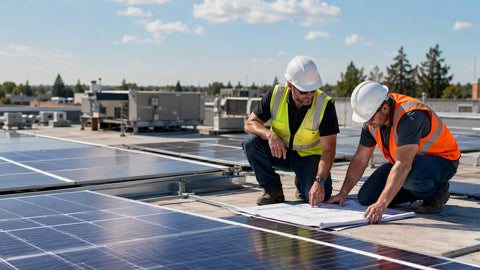
The in-house academy trend is the one to watch. Facing a market that will not supply experienced leads, the larger regional installers have stopped fishing and started farming: structured 90-day programs that take a reliable construction laborer to a productive third-hand, with torque specs, fall protection, and NEC fundamentals taught on mock roofs before a real customer ever sees them. The programs that work share one feature — they pay trainees a living wage from day one, because the alternative is training people who leave for the warehouse job across the street.
What the market is paying in 2026
The BLS median of about $48,800 for solar installers (May 2023 data) badly understates what experienced field talent commands in tight markets. Counter-level reality, drawn from what our contractor customers report paying to keep crews intact:
| Role | BLS/reference frame | 2026 market reality (tight metros) |
|---|---|---|
| Entry installer, first 90 days | ≈ $18–22/hr | $20–26/hr with paid training |
| Experienced installer (2+ yrs) | Median ≈ $23.5/hr | $26–34/hr |
| Crew lead / foreman | Top quartile ≈ $30+/hr | $32–42/hr plus vehicle and perdiem |
| Journeyman electrician (solar focus) | Median ≈ $61,600/yr (all electricians, May 2023) | $38–55/hr; sign-on bonuses common |
| NABCEP PVIP, project lead track | — | $80–110k salaried, commercial side higher |
The retention math underneath those wages is the real story: losing a trained crew lead costs a midsize installer six months of recruiting plus the throughput of every job that lead would have run, and the market knows it. Wages have responded accordingly, which is healthy — a trade that pays attracts a pipeline, and this pipeline needs attracting.
The labor math per megawatt
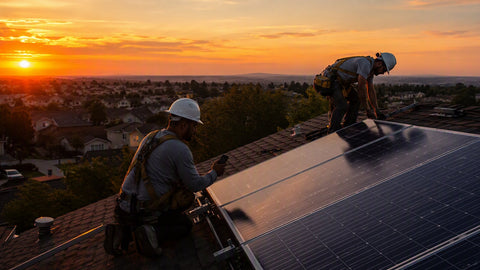
For contractors bidding 2026 work, the planning figures we see holding up in the field: a residential rooftop crew of three to four installs roughly 8–12 kW per day on straightforward comp roofs — call it 30 to 40 labor-hours per kW all-in including electrical. Small commercial ballasted rooftops run 15 to 25 labor-hours per kW; ground mounts with driven piles drop toward 10 to 15. A company targeting 10 MW of residential next year is therefore planning for on the order of 300,000 field labor-hours — roughly 150 full-time field employees before overhead, service work, and the inevitability of weather. Run your own backlog through that arithmetic and the hiring plan writes itself, along with the explanation for why every competitor's yard has a help-wanted banner.
What actually works: notes from the contractor side
We have supplied hundreds of installation companies through boom and tariff cycles, and the ones holding crews together share practices that have nothing to do with ping-pong tables. They pay for certifications — NABCEP exam fees, OSHA 30, first-aid — and they say so in the job post. They publish the promotion ladder: third-hand to lead in writing, with the wage steps printed. They keep winter reasonable with service and repower work instead of February layoffs, because a crew laid off in January is a crew working for someone else in April. And they buy material predictably — the contractor whose jobs never stall for missing parts is the contractor whose crews stop taking recruiters' calls. Predictability is a retention benefit. We see it in the reorder data every single quarter.
For the career-changer reading this
If you are an electrician, a roofer, a veteran, or someone leaving a warehouse job with a strong back and a good attitude: the solar industry needs you more than it needs another sales hire. The fastest credible entry is a paid apprenticeship or an installer academy; the fastest credential signal is the NABCEP PV Associate; the highest-leverage long-term move is the journeyman license, because licensed electricians with solar experience sit at the intersection of the two tightest labor markets in the energy transition. Our EV charging coverage and generator sizing work document the adjacent electrification trades pulling on the same workforce — the skills compound across all of them, and so does the demand.
What homeowners should take from the shortage
The labor crunch reaches customers as calendar and as price. A reputable contractor booked six to ten weeks out is not being dramatic — that is what a staffed pipeline looks like in 2026, and the bid that promises installation next Tuesday deserves more suspicion than gratitude. Verify licensure, ask who supervises the roof, and be wary of bids that only work with untrained labor at unsustainable wages; those crews churn, and churn shows up in torque specs and flashing details. The companies worth hiring are the ones investing in their people, because the people are the product. Our panel kit guide and commercial cost breakdown give useful reference points for what equipment versus labor should each contribute to a quote.
The policy layer: registered apprenticeships and prevailing wage
Licensing Requirements by State
Federal Apprenticeship Requirements
Federal policy has quietly made workforce development a line item in project economics. Prevailing wage and apprenticeship requirements attached to federal clean-energy incentives push commercial-scale projects toward registered apprenticeship programs, which is exactly where the training capacity lives — IBEW/NECA programs, state-registered construction apprenticeships, and their community-college partners. For contractors, this converts training from an optional virtue into bid compliance: the ability to document registered apprentices on a crew increasingly decides which firms can chase incentivized work at all. The firms that built apprenticeship relationships in 2023 and 2024 are now harvesting the bids; the firms that treated it as paperwork are discovering it is a moat they do not own. Our commercial cost guide touches the bid side of that equation.
The untapped workforce the industry keeps missing
Solar's workforce problem is partly self-inflicted, and the fix is sitting in plain sight. Women remain a small minority of installation crews despite no physical or licensing barrier that the industry has any excuse for — the shops that have fixed their PPE sizing, facilities, and crew culture report recruiting advantages their competitors cannot match. Veterans transition into the trade almost seamlessly; the discipline maps one to one, and several training nonprofits exist solely to run that pipeline. Justice-impacted workers represent another pool the trades have historically hired well and solar has hired timidly. And every experienced roofer in America already owns 80 percent of a solar installer's skill set — the remaining 20 percent is the electrical discipline, which is teachable, structured, and exactly what community-college certificate programs exist to deliver. An industry short on people cannot afford to recruit from half the people.
What the equipment side can do — our seat at the table
Distributors are not bystanders in the labor shortage; we are force multipliers or friction, depending on how we behave. The practices that genuinely save crew hours: kitting complete bills of material so a crew never leaves a roof for a missing hold-down kit; pre-cutting and labeling where the job justifies it; stocking the panel tiers, hybrid inverters, and battery lines deep enough that schedules do not slip into the next crew's calendar; and keeping the reference material current — the conduit fill chart, the ampacity guide, and the OCPD guide exist because every hour an apprentice does not spend hunting a table is an hour of crew capacity returned. We also train: counter days, lunch-and-learns on new code cycles, and datasheet walk-throughs for new hires are unglamorous workforce development, and they work.
The 2026–2030 outlook, honestly drawn
Demand-side signals point the same direction: electrification of vehicles and heat, data-center load growth tightening grids, and utility-scale pipelines all keep installation demand climbing while the licensed-electrician pipeline empties faster than it fills. Expect installer wages to keep outpacing general construction wages, expect NABCEP and licensure credentials to command growing premiums, and expect the contractors who invested in training to consolidate share from those who rented it. The wildcard is permitting reform — every hour removed from a permit queue is labor capacity no one had to hire. Jurisdictions piloting instant residential permitting have demonstrated that software can compress weeks to days; spreading that practice is the single cheapest workforce policy available, because it multiplies every existing crew.
Notes for workforce boards and community colleges
For the public institutions designing programs: align to the credential the market actually pays for. Programs that feed directly into NABCEP PVA readiness, OSHA 30, and a state-recognized apprenticeship placement outperform generic "green jobs" curricula every placement season we have watched. Buy modern equipment for the training roof — students should torque their first mid-clamp on the same rail systems they will meet on real jobs, and our racking overview is the kind of current reference that keeps curricula honest. Partner with the contractors who will hire the graduates before writing the curriculum, not after. And schedule cohorts to graduate in spring, when the hiring season actually opens; a December graduate competes with layoff season, and the placement statistics carry that scar for years.
The bottom line for everyone in the chain
The solar workforce crisis is real, measurable, and solvable — but only at the speed of training pipelines, which is to say slowly, which is to say starting now. Contractors: build the academy, publish the ladder, keep winters humane. Career-changers: the credentials compound, and the market is paying. Homeowners: the booked-out contractor with the training program is the one whose crew will still exist when your warranty needs them. And for everyone who touches this industry, the math is the same — the energy transition is a construction project, construction projects are built by people, and people are the shortage. The panels are easy. We have warehouses full of them. What we need is you.
A field note on what one trained installer is worth
Years ago we watched a midsize contractor lose a lead installer to a competitor over a dollar fifty an hour. The departing lead took his crew rhythm with him: the jobs he would have run slipped three weeks while a replacement was hired, two apprentices he was training drifted away within the quarter, and the service backlog aged past the point where customers stayed polite. The controller ran the numbers at year end — recruiting fees, overtime for the surviving crews, one contract penalty, and the marketing spend to replace the referrals that did not happen — and put the total near ninety thousand dollars. For a dollar fifty an hour, times two thousand working hours, the raise would have cost three thousand. Nobody in this industry needs a spreadsheet to understand retention after they have lived that story once, but we keep the story laminated near the counter anyway, because the industry keeps supplying fresh audiences.
The shortage will not be solved by any single program, wage move, or policy. It will be solved the way crews are built: one hire, one apprentice, one training roof at a time, by companies that decided the people were the strategy. Start this quarter. The 2027 backlog is already watching.
And to the apprentice starting Monday morning: learn the torque specs, ask the lead why the rows are laid out the way they are, keep your harness buckled even when nobody is watching, and write down what the inspector corrects. Five years from now the industry will call you the shortage's solution. Act like it from day one.
Twenty years from now the workforce question will look like every skilled-trade question in American history: the shops that trained people will have built institutions, and the shops that poached people will have built turnover. Choose which one you are running now, while the choosing is still cheap.
The cranes, the rails, the inverters — all of it is in stock and ready to ship. The only backorder that matters in 2026 is the human one, and it clears one well-trained installer at a time.
Frequently asked questions
The Solar Workforce Gap: SEIA and IREC Data
Solar Workforce Snapshot
Is there really a solar installer shortage in 2026? Yes. The BLS projects roughly 22 percent growth for solar PV installer employment over 2022–2032 — among the fastest of any US occupation — while the broader solar workforce measured by IREC's jobs census was already near 280,000 workers in 2023 and still short of demand.
How much do solar installers make? The BLS median was about $48,800 per year (May 2023), but experienced installers in tight markets now commonly earn $26–34 per hour, crew leads $32–42 per hour, and journeyman electricians with solar experience $38–55 per hour.
Apprenticeship Program Expansion
Community College Solar Programs
How do I become a solar installer? The main paths are a paid electrical apprenticeship (4–5 years to journeyman), community college energy programs, contractor-run installer academies that pay from day one, and entry through construction labor with NABCEP PV Associate certification as an early credential.
What is NABCEP certification and does it matter? NABCEP is the North American Board of Certified Energy Practitioners, the industry's leading credentialing body. Its PV Installation Professional certification requires documented field experience plus an exam, and it is increasingly required for commercial bids and preferred by quality residential contractors.
Why are electricians such a bottleneck for solar? Service upgrades, interconnections, and code sign-offs require licensed electricians, whose 4–5 year training pipeline cannot accelerate on demand. The BLS projects roughly 73,000 electrician openings per year through 2032, mostly replacing retirees before any new electrification demand is served.
Will automation or AI reduce the need for solar installers? Not meaningfully this decade. Design and permitting software is compressing office hours, but panels still get carried up ladders, torqued onto rails, and wired to code by human beings on physical roofs. The field-labor constraint is structural, not technological.