"Zero grid flow" — often configured as zero export or zero-import mode — is the holy grail of residential energy storage: a home that runs its loads, charges its battery, and consumes its solar while the utility meter sits at 0 watts, neither importing nor exporting. Utilities care because export limits are increasingly a condition of interconnection; homeowners care because a meter pinned at zero means every watt of sunshine gets used on-site at full retail value. I've commissioned systems chasing this behavior on everything from Sol-Ark hybrids to Victron-based off-grid-capable builds, and the honest summary is this: hitting 0W as an average is easy, holding it instant-by-instant is a control-systems problem, and the details decide which you get. Here's how it actually works.
What "0W Grid Flow" Actually Means
At any instant, a home's power balance is simple: solar production plus battery discharge plus grid import equals household load plus battery charging plus grid export. Zero grid flow means the grid terms are both zero — the home is momentarily self-contained, riding on solar and battery alone while remaining grid-connected. That's distinct from three neighboring concepts that get confused with it constantly:
- Zero export — the system never pushes power to the grid, but it still imports when solar and battery fall short. This is the utility-mandated version and the most common configuration.
- Self-consumption mode — the system minimizes grid exchange but tolerates small imports and exports during transitions. Most "zero grid flow" behavior in the real world is actually well-tuned self-consumption.
- Net-zero energy — an annual accounting goal (exports equal imports over a year), unrelated to instantaneous flow. Marketing materials conflate these weekly.
True instantaneous zero — a meter reading of exactly 0.000 kW — is not physically achievable because control loops need error to act. What the best systems deliver is grid flow held inside a tight band, typically ±20 to ±100 watts, with brief excursions during load steps. When a data sheet or installer promises "0W grid flow," ask what the tolerance band and response time are; those two numbers tell you what you're actually buying.
The Measurement Hardware: CTs and Meters
The entire control strategy rests on one measurement: how much power is crossing the utility boundary, right now. Two sensor families deliver it:
| Sensor type | Examples | Accuracy | Cost | Install notes |
|---|---|---|---|---|
| Split-core CT clamps on service conductors | Inverter-bundled 200A CTs (Sol-Ark, EG4, Deye-class) | ±1–2% of reading; poor below ~50W | Included–$150 | Clamp both legs for split-phase; orientation arrows toward the grid |
| Solid-core CTs | High-accuracy revenue-grade CTs | ±0.5% | $80–$250 | Requires disconnecting conductors; electrician territory |
| Dedicated energy meter (Modbus/RS-485) | Carlo Gavazzi EM24/EM340, Acrel, Eastron SDM series | ±0.5–1%, bidirectional, per-phase data | $120–$400 | DIN-rail in or beside the panel; communicates digitally to the inverter |
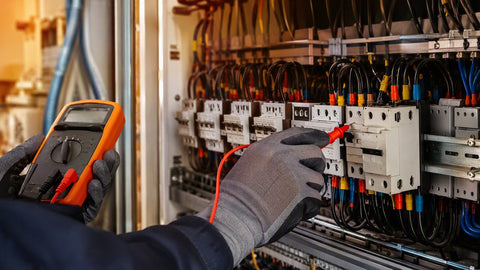
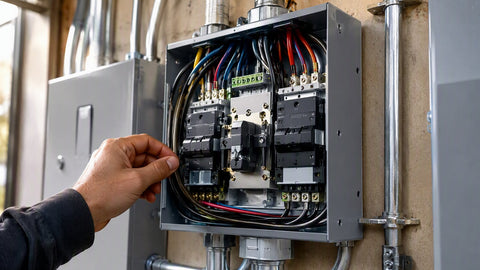
Placement is everything. The CTs or meter must sit at the point of common coupling — typically on the service entrance conductors in or right after the main panel — so the inverter sees the true grid exchange, not a branch-circuit fiction. Reversed CT orientation is the single most common commissioning failure in the field: the system reads import as export, inverts its control response, and chases its own tail, ramping solar curtailment when it should be discharging the battery. I've diagnosed that exact fault over the phone twice this year: if your "zero export" system behaves like a drunk, check the CT arrows first.
The Control Loop: How Fast Is Fast Enough
With measurement in hand, the inverter runs a continuous loop: read grid flow, compare to the target (0W), adjust battery power and solar output, repeat. The physics that determine success are sample rate and actuator speed. A loop sampling at 1 Hz with battery power electronics that slew in under a second can hold a tight band; a system with a cloud-polled meter updating every 30 seconds cannot, full stop — no software update fixes a slow sensor.
| System class | Typical control response | Achievable grid-flow band | Notes |
|---|---|---|---|
| Premium hybrid inverters with hardwired meter (Sol-Ark, Deye/Sunsynk class) | Under 1 second | ±20–50 W steady-state | The reference standard for zero export |
| AC-coupled battery systems (Powerwall-class, Enphase IQ Battery) | 1–3 seconds | ±50–150 W | Grid-forming electronics are fast; control loop latency is the limit |
| PCS-certified zero-export controllers (NEC 705.13) | 1–10 seconds | Certified never-export guarantee | Utility-accepted for export-limited interconnections |
| Retrofit monitor + cloud control | 15–60 seconds | Not suitable | Fine for dashboards, unusable for control |
The real-world test isn't steady-state — it's load steps. Drop a 1,500W microwave on a house idling at zero flow and the grid must bridge the gap for the fraction of a second the battery needs to ramp; kill the microwave and a brief export blip follows while the system catches up. Those transients are normal, and utilities that mandate zero export evaluate them accordingly — what they prohibit is sustained export, not hundred-millisecond overshoot.
Configuration Modes and What Each Buys You
| Mode | Grid import | Grid export | Best for |
|---|---|---|---|
| Self-consumption (default) | Allowed, minimized | Allowed, minimized | Full-retail net metering territories; simplest commissioning |
| Zero export | Allowed | Blocked (beyond brief transients) | Export-limited interconnections; utilities with no net metering |
| Zero import ("grid-tied off-grid") | Blocked while battery lasts | Allowed or blocked | Demand-charge tariffs; maximizing solar+storage value |
| Time-of-use arbitrage | Scheduled (cheap hours) | Scheduled or blocked | TOU rates with big peak/off-peak spreads |
Zero export mode adds a subtle behavior worth understanding: when the battery is full, loads are low, and solar is producing more than the house can absorb, the inverter must curtail — it deliberately throttles solar production to hold export at zero. That curtailed energy is simply foregone. On a system sized for winter, summer curtailment can reach 10 to 20 percent of potential annual production, which is the hidden cost of export blocking and the reason slightly undersizing the array relative to battery and load can out-earn a bigger array that gets throttled.
With a Battery vs. Without: Night and Day
Can a batteryless solar system achieve zero grid flow? Only while the sun shines and only by curtailment — the inverter holds production at exactly the load line, wasting the surplus. The moment a cloud passes or a load spikes, the grid must fill the gap. A battery transforms the economics and the control quality: it absorbs solar surplus instead of curtailing it, covers load steps with sub-second response, and carries the home through evening peaks without import. The comparison in practice:
| Capability | Solar-only, zero export | Solar + battery, zero export |
|---|---|---|
| Daytime solar utilization | Curtailed to load; 10–30% surplus wasted | Surplus charges battery; near-full capture |
| Evening/night grid flow | Full import | Battery serves loads; near-zero import until depleted |
| Load-step handling | Grid bridges every transient | Battery absorbs; smaller, rarer grid excursions |
| Outage behavior | System shuts down (anti-islanding) | Islands and keeps critical loads alive |
| Typical self-sufficiency (avg U.S. home, 10 kW PV) | 25–40% | 60–90% with 13–27 kWh storage |
That last row is the whole ballgame. Solar-only zero export is a compliance configuration; solar-plus-storage zero export is a lifestyle. Our battery sizing calculator and the battery runtime calculator will put your own loads into those ranges, and the battery and energy storage catalog covers the hardware tiers.
Code and Utility Notes: NEC 705.13 and Export Limits
Since the 2020 NEC, Article 705.13 formally recognizes the Power Control System (PCS) — listed equipment that monitors and actively limits current at the service or feeder, which is exactly what a certified zero-export controller does. A listed PCS unlocks real engineering benefits: it can legally justify larger PV systems on existing services (the PCS guarantees the busbar and service conductors never see the overcurrent the 120-percent rule worries about), and many utilities now accept PCS-based export limitation as an interconnection pathway where net metering is capped or unavailable. Sizing still follows NEC 690.8 — inverter output current multiplied by 1.25 for continuous duty — and everything lands in the permit package. Our NEC compliance guide covers the surrounding framework, and the inverter sizing calculator keeps the continuous-duty math honest.
On the utility side: read your interconnection agreement before configuring anything. Some utilities mandate certified zero-export equipment specifically; others allow self-certified settings; a few prohibit even inadvertent export hard enough to specify the tolerance band. Configuring zero export without telling the utility, in territories that require approval, risks the interconnection agreement itself.
Why Homeowners Chase Zero Grid Flow
The motivations are more varied than the installers' brochures suggest. Export economics lead: in markets where exported solar earns 3 to 5 cents against a 16-cent retail import, every exported kilowatt-hour is money thrown away, so holding it on-site is worth real money. Interconnection approval is second — zero export is frequently the only pathway to approval on constrained feeders. Demand charges drive the commercial and some residential cases: shaving the 15-minute peak that sets the month's demand charge can dwarf energy savings. And a growing group simply wants operational independence — the grid as backup, not as master. That last group should know what they're asking for: true zero import through a dark January week requires storage and array sizes that most budgets decline, which is why "near-zero with grid backup" is where good designs land.
Sizing the Battery for Zero-Import Operation
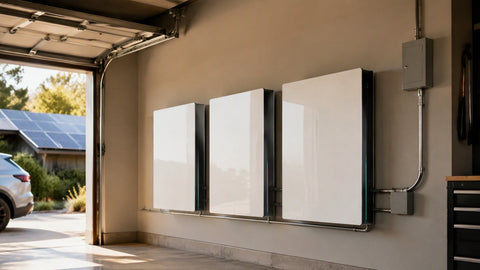
If the goal shifts from "never export" to "rarely import," the battery becomes the sizing problem, and the math is refreshingly simple: overnight consumption in kWh, divided by the depth of discharge you're willing to use, plus a reserve you're unwilling to touch. A home that idles at 400 watts overnight and peaks at 2 kW cooking breakfast burns roughly 6 to 9 kWh between sunset and sunrise; at 90 percent usable depth of discharge on lithium iron phosphate, that's an 8 to 10 kWh battery to reach morning on stored solar — one Powerwall-class unit or a single rack of server-style LFP modules. Add a cloudy-day buffer or an EV that charges at night and the requirement doubles quickly. The discipline that makes it work is load management: the water heater, dryer, and range don't belong on the overnight budget, and most hybrid inverters can shed them automatically when the battery reserve drops below a threshold you set. Commission that shedding logic on day one — I've seen beautifully sized batteries drained by midnight because a 4,500-watt water heater element nobody thought about decided to run.
Monitoring and Verification: Proving Zero
A zero-export system you can't verify is a claim, not a configuration. Three verification habits separate professionals from checkbox installers. First, baseline the meter: with the system commissioned, watch the inverter's grid-flow reading against the utility meter's instantaneous display for ten minutes across varying loads — they should agree within the tolerance band. Second, review the event log after the first week: every quality platform records grid-flow excursions, and a daily pattern of 200-watt export blips at solar noon means your curtailment ramp is too slow, a fixable settings problem. Third, reconcile monthly: compare the inverter's export total against the utility's metered export on the bill. Utility meters are revenue-grade and they don't lie; if yours shows measurable export on a zero-export site, something in the chain — CT, meter, settings, firmware — needs attention before the utility notices it for you. Keep screenshots of your configuration pages with dates. When firmware updates reset settings — and they do — that record turns a week of detective work into a ten-minute restore.
A Day in the Life of a Well-Tuned Zero-Export System
Abstractions aside, here's what 0W grid flow looks like hour by hour in a real home with 10 kW of solar and 20 kWh of LFP storage. At 7 a.m. the house wakes — coffee maker, toaster, a shower reheating the tank — and the battery, sitting at 55 percent after carrying the night, discharges 2 to 3 kW to cover it while the array ramps. Grid flow: zero. By 9:30 a.m. solar passes house load and the surplus flows to the battery instead of the street. Grid flow: zero, plus or minus a few watts. Solar noon brings the day's only drama: the battery hits full at 1:40 p.m., the array could make 9 kW, and the inverter curtails to exactly house load — holding export at zero by deliberately leaving sunshine on the table. Evening is the payoff: the 5 to 9 p.m. peak, with its oven, HVAC, and EV charge session, draws 14 kWh entirely from the battery while neighbors pay peak rates. At 11 p.m. the battery settles at its 20 percent reserve floor and the grid quietly resumes the overnight base load — the one planned exception in an otherwise gridless day. Monthly result: under 5 percent of consumption imported, zero exported, and a utility bill that reads like a vacant house.
Configuration Mistakes That Break Zero Export
The failure patterns repeat across brands, so learn from others' service calls. Reversed CTs, covered above, remain number one. Second place goes to meter placement downstream of a backed-up subpanel — the system optimizes the branch it can see while the service meter happily exports from a circuit it can't. Third is reserve-floor misconfiguration: a zero-import system with its battery reserve set to zero drains itself nightly, then imports through the small hours exactly as it was built not to. Fourth is enabling export limiting without disabling the utility-interactive sell function — some firmware treats these as separate toggles, and I've audited one site that "limited" export while a legacy sell-to-grid schedule kept running every afternoon. Fifth is ignoring the tolerance band setting entirely; the factory default on some platforms is a generous 100 watts, which on a strict interconnection is a compliance problem wearing a costume. None of these are hardware faults. All of them are commissioning discipline, which is why the verification habits above matter more than any spec sheet.
What a Zero-Export System Costs
Budget honestly for the full chain, because the inverter is only part of it. A premium hybrid inverter with native export limiting runs $3,000 to $7,000; the battery that makes the mode worthwhile adds $6,000 to $15,000 for 10 to 20 kWh of LFP storage; the meter or CTs are usually included but figure $150 to $400 when they're not; and installation plus commissioning — including the tuning sessions this article describes — typically adds $2,000 to $5,000 depending on panel work and utility paperwork. All-in, a solar-plus-storage zero-export build lands between $18,000 and $35,000 for most homes before incentives. State programs and utility storage rebates can still take a real bite out of that even with the federal residential credit gone, so check current programs before you finalize the budget.
Practical Limitations and Tuning
Commissioning a zero-export system to actually hold zero takes more than checking a box. Expect to tune: minimum battery reserve (set too low and the system imports during overnight depletion; too high and you strand capacity), solar curtailment ramp rates, and the control band width itself. Expect small standing flows — many systems idle at a deliberate 20 to 50 watt import as a safety margin against accidental export. Expect seasonal drift as production and load profiles swing. And expect the occasional legitimate failure: a failing CT, a meter communication dropout, or a firmware update that resets your carefully tuned settings. Log your config. I've been burned once by a firmware reset that re-enabled export on a zero-export-mandated site; the utility noticed before the customer did, and the recertification paperwork was an education I didn't need twice.
Frequently Asked Questions
Is a battery required to achieve zero grid export?
No — zero export can be achieved by solar curtailment alone, with the inverter throttling production to match the load. But without a battery, surplus solar is wasted, evenings run fully on the grid, and every load transient pulls from the utility. A battery converts zero export from a compliance exercise into genuine self-sufficiency, typically lifting self-consumption from 25–40 percent to 60–90 percent.
Where exactly does the CT clamp need to be installed?
At the point of common coupling — on the service entrance conductors at or just after the main panel — so the inverter measures true grid exchange rather than a branch circuit. For split-phase 120/240V services, clamp both legs or use a meter measuring both, and mind the orientation arrows: a reversed CT reads import as export and inverts the entire control response.
Can zero export mode cause the system to trip or malfunction?
Correctly commissioned, no. Poorly configured systems can oscillate — over-curtailing then releasing, hunting around the setpoint — and a failed or reversed CT can cause erratic battery and solar behavior. Quality hybrid inverters with hardwired meters hold a steady band; cloud-polled monitoring add-ons should never be used as the control sensor.
Do all utilities allow zero export configurations?
Most do, and many constrained feeders effectively require it, but the rules vary: some utilities mandate listed PCS equipment certified under NEC 705.13, some accept inverter-native settings, and some specify the permissible tolerance band and transient behavior. Always configure within your signed interconnection agreement — unapproved configuration changes can jeopardize it.
How fast does a zero-export system respond to changing loads?
Premium hybrid inverters with hardwired meters adjust battery and solar output in under a second, holding grid flow within roughly ±20–50 watts steady-state. AC-coupled battery systems typically respond in one to three seconds. Brief excursions during large load steps — a microwave or well pump starting — are normal and acceptable; sustained export is what export limits prohibit.
Design a System That Actually Holds Zero
Zero grid flow is a system property, not a feature checkbox: a fast hardwired meter at the service, a hybrid inverter with a sub-second control loop, a battery sized to your evening loads, and settings tuned to your tariff and interconnection agreement. Get those four right and your meter becomes the quietest appliance in the house. Explore battery storage options, hybrid inverters, and even EV chargers that can join the load-management picture; read how the underlying hardware behaves in our hybrid inverter guide and Sol-Ark brand guide; and when you're ready to spec a zero-export build around your utility's exact rules, request a quote — we design to the interconnection agreement, not the brochure.