Section 232 Polysilicon Tariffs Hit Solar: What August 2026 Means for Your Inventory
The Trump administration's Section 232 action on solar-grade polysilicon and its derivatives landed August 6, 2026. Here's what it covers, who it hurts, who it helps, and what your Q4 procurement should look like.
The Trump administration's Section 232 tariffs on solar-grade polysilicon and derivative products were announced August 6, 2026. If you're wondering whether this affects the modules sitting in your warehouse — it does. If you're wondering whether it affects the modules you're quoting for Q4 — it really does.
Here's the situation. The Department of Commerce action uses the same Section 232 authority that hit steel and aluminum back in 2018, but aims it at the base of the solar supply chain. Polysilicon is the raw material that becomes ingots, wafers, cells, and ultimately modules. The U.S. has roughly 3 GW of domestic cell capacity right now against roughly 60 GW of announced module manufacturing. That math doesn't work without imported upstream material — which means this tariff touches every domestic crystalline-silicon module maker to some degree, and every buyer who thought domestic assembly meant tariff immunity.
Our deeper compliance guide — Section 232 Solar Tariffs & Minimum Import Prices: The December 4, 2026 Deadline — walks the full proclamation line by line, including the minimum import price floors and the HTS codes. This article is the operator's summary: what changed, what it costs, and what to do about it this quarter.
The action applies to solar-grade polysilicon and "derivative products" — and the scope statement from SEIA on August 6 called that scope "incredibly broad." Read together with the implementing Federal Register notice, the coverage runs the full crystalline chain:
| Product Tier | HTSUS Subheading(s) | Treatment |
|---|---|---|
| Solar-grade polysilicon | 2804.61.0000 | MIP floor only ($21.00/kg) |
| Silicon ingots & wafers | 3818.00.0020 / .0040 / .0045 / .0050 / .0091 | MIP floor ($100.00/kg) + ad valorem |
| Solar cells | 8541.42.0010 / .0080 | MIP floor ($0.22/W) + ad valorem |
| Solar modules | 8541.43.0010 / .0080 | MIP floor ($0.38/W) + ad valorem |
Our read: this isn't a targeted 10% adjustment. This is a structural tariff designed to re-price the entire crystalline-silicon supply chain entering the U.S. Several module manufacturers we work with have already paused expansion announcements pending clarity on whether their imported wafer supply qualifies as a covered derivative product.
Two mechanisms stack here, and confusing them is the most expensive spreadsheet error you can make this quarter. The minimum import price (MIP) sets a floor: if the first arm's-length sale for export to the U.S. is below the floor, the difference becomes a specific duty at entry. The ad valorem duty applies on top for ingots, wafers, cells, and modules — raw polysilicon is MIP-only.
| Country / Group | Ad Valorem Rate | Note |
|---|---|---|
| General (all other origins) | Additional 15% | Stacks on Column 1 and any AD/CVD |
| United Kingdom | 10% | Flat negotiated rate |
| EU, Japan, Korea, Taiwan, Switzerland, Liechtenstein | 15% combined | Column 1 + Section 232 together total 15% — not 15% on top |
Fixed-term contracts signed before August 6, 2026 can be certified at entry to escape the MIP floor — which is why every procurement team we know spent mid-August pulling contract files. Pre-existing contracts do not escape the ad valorem layer.
Global benchmarks heading into August: polysilicon near $5.27/kg, cells near $0.058/W, and modules in a $0.07–0.25/W global band depending on origin and technology, with recent U.S.-delivered TOPCon pricing reported at $0.27–0.32/W. Set those against the floors and the direction is obvious:
| Product | Recent Global Price | MIP Floor | Implied Uplift |
|---|---|---|---|
| Polysilicon | $5.27/kg | $21.00/kg | +298% |
| Solar cells | $0.058/W | $0.22/W | +279% |
| Modules (low end) | $0.07–0.25/W | $0.38/W | +52% to +443% |
| Modules (recent U.S. TOPCon) | $0.27–0.32/W | $0.38/W | +$0.06–0.11/W |
Translate that to the unit everyone actually buys: a pallet of 31 × 450W modules (13.95 kW) picks up roughly $837–$1,534 in additional cost from the MIP delta alone, before the 15% ad valorem. An 8 kW residential system (~18 modules) absorbs roughly $960–$1,200 of combined impact. And none of that touches Southeast Asia-origin AD/CVD exposure, where Cambodia's worst-case combined rate runs into four digits. These are our computations from the proclamation's thresholds and reported market pricing — illustrative, not a quote.
Domestic module manufacturers with imported wafers: Most U.S. module factories rely on imported wafers and cells. If those inputs are tariffed, the cost advantage of domestic manufacturing shrinks — potentially toward zero. We've heard from two manufacturers in the last week that they're reconsidering 2027 capacity additions.
Developers who safe harbored domestic-content modules: The domestic content bonus requires a rising share of domestic manufactured product by cost. If imported polysilicon gets tariffed and domestic polysilicon can't scale fast enough, the math on that threshold gets messy. Developers who banked on the 10-point domestic content adder may find their module BOM no longer qualifies — a nasty surprise layered on top of the July 4 safe harbor scramble.
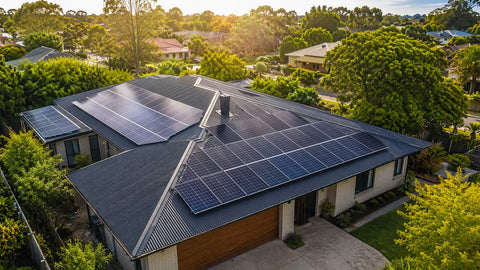
Residential installers: Module prices had been falling — $0.34/W in Q1 2026, down from $0.43/W a year earlier. This tariff reverses that trend for anything crystalline. If you're selling on price, your competitive window just narrowed.
REC Silicon (Moses Lake, WA) and Hemlock Semiconductor (Michigan): The two major U.S. polysilicon producers have run at reduced capacity for years because Chinese polysilicon undercut them. A Section 232 floor at $21/kg changes that equation overnight, and both have been positioning for exactly this restart.
Module makers with fully domestic supply chains: First Solar is the obvious structural winner — its CdTe thin-film technology doesn't use crystalline silicon at all, so polysilicon tariffs are irrelevant to its cost stack. Qcells (Georgia) and Silfab (Washington), which have invested in U.S. wafer and cell capacity rather than assembly-only, are better positioned than peers importing wafers into U.S. laminating lines.
| Period | Residential Module Benchmark | Driver |
|---|---|---|
| Q1 2025 | $0.43/W | Post-201 safeguard regime; softening demand |
| Q1 2026 | $0.34/W | Global oversupply, Section 201 expiry Feb 7, 2026 |
| Post–Dec 4, 2026 (modeled) | $0.38/W floor + 15% ad valorem | Section 232 MIP regime at entry |
The six-month window between the Section 201 safeguard expiring (February 7, 2026) and Section 232 arriving (December 4, 2026) was the cheapest module procurement window in a decade. That window is closing. The warehouses are the last place the old prices live.
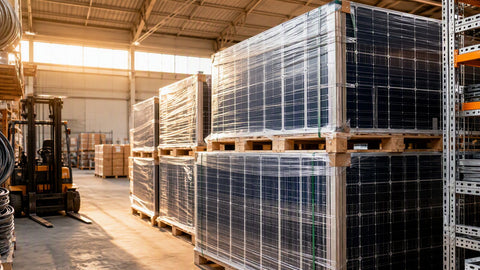
We've locked in Q3 pricing on our Qcells, Silfab, and VSUN modules. That inventory is in U.S. warehouses now and won't be repriced. For Q4, we're negotiating volume commitments with manufacturers holding the most domestic content in their supply chains, and we're deepening positions in U.S.-made panels across residential and commercial formats.
We're also watching the FEOC guidance closely. Treasury is expected to publish full foreign-entity-of-concern rules later this year, and the overlap between FEOC and Section 232 could create a compliance tangle for manufacturers trying to qualify for 45X manufacturing credits and domestic content adders simultaneously. If you're a developer counting on those credits, our advice mirrors what we said during the safe harbor run: document origin early and safe-harbor sooner rather than later.
Your August–September checklist:
- Pull every open PO and flag covered HTS codes — 2804.61, 3818.00, 8541.42, 8541.43.
- Identify pre-August 6 contracts and get the certification paperwork ready; they escape the MIP floor but not the ad valorem.
- Re-price Q4/Q1 quotes now. A $0.10/W swing on a 500 kW commercial job is $50,000. Don't let your sales team quote September prices into a December regime.
- Ask suppliers for origin documentation down to the polysilicon tier, not just "assembled in USA."
- Compare against the old playbook. The 2018 Section 201 rollout taught the same lesson: entry date, not purchase date, controls the duty.
I've been through four tariff regimes at this company — 201, 301, the AD/CVD rounds, and now 232 — and the pattern has never changed: the buyers who reprice in the first 30 days keep their margins, and the buyers who wait for "clarity" spend the next year explaining cost overruns. I've already had two installers call this week asking if they can return Q3 quotes to customers at the old numbers. They can't. Nobody can.
The bottom line: this tariff isn't a one-time price bump. It's a permanent structural cost added to every crystalline-silicon module made with imported upstream material. For the next 12–18 months, expect pricing volatility as manufacturers reconfigure supply chains and domestic polysilicon ramps back up. If you've got a project in procurement right now, our advice is simple: buy what you can at today's pricing. The modules in our warehouse don't know about Section 232.
The structural problem this tariff exposes in one table — U.S. capacity by supply-chain tier against U.S. module demand:
| Supply-Chain Tier | U.S. Capacity (mid-2026, approx.) | Gap vs ~60 GW Module Output |
|---|---|---|
| Polysilicon | Restarting — REC Silicon and Hemlock ramping from reduced rates | Years of underinvestment to unwind |
| Ingots & wafers | Minimal; a handful of announced projects | Nearly total import dependence |
| Cells | ~3 GW operating | ~95% of module feedstock imported |
| Module assembly | ~60 GW announced/operating | Capacity exists — feedstock doesn't |
That pyramid is the whole story. You cannot run 60 GW of module lines on 3 GW of domestic cells, and you cannot run domestic cell lines on wafers that don't exist. Every layer below module assembly is import-dependent, which is why a polysilicon tariff propagates downstream with interest. It's also why the minimum import price floors — not the headline ad valorem rate — are the mechanism that actually bites.
Take a standard high-volume module bought at $0.30/W contract price (a realistic mid-2026 entry value) and run it through the December 4 regime three ways:
| Entry Scenario | MIP Duty | Ad Valorem (15%) | Total Added per Watt |
|---|---|---|---|
| Clear customs before Dec 4, 2026 | — | — | $0.00/W |
| Enter after Dec 4 with certified pre-Aug 6 contract or first-sale ≥ $0.38/W | — | $0.045/W (15% × $0.30) | $0.045/W |
| Enter after Dec 4, no documentation | $0.08/W ($0.38 − $0.30) | $0.045/W | $0.125/W |
On a 500 kW commercial project, the difference between row one and row three is $62,500 — on a 10 MW utility block, $1.25 million. Documentation is worth roughly $0.08/W all by itself. On a 2 MW order we modeled the week the proclamation dropped, the duty delta exceeded freight, broker fees, and warehousing combined; paper is now the most valuable thing in the container.
Fixed-term contracts signed before August 6, 2026 escape the MIP floor when certified at entry — the single most valuable exemption in the proclamation. Three details decide whether yours qualifies. First, "fixed-term" means real commercial terms: price, volume, and duration committed, not an MOU or a pricing email. Second, the certification happens at entry — your customs broker files it, which means your broker needs the documents before the vessel arrives, not after the exam hold. Third, the exemption covers the floor only; the ad valorem layer applies regardless. I spent the second week of August redlining "price subject to change" riders out of certification packages, because a contract with a floating price is not a fixed-term contract and CBP will not pretend otherwise.
The manufacturer reactions we've tracked since August 6 fall into three buckets. The integrators — Qcells with its Georgia cell ambitions, Silfab pushing domestic cell capacity — are accelerating upstream timelines, because every tier they bring onshore removes a tariffed input from their BOM. The assemblers — plants that laminate imported cells into U.S.-branded modules — are quietly repricing 2027 and asking suppliers whether wafers count as covered derivatives, because their entire cost advantage hangs on the answer. The thin-film camp is simply taking orders: First Solar's CdTe line sits outside the crystalline scope, and every crystalline tariff dollar makes its Series modules more competitive on utility bids.
For buyers, the implication is practical: the SKU-level tariff exposure now varies inside a single brand's catalog. Two modules with the same badge can carry different duty loads depending on where the cell and wafer tiers sit. That's why our quotes now carry origin documentation down to the wafer tier — a habit we picked up the hard way during the AD/CVD rounds, and one we wish the whole industry had adopted before December got this close.
Between now and December 4, the operators we respect most are running the same play: front-load stateside inventory, back-load import commitments. Take delivery of what you can from U.S. warehouses at today's prices — that product cleared customs before the regime existed. Push new import POs into Q1 2027 with MIP-adjusted pricing already in the pro forma, so the December quote you give a customer survives contact with February delivery. And hold a domestic-content option in reserve for every bid, because the projects chasing ITC adders will pay the premium that tariffed imports no longer undercut.
Watch the warehouse numbers too: if the industry front-loads imports ahead of December 4 the way it did before the 2018 safeguard, expect a Q1 2027 air pocket in new orders and aggressive discounting on anything landed early. The buyers who kept powder dry in late 2018 bought the best module prices of that cycle in Q1 2019. History doesn't repeat exactly, but in this trade it rhymes on a four-to-eight-year beat.
The compliance headache compounding this tariff is the overlap with foreign-entity-of-concern restrictions. Section 232 cares about where your polysilicon and cells were made; FEOC rules care about who owns and controls the companies that made them. A module can clear the tariff regime cleanly and still poison a project's tax-credit eligibility if a prohibited foreign entity sits anywhere in the material-assistance chain. Manufacturers are now running two parallel documentation tracks — one for customs, one for Treasury — and the ones with fully domestic or allied-nation supply chains are the only ones whose paperwork is simple on both sides.
Our standing advice to developers: request the FEOC attestation and the origin certificate in the same email, from the same supplier contact, on the same day. The suppliers who answer both promptly are the supply chains you want. The ones who go quiet on the FEOC half are telling you something the price list won't.
Whatever happens with rates and exemptions, the strategic picture is set: the U.S. has now committed, across three administrations and four distinct statutes, to making imported crystalline-silicon supply chains progressively more expensive. You can disagree with the policy and still plan around the reality. The distributors, developers, and installers who internalized that after 2018 built the supplier relationships that are paying off now. The ones still waiting for the old normal to return have been waiting eight years — and the December 4 floor says they'll be waiting longer. The calendar is the strategy now. Every quote written this quarter should carry the December 4 assumption explicitly, in writing, so there are no surprises on either side of the table. The teams that win this cycle will be the ones whose paperwork was ready before the ships arrived — that has been the dividing line in every tariff round we've supplied through, and this one will be no different. Every week between August 6 and December 4 is a procurement decision whether you make one or not — and the importers who treat the window as working time, rather than waiting time, will own the pricing advantage into 2027.
What is the Section 232 polysilicon tariff?
A trade action under Section 232 of the Trade Expansion Act of 1962, proclaimed August 6, 2026, imposing minimum import prices on polysilicon ($21/kg), ingots and wafers ($100/kg), cells ($0.22/W), and modules ($0.38/W), plus ad valorem duties of 10–15% on ingots, wafers, cells, and modules. It takes effect at entry on December 4, 2026.
Do the tariffs apply to modules assembled in the USA?
Only to their imported covered inputs. A U.S.-assembled module using imported wafers or cells carries the tariff burden on those components at their entry; fully domestic supply chains — and thin-film technology like First Solar's CdTe — sit outside the crystalline scope entirely.
Are my existing contracts exempt?
Partially. Fixed-term contracts entered before August 6, 2026 can be certified at entry to avoid the minimum-import-price duty. The ad valorem duty still applies. Get the certification documentation from your supplier now, not in December.
Which manufacturers are best positioned?
First Solar (thin-film, outside scope), Qcells (Georgia, deep U.S. integration), and Silfab (Washington, domestic cell ambitions) are structurally advantaged. Assembly-only plants relying on imported wafers face the hardest math.
How does this interact with Section 301 and AD/CVD duties?
Section 232-covered solar products are excluded from the July 2026 Section 301 forced-labor duties — no stacking there. But AD/CVD orders on Southeast Asian solar products remain in force and stack on top of Section 232 for those origins.
What should residential installers do right now?
Lock Q4 pricing on in-stock, stateside inventory; re-quote anything scheduled for December or later delivery; and shift your value pitch from price-per-watt to availability and domestic content, because price-led selling gets harder at a $0.38/W floor.
Need Module Pricing for Q4?
We'll hold pricing on in-stock inventory and flag any SKU subject to repricing. Domestic-content and standard modules are in U.S. warehouses now.
Browse Solar PanelsRequest a quote or call (502) 790-0600. Related reading: Section 232 Minimum Import Prices — the December 4, 2026 compliance guide and how Section 301 hit inverters and BOS.