Updated September 2026 — content reviewed and refreshed by the PES team. For current pricing and availability, see the linked product pages or request a quote.
The question sounds academic — when is a storage battery installed in the circuit of a solar energy system? — but on real jobs it is the single design decision that determines the architecture of everything else. The battery's position in the circuit dictates which inverter you buy, how the system behaves in an outage, whether you can retrofit it later, and what the inspector expects to see. We design and supply all three architectures weekly — DC-coupled, AC-coupled, and battery-first off-grid — and this guide walks each one with the sizing math and component tables to spec the system correctly.

Where the Battery Sits: The Three Circuit Architectures
DC-Coupled: Battery on the DC Bus
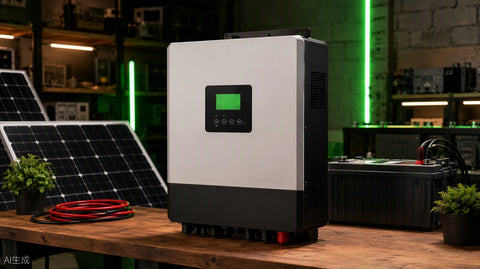
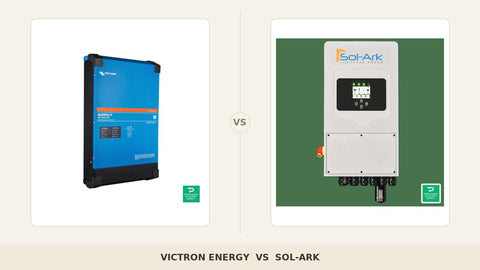
In a DC-coupled system, the battery hangs on the DC side of a hybrid inverter, sharing the bus with the solar array. Solar charges the battery directly as DC; only one inversion happens on the way to your loads. Round-trip efficiency runs 95–98%, and the whole system — solar, battery, grid, generator input — is orchestrated by one box. This is the architecture we spec for new builds and whole-home backup: one inverter, one monitoring platform, one warranty conversation. Units like the Sol-Ark 8K and the EG4 hybrid line are the modern reference points.
AC-Coupled: Battery Behind Its Own Inverter
In an AC-coupled system, the battery carries its own inverter and connects on the AC side — anywhere downstream of the main panel, which is why it is the retrofit architecture. Existing solar stays untouched; the battery system senses the grid, charges from excess solar (or the grid), and discharges when needed. The price of flexibility is efficiency: solar energy inverts twice on its way into the battery and once more on the way out, for round-trip efficiency around 90%. The Powerwall 2 is the canonical example. AC coupling is also how you stack multiple batteries across different subpanels.
Battery-First: Off-Grid and Standalone Systems
Off-grid flips the logic: the battery is the heart of the circuit, and everything else — solar through a charge controller, generator through the inverter/charger's AC input — exists to keep it charged. NEC Article 710 governs standalone systems. Here the battery bank is sized first, the array is sized to refill it, and the inverter is sized for the loads. Get the bank wrong and no amount of panel wattage saves the design.
| Attribute | DC-Coupled | AC-Coupled | Off-Grid (Battery-First) |
|---|---|---|---|
| Round-trip efficiency | 95–98% | ~90% | 92–96% (system-dependent) |
| Best use case | New solar + storage installs | Retrofits onto existing solar | No-grid and weak-grid sites |
| Inverter count | One hybrid | Solar inverter + battery inverter | Inverter/charger (often stacked) |
| Retrofit difficulty | Requires inverter swap | Minimal — no array changes | N/A (standalone design) |
| Black-start capability | Yes (most hybrids) | Yes (gateway-dependent) | Yes — fundamental to design |
| Grid outage behavior | Seamless transfer via hybrid | Gateway islands the home | Always islanded |
| Code framework | NEC 690, 705, 706 | NEC 705.12 interconnection, 706 | NEC 710, 706 |
How Solar Batteries Work Within the Circuit
Whichever architecture, the battery does four jobs: it absorbs solar energy that exceeds instantaneous load, it supplies loads that exceed instantaneous solar, it stabilizes the DC bus or AC waveform as the reference source, and — with the right transfer equipment — it islands the building when the grid fails. The battery management system (BMS) is the traffic cop: it watches cell voltages, temperatures, and current, enforces charge and discharge limits, and talks to the inverter over CAN or Modbus. A closed-loop BMS-inverter pairing is worth real money; it prevents the overcharge and over-discharge events that quietly age a bank. When we kit systems, matched BMS communication is on the checklist next to voltage and capacity — a battery the inverter cannot talk to is a battery that gets babied or abused by generic charge settings.
Types of Solar Battery: Chemistry Comparison
Chemistry choice sets cycle life, safety margin, footprint, and cost. The 2026 field:
| Attribute | LiFePO4 (LFP) | NMC Lithium | AGM Lead-Acid | Flooded Lead-Acid |
|---|---|---|---|---|
| Cycle life (to ~80% capacity) | 6,000–10,000 | 2,000–5,000 | 500–1,200 | 800–1,500 |
| Recommended DoD | 90–100% | 80–95% | 50% | 50% |
| Round-trip efficiency | 95–98% | 92–96% | 80–85% | 75–85% |
| Thermal stability | Excellent | Good (BMS-dependent) | Good | Good (venting required) |
| Maintenance | None | None | None | Watering, equalization, ventilation |
| Energy density | Moderate | High | Low | Low |
| Usable cost per kWh-cycle | Lowest | Low-moderate | High | Moderate-high |
| Typical format | Server-rack, wall-mount modules | Integrated all-in-one | 12V blocks | 2V/6V/12V cells |
| Where it fits | Daily cycling, off-grid, DIY banks | Compact backup units | Small backup, gate/RV duty | Budget off-grid with maintenance appetite |
Our default recommendation for anything cycling daily is LFP, full stop — the cycle-life math is not close. Lead-acid still earns its place in small standby systems where the battery sits at float for months; at 30 cycles a year, a 1,000-cycle AGM bank lasts as long as the electronics around it, at a third of the upfront cost. Browse the current inventory: LiFePO4, AGM, server-rack batteries, and 48V banks.
Sizing the Battery: The Math That Actually Gets Used
Battery sizing is energy arithmetic plus one power check. The energy side: multiply your daily consumption (kWh) by days of autonomy, divide by usable depth of discharge, divide by round-trip efficiency if charging from solar, then divide by system voltage to get amp-hours. The power side: the bank's discharge rate (C-rate) and the inverter it feeds must cover your peak simultaneous load. A 10 kWh LFP battery at a 0.5C continuous rating delivers 5 kW — enough for essentials, not enough for two air conditioners.
| Design Scenario | Daily Load | Autonomy Target | DoD Assumed | Required Nameplate Capacity |
|---|---|---|---|---|
| Essential-loads backup | 6 kWh | 1 day | 90% LFP | 6.7 kWh → one 5–10 kWh module |
| Essential backup, 2-day storm margin | 6 kWh | 2 days | 90% LFP | 13.3 kWh → one 13.5 kWh unit or two 5 kWh modules |
| Off-grid cabin | 8 kWh | 2 days | 80% LFP | 20 kWh → four 5 kWh rack modules |
| Off-grid home with workshop | 20 kWh | 2 days | 80% LFP | 50 kWh → ten 5 kWh modules |
| Whole-home backup with HVAC | 30 kWh | 1 day (solar refills daily) | 90% LFP | 33 kWh → 27–40 kWh installed stack |
| AGM standby (rare cycling) | 4 kWh | 1 day | 50% AGM | 8 kWh → eight 100Ah 12V blocks at 48V |
Worked example, the way we do it on a call. A customer wants overnight backup for essentials drawing 6 kWh between sunset and sunrise, with a one-storm-day margin: 6 kWh × 2 days = 12 kWh of energy needed. At 90% usable DoD on LFP: 12 ÷ 0.9 = 13.3 kWh nameplate. At 48V that is 13,300 ÷ 48 ≈ 277 Ah — call it 280 Ah, which is conveniently one popular server-rack format (a 51.2V, 280Ah module in the Fortress eFlex class at 5.4 kWh each would need three in parallel). Check the power side: 6 kWh spread over 14 night hours averages 430W, trivial for the bank — but if a well pump with a 2,800W surge is on the list, the inverter and the bank's discharge rating must both cover it. The battery bank sizing guide, off-grid sizing article, and sizing calculator walk this same math interactively, and how many batteries for a 4,000W system answers the most common variant of the question.
Grid-Tie vs. Off-Grid: How the Battery's Role Changes
On-grid, the battery is an optimization layer: it time-shifts solar into evening peak rates, provides backup during outages, and in some markets sells grid services. Off-grid, the battery is the system — voltage reference, surge source, and night-shift all at once. The practical differences that reach the wiring: grid-tied storage needs UL 1741 SB inverter behavior, NEC 705.12 interconnection compliance, and usually a gateway or transfer device; off-grid needs a charger for every source (solar MPPT, generator AC input), a low-frequency-capable inverter for motor surges, and generator support sized to refill the bank in a few hours, not a day. Our energy storage system overview covers the on-grid side; for off-grid charge control, see the charge controller sizing guide.
How to Add a Battery to an Existing Solar System
The retrofit path, step by step. First, confirm the existing system's inverter situation — if it is a standard string inverter, you are AC-coupling (or replacing it with a hybrid). Second, pick the coupling: AC-coupled battery for minimal disruption, hybrid inverter swap for better efficiency and single-box monitoring. Third, verify panel capacity: NEC 705.12's 120% rule decides whether the battery's inverter can land in your existing main panel or needs a supply-side tap. Fourth, permit and inspect — storage permits now routinely include NEC 706 documentation, UL 9540 listings for the ESS, and clearances (3 feet between units and from openings is the common AHJ baseline). Fifth, commission and program: charge windows, reserve percentages for backup, and TOU schedules are where the actual savings get configured. The battery installation guide covers the physical sequence.
How Long Do Solar Batteries Hold a Charge — and Hold Up?

Two different questions get tangled here. Shelf charge: a lithium bank in storage loses roughly 1–3% per month to self-discharge plus BMS standby draw; lead-acid loses 3–5% per month and sulfates if left discharged. Service life: LFP banks routinely deliver 6,000+ cycles — 15+ years of daily cycling — while NMC all-in-ones are typically warranted 10 years to 70% retained capacity, and AGM gives 3–7 years depending on depth of discharge discipline. The habits that protect lifespan are boring and effective: keep the bank between 32°F and 95°F (charge below freezing only with heaters or BMS low-temp protection), avoid living at 100% or 0% state of charge for weeks at a time, and follow the battery life extension practices. For daily-cycling banks, keeping the working window between roughly 20% and 80% state of charge measurably slows degradation — the cells spend their life in the gentle middle of the voltage curve. Pure-backup systems play by different logic, though: during storm season, keep the reserve at 100%, because a half-full backup battery is half a backup. The smart compromise most modern systems support is a scheduled seasonal change — cycling windows in spring and fall, full reserve when the forecast threatens.
Warranty, Safety, and What to Verify Before You Buy
Read the warranty like an engineer: years, cycles, energy throughput (MWh), retained-capacity guarantee, and — critically — whether the warranty requires internet connectivity and approved inverter pairing. Many do; an offline battery can be an unwarrantied battery. On safety, the 2026 baseline is a UL 9540-listed energy storage system with 9540A thermal runaway test data, installed with the clearance and ventilation its listing specifies. Garage installs need vehicle-impact protection. Outbuildings need temperature management. And every bank needs a Class T or equivalent fuse within inches of the positive terminal — a 48V lithium bank can deliver 10,000+ amps into a dead short, and the fuse is the only thing between a wrench slip and a fire. We fuse every bank we kit, no exceptions; I have seen the aftermath of one that was not, and once is enough for a career.
Benefits of Pairing Solar and Storage
The paired system earns in three directions at once: resilience (outages become non-events), economics (self-consumption and TOU arbitrage typically capture 20–40% more value than solar-only in high-rate territories), and grid independence (generator runtime drops 80%+ when the battery carries the first hours of every outage). Payback math varies by rate structure, so run your utility tariff through the ROI calculator — in TOU markets the battery often becomes the best-returning component in the whole system. For complete packages, our battery backup kits and hybrid storage systems bundle the matched components, and charging-time questions like how long a 200W panel takes to charge a 12V 100Ah battery have their own deep-dives.
C-Rate: The Spec Everyone Skips
Capacity gets the marketing; discharge rate does the work. A battery's C-rate expresses how fast it can deliver its energy: a 10 kWh battery at 0.5C continuous delivers 5 kW, at 1C delivers 10 kW. Two batteries with identical kWh on the label can differ by 2× in usable power — and the difference shows up exactly when the well pump and the microwave collide during an outage. The check takes thirty seconds: divide the battery's continuous discharge watts by its usable kWh, and compare the result against your peak simultaneous load.
| Bank Size (usable) | 0.5C Continuous Output | 1C Continuous Output | What That Covers |
|---|---|---|---|
| 5 kWh | 2.5 kW | 5 kW | Essentials only at 0.5C; essentials + one motor load at 1C |
| 10 kWh | 5 kW | 10 kW | Essentials + well pump; whole home minus HVAC at 1C |
| 15 kWh | 7.5 kW | 15 kW | Most homes including a mini-split |
| 20 kWh | 10 kW | 20 kW | Whole home with managed HVAC |
| 40 kWh | 20 kW | 40 kW (inverter-limited) | Whole home unmanaged; inverter becomes the bottleneck |
Note the last row: past a point, the inverter — not the battery — limits output. Stacking batteries adds energy and available current, but the inverter's kW rating is the ceiling the loads actually see. Size the two together, and check surge ratings on both sides of the pair.
Location, Clearances, and Code on Install Day
Physical placement has quietly become one of the most-inspected parts of residential storage. The baseline most AHJs enforce: UL 9540-listed equipment installed per its listing, individual units separated per the manufacturer (36 inches is the common number), clearance from doors, windows, and combustible appliances, and vehicle-impact protection in garages — a bollard or wheel stop, not good intentions. Outdoors, units need the weather rating on their label and shade from direct summer sun where possible; thermal management works harder and batteries age faster on a west-facing wall in Phoenix. Indoors, many jurisdictions now restrict placement in sleeping rooms and require smoke detection in the battery room. None of this is red tape for its own sake — it is the distillation of a decade of thermal-event data — and it is far cheaper to design around than to relocate after a failed inspection. We have moved exactly one battery post-inspection in the last two years, and the customer paid for the same wall twice. Measure the clearances before the anchors go in.
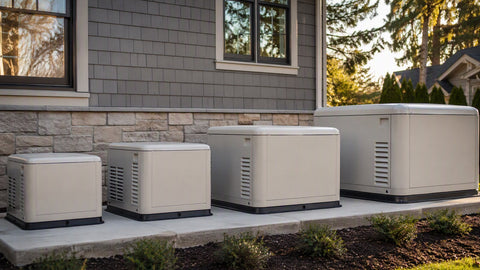
Generator Pairing for Off-Grid and Backup Banks
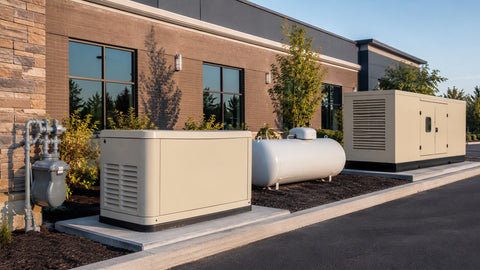
A battery bank without a recharge plan is a countdown timer, and for off-grid and extended-outage duty the recharge plan of record is still a generator. The pairing rules: size the generator to the inverter/charger's acceptance rate — a 48V bank charged at 100A DC wants roughly 6–7 kW of generator after charger efficiency and power factor; use a generator with clean enough output for the charger's input tolerance (inverter generators and quality standby sets pass; bargain open-frame units often get rejected by the charger's qualification logic); and program the auto-gen-start thresholds so the generator runs in long, efficient bursts rather than short cycling. A well-paired system runs the generator two to four hours on the worst solar day and not at all the rest of the week. A badly paired one short-cycles itself into a maintenance problem. One more field rule: test the pairing before you need it — run a full generator-charge cycle at commissioning, because the day you discover the charger rejects the generator's waveform should not be the night the bank hits 10%. The standby generator overview covers the hardware classes that pair cleanly with inverter/chargers. Finally, exercise the generator monthly and log every run — a generator that only runs in emergencies is a generator you are trusting blind, and the battery bank deserves a partner as well-maintained as itself. Size the fuel supply for the worst week, not the average one: a propane tank that looks generous in October runs short in a February ice storm exactly when vaporization rates fall and the engine needs it most. The same discipline applies to the battery side: cold banks charge slowly or not at all without thermal management, so an unheated battery room in a cold climate needs a heating plan sized alongside the generator from day one, not discovered after the first frozen commissioning attempt leaves the bank refusing a charge on the very coldest night of the entire year, every single time.
Monitoring, Commissioning, and Living With the System
The systems that perform for a decade share one trait: somebody looks at the dashboard. At commissioning, verify the BMS and inverter agree on state of charge (a fresh bank often needs a full charge cycle to calibrate), program charge and discharge limits to the battery datasheet rather than inverter defaults, set the backup reserve deliberately, and record baseline readings — resting voltage, full-charge voltage, and a logged discharge curve. Thereafter, a five-minute monthly glance catches the two failure precursors that matter: a bank that no longer reaches full charge (failing cell or charge-source problem) and a bank that drops faster than history at the same loads (capacity fade or a new phantom load). Lithium banks fail silently and then suddenly; the dashboard is the early-warning system. Treat monitoring as part of the battery, not an accessory, and the battery will outlive its warranty. We tell every customer the same thing at handoff: the day the app shows something you do not understand, call before you tweak. Most "battery failures" we get called about are settings, not hardware — and settings are free to fix.
Frequently Asked Questions
When is a storage battery installed in the circuit of a solar energy system?
In three places depending on architecture: on the DC bus ahead of a hybrid inverter (DC-coupled), behind its own inverter on the AC side of the panel (AC-coupled, the retrofit standard), or as the central reference source that all charging sources feed (off-grid). The position determines inverter choice, efficiency, and outage behavior.
Which is better: AC-coupled or DC-coupled battery storage?
DC-coupled wins on efficiency (95–98% round-trip) and simplicity for new installs. AC-coupled wins for retrofits because it requires no changes to the existing array or inverter. Both deliver backup; choose by whether solar already exists.
What type of battery is best for solar storage?
LiFePO4 for anything cycling daily — 6,000–10,000 cycle life, 90–100% usable DoD, and strong thermal stability. NMC suits compact integrated backup units. AGM lead-acid remains defensible only for small standby systems cycled rarely.
How many kWh of battery do I need for my home?
Multiply daily essential consumption by days of autonomy, then divide by usable depth of discharge. Essentials-only backup typically lands at 10–15 kWh; whole-home coverage with solar recharge runs 27–40 kWh; true off-grid homes commonly need 40–80 kWh depending on loads.
How long do solar batteries last?
LFP banks routinely deliver 6,000+ cycles or 15+ years of daily use. Integrated NMC units carry 10-year warranties to around 70% retained capacity. AGM banks last 3–7 years depending on depth-of-discharge discipline and temperature control.
Can I add a battery to my existing solar panels?
Yes — an AC-coupled battery installs alongside virtually any existing solar system without touching the array. The main technical gates are NEC 705.12 panel-capacity math, permitting with UL 9540 documentation, and programming the charge and backup settings at commissioning.