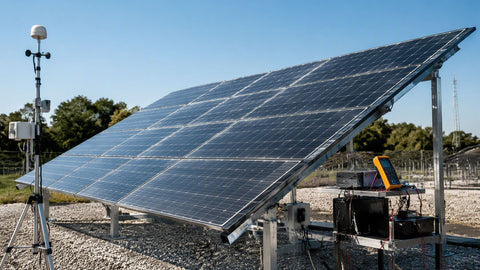
A 200-watt solar panel will recharge a 12V 100Ah lithium (LiFePO4) battery from 20% in about one to two days of good sun — roughly 5 to 7 peak-sun-hours of charging time. The same panel takes a 12V 100Ah lead-acid battery from 50% (its safe discharge floor) to full in about 4 to 6 peak-sun-hours, plus another hour or two of slow absorption charging that no panel can hurry. Those are the real numbers; below is the math behind them, the tables for every common scenario, and the wiring details that decide whether your 200W panel actually delivers 200W.

I have set up dozens of these little 12V charging rigs — RV house banks, gate operators, cabin lighting, trolling-motor top-ups — and the gap between the brochure answer ("a few hours!") and the measured answer is almost always the same three culprits: panel derating, controller losses, and battery chemistry. Fix those in your expectations and the arithmetic in this guide will match what your battery monitor reports.
The Quick Answer Table


| Battery Type (12V 100Ah) | Recharge From | Energy to Replace | Charge Time @ 4 Peak Sun Hours | Charge Time @ 5 Peak Sun Hours | Charge Time @ 6 Peak Sun Hours |
|---|---|---|---|---|---|
| LiFePO4 (lithium) | 20% state of charge | ~1,024 Wh | ~1.6 days (6.4 PSH) | ~1.3 days (6.4 PSH) | ~1.1 days (6.4 PSH) |
| LiFePO4 (lithium) | 0% (full recharge) | ~1,280 Wh | 2.0 days | 1.6 days | 1.3 days |
| AGM / flooded lead-acid | 50% (recommended floor) | ~600 Wh | ~1 day + 1–2 hr absorption | ~1 day + absorption | Under 1 day + absorption |
| AGM / flooded lead-acid | 80% depth of discharge (not recommended) | ~960 Wh | ~1.6 days + absorption | ~1.3 days + absorption | ~1.1 days + absorption |
"Days" in that table means days at that many peak sun hours (PSH) — the unit that collapses a whole day of varying irradiance into equivalent full-sun hours. Most of the US averages 4–5.5 PSH annually; the Southwest sees 6+, the Pacific Northwest and Northeast average 3.5–4.5. If you do not know your local PSH, assume 4 and you will rarely be disappointed.
The Math, Step by Step
Charging time is one division problem. Get the four inputs right and the answer takes care of itself:
Charge time (peak sun hours) = Watt-hours to replace ÷ (Panel watts × system efficiency)
Understanding Your 12V 100Ah Battery
- Battery watt-hours. A "12V 100Ah" lithium battery is really a 12.8V nominal pack: 12.8V × 100Ah = 1,280Wh. A lead-acid 12V 100Ah is 12.0V × 100Ah = 1,200Wh nominal.
- Depth of discharge. LiFePO4 tolerates 80–100% discharge routinely, so from 20% you replace 1,024Wh. Lead-acid lives longest at 50% maximum discharge, so you replace about 600Wh.
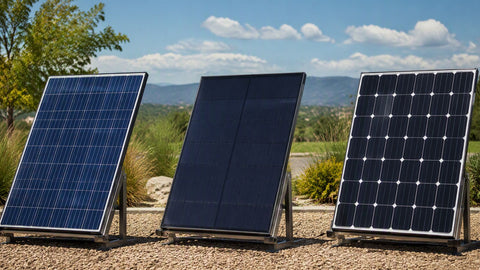
- Real panel output. A 200W panel on a warm roof or ground mount delivers 75–85% of nameplate in real sun: call it 150–170W at the controller input. Heat, imperfect tilt, haze, and dust each shave a few percent.
- Controller efficiency. MPPT controllers run 93–98% efficient; PWM units effectively waste the panel's excess voltage and deliver roughly 70–80% of what the same panel could produce into a 12V battery.
Worked example, lithium from 20%: 1,024Wh ÷ (200W × 0.80 panel derate × 0.96 MPPT) = 1,024 ÷ 154W ≈ 6.6 peak-sun-hours. At 5 PSH per day, that is about 1.3 days. For lead-acid from 50% on a PWM controller: 600Wh ÷ (200 × 0.80 × 0.75) = 600 ÷ 120W = 5.0 PSH — call it one full summer day, then absorption taper on top.
Charge Time by Panel Wattage and Chemistry
Scaling the array is the only honest way to charge faster (a bigger panel does not stress a healthy battery — the controller limits current). Here is the full grid:
| Solar Array | Real Delivered Power (MPPT) | LiFePO4 100Ah from 20% | LiFePO4 100Ah from 0% | Lead-Acid 100Ah from 50% |
|---|---|---|---|---|
| 100W panel | ~77W | ~13.3 PSH (~2.7–3.3 days) | ~16.6 PSH (~3.3–4.2 days) | ~7.8 PSH (~1.6–2 days) |
| 200W panel | ~154W | ~6.6 PSH (~1.3–1.7 days) | ~8.3 PSH (~1.7–2.1 days) | ~3.9 PSH (~1 day) |
| 400W (2×200W) | ~307W | ~3.3 PSH (under 1 day) | ~4.2 PSH (~1 day) | ~2.0 PSH (half day) |
| 600W (3×200W) | ~461W | ~2.2 PSH (half day) | ~2.8 PSH (half–full day) | ~1.3 PSH (few hours) |
Day estimates assume 4–5 PSH. If you rely on this battery daily — an off-grid cabin or a work trailer — 200W is the bare floor for lithium and honestly undersized for winter. Most of the rigs I build for daily cycling run 400W minimum, which turns "a day and a half" into "done before lunch." Panels from our portable solar panel collection or a pair of 400W-class modules make that upgrade cheap.
MPPT vs. PWM: The 30% Nobody Budgets For
| Factor | PWM Controller | MPPT Controller |
|---|---|---|
| How it works | Pulls panel down to battery voltage (~12–14.4V); panel's excess voltage is discarded | Converts excess voltage to extra current at battery voltage |
| Effective harvest from a 200W panel into 12V | ~120–140W (60–70%) | ~150–170W (75–85%) |
| Panel voltage compatibility | Needs "12V" panels (Vmp ~18V); wastes 60-cell/72-cell panels | Uses any panel Vmp up to its input limit; series strings OK |
| Cold-weather gain | None | +10–20% in cold climates (panel Vmp rises in cold) |
| Typical cost | $15–40 | $60–150 for a quality 20–30A unit |
| Charge time impact (LiFePO4 from 20%) | ~8.5 PSH (~1.7–2.1 days) | ~6.6 PSH (~1.3–1.7 days) |
That table is why I stopped speccing PWM on anything larger than a trickle charger. The MPPT premium pays for itself in the first battery cycle's worth of recovered energy, and on a 200W panel it is the difference between finishing today and finishing tomorrow afternoon. The MPPT vs. PWM deep dive and the controller sizing guide cover selection in detail; current stock lives in the charge controller collection and 30A controllers (the right size class for 200–400W at 12V). For a proven unit, the Victron SmartSolar MPPT line is what I reach for first, and the broader Victron catalog covers monitoring add-ons.
How to Charge a 12V 100Ah Battery With a 200W Panel (Step by Step)
Chemistry Charge-Rate Limits: Why LiFePO4 Charges Faster Than Lead-Acid
- Confirm chemistry and setpoints. LiFePO4 charges to 14.2–14.6V absorption with no float (or 13.6V float max); AGM wants 14.4–14.8V absorption and 13.5–13.8V float; flooded wants temperature-compensated 14.4–14.8V. Program the controller for your exact battery — the wrong profile is the #1 battery killer I see.
- Size the wire and fuse. 200W at 12V is roughly 14A of charge current. Apply the NEC 690.8 continuous-duty multiplier (×1.25): 17.5A → protect with a 20A fuse or breaker (the standard NEC 240.6 size) within 7 inches of the battery positive. 12 AWG THHN (25A at 75°C per NEC 310.16) carries it; use 10 AWG for runs over 10 feet to hold voltage drop under 2%.
- Mount and aim the panel. Tilt at your latitude ±15° seasonally, face true south (US), and keep it out of even partial shade — one shaded cell string can halve output.
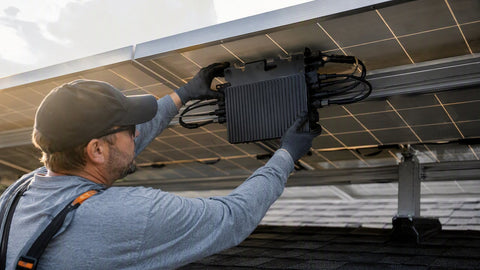
- Connect battery first, panel second. Controllers need battery voltage present to boot and sense system voltage. Panel-first connection is a classic way to fry a controller.
- Verify charging. In full sun you should see 13–16A into a depleted battery with MPPT (9–11A with PWM) and battery voltage climbing toward the absorption setpoint.
- Let it finish. Lithium is done when current tapers near zero at absorption voltage. Lead-acid needs 1–3 hours of absorption after reaching 14.4V — ending early is how sulfation starts.
What Changes the Answer in the Real World

| Factor | Effect on Charge Time | Mitigation |
|---|---|---|
| Panel temperature | Hot panels lose ~0.4%/°C above 25°C; a 65°C panel is down ~16% | Airflow gap behind the panel; morning charging |
| Tilt & orientation | Flat-mounted loses 10–25% seasonally; wrong azimuth loses 10–30% | Adjustable tilt; south-facing |
| Partial shading | One shaded cell can cut a string's output 30–50% | Site survey; bypass diodes help but are not magic |
| Cold weather | Panels gain power; LiFePO4 below 0°C (32°F) must not be charged | Use a battery with low-temp charge cutoff or BMS heating |
| Cable losses | Long/thin 12V runs burn 3–10% as heat | 10 AWG or thicker, short runs, tight crimps |
| Soiling | Dust/pollen: 3–7% typical | Rinse monthly in dry seasons |
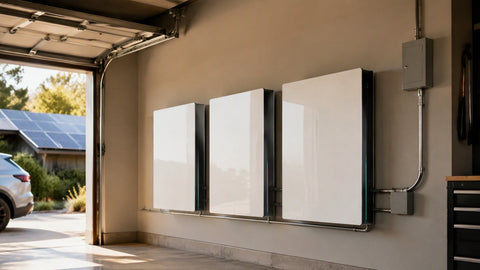
The low-temperature lithium row deserves emphasis: charging a LiFePO4 battery below freezing plates metallic lithium inside the cells and permanently destroys capacity. Most quality batteries in our 100Ah battery collection and LiFePO4 lineup include BMS low-temperature cutoff, but verify it — it is a one-line spec that decides whether your battery survives its first winter.
Battery Chemistry Changes the Whole Problem
| Property | LiFePO4 | AGM | Flooded Lead-Acid |
|---|---|---|---|
| Usable capacity (100Ah nameplate) | 80–100Ah | 50Ah recommended | 50Ah recommended |
| Charge acceptance | Up to 50–100A (0.5–1C); a 200W panel's ~14A is trivial | ~20–30A max recommended | ~10–20A (C/10–C/5) preferred |
| Absorption tail | Short — nearly full when voltage target hit | 1–3 hours | 2–4 hours, temperature-sensitive |
| Cycle life at recommended DoD | 3,000–6,000 cycles | 400–800 cycles | 300–700 cycles |
| Real recharge time from normal use (200W MPPT) | ~1.3–1.7 days | ~1 day + long tail | ~1 day + long tail |
The 20–80 rule of thumb for lithium daily cycling — covered in our 20–80 battery rule guide — is worth adopting if this battery cycles daily: living between 20% and 80% roughly doubles cycle life, and it conveniently matches what 200W can restore in a single sunny day (0.6 × 1,280Wh = 768Wh ≈ 5 PSH at 154W). For sizing the whole bank rather than one battery, the off-grid battery sizing guide is the next read, and the sister article on what a 200W panel can run on 12V covers the load side of the equation.
Field Notes From the Rigs I Have Actually Built
Three lessons repeat. First, nobody's panel makes nameplate at noon in July — I have clamp-metered a brand-new 200W panel delivering 158W in perfect sun on a 90°F day, which is exactly what the derate math predicts, yet the customer was sure it was defective. Second, the fuse location matters more than the fuse size: every short I have ever diagnosed on a 12V rig happened in the first foot of wire off the battery post, which is why code wants the protection right there. Third, people under-buy panels and over-buy batteries. A 100Ah lithium paired with a single 200W panel works, but the pair that makes owners happy is 200Ah of storage with 400W of solar — charge anxiety disappears, and the battery spends its life in the shallow-cycle zone where lithium lasts a decade.
Three Worked Scenarios
Scenario 1: The weekend RV. A couple runs lights, a fan, phone chargers, and a water pump — about 400Wh per day. Their 100Ah lithium drops from 100% to roughly 70% over a weekend. Monday morning the 200W panel has about 380Wh to replace: 380 ÷ 154W ≈ 2.5 peak-sun-hours, done before lunch on any clear day. Verdict: 200W is comfortably oversized for this duty; even a PWM controller keeps up.
Scenario 2: The full-time boondocker. Add a 12V compressor fridge (500–700Wh/day), laptop work (200Wh), and the same baseline — call it 1,100Wh/day. The lithium drops to 14% overnight and needs ~1,100Wh back. At 154W delivered, that is 7.1 PSH — more than a summer day provides in most of the country, and impossible in winter. Verdict: 200W fails this job. The fix is 400W (3.6 PSH, doable May–September) or 600W for four-season margin. This mismatch — daily draw exceeding daily harvest — is the single most common design error I correct in the field.
Scenario 3: The gate operator / remote pump. The load is 150Wh/day and the site gets 4 PSH. A 200W panel harvests ~620Wh on an average day — four times the load. Verdict: 200W is ideal; the battery floats near full almost every day, and the panel even carries the load through a 3-day storm sequence. When the array harvests 3–4× the daily load, the battery's calendar life, not its cycle life, becomes the limiting factor — a nice problem to have.
When to Stop Adding Panels and Start Adding Voltage
One 200W panel on one 12V battery is a classic pairing. The trouble starts when the job grows: at 12V, 400W of solar means ~28A of charge current, 800W means ~55A, and cable sizing, voltage drop, and controller cost all balloon with amperage. The practical breakpoints I use:
| System Scale | Battery Bank | Array | Charge Current | Recommended System Voltage |
|---|---|---|---|---|
| Small (RV weekend, gate, boat) | 100–200Ah | 100–400W | 8–28A | 12V — stay here |
| Medium (full-time RV, small cabin) | 200–400Ah | 400–800W | 28–55A @12V / 14–28A @24V | 24V starts paying off |
| Large (cabin homestead, workshop) | 400Ah+ | 800–2,000W | 55A+ @12V | 48V is the honest answer |
Moving from 12V to 24V halves the current for the same watts, which quarters the wiring loss (I²R), halves the fuse sizes, and opens the door to controllers that cost the same but handle double the array. If your project brief already says "and next year I want to add a freezer," design at 24V today. The 48V battery collection shows where the larger systems end up, and the off-grid inverter collection shows why: inverter-chargers above ~2,000W almost all want 24V or 48V banks.
The Five Mistakes That Make 200W Rigs Fail
After years of fixing other people's 12V systems, the failure list is short and repetitive:
- Charging lithium below freezing. Already covered, but it bears repeating because it kills more batteries than every other mistake combined. Verify low-temperature cutoff or add a battery heater.
- Panel-first wiring. Connecting the panel to the controller before the battery confuses or burns controllers. Battery first, always; cover the panel or flip its breaker when disconnecting.
- Undersized wire on long runs. A 30-foot loop of 16 AWG at 12V/14A drops about 1.4V — 10% of your harvest warming the cable. 10 AWG on anything over 10 feet is cheap insurance.
- Flat-mounted panels at northern latitudes in winter. December sun at 45°N comes in at a low angle; a flat panel can lose 50%+ versus proper tilt. Adjustable brackets pay for themselves in one winter.
- Trusting "12V panel" labels. Some cheap "12V" panels have Vmp of 17V or lower and cannot push a full absorption charge into a battery needing 14.4V on a hot day. Check the datasheet: Vmp ≥ 18V for PWM on lead-acid, or use MPPT and stop worrying about it.
Season by Season: What to Expect From 200W

| Season (mid-US, ~40°N) | Effective PSH | Daily Harvest @ 154W | LiFePO4 20→100% Recharge | Verdict |
|---|---|---|---|---|
| Summer (Jun) | 5.5–6.5 | 850–1,000Wh | ~1 day | Effortless |
| Spring/Fall (Apr/Oct) | 4–5 | 620–770Wh | 1.3–1.7 days | The design point |
| Winter (Dec/Jan) | 2.5–3.5 | 390–540Wh | 2–3 days | Marginal for daily cyclers; fine for weekend/standby duty |
That winter row decides most designs. If the battery must cycle daily in January — a cabin you live in, a pump that runs every day — either size the array to the December PSH (which usually means 400–600W) or accept a generator topping the battery through the dark weeks. If the battery serves weekend or emergency duty, winter's slow recharge is irrelevant: the battery sits full between uses, and even 2.5 PSH replaces a weekend's draw by midweek.
The Complete Parts List for a 200W Charging Rig
Everything between sunlight and a full battery, with the specs that matter:
| Component | Spec to Buy | Why It Matters |
|---|---|---|
| Panel | 200W, Vmp 18–22V (12V-nominal) for PWM, or any Vmp for MPPT | Voltage headroom decides whether absorption voltage is reachable on hot days |
| Charge controller | 20–30A MPPT preferred; 20A PWM acceptable on a tight budget | 25–30% more harvest with MPPT; room for a second panel later |
| Battery | 12V 100Ah LiFePO4 with low-temp cutoff, or 100Ah AGM | Lithium delivers ~2× usable capacity and 5× cycle life per dollar of lifetime energy |
| Battery fuse/breaker | 20A (NEC 240.6 standard size) within 7 in. of the positive post | The first foot of wire is where shorts happen |
| Wire, controller↔battery | 10–12 AWG copper, both conductors | Holds voltage drop under 2% at 14A |
| Wire, panel↔controller | 12 AWG PV wire, UV-rated | Outdoor-rated insulation is not optional on roofs |
| Mounting | Tilt-adjustable brackets or a ground frame | Tilt is worth 15–25% seasonally, more in winter |
| Monitoring | Bluetooth in the controller, or a shunt-based battery monitor | You cannot manage what you cannot see; a $40 shunt ends all guessing |
Total street price lands between $350 and $600 depending on controller and battery choices — lithium at the top of that range, AGM at the bottom, and lithium winning on cost per cycle by a wide margin over its 3,000–6,000-cycle life.
Solar Is Not the Only Charger: Hybrid Charging Done Right
Most real-world 12V systems have two or three charge sources, and getting them to cooperate is simpler than people fear. Modern LiFePO4 batteries tolerate simultaneous sources gracefully because each source is voltage-limited: a solar controller holding 14.4V absorption and a vehicle DC-DC charger holding 14.4V simply share the load, and whichever sees the battery reach setpoint first tapers off. The pairings that work well:
- Solar + DC-DC (vehicle alternator): the standard RV pairing. A 20–30A DC-DC charger replaces 280–400Wh per driving hour — the exact deficit solar cannot cover on travel days. Do not connect a lithium bank directly to an alternator without a DC-DC unit; lithium's low internal resistance will happily pull 100A+ and cook the alternator.
- Solar + shore power (AC charger): the cabin pairing. A 20A AC charger refills the bank overnight during generator or grid time; solar maintains it the rest of the week. Set the AC charger's absorption a hair below solar's (14.2V vs 14.4V) and solar always finishes the job.
- Solar + small wind: niche but genuinely complementary in winter, when wind harvest peaks as solar bottoms out.
The one pairing to avoid is two unregulated sources with different chemistry profiles — for example, a legacy automotive "battery isolator" feeding a lithium house bank with an AGM profile. Mismatched setpoints chronically undercharge lithium (robbing 20–30% of capacity) or overcharge AGM (boiling it dry). Match every source to the battery's actual profile and the system runs itself.
How to Know It Is Working: Reading the Signs
A healthy 200W rig has a visible daily rhythm. In morning sun, the controller shows bulk charging with current near the panel's limit (13–16A MPPT into a depleted bank). Battery voltage climbs through 13.2–13.6V (lithium's long flat plateau) for hours, then rises briskly toward 14.2–14.6V in the final 10% — lithium's voltage curve is famously flat, so do not mistake 13.3V for "almost full"; it can be anywhere from 30% to 90% depending on the day. At absorption, current tapers to near zero and the controller drops to float or terminates. If instead you see low current at low voltage in good sun, check the panel connections before blaming the battery; if you see full current that never tapers by evening, your daily draw exceeds your harvest and the battery is quietly marching toward empty — the exact situation Scenario 2 above warns about.
The Upgrade Path: Growing Beyond One Panel
Nearly every 200W rig I install is phase one of something bigger, and the ones that grow gracefully share three decisions made on day one. The controller was bought one size up (a 30A MPPT instead of a 20A) so a second panel drops in without replacing electronics. The battery was bought with a parallel-capable BMS — most quality LiFePO4 units support four in parallel, but budget models sometimes do not, and discovering that after purchase is an expensive lesson. And the wiring was run in 10 AWG from the start, so doubling the array did not mean re-pulling cable. Follow those three rules and the path from "200W charges my battery in a day and a half" to "600W runs my cabin" is a Saturday of bolt-on work rather than a rebuild. Skip them, and every upgrade becomes a do-over.
The other graceful-growth trick is modular redundancy: two 200W panels on two small controllers beat one 400W array on one big controller for mission-critical remote sites, because any single failure leaves half the system alive. Gate operators and telemetry sites are where this earns its keep.
Troubleshooting: When Charge Times Stretch
If your rig takes longer than the tables predict, work this checklist in order — it resolves about 95% of the slow-charging calls I get. First, confirm the panel is actually producing: cover and uncover it while watching controller current; a panel showing less than 60% of expected amps in clear midday sun has a wiring, shading, or diode problem. Second, check controller setpoints — a lithium-profile controller accidentally left on AGM will undercharge; one on flooded will overcharge. Third, measure voltage at the battery versus at the controller output; more than 0.3V of difference at full current means wire or connection losses are eating your harvest. Fourth, look at the battery's own current limit — a BMS protecting a cold or nearly-full battery will throttle charge regardless of available sun. Fifth, re-aim the panel; a 30-degree azimuth error costs 10–15% and nobody notices from the ground. And sixth, accept the season: December charge times genuinely are double June's, and no troubleshooting will fix the tilt of the Earth.
The One-Paragraph Summary
Everything above compresses to this: a 12V 100Ah lithium battery holds 1,280Wh; a 200W panel delivers 150–170W of that through an MPPT controller in real sun; divide the watt-hours you used by the watts you harvest and you get your charge time in peak-sun-hours — about 6.5 PSH from 20%, or one to two days in most of America. Buy the MPPT, fuse at the battery, tilt the panel, never charge lithium below freezing, and the rig will outlast the vehicle it is mounted on.
Frequently Asked Questions
How long does a 200W solar panel take to charge a 12V 100Ah lithium battery?
From 20% state of charge: about 6.5 peak-sun-hours with an MPPT controller — roughly 1.3 to 1.7 days in typical 4–5 PSH conditions. From fully empty, expect 8+ PSH or about two days. A PWM controller adds 25–35% more time.
Can a 200W panel charge a 100Ah battery in one day?
For lead-acid recharged from its recommended 50% floor: yes, comfortably in 4–5 peak sun hours. For lithium from 20%: only in strong sun (6+ PSH) with MPPT, or if you only draw the battery down partway. For guaranteed same-day recovery, step up to 400W.
What size charge controller do I need for a 200W panel on 12V?
200W ÷ 12V ≈ 16.7A maximum charge current; apply the 1.25 continuous-duty factor and you need a controller rated 20A or more. A 20–30A MPPT controller is the right class, and buying the 30A unit leaves headroom for a second panel later.
Is 200W of solar enough to keep a 100Ah battery topped off in an RV?
For weekend use — lights, fans, phones, a water pump, occasional 12V fridge duty — yes in most seasons, since daily draw often stays under 600Wh. For full-time boondocking with a compressor fridge running daily (500–800Wh/day alone), 200W is marginal outside summer; 300–400W is the comfortable answer.
Why does my battery take longer to charge than the math says?
The usual suspects, in order: panel derating from heat and tilt (budget 20–25% below nameplate), PWM controller losses, partial shading, thin or long cable runs dropping voltage, and — for lead-acid — the absorption tail, which adds 1–3 hours after the battery looks nearly full.
Can I connect two 200W panels to charge faster?
Yes, and it is the best upgrade available. Wire them in parallel (12V panel pairs) or series if your MPPT input voltage allows, keep total charge current under both the controller rating and the battery's charge limit, and your lithium goes from 20% to full in about 3.3 peak-sun-hours — a single decent morning.
Related reading: Solar kits · NEC wire ampacity chart · AGM batteries · Battery sizing calculator