Updated September 2026 — refreshed against the live PES catalog; product pricing verified 2026-09-26.
I've walked into hundreds of homes after a multi-day outage, and the conversation is always the same: the family that bought a standby generator before the storm sleeps fine, and the family that didn't is asking me how fast we can install one. A full house generator is no longer a luxury appliance in most of the country — between aging grid infrastructure, more frequent extreme weather, and the sheer number of devices a modern home depends on, standby power has become core infrastructure, right alongside the electrical panel and the HVAC system.

This guide covers what a whole-house standby generator actually costs, how to size it correctly using the same load calculations we run on job sites, what the NEC requires for the installation, fuel consumption math that most sales brochures gloss over, and how to think about the return on investment — both in resale value and in avoided losses every time the grid goes down. The numbers here come from manufacturer spec sheets, NEC tables, and fifteen years of field installs — not marketing copy.
What a Full House Generator Actually Is
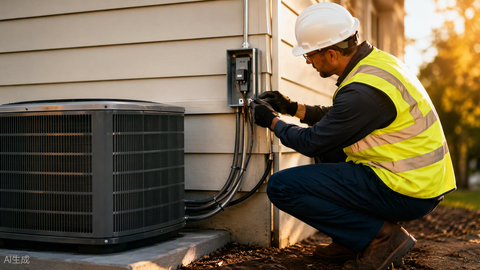
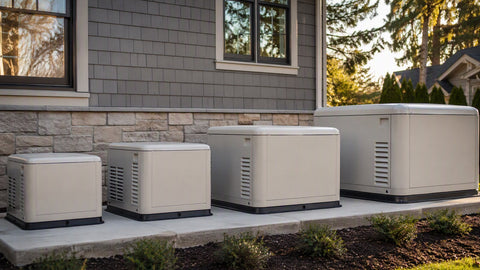
A full house (whole-home) standby generator is a permanently installed engine-generator set, usually fueled by natural gas or liquid propane, wired into your home through an automatic transfer switch (ATS). When utility power drops, the ATS senses the loss, signals the generator to start, and transfers the home's load to generator power — typically within 10 to 30 seconds. When the utility comes back, the switch transfers back and the generator cools down and shuts off. Nobody has to be home. Nobody drags a portable unit out of the garage, and nobody runs extension cords through a cracked window.
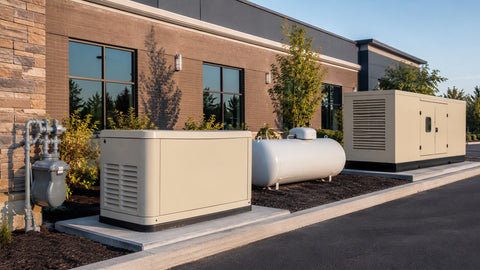
That automatic behavior is the whole point. The units we install most often sit in the 14kW to 26kW range for single-family homes — you can browse the size classes we stock in our 14–17kW standby generators, 17–20kW standby generators, and 20–28kW standby generators collections. Larger homes, small businesses, and properties with heavy motor loads move up into 48kW and 60kW liquid-cooled territory — a different animal entirely, built on commercial engine platforms with duty cycles measured in weeks rather than hours.
Sizing: The Load Calculation That Actually Matters
The single biggest mistake I see is a homeowner buying a generator by square footage alone. Square footage is a rough proxy at best. What matters is the connected load — specifically, which loads you want running during an outage and what their starting (inrush) demands are. A central air conditioner that runs at 3,500 watts can demand two to three times that for a few seconds at compressor start, and the generator has to absorb that hit without the voltage sagging enough to drop out your electronics.
Here's the honest sizing table we start from on site visits. Running watts are the continuous draw; starting watts are the brief surge a motor-driven load pulls when it kicks on:
| Load | Running Watts (typical) | Starting Watts (typical) |
|---|---|---|
| Central AC, 3-ton (36,000 BTU) | 3,500 | 7,000–10,500 |
| Central AC, 5-ton (60,000 BTU) | 6,000 | 12,000–18,000 |
| Refrigerator / freezer | 700 | 2,100 |
| Well pump, ½ HP | 1,000 | 2,500 |
| Sump pump, ⅓ HP | 800 | 2,000 |
| Electric water heater | 4,500 | 4,500 |
| Furnace blower, ½ HP | 875 | 2,300 |
| Electric range (one burner + oven) | 5,000 | 5,000 |
| Lighting + electronics, whole house | 1,500–2,500 | — |
Add up the running watts of everything you want on simultaneously, then add the single largest starting surge on top — not all of them at once, because motors almost never start at the same instant. A typical 2,500-square-foot home with one 3-ton AC, gas heat, and normal appliances lands around 12–14kW of managed load, which is why the 18–22kW class with load management is the volume seller. If you're running two AC compressors, a well pump, and electric cooking, do the math honestly — you may be a 26kW household.
We break the sizing process down further in our standby generator sizing guide and the 2026 whole-home sizing walkthrough, and our brand-specific deep dives on 22kW generators and 26kW generators cover the two most popular size classes in detail.
Fuel: Natural Gas vs. Propane vs. Diesel
Fuel choice drives everything else about the installation: runtime, cost per hour, and whether the unit can even make full rated power. One detail that surprises homeowners: most air-cooled standby units are de-rated on natural gas. A generator rated 22kW on propane often delivers around 19.5–20kW on natural gas because NG carries less energy per cubic foot. Check the spec sheet for both ratings before you buy.
| Fuel | Typical Consumption at 50% Load (22kW class) | Runtime Basis | Pros | Cons |
|---|---|---|---|---|
| Natural gas | ~200–250 ft³/hr | Unlimited (utility feed) | No tank, no refills, runs indefinitely | Power de-rating; useless if gas service is interrupted |
| Liquid propane | ~2.0–2.5 gal/hr | 250-gal tank ≈ 3–4 days at half load | Full rated power, long storage life | Tank sizing and refill logistics; freezes at extreme draw rates |
| Diesel (liquid-cooled units) | ~1.0–1.5 gal/hr | Onsite tank, sized to need | Best energy density, longest engine life | Fuel polishing, gel risk in cold climates, permitting |
The propane runtime math is simple but worth doing before you pick a tank. A 500-gallon propane tank holds about 400 usable gallons (tanks are filled to 80% for expansion). At 2.2 gallons per hour at half load, that's 400 ÷ 2.2 ≈ 182 hours, or roughly 7.5 days of continuous runtime. At full load, consumption roughly doubles, so plan on 3.5–4 days. I've seen too many 250-gallon tanks run dry on day five of an ice-storm outage — if your area has a history of week-long outages, size the tank for the worst case, not the average case.
Natural gas de-rating deserves a closer look. Methane delivers approximately 1,000 BTU per cubic foot; propane delivers 2,500 BTU per cubic foot. A 22kW generator needs roughly 80,000 BTU/hr at full load. On propane, that's 32 ft³/hr. On natural gas, it's 80 ft³/hr — and more importantly, the lower energy density means the engine cannot produce full rated power. The exact de-rating varies by manufacturer: Generac's 22kW Guardian makes 22kW on propane and 19.5kW on NG. Kohler's 20kW makes 20kW on propane and 18kW on NG. Always check the dual-fuel ratings on the spec sheet and size accordingly.
The Electrical Side: NEC Requirements You Can't Skip
A standby generator installation is a permitted electrical job in virtually every jurisdiction, and it should be. The three NEC areas that come up on every install:
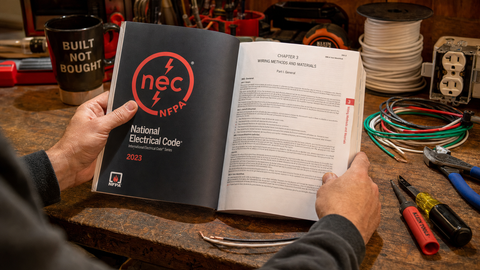
1. Feeder and wire sizing (NEC 310.16). The conductors from the generator to the transfer switch must be sized for the generator's output breaker. Using the 75°C copper column of Table 310.16, the common pairings look like this:
| Generator Output Breaker | Min. Copper Conductor (75°C, THHN/THWN-2) | Ampacity per NEC 310.16 | Typical Generator Class |
|---|---|---|---|
| 60 A | 6 AWG | 65 A | 10–14kW air-cooled |
| 80 A | 4 AWG | 85 A | 16–18kW air-cooled |
| 100 A | 3 AWG | 100 A | 20–24kW air-cooled |
| 125 A | 1 AWG | 130 A | 26kW air-cooled |
| 200 A | 3/0 AWG | 200 A | 36–48kW liquid-cooled |
Note the 100A row uses a 3 AWG conductor rated exactly 100A — the conductor ampacity must meet or exceed the breaker rating, and NEC 240.6(A) defines the standard overcurrent device sizes (15, 20, 25, 30, 35, 40, 45, 50, 60, 70, 80, 90, 100, 110, 125, 150, 175, 200, 225, 250, 300, 350, 400 amperes, and up). When a calculated load falls between two standard sizes, NEC 240.4(B) lets you round up to the next standard size in many feeder applications — but only if the conditions of 240.4(B) are met, which is exactly the kind of judgment call your inspector will check. For a deeper dive on conductor selection, see our NEC wire sizing and ampacity guide.
2. Transfer switching (NEC 702). The transfer switch is the safety heart of the system — it makes backfeeding the grid (which can kill a utility lineworker) physically impossible. Whole-home service-rated ATS units come in standard amperage classes that match NEC 240.6(A) ratings: 100A, 200A, and 400A for residential and light commercial service. We stock automatic transfer switches across the 100A, 200A, and 400A service classes, plus transfer switch kits that pair the switch with the generator.
3. Grounding and bonding. Whether the generator neutral is switched or solid at the ATS determines how the generator is grounded — get this wrong and you create parallel neutral paths that trip GFCI devices and confuse fault clearing. Our grounding and bonding guide walks through the NEC 250 logic that applies here.
What the Full Installation Costs
Installed pricing varies by region, but the components are consistent. Here's an honest breakdown for a typical 22–26kW air-cooled installation on natural gas:
| Component | Typical Cost Range | Notes |
|---|---|---|
| Generator unit (22–26kW) | $5,500–$7,500 | Equipment only, air-cooled |
| Service-rated ATS (200A) | $700–$1,200 | Often bundled with generator |
| Electrical labor + materials | $2,000–$4,000 | Panel work, feeder, permit, inspection |
| Gas plumbing | $1,000–$3,000 | Meter upsize, new run, regulator |
| Pad, trenching, misc. | $500–$1,500 | Composite or poured concrete pad |
| Total installed | $10,000–$17,000 | Region and site conditions swing this hard |
Liquid propane adds the tank ($500–$2,500 installed depending on size and whether it's leased), and liquid-cooled diesel or gaseous units in the 36kW+ class push the total well past $20,000. Two cost traps worth flagging: quotes that exclude the gas meter upsize (the utility's work, but you pay for the plumber's coordination), and quotes that assume a composite pad when your soil or frost depth requires poured concrete. Ask every bidder to itemize the pad, the gas run length, and the permit fees separately — the cheapest headline number rarely stays cheapest once those lines appear.
Return on Investment: Resale Value and Avoided Losses

The resale-value question comes up on almost every sales call. Appraisal studies and agent surveys consistently put the recovered value of a whole-house generator at roughly 50–75% of installed cost at resale, with the higher end in outage-prone regions — think Gulf Coast hurricane country, the ice-belt, and rural areas at the end of long distribution feeders. In those markets, agents increasingly report that a standby generator is a listing feature that shortens days-on-market, which has real dollar value even if it doesn't show up in the appraisal line item.
The avoided-loss math is more concrete. A single multi-day outage can cost a household:
| Loss Category | Typical Cost of One Multi-Day Outage |
|---|---|
| Spoiled food (full fridge + freezer) | $400–$800 |
| Hotel for family of 4, 4 nights | $600–$1,200 |
| Frozen/burst pipe repair (winter outage) | $2,000–$10,000+ |
| Finished basement flood (sump pump dead) | $5,000–$25,000+ |
| Lost work-from-home income, 3–5 days | $750–$2,500 |
One flooded basement pays for the whole installation. I've had exactly that conversation with a customer standing in two inches of water next to a silent sump pump — he signed the install contract before the restoration crew finished the demo. If outages in your area average even one multi-day event every two or three years, the generator is effectively paying you back a few hundred dollars a year in avoided losses before you count a dime of resale value.
Homeowners insurance sometimes adds a small discount for a permanently installed standby system, and some insurers will negotiate on sump-pump-failure endorsements when a generator is present. Ask your agent — the answer varies by carrier, but the question is free.
Maintenance and Lifespan
Air-cooled standby units are built for standby duty, not continuous prime power, and the maintenance schedule reflects that: oil and filter annually or every 100–200 run hours, spark plugs and valve lash checks on a multi-year cycle, and a weekly self-test the unit runs on its own. Budget $150–$400 per year for a service contract, or do the basics yourself if you're comfortable with small engines. Well-maintained air-cooled units routinely deliver 15–25 years of service life. Liquid-cooled units — the same engine architecture as commercial gensets — run 20–30+ years and are the right answer when runtime expectations are measured in weeks per year rather than days.
One maintenance item people skip: exercise the transfer switch. Once a year, during a mild-weather afternoon, flip the main breaker off and let the system carry the house for 30 minutes. You learn whether the ATS works now, on a Tuesday with full pressure in the gas line — not at 2 a.m. in an ice storm. That's the whole philosophy of standby power in one sentence.
Placement, Noise, and Permitting
Where the generator sits matters more than most buyers expect. Air-cooled standby units in the 14–26kW class produce roughly 63–67 dB at 23 feet under load — comparable to a central air conditioner, loud enough that your neighbor will notice if the unit sits three feet from their bedroom window. Most manufacturers require minimum clearances: typically 18 inches from the structure for the unit itself, 5 feet from windows, doors, and fresh-air intakes (this is a carbon monoxide requirement, and inspectors enforce it), and 3 feet of clearance on the service side. Local noise ordinances and HOA rules layer on top of the manufacturer's clearances, so check both before the pad gets poured.
On permitting: expect an electrical permit at minimum, a plumbing or mechanical permit for the gas work, and in some jurisdictions a separate generator permit or zoning review for the pad location. The gas utility often needs to upsize the meter — a 22kW unit at full load can pull over 300 cubic feet per hour on NG, and a meter sized for a furnace and water heater won't feed it. I've had installs delayed three weeks waiting on a meter swap that nobody scheduled at contract signing. Put the gas utility work order in motion the day you sign, not after the generator arrives.
Load Management: How a Smaller Generator Carries a Big House
Load management is the single best money-saver in modern standby installations. Instead of sizing the generator for every load at once, smart load modules or a load-management ATS monitor generator output and shed non-critical circuits when capacity runs short — typically the second AC compressor, the electric water heater, or the range. The compressor waits 30 seconds, starts, and the module re-arms. From inside the house, nobody notices anything except that everything works.
The math is compelling. A house that pencils out to 24kW of worst-case simultaneous load can often run on an 18kW generator with two managed loads, saving $1,000–$1,500 on equipment and a comparable amount on gas plumbing, because the smaller unit needs less gas supply capacity. The trade-off is honest: load management manages convenience loads, not critical ones. Never manage a sump pump, a medical device circuit, or a well pump that's your only water source. I tell every customer the same rule — if losing a circuit for five minutes would damage property or hurt someone, that circuit doesn't get managed, period.
Standby Generator vs. Battery Backup: The Honest Comparison
Battery storage has changed the conversation, and any guide that pretends otherwise is selling you something. Here's the real comparison:
| Factor | Standby Generator | Battery Backup |
|---|---|---|
| Runtime | Days to weeks (fuel-limited) | Hours to a day without solar recharge |
| High-surge loads (central AC) | Handles easily | Needs large inverter stack; often impractical |
| Transfer time | 10–30 seconds | Near-instant (UPS-grade) |
| Maintenance | Oil, filters, annual service | Essentially none |
| Installed cost (whole-home) | $10,000–$17,000 | $15,000–$30,000+ for comparable coverage |
| Fuel/energy cost per outage day | $30–$80 (NG/LP) | Near zero with solar recharge |
Our field verdict, after installing both: for short outages measured in hours, batteries are quieter, cleaner, and instant. For multi-day outages — the ones that actually hurt — a generator is still the only technology that runs a whole house indefinitely for a reasonable price. The hybrid approach is increasingly common: a modest battery rides through the 30-second generator start and covers overnight hours quietly, while the generator handles daytime load and recharges the battery. If that architecture interests you, our battery backup runtime calculator and home battery bank sizing guide will help you size the storage side.
Regional Cost Variations: What Geography Does to Your Quote
The $10,000–$17,000 range is national median, but local factors move it significantly. In coastal California, labor rates and permit fees push the upper end; in rural Texas, lower labor costs and simpler permitting keep it at the bottom. Frost depth determines whether a pad needs footings; seismic zones require additional anchoring. The table below shows how geography affects the all-in installed cost for a 22kW air-cooled natural gas system:
| Region | Labor Rate Factor | Permit Complexity | Typical All-In Cost (22kW NG) |
|---|---|---|---|
| Coastal California (LA, Bay Area) | High ($120–180/hr) | High (multi-agency) | $14,000–$19,000 |
| Pacific Northwest (Portland, Seattle) | Moderate ($90–140/hr) | Moderate | $12,000–$16,500 |
| Texas / Oklahoma | Lower ($70–110/hr) | Low | $10,000–$14,000 |
| Upper Midwest (Chicago, Minneapolis) | Moderate ($85–130/hr) | Moderate (frost depth) | $11,500–$16,000 |
| Southeast (Atlanta, Charlotte) | Moderate ($75–120/hr) | Moderate | $11,000–$15,500 |
| Northeast (Boston, NYC metro) | High ($110–170/hr) | High (dense permitting) | $13,500–$18,500 |
Frequently Asked Questions
How much does a full house generator installation cost?
For a 22–26kW air-cooled unit on natural gas, expect $10,000–$17,000 all-in: equipment, transfer switch, electrical and gas labor, permits, pad, and inspection. Propane systems add tank cost, and liquid-cooled units in the 36kW+ class commonly exceed $20,000 installed.
How much value does a standby generator add at resale?
Most appraisal and agent data points to recovering 50–75% of installed cost at resale, with the best recovery in outage-prone regions. In hurricane and ice-storm markets, agents also report meaningfully faster sales for homes with installed standby power.
What size generator do I need for my whole house?
Add the running watts of everything you want operating simultaneously, then add the largest single motor-starting surge. Most 2,000–3,000 sq ft homes with one central AC land in the 18–22kW class; homes with two compressors, well pumps, or electric cooking often need 26kW or a managed-load strategy.
How long will a whole-house generator run?
On natural gas, indefinitely — the limiting factor is maintenance intervals, not fuel. On propane, divide usable tank gallons by the consumption rate: a 500-gallon tank (about 400 usable gallons) at roughly 2.2 gal/hr half-load consumption gives around 7.5 days of continuous runtime.
Is natural gas or propane better for a standby generator?
Natural gas wins on convenience — no tank, no refills — but most air-cooled units are de-rated on NG (a 22kW LP unit typically makes about 20kW on NG). Propane delivers full rated power and works when gas service is out, but requires tank sizing and refill logistics.
How long do standby generators last?
Air-cooled units with annual maintenance routinely deliver 15–25 years. Liquid-cooled units, built on commercial engine platforms, regularly exceed 25–30 years and are the better fit for properties expecting weeks of runtime per year.
Can I install a standby generator myself?
The generator pad and enclosure can be owner-installed, but the electrical and gas connections require licensed contractors in virtually every jurisdiction. The transfer switch involves live service-panel work, the gas line requires a licensed plumber, and the permit must be pulled by a licensed contractor. DIY electrical work on a generator feed is unsafe and uninsurable.
Will a standby generator work with solar panels?
Not directly — a standard ATS cannot interface with a grid-tied solar inverter. For homes with solar, a hybrid inverter or AC-coupled battery system (like a Sol-Ark or Enphase system with generator input) is required. The generator charges batteries, and the hybrid inverter powers the home from batteries. We cover this architecture in our battery backup runtime calculator.
Related Products & Resources
- 22kW generators — the most popular whole-home size class we stock
- 26kW generators — headroom for two-compressor homes
- Commercial standby generators — liquid-cooled units for heavy duty cycles
- Standby generators for the home: the fundamentals
- Whole house generator overview
- Generator sizing guide — step-by-step load calculation
- 2026 whole-home sizing walkthrough
- 22kW generator deep dive
- 26kW generator deep dive
- Battery backup runtime calculator — hybrid generator + battery architectures
- Home battery bank sizing guide
- NEC wire sizing and ampacity guide
- Grounding and bonding guide
- Automatic transfer switches
- Generator transfer switch kits
Need pricing or availability on anything in this guide?
Portlandia Electric Supply dropships direct from the manufacturer — most items Ship Direct with lead times stated up front, no surprises.
Get a quote from PESBulk, pallet and contractor pricing available.