Type "residential solar installation near me" into a search engine and you will get a wall of ads, lead-aggregators, and national brands bidding on your ZIP code. Buried under them are the local installers who will actually design, permit, build, and service your system — and the difference between a great local installer and a polished lead-funnel is the difference between a 25-year asset and a 25-year headache. We supply equipment to installers across the country and hear the post-mortems from homeowners who chose badly. This guide is the vetting playbook we wish every homeowner read before signing anything: how to build a shortlist, how to verify credentials, what to ask, how to read the quotes, and what the installation process should look like when professionals run it.

Starting Your Search for Local Solar Installers
Do a Quick Home Self-Assessment First
Before you talk to a single salesperson, spend thirty minutes on your own homework — it will change every conversation that follows. Pull twelve months of electric bills and note your annual kilowatt-hours; that number, not your roof's square footage, sizes the system. Look at your roof: age (under ten years is fine; over fifteen, plan on re-roofing first or price a future detach-and-reset into the decision), orientation (south is best, east/west is fine, north is usually a no), and shade from trees, chimneys, and neighboring structures between 9 a.m. and 3 p.m. Check your electrical panel: a 100A service may need an upgrade or a load-side calculation before a large system can backfeed it — our bus bar capacity guide explains the 120% rule that governs this. And note your utility's interconnection and net metering policy, because the value of a solar kilowatt-hour varies enormously by state and utility.
Build Your Shortlist of Potential Installers
Three sources beat search ads every time. Neighbors with visible arrays — knock on the door; solar owners love to talk, and they will tell you exactly how the crew behaved, whether the job finished on schedule, and whether anyone answered the phone a year later. Local trade reputation — ask a roofer or electrician you trust who does clean solar work in your area; tradespeople know which solar companies respect their roofs and panels. And state licensing-board lookups, which confirm the license is real and reveal complaint history. Aim for a shortlist of three to five companies with physical local presence, at least five years in business, and installation crews on payroll rather than pure subcontract models. National brands are not automatically bad, but the ones that sell and vanish leave you calling a 1-800 number when the inverter faults in year nine. Local companies survive on referrals, which aligns their interests with yours for the long haul — and in a purchase you will live with for three decades, that alignment is worth more than any single line item on the quote.
How to Properly Vet Solar Installation Companies
The Non-Negotiables: Your First-Pass Filter
| Credential | What to Verify | How to Check | Walk Away If |
|---|---|---|---|
| Contractor's license (electrical or solar specialty) | Active, in the company's name, correct classification | State licensing board website | License belongs to "a partner" or is pending |
| General liability + workers' comp insurance | Current certificates, adequate limits ($1M+ GL) | Certificates sent from the insurer, not the sales rep | Any hesitation or "we're covered under..." answers |
| NABCEP-certified staff | At least one certified professional on the install side | NABCEP directory lookup | Zero certified staff anywhere in the company |
| Local track record | 5+ years, verifiable local installs | References, permit records, drive-by addresses | Company formed last year with out-of-state parent |
| Warranty servicing plan | Written workmanship warranty (10+ years), named service contact | In the contract, not the pitch deck | "The manufacturer covers everything" (they don't) |
Asking the Right Questions to Cut Through the Noise
Good installers welcome hard questions; bad ones deflect. Ask these in the first call and listen to the how, not just the what. "Who designs my system?" — you want an in-house designer or engineer who has seen your roof data, not a sales-app auto-layout. "Who pulls permits and schedules inspections?" — the answer should be the installer, full stop. "What equipment will you install, and why those specific models?" — a good answer names module and inverter models and explains the choice (for instance, Mission Solar or REC modules with a hybrid inverter for battery-readiness); a bad answer says "Tier 1 premium panels" and changes the subject. "What happens when something breaks in year seven?" — listen for a service department, response times, and warranty-claim handling. "Can I see three local installs from two-plus years ago?" — recent installs look great on everyone; aged installs reveal workmanship.
Key Topics for Your Initial Call: Vetting Checklist
- Years in business under the current entity name, and install count in your county
- In-house crews vs. subcontractors, and who supervises the roof
- Design process: site survey or satellite-only?
- Equipment brands stocked and spares policy
- Permitting and utility interconnection handled end-to-end
- Monitoring platform included, and who watches it after install
- Workmanship warranty term and transferability if you sell the home
- Payment schedule — never more than 10–20% down before materials land
Decoding Your Solar Quotes and Proposals
Understanding the Core Numbers
Every legitimate residential proposal contains five numbers, and comparing them across bids is the whole game. System size (kW DC) — the array's nameplate. Estimated annual production (kWh) — check the assumptions: shading factor, weather data source, and degradation should be disclosed; a bid projecting 10% more production than the others on the same roof is not optimistic, it is marketing. Total price and $/watt — residential cash prices typically land between $2.50 and $3.50/watt before incentives in most markets; extremes in either direction deserve scrutiny. Equipment schedule — exact module, inverter, and racking models. Warranty stack — module product and performance warranties (12–25 and 25–30 years respectively), inverter warranty (10–25 years by class), and the installer's workmanship warranty. Our solar quote comparison guide walks two real proposals line by line, and the inverter pricing guide explains the largest cost variable inside most quotes.
Comparing Financing and Ownership Models
| Model | You Own the System? | Federal Tax Credit | Upfront Cost | 25-Year Economics | Best For |
|---|---|---|---|---|---|
| Cash purchase | Yes | You claim it (30% at time of writing) | Full | Best — shortest payback (6–10 yrs typical) | Owners with available capital |
| Solar loan | Yes | You claim it | Zero to low | Good — interest eats some savings; watch dealer fees up to 20–30% | Most homeowners |
| Lease | No | Third party claims it | Zero | Modest — fixed payments, escalators of 1–3%/yr common | Low-tax-liability households |
| PPA (power purchase agreement) | No | Third party claims it | Zero | Modest — pay per kWh generated, usually below utility rate | Similar to lease |
Two warnings on financing. First, dealer fees: many "2.99% solar loans" embed 20–30% dealer fees in the financed principal — compare the cash price to the loan price and the difference is the true cost of that rate. Second, leases and PPAs complicate home sales; the contract must be transferred or bought out, and some buyers' lenders balk. Neither model is a scam, but both deserve eyes-open math, and any salesperson who resists showing you the cash price is telling you something.
Navigating Permits, Incentives, and Utility Paperwork
The Permitting and Interconnection Journey
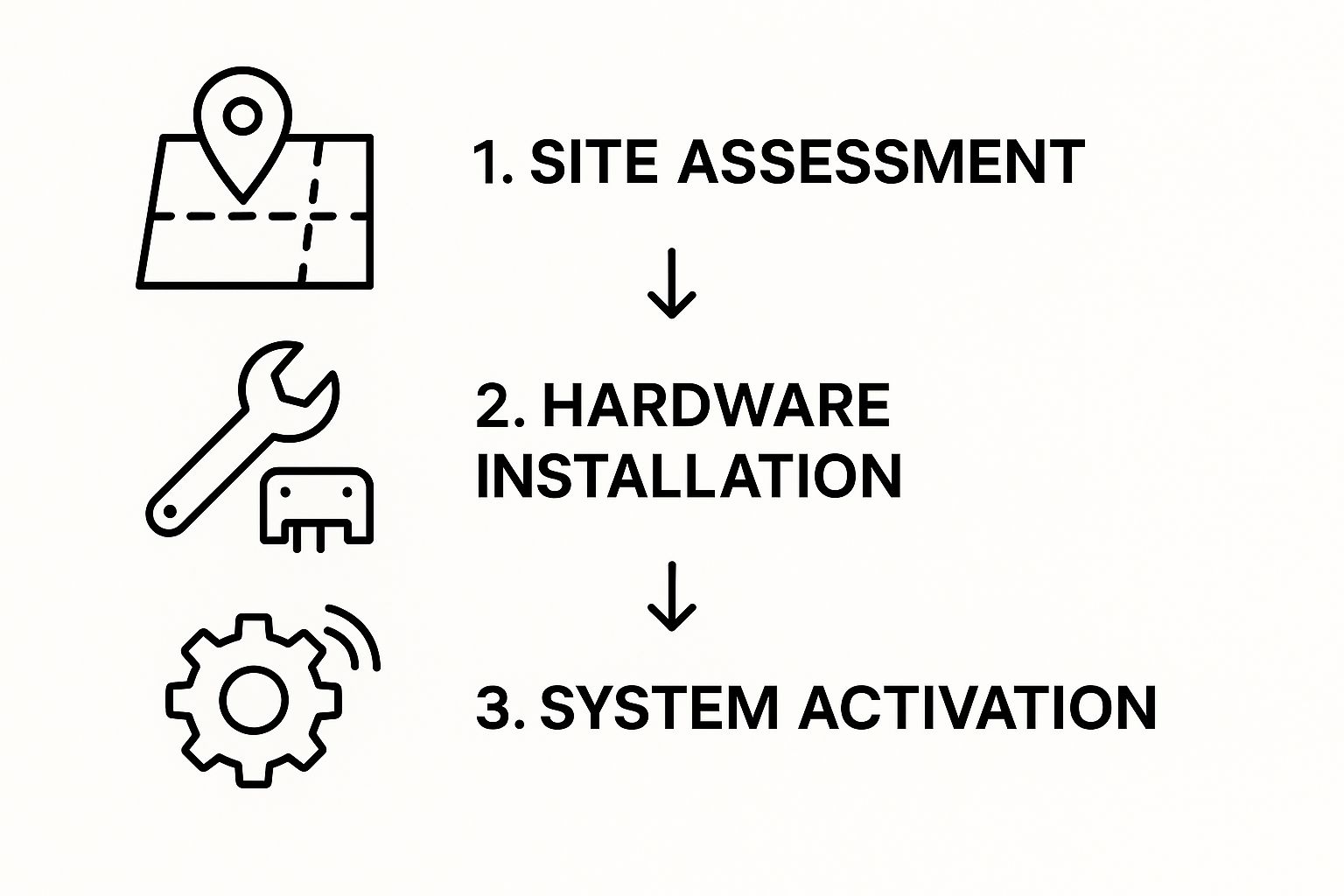
A professional installer runs this gauntlet for you, but knowing the stations helps you spot incompetence early. The sequence: site survey and structural review → design finalization → permit submission to the AHJ (building and electrical, sometimes fire review) → utility interconnection application → installation → city/county inspection → utility permission to operate (PTO). The permitting-and-PTO tail is where timelines stretch: installation takes one to three days, but jurisdictions and utilities routinely take two to eight weeks at each paper gate. An installer who quotes "two weeks start to finish" in a slow jurisdiction is guessing or fibbing; ask what current permitting lead times are in your specific city and utility territory.
Unlocking Your Financial Incentives
The federal Residential Clean Energy Credit (30% at the time of writing — confirm current law with your tax professional, because these provisions have changed repeatedly) applies to equipment and installation labor, including batteries paired with the system. Stack on state and utility incentives where they exist: state tax credits, sales-tax exemptions, property-tax exclusions (solar typically should not raise your assessed value — verify your state's rule), SRECs in eligible markets, and utility rebates. Net metering policy is the big economic lever: full retail-rate net metering makes solar economics sing; avoided-cost or net-billing structures stretch payback and reward battery pairing and self-consumption design. Your installer should model your actual rate tariff, not a generic savings slide.
What to Expect During the Installation Process
Final Design and On-Site Survey
After contract signing, a legitimate process starts with a physical site survey: roof measurements and condition, attic structural check, electrical panel inspection, shade analysis with a site tool, and photos for the design team. Satellite-only designs routinely miss vent stacks, attic surprises, and panel-capacity issues; if no one ever visits your house before install day, expect change orders. Final design should land in your inbox for approval — array layout, equipment list, production estimate — before permits are filed.
The Physical Installation
Residential installs run one to three days with a crew of three to five. Day one is typically racking and attachments; modules and electrical follow. What good looks like: flashed penetrations (not just sealant), torque-marked clamps, tidy wire management with UV-rated clips, conduit runs that follow the roofline, and a crew lead who walks you through the shutdown procedure and monitoring setup at the end. Panels come from the distributor's shelf — the same module inventory and pre-configured kits we ship to installers daily — and you can verify the model numbers on the boxes against your contract before they go on the roof. Do that. It is your right, and good crews expect it.
Inspection and Commissioning
After the city inspection comes utility PTO — the meter swap or reprogramming that legally lets you export. Do not energize before PTO; utilities take a dim view and some levy fees. At commissioning, your installer should hand over: as-built drawings, permit sign-offs, equipment warranty registrations, monitoring login, and a production baseline. Photograph your meter and the first day's production. That baseline is what every future warranty conversation starts from — and if you ever want module-level verification, our panel output testing guide shows what a professional baseline test involves.
Considering Batteries or a DIY Path?
If outage protection matters, discuss storage at quote time — battery-ready hybrid inverters and battery systems are far cheaper to integrate on day one than to retrofit. And if you are a genuinely handy owner-builder in a jurisdiction that allows homeowner electrical work, DIY solar kits with engineered documentation exist for exactly that path — but be honest about the permitting, roof-work safety, and warranty-service implications before choosing it.
Sizing the System to Your Actual Usage
Before comparing bids, know your own target. The math is one line: annual kWh ÷ (peak sun hours × 365 × performance ratio) = required kW DC. With a performance ratio of 0.80 (accounting for temperature, soiling, inverter, and wiring losses), a home using 12,000 kWh/year in a 4.5-sun-hour region needs 12,000 ÷ (4.5 × 365 × 0.80) ≈ 9.1 kW — call it twenty-three 400W modules. The reference table below uses that same math across usage levels and sun regions:
| Annual Usage | Avg. Monthly Bill Context | System Size @ 4.0 PSH | System Size @ 5.5 PSH (SW US) | Modules (400W) |
|---|---|---|---|---|
| 6,000 kWh | Modest 1–2 bed home | 5.1 kW | 3.7 kW | 10–13 |
| 9,000 kWh | Typical efficient home | 7.7 kW | 5.6 kW | 14–19 |
| 12,000 kWh | Average US home | 10.3 kW | 7.5 kW | 19–26 |
| 18,000 kWh | Large home / EV owner | 15.4 kW | 11.2 kW | 28–39 |
| 24,000 kWh | All-electric + 2 EVs | 20.5 kW | 14.9 kW | 38–52 |
If a bidder proposes a system wildly above your usage-based size, ask why — oversizing beyond 100–110% of annual use rarely pays under net-billing regimes, because exported energy credits at a fraction of retail. If a bidder proposes far below it, confirm whether shade or roof area is the constraint, and whether the production estimate accounts for it honestly. This is also the moment to plan for the loads you know are coming: the EV, the heat-pump conversion, the hot tub somebody will buy. Upsizing now costs module prices; upsizing later costs a second permit, a second crew, and a second interconnection review.
Red Flags and Sales Tactics to Recognize on Sight
The residential solar industry's worst actors share a playbook, and it is short. Learn it once and you are immune:
| Tactic | What It Sounds Like | What It Actually Means |
|---|---|---|
| Urgency pricing | "This price expires tonight" | Equipment and labor markets do not move in hours; the discount was fake |
| "Free solar" | "No cost to you — the government pays" | A lease or PPA described dishonestly; you are signing a 20–25 year contract |
| Utility impersonation | "We're working with your power company" | Utilities do not sell rooftop solar door-to-door; verify independently |
| Vague equipment | "Premium Tier 1 panels" | Refusing model numbers means shopping your contract to the cheapest hardware |
| Inflated production | "You'll never have a power bill again" | Check the shading assumptions; trees do not move for sales targets |
| Pressure against competing bids | "Other companies will just lowball you" | Confident installers encourage comparison; frightened ones prevent it |
One behavioral rule covers most of the table: any deal that cannot survive you sleeping on it and getting two competing quotes is a deal you do not want. Legitimate installers hold prices for weeks and encourage shopping — they know how the comparison ends.
After the Install: Monitoring, Maintenance, and Warranty Life

The relationship with your installer matters most after the ribbon-cutting. Learn your monitoring app in week one and set production alerts — a 20% drop against expected output is the threshold that deserves a service ticket. We tell every homeowner the same thing: look at the app monthly for the first year and quarterly after that, because the customers who catch faults early are the ones watching. Maintenance is light but real: annual visual inspection, occasional cleaning where soiling warrants (most rain-shed climates need none; dusty agricultural areas need one to two cleanings a year), and a production review every year against your commissioning baseline. Module-level electronics make diagnosis cheap; string systems rely on the installer's service rigor. Put the warranty stack somewhere findable — a folder with the contract, permits, equipment serials, monitoring login, and the installer's service number — and photograph it. When the inverter faults on a Saturday in 2031, that folder is the difference between a ten-minute call and an archaeology project. If you add storage later, the battery care rules and our battery maintenance guide will keep that half of the system healthy too.
Special Situations: HOAs, Renters, Shade, and New Construction
HOAs: roughly half of US states now have solar access laws that limit an HOA's ability to prohibit installations — but HOAs can still impose reasonable aesthetic conditions (street-facing placement restrictions, conduit painting) in most of them. Pull the CC&Rs and your state's statute before design, and submit the architectural review early; it runs on HOA-meeting time, not contractor time. Renters: rooftop solar is the landlord's decision, full stop — community solar subscriptions are the practical alternative, and they are worth evaluating on the same $/kWh basis. Heavy shade: a roof with meaningful shade between 9 a.m. and 3 p.m. needs either tree work or module-level power electronics, and sometimes the honest answer is that solar does not pencil on this house. A good installer says so. We respect the companies that decline bad roofs more than the ones that sell them anyway. New construction: if you are building, solar-ready design is nearly free at blueprint stage — south-facing roof plane at a reasonable pitch, a conduit chase from attic to panel, panel capacity headroom, and rafters laid out to avoid vent conflicts. Builders who offer "solar-ready" packages and actual solar installations are different products; ask which one is on the spec sheet and what it includes.
How Your Installer's Supply Chain Affects You
One vetting dimension homeowners rarely consider: where does the installer's equipment actually come from? Companies with real distributor relationships get firm lead times, consistent module batches (mixing module batches on one roof creates visible color mismatch and warranty headaches), and warranty support that flows. Companies buying spot-market leftovers inherit whatever the market is dumping that month — sometimes genuinely fine equipment, sometimes orphan SKUs from bankrupt manufacturers with warranties that are already fiction. Ask your bidder a simple question: "If a module fails in year six, who stocks the replacement, and who pays the labor?" The answer reveals the entire supply chain behind your roof. Installers sourcing through established distribution — the same inventory behind our panel, microinverter, and string inverter catalogs — can answer it in one sentence.
Answering Your Top Solar Installer Questions
How many solar quotes should I get before deciding?
Three is the sweet spot — enough to reveal the market's shape, few enough to stay sane. Five quotes rarely add information; they add confusion. If the three diverge wildly on system size or production estimates, get a fourth specifically to arbitrate the gap.
What are the most important qualities in a solar company?
In order: longevity and local service capability (they will answer the phone in year nine), installation quality (references and drive-bys, not brochure photos), transparent equipment and pricing, and design competence. Sales polish is not on the list. The best installers we supply are often mediocre marketers.
How long does the entire solar process take?
Contract to PTO typically runs six to fourteen weeks depending on your jurisdiction and utility. Installation itself is one to three days. The paper gates — permits, utility review, PTO — consume the calendar, and no honest installer can fully control them.
Should I wait for better technology or lower prices?
No. Module efficiency improves a percent or two a year and prices drift, but the utility bill you pay while waiting is real money, and incentive structures change in both directions. The best time to install a well-designed system from a solid installer is when your roof, finances, and incentives line up — not after another year of waiting for a marginally better panel.
What if my installer goes out of business?
Manufacturer warranties survive the installer; workmanship warranties do not. This is the strongest argument for established companies and for equipment with strong manufacturer support networks. Keep your documentation packet — permits, equipment serials, warranty registrations — so any competent local company can service the system later.