Solar Array Size Basics: What "25 kW" Actually Means
Shop this guide


Number of Panels Needed
A 25 kW solar array is rated by its DC nameplate capacity: the sum of every panel's wattage under standard test conditions — 1,000 watts of irradiance per square meter, 25°C cell temperature, laboratory light. Twenty-five kilowatts is 25,000 watts of panels. That single number drives everything else in this guide: how many panels you buy, how much roof they cover, what inverter you pair them with, and how much energy the system produces where you live.

Two things the nameplate is not. It is not what the array produces at noon in your yard — real output depends on peak sun hours, cell temperature, shading, soiling, and system losses. And it is not a residential-standard size. The typical American home installs 8–12 kW, so a 25 kW array is two to three times that. It belongs on large homes with serious consumption, small commercial buildings, farms, and warehouses. We've supplied equipment for several 25 kW-class projects, and they all shared one trait: the owner had already done the math on their utility bill and knew exactly why they needed this much array.
If you're converting between electrical units while planning, the logic is the same one we use in our electrical panel capacity work: nameplate is potential, not delivery. Delivery is engineering.
Key takeaways
- Panel count: 45–100 panels depending on wattage class (63 at 400W, ~46 at 550W).
- Module area: roughly 1,100–1,750 sq ft of panels before setbacks and aisles.
- Daily production: ~74–128 kWh depending on regional peak sun hours.
- Roof or ground: both work; ground mounts simplify layout but cost more up front.
- Electrical: a 25 kW array typically needs 200A+ service and often three-phase at commercial sites.
Panels Required by Wattage

Divide 25,000 watts by the panel wattage and you get the count. Round up — you can't install a third of a panel:
Total Array Area by Panel Wattage
| Panel Wattage | Panels Required for 25 kW | Total Panel Area (sq ft) |
|---|---|---|
| 250 W | 100 panels | 1,750 sq ft |
| 300 W | 83 panels | 1,453 sq ft |
| 350 W | 72 panels | 1,260 sq ft |
| 400 W | 63 panels | 1,103 sq ft |
The 250W row is mostly history — that class has aged out of new installations and survives mainly in the used and surplus market. Today's residential market runs on 400–450W modules, and commercial work increasingly standardizes on 500–600W formats. Here is the same math with current-generation panels:
| Panel wattage | Panels for 25 kW | Approx. module area | Notes |
|---|---|---|---|
| 400–450W residential | 56–63 | ~1,100–1,310 sq ft + aisles | Standard residential class; easy two-person handling |
| 440W | 57 | ~1,310 sq ft | Common premium residential class |
| 500W commercial | 50 | ~1,275 sq ft | Balance of size and handling |
| 550–615W commercial (large format) | 45–46 | ~1,225 sq ft | Fewest modules; heavier per unit, plan crew size |
Fewer panels means less racking, fewer clamps, fewer wiring connections, and less labor per installed watt — which is why commercial installers love big-format modules. Every module-to-module junction is one more pair of hands on the roof and one more connection to torque and inspect. The tradeoff is handling: a 550W commercial panel runs roughly 7.5 feet long and 60+ pounds, and it turns into a sail in any wind. I have watched a two-man crew wrestle large-format modules up a ladder lift in a 15-mph breeze; it is the part of the job nobody puts in the brochure.
One more consideration that rarely makes the brochures: panel count affects resilience. A 100-panel array loses 1% of capacity when one module fails or shades out. A 45-panel array loses over 2% per module. With module-level electronics the difference is manageable, but on a plain string design the high-count array degrades more gracefully.
Physical Space Requirements

A standard residential panel occupies about 17.5 square feet. Multiply panel count by that figure and then add what the module spec sheet doesn't tell you: fire-code setbacks at ridges and eaves (typically 3 feet), maintenance walkways, and the dead space around roof penetrations, vents, and skylights.
| Panel Wattage | Panels Needed | Panel Area (sq ft) | Total with Clearance |
|---|---|---|---|
| 250 W | 100 | 1,750 | ~2,000 sq ft |
| 300 W | 83 | 1,453 | ~1,650 sq ft |
| 350 W | 72 | 1,260 | ~1,450 sq ft |
| 400 W | 63 | 1,103 | ~1,250 sq ft |
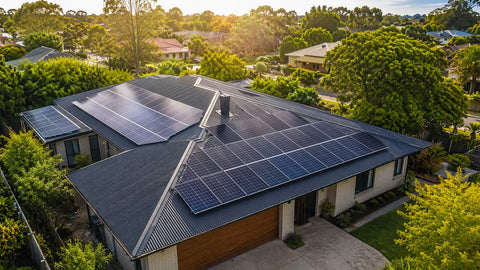
So the honest answer to "how big is a 25 kW array": plan on 1,250 to 2,000 square feet of usable mounting surface, with 1,300–1,500 sq ft being typical for current 400W+ modules. That is a large residential roof's worth of south- and west-facing planes, or a ground mount roughly the footprint of a three-car garage.
Factors Affecting Array Size
For perspective, a 10 kW array with the same 350W panels needs about 500 sq ft and a 50 kW array about 2,500 sq ft. Array area scales almost perfectly linearly with system size — the only variable is the module class you choose:
| System Size (kW) | Panels (350W each) | Area per Panel (sq ft) | Total Panel Area (sq ft) |
|---|---|---|---|
| 10 kW | 29 | 17.5 | 507 |
| 25 kW | 72 | 17.5 | 1,260 |
| 50 kW | 143 | 17.5 | 2,503 |
How panel efficiency changes the footprint
Solar Panel Efficiency
| Panel Efficiency | Approx. Area Needed (sq ft) | Notes |
|---|---|---|
| 15% | 1,600–1,700 | Standard polycrystalline — most space required |
| 18% | 1,300–1,400 | Mid-grade monocrystalline — moderate use |
| 20% | 1,100–1,200 | High-efficiency monocrystalline — recommended for tight roofs |
| 22–24% | 1,000–1,100 | Premium panels — smallest footprint possible |
Efficiency buys area, nothing more. A 15%-efficient panel and a 22%-efficient panel produce the same watt per nameplate dollar in the same sun; the premium panel just does it in less space. Pay for efficiency when the roof is the constraint. When space is abundant — a barn roof, an open field — mid-efficiency panels win on cost per watt every time. We see buyers overpay for premium efficiency on forty-acre farms about as often as we see buyers try to squeeze bargain panels onto a chopped-up Victorian roof. Match the module to the constraint, not the marketing.
Factors That Shrink or Stretch Your Real Footprint

Four variables move the space requirement beyond the tables above. Tilt first: panels at optimal tilt produce more per square foot of module, but tilted rows on flat roofs and ground mounts must be spaced to avoid self-shading, so the land footprint grows even as module efficiency improves. Azimuth second: south-facing is ideal in the northern hemisphere, but west-facing arrays trade a few percent of annual production for late-afternoon output that better matches evening loads and time-of-use rates.
Shading third — and this is the one that kills amateur layouts. A single vent pipe shadow crawling across a string of panels can cost that string a third of its daily production. At 25 kW, a proper shade analysis is not optional. Fourth is setbacks: fire codes typically require 3-foot clear pathways at ridges and eaves and along at least one roof edge, and on a complex roof those pathways consume 15–25% of the gross roof area. A 2,000 sq ft roof does not hold 2,000 sq ft of panels. It never has.
Power Output: What 25 kW Produces Where You Live

Production math is one multiplication: nameplate kW × peak sun hours × system efficiency (figure 85% after inverter, wiring, temperature, and soiling losses). Peak sun hours are not daylight hours — they are the equivalent hours of full-strength test-condition sun your location averages per day across the year. A 25 kW array in Portland and a 25 kW array in Phoenix are the same equipment producing very different results:
| Region | Peak sun hours | Daily kWh | Monthly kWh | Annual kWh |
|---|---|---|---|---|
| Pacific Northwest | 3.5 | ~74 | ~2,230 | ~27,000 |
| Midwest / Northeast | 4.0 | ~85 | ~2,550 | ~31,000 |
| Mid-Atlantic / California | 5.0 | ~106 | ~3,190 | ~38,800 |
| Southwest | 6.0 | ~128 | ~3,830 | ~46,500 |
For context, the average US household uses about 30 kWh per day — roughly 10,500 kWh per year. A 25 kW array covers that two to four times over in most regions. That is exactly the point: systems this size are sized against big loads. Electric heating, multiple EVs charging nightly, a workshop, a pool, or genuine commercial daytime demand. If your annual usage is under 15,000 kWh, a 25 kW array is the wrong tool; our grid-tied solar systems run the full size range down to starter residential kits.
Seasonality matters as much as the annual average. Summer production can run 60% above winter in northern latitudes — a Pacific Northwest array that makes 100+ kWh on a long June day might manage 35 on a gray December one. Size the array against your annual goal and let net metering smooth the seasons. Temperature cuts the other way: panels lose roughly 0.3–0.4% of output per degree Celsius above 25°C cell temperature, which is why a cool, bright April day often outperforms a scorching August afternoon. Roof-mounted arrays run hotter than ground mounts because airflow underneath is restricted — one more small edge to ground mounting when land allows.
Roof vs. Ground Mounts
| Feature | Roof Mount | Ground Mount |
|---|---|---|
| Space needed | ~1,500–1,700 sq ft on roof | ~1,500–2,000 sq ft on ground |
| Installation location | On existing roof surface | Open land or yard |
| Sunlight angle | Fixed by roof angle and pitch | Fully adjustable for optimal angle |
| Ease of maintenance | Harder — roof access required | Easy access for cleaning and inspection |
| Structural requirements | Roof load capacity must be verified | Ground anchoring; soil assessment needed |
| Impact on property | Uses existing building space | Requires dedicated land area |
| Typical cost difference | Lower install cost (no ground framework) | Higher initial cost — better long-term performance |
At 25 kW the roof question gets structural. Sixty-plus panels plus racking adds several tons of distributed load — figure 3–4 pounds per square foot including racking — and any roof over fifteen years old should be evaluated, and usually re-roofed, before the array goes on. Pulling an array to reshingle underneath it is the most expensive maintenance event in residential solar; spend the roof money first.
Ground mounts solve the roof problem and add a row-spacing problem: tilted rows shade each other, so arrays need inter-row clearance that scales with latitude. In the Pacific Northwest we plan row spacing at roughly 2.5 times panel height to protect December production, when the sun rides low and shadows stretch long. Soil matters too — expansive clay or high water tables change the footing design. For serious ground-mount work, engineered racking like the Sinclair Sky Rack 2.0 ground-mount kit takes the guesswork out of wind-load and footing design, and bifacial modules from our bifacial collection add a measurable rear-side production bonus over reflective ground cover.
Residential vs. Commercial at 25 kW

The same 25 kW nameplate behaves like two different systems depending on the building under it:
| Aspect | Residential 25 kW Array | Commercial 25 kW Array |
|---|---|---|
| Number of panels | ~56–63 (400–450W) | ~45–50 (500–550W) |
| Total area | ~1,300–1,450 sq ft | ~1,225–1,300 sq ft |
| Roof type | Pitched (asphalt, tile, metal) | Flat commercial or ground mount |
| Inverter type | String inverter or microinverters | String or central 3-phase inverter |
| Typical use | Large home, EV charging, high-consumption property | Small business, office, retail, light industrial |
| Utility connection | Single-phase (typically 240V) | Three-phase (208V or 480V) |
The electrical service is where residential 25 kW projects hit their real constraint. A 25 kW array backfeeding through a single-phase inverter can push 100+ amps, and the NEC 120% rule on a standard 200A panel caps solar backfeed at 40A unless the service is upgraded, the main breaker is downsized, or a line-side tap is used. We have seen more than one residential project value-engineered down to 18 kW purely because the service panel said so. Plan the interconnection before you fall in love with a panel count.
Commercial sites dodge that problem with three-phase service but inherit demand-charge economics instead: a 25 kW array shaves energy charges beautifully while doing less for peak demand charges unless it is paired with storage. Two systems, same nameplate, different spreadsheets.
Inverters, Storage, and System Balance

A 25 kW array pairs with inverter capacity somewhat below nameplate — a DC-to-AC ratio of 1.2 to 1.35 is standard practice, so 18–20 kW of inverter is typical. Clipping losses at peak noon are trivial against the hardware savings and the better low-light efficiency of a well-loaded inverter. String inverters win on cost for unshaded commercial layouts; module-level electronics earn their premium on complex residential roofs with multiple planes and partial shade. Browse the current options in our solar inverter collection.
Storage changes the sizing logic entirely. If the goal is backup or self-consumption rather than pure grid offset, pair the array with a battery bank sized to your critical loads — our battery sizing guide walks the full calculation step by step, and the battery storage collection covers current LiFePO4 options. A 25 kW array can recharge 30–50 kWh of storage on an average day in most of the country, which is genuine whole-home autonomy. The 20-80 battery rule explains how to keep that bank healthy for a decade once it's in.
Permitting, Interconnection, and Inspection

At 25 kW you are past the size where anyone waves paperwork through. Expect a structural review of the roof or ground-mount footings, an electrical permit covering the array, rapid-shutdown compliance (NEC 690.12) at the module level, and a formal utility interconnection agreement. Residential interconnections above ~10 kW often trigger a utility engineering review; above 25 kW many utilities require an impact study. Budget four to twelve weeks for the interconnection queue depending on your utility, and do not schedule the install crew until the agreement is signed. I've seen a completed 25 kW array sit dark for six weeks waiting on a utility witness test — the panels don't care, but the customer's payback clock started late.
What 25 kW Costs and What It Earns

Installed residential solar in the US runs roughly $2.50–$3.50 per watt before incentives, putting a turnkey 25 kW system in the $62,000–$87,000 range, with commercial ground mounts sometimes lower per watt due to labor efficiency. The 30% federal Investment Tax Credit — still the backbone of project economics — pulls the effective cost down by nearly a third. Against that, annual production of 27,000–46,500 kWh offsets $3,500–$7,000+ of retail electricity depending on your utility rate.
| Scenario | Installed cost (before ITC) | After 30% ITC | Annual offset @ $0.14/kWh | Simple payback |
|---|---|---|---|---|
| Pacific Northwest, roof mount | ~$75,000 | ~$52,500 | ~$3,780 | ~14 years |
| Midwest, roof mount | ~$72,000 | ~$50,400 | ~$4,340 | ~11.5 years |
| California / Mid-Atlantic | ~$70,000 | ~$49,000 | ~$5,430 | ~9 years |
| Southwest, ground mount | ~$80,000 | ~$56,000 | ~$6,510 | ~8.5 years |
Payback shortens wherever retail rates run higher than $0.14/kWh — California and Northeast rates push these numbers well under eight years — and lengthens in cheap-power states. Equipment-only buyers and DIY-capable owners can cut the installed figure dramatically; the DIY solar kit collection exists for exactly that buyer. One caution from experience: at this system size the difference between a well-priced and a poorly-priced quote can be $20,000. Get three bids, compare $/W line by line, and ask each bidder to explain their interconnection plan.
Maintenance and Degradation Over 25 Years

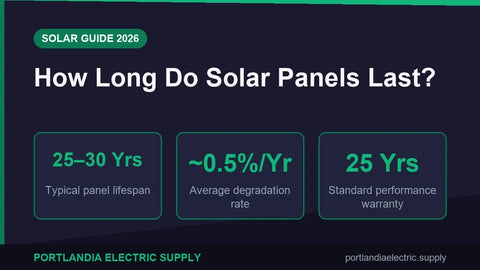
Panels degrade roughly 0.5% per year — a 25 kW array is a 22–23 kW array at year twenty, still productive, still earning. Maintenance at this scale is mostly vigilance: annual production review against expectation, an occasional rinse in dusty or pollen-heavy regions, and a string-level check if monitoring shows one string lagging its siblings. Keep gutters and overhanging branches managed so debris and shade don't creep onto the array year by year — both arrive gradually and both bill you gradually. Snow clears itself from tilted arrays faster than people expect — the dark glass warms quickly in morning sun and sheds the load in sheets; do not climb up there with a broom. Budget for one inverter replacement over the system's life on string designs — that is the component with the real wear curve, and the inverter collection will still be here when it happens.
A Real Layout Walkthrough: 57 Panels on a Two-Plane Roof

Theory is tables; practice is a roof with a mind of its own. Take a recent project: a 2,900 sq ft two-story with a main south plane of about 900 sq ft and a west plane of roughly 700. The owner's target was 25 kW using 440W panels — 57 modules. The south plane swallowed 34 panels in four rows with the required 3-foot ridge setback and a pathway down the east edge. The west plane took 18 more in three rows. That left five panels with nowhere sensible to live.
Options were a small east dormer (shaded by a maple until noon, a non-starter), a garage roof (structurally fine, but it pushed the array's DC run another sixty feet), or dropping to 52 panels and calling it 22.9 kW. The owner chose the garage. The lesson generalizes: at 25 kW you will almost never use every roof plane you thought you had. Chimneys, plumbing vents, setbacks, and the fire marshal's pathways take their cut first. Design to 110% of the roof you think is available and you land at 100% of the system you wanted.
Stringing followed the planes: three strings on the south, two on the west, one on the garage, each on its own MPPT input so the maple's morning shadow on the west plane never touched the south plane's production. That detail — one input per plane, minimum — is the cheapest production insurance in residential solar.
Reading Your Local Sun Hours Correctly

The peak-sun-hour figure in the production table is an annual average, and annual averages lie politely. They hide the fact that a 4.0-sun-hour region might see 6.5 in July and 1.8 in December. For grid-tied sizing with net metering, the annual number is the right one — the grid is your battery and the seasons cancel. For off-grid or storage-heavy design, the worst month is the right number, because your battery bank has to survive December, not average through it.
Find your local figure in NREL's PVWatts database or your state's solar resource map, and be honest about your site versus the map. The map assumes an unshaded array at optimal tilt. Your roof's actual tilt and azimuth might cost you 5–15% against the ideal, and that's before the neighbor's oak tree votes. A 25 kW array at a 15% site penalty behaves like a 21 kW array on paper — which is why we size from the production target backward, not from the roof forward, whenever consumption is the driver.
Electrical Design: Strings, Voltage, and Conductor Sizing

At 25 kW the DC side stops being trivial. Sixty-odd panels wire into series strings whose voltage must stay inside the inverter's MPPT window across your local temperature range — remember that panel voltage rises as temperature falls, and a string that's legal in September can exceed the inverter's 600V (residential) or 1,000V (commercial) input limit on a January morning. String sizing software exists precisely for this calculation; use it with your record-low temperature, not your average low.
On the AC side, 20 kW of inverter output at 240V single-phase is about 83 amps continuous — call it 105A of overcurrent protection after the 125% continuous-load factor, which means 1/0 copper feeders and, per the 120% rule discussion above, usually a line-side tap or a service upgrade on a 200A panel. Three-phase commercial services handle this more gracefully: the same power spreads across three legs at 208V or 480V and the per-leg amperage drops to comfortable levels. This is the unglamorous engineering that separates a 25 kW system that inspects cleanly from one that gets red-tagged, and it's why the electrical design belongs in the first conversation, not the last.
Warranties, Degradation, and What the Paperwork Actually Promises

Current-tier panels carry 25-year performance warranties guaranteeing roughly 85–90% of nameplate output at year 25, plus 12–25-year product warranties against defects. Read which is which: the performance warranty is the one that matters economically, and it only promises the degradation curve, not a service visit. Keep your commissioning photos and production baseline — a warranty claim on an underperforming string is won with data, not with vibes.
Inverters carry shorter coverage, typically 10–12 years on string units, extendable for a price. On a system this size, extended inverter warranty is usually worth buying: one out-of-warranty central inverter replacement is a four-figure event plus labor, and the math favors the extension more often than not. Module-level electronics flip the economics — 25-year coverage is standard there, which is part of their value case on complex roofs.
Common Mistakes at the 25 kW Scale

After watching projects in this class succeed and stumble, the failure patterns repeat. Sizing from roof space instead of consumption, and ending up with a system that over-produces into a utility that pays pennies for exports. Skipping the re-roof, and paying double labor five years later. Ignoring the interconnection timeline, and watching the array sit dark waiting for permission to operate. Under-speccing the inverter ratio at 1.0, and clipping away free production every sunny noon for twenty-five years. And the quietest mistake: no consumption monitoring, so nobody notices when a string drops out in year three and the array silently becomes a 23 kW system. Put eyes on production from day one.
Snow, Hail, Wind: Weather Engineering at This Scale
A 1,400-square-foot array is a weather surface, and the engineering treats it that way. Wind load drives racking selection: modules act as lifting surfaces, and the uplift forces on a 60-panel array in a 90-mph design-wind zone are measured in tons. Rails, attachments, and their spacing into the rafters — not just the decking — are what keep the array on the building. This is why engineered racking with stamped calculations matters more at 25 kW than at 8 kW; the surface area triples and so does the consequence of getting attachment spacing wrong.
Snow load works the other direction, pushing down. Modules are typically rated for 5,400 Pa front load (about 113 psf), which handles realistic snow depths on any reasonable pitch — steep sheds snow before depth accumulates. Hail is the anxiety everyone voices and the statistic that reassures: panels are tested to survive 25mm (1-inch) hail at 23 m/s, and field survival rates in hail events run above 99%. The bigger weather risk at this scale is mundane: a single broken module from a falling branch is cheap to replace, but finding the exact replacement model five years into a product cycle can be a scavenger hunt. Buy two spares with the original order. Future you will be grateful.
Build It All at Once or in Phases?
Some buyers split 25 kW into two phases — 12.5 now, 12.5 later — usually for cash-flow reasons. It works, but understand the cost: two mobilizations, two permitting cycles, two interconnection applications, and often two inverter platforms if the second phase lands years later. The electrical infrastructure — service upgrade, conduit runs, inverter pad — should be built for the final size in phase one even if the modules arrive later. Trenching twice is the most avoidable expense in phased solar.
The stronger argument for phasing is technological: module wattages keep climbing, and the 450W panel you buy today will be a 550W panel at the same price in a few years. The counterargument is that incentive structures, utility export rates, and interconnection rules change too — and rarely in the buyer's favor. Our standard advice: if you have the roof, the service, and the capital, build once at full size. If any of the three is missing, fix it first, then build once.
Net Metering, Export Rates, and Why the Spreadsheet Changed
Production math tells you what the array makes; rate math tells you what it's worth, and the two diverge more every year. Under classic one-for-one net metering, every exported kWh offsets a retail kWh and the payback table above holds. Under the export-rate structures spreading across the country — avoided-cost credits, time-of-use netting, reduced export compensation — an exported kWh might be worth a third of a consumed one. At 25 kW, where daytime production can double your building's daytime consumption, that difference is the whole ballgame.
The countermove is load shifting and storage. Run the big discretionary loads — water heating, EV charging, pool pumps, commercial process loads — against the solar peak, and the array's value stays at retail rates. Add batteries and you carry the peak into the evening, selling nothing at a discount. A 25 kW array on a weak export rate without a load-shifting plan is a donation to your utility; the same array with aligned loads is the best investment on the property. Design the consumption side with the same care as the generation side. It is the single biggest change in solar economics since the module price collapse, and it rewards owners who think like operators.
Ground-Mount Layout Math: A Worked Example
Say you're ground-mounting 50 large-format 500W panels at 40°N latitude. Each module is about 7.5 ft by 3.7 ft. Mount them two-high in portrait on fixed-tilt racking at 30° and each row presents roughly 10 feet of panel height measuring from ground to top edge. The row-spacing rule of thumb — 2.5 times panel height at Pacific Northwest latitudes, closer to 2 times in the Southwest — puts your row pitch at 20–25 feet measured from the front edge of one row to the front edge of the next.
Twenty-five panels per row, two rows: that's 50 modules on two rows of roughly 95 feet each. Total land envelope with spacing and access: about 100 ft by 45 ft, or 4,500 sq ft — three times the module area. This is the number people underestimate. Module area is what the panels cover; land area is what the sun demands. On a roof the geometry is fixed for you by the building; on the ground you pay for the geometry in acreage. Either way, run the shading math for the winter solstice, because that's when the sun is lowest, shadows are longest, and an undersized row pitch quietly eats your December production — the production your batteries wanted most.
25 kW Array Size at a Glance
| Question | Short answer |
|---|---|
| How many panels? | 45–100 depending on wattage; 56–63 for standard 400–450W modules |
| How much roof? | 1,250–2,000 sq ft including setbacks and aisles |
| Daily energy? | 74–128 kWh by region |
| Annual energy? | 27,000–46,500 kWh |
| Homes covered? | 2–4× average US household usage |
| Service needed? | 200A+ residential with interconnection planning; 3-phase common commercially |
Source Your 25 kW Solar Equipment
We stock the modules this size class actually uses. For premium residential footprints, the Silfab Elite N-Type TOPCon residential panel delivers high efficiency in a standard residential format; for commercial-format builds, browse the commercial solar panel collection for 500W+ modules. The full solar panel catalog spans every wattage class in this guide. Brand-loyal buyers can shop Qcells, REC, Trina, JA Solar, and Mission Solar directly, and the energy storage collection covers the batteries that turn a big array into a resilient one.
Shop this guide
Frequently Asked Questions
How much power does a 25 kW solar system produce per day?
Between about 75 and 130 kWh per day depending on location. Multiply 25 kW by your peak sun hours and an 85% system efficiency: 3.5 sun hours (Pacific Northwest) yields ~74 kWh/day, 4.5 hours (US average) ~96 kWh/day, and 6 hours (Southwest) ~128 kWh/day.
How many solar panels are in a 25 kW system?
Between 45 and 63 panels with current modules: about 63 panels at 400W, 57 at 440W, 50 at 500W, or 45–46 at 550W. Commercial projects increasingly standardize on 500–600W modules to cut racking and labor costs.
How much space does a 25 kW solar array take up?
Impact of Panel Efficiency
Area vs. Panel Efficiency
Plan on 1,200–1,700 sq ft of module area — roughly 1,250 sq ft for high-efficiency panels in tight rows, up to 1,700+ sq ft for lower-wattage panels with generous setbacks and maintenance aisles. Ground mounts need additional clearance for shading between rows.
Is a 25 kW solar system residential or commercial?
It sits at the boundary. It's 2–3× the size of a typical US residential system (8–12 kW), so it's most common on small commercial buildings, farms, warehouses, and very high-consumption homes — often with EV charging or electric heating.
Can a 25 kW system run a house off-grid?
25 kW Production by Region
Production-wise, easily — even the cloudiest regions see 74 kWh daily against ~30 kWh of average household use. But off-grid living is a storage problem, not a generation problem: you'd need a battery bank sized for your overnight and autonomy loads plus a hybrid inverter. The array is the easy half of that system.
How many batteries do I need with a 25 kW array?
For overnight self-consumption of a large home, 20–30 kWh of usable storage is typical; for multi-day autonomy, 40 kWh and up. A 25 kW array produces enough daily energy to refill those banks in most climates with room to spare.
Sources & Standards
Production estimates use NREL peak-sun-hour methodology with an 85% system efficiency factor; panel dimensions reflect current residential and commercial module datasheets; cost ranges reflect reported US installed-price benchmarks and Portlandia Electric Supply project experience. Structural, setback, and interconnection requirements follow the International Residential Code, local fire codes, and NEC Article 690 (Solar Photovoltaic Systems) including the 120% busbar rule and 690.12 rapid shutdown. Your installer, AHJ, and utility interconnection agreement always govern the final design, and site-specific engineering always wins over any table in this guide.