A hybrid inverter is the one box that ended the solar industry's oldest argument: grid-tied or off-grid. It is both. It converts your panels' DC to household AC like any inverter, but it also manages a battery bank, talks to the grid, switches to backup power when the grid drops, and — on most modern units — accepts a generator input for the ugly weeks. At our counter, the hybrid inverter has gone from specialty item to default recommendation in about five years, and this guide is the full explanation we give installers and homeowners who ask why: what it is, how it differs from every other inverter architecture, how to size one with real math, and what the NEC says about where it lives in your system.
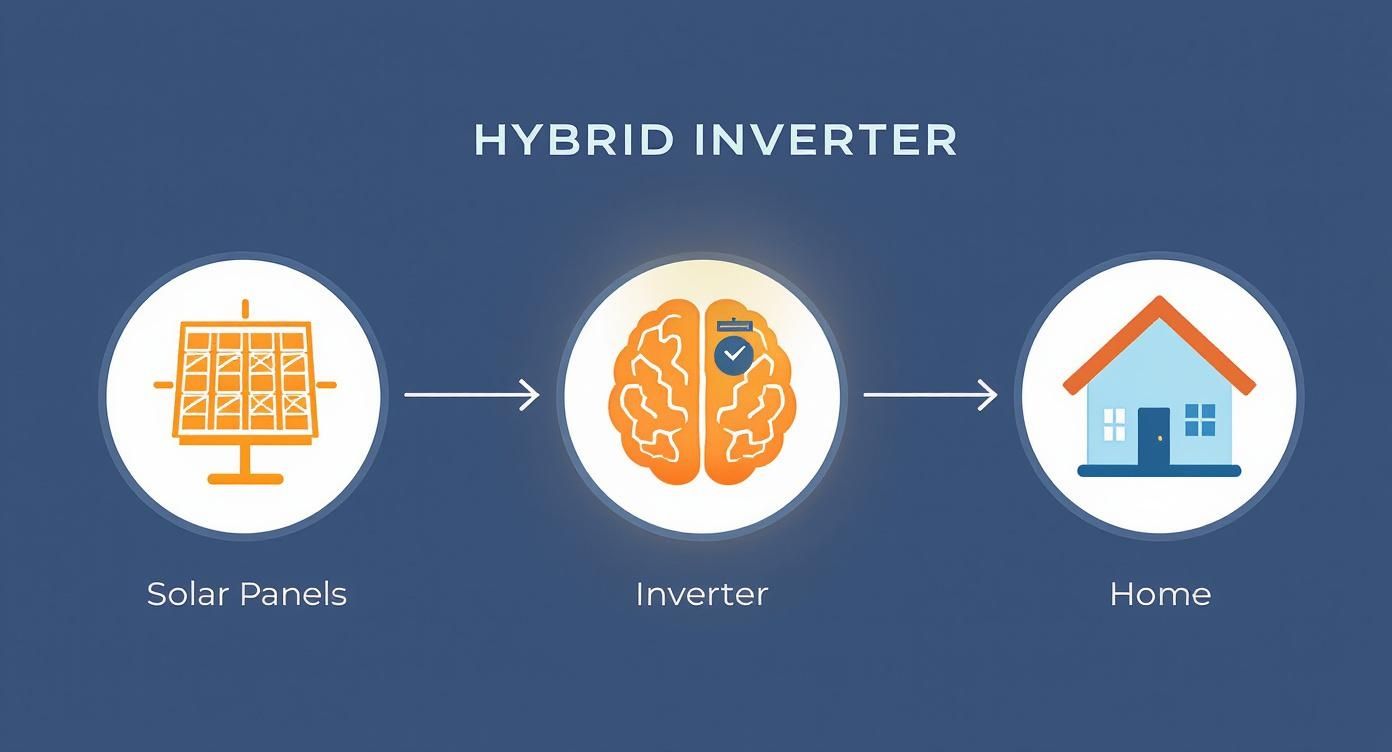
If you already know you want the short version: a hybrid inverter is a bidirectional battery inverter plus a solar inverter plus an automatic transfer switch in a single listed enclosure. For everything that sentence glosses over, read on.
What a hybrid inverter actually does, port by port
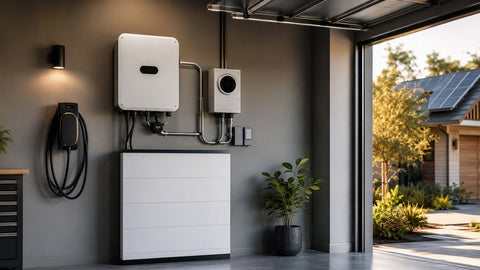
Open the wiring compartment of a modern residential hybrid — the 10 to 12 kW class units we stock for whole-home builds — and you find four electrical territories. The PV inputs: two to four MPPT trackers accepting solar strings, each with a voltage window and current ceiling that string design must respect. The battery port: bidirectional DC, usually 40–60 V nominal for the residential 48 V class, pushing power into the bank when the sun is generous and pulling it out when it is not. The grid port: a bidirectional AC connection that sells surplus, imports when the sun and battery are both short, and participates in grid services where the utility allows. And the backup or loads port: a separate AC output feeding your protected loads panel, energized whether or not the grid exists.
The brain coordinating those four territories is what you are actually paying for. A good hybrid runs programmable operating modes — self-consumption, time-of-use arbitrage, backup reserve, generator support — and makes millisecond decisions about which source serves which load. A great one does it while logging data granular enough to diagnose a failing string from your phone. Our hybrid inverter explainer covers the brand-level differences; this article stays at the architecture level.
Hybrid versus every other architecture
The inverter landscape confuses customers because four different machines all get called "the inverter." Here is the honest taxonomy:
| Architecture | Grid-down operation | Battery integration | Best use case | Weakness |
|---|---|---|---|---|
| String inverter | None — anti-islanding shuts it off (UL 1741) | None native; requires AC-coupled add-on | Simple grid-tied offset, lowest cost per watt | Grid outage = dark house despite a sunny roof |
| Microinverters | None (standard) / limited (grid-forming micros on newer platforms) | AC-coupled only | Shaded or complex roofs, module-level monitoring | Highest cost per watt; battery retrofit is a second system |
| Off-grid inverter-charger | Yes — it IS the grid | Native, DC-coupled | No utility service at all | Cannot sell surplus; no grid assist when stretched |
| Hybrid inverter | Yes — backup port islands protected loads | Native, DC-coupled, bidirectional | Grid-tied with backup, TOU arbitrage, future-proof storage | Higher upfront cost than string; backup panel adds electrical scope |
The killer feature is the last column's flip side: a hybrid installed today with no battery at all still gives the customer the backup port and the battery-ready DC interface. Two years later, adding storage is a battery purchase and a day's labor — not an inverter replacement and a repull of the homeruns. For the retrofit-versus-day-one economics, our energy storage system guide carries the storage side of the story.
Sizing a hybrid inverter: the three-number method
Sizing errors on hybrids come from optimizing one number and ignoring the other two. All three must pass:
| Number | Rule of thumb | Worked example |
|---|---|---|
| Continuous AC output | ≥ the protected loads' simultaneous demand with margin | Household critical loads total 6.5 kW → 10 kW-class unit ✓, 8 kW marginal |
| Surge capacity | ≥ motor starting surge of the largest protected motor | Well pump LRA demands ~3× running; 10 kW unit with 20 kVA 10-second surge handles a 2.5 kW pump start ✓ |
| PV input capacity | Array watts ≤ max PV input; MPPT current ≥ string Imp | 12 kW array on a unit rated 15 kW PV input ✓; 15 kW array on 12 kW input = clipped production |
| Battery charge/discharge rate | Match to bank's C-rating and usable capacity | 20 kWh LFP bank at 0.5C wants 10 kW charge rate — verify the inverter can deliver and the battery can accept |
The surge number is the one that strands people. Air conditioners, well pumps, and shop compressors all present locked-rotor current at start that dwarfs running current. Modern hybrids advertise surge as "2× for 10 seconds" or similar; read the fine print for the duration, because a 3-second surge rating and a 10-second surge rating are different machines in front of a stubborn compressor. The generator sizing guide uses the same surge discipline if you are weighing a genset instead — the physics do not care which box supplies the surge.
The battery side: chemistry and charge profiles
Hybrid inverters are battery-agnostic in theory and battery-particular in practice. The inverter must speak the battery's protocol (CAN or RS485 for managed lithium) or be programmed with correct voltages for unmanaged banks. Typical 48 V-class charge targets:
| Parameter | LiFePO4 (16-cell, typical) | AGM / sealed lead (typical) |
|---|---|---|
| Nominal bank voltage | 51.2 V | 48 V |
| Absorb / charge target | 56.0–58.4 V | 57.6 V |
| Float voltage | 54.0–54.8 V (or float disabled) | 54.0 V |
| Low-voltage cutoff | ≈ 44–48 V (BMS-governed) | ≈ 42–46 V to protect cycle life |
| Round-trip efficiency | ≈ 95% | ≈ 80–85% |
| Usable depth of discharge | 80–90% routine | 50% for reasonable life |
Always confirm the exact values against the battery manufacturer's documentation — the table shows typical published ranges, not a substitute for the datasheet. Our 48 V battery lineup is dominated by lithium iron phosphate for good reason, and the bank sizing guide converts a customer's outage wishlist into kWh. For runtime expectations, the backup runtime calculator makes the math concrete.
Grid interaction: what the utility sees
To the utility, a hybrid inverter is a grid-interactive device that must behave like a good citizen: UL 1741 SB certification (or its SB-listed successor per IEEE 1547-2018) is the interconnection ticket in most territories, covering anti-islanding, ride-through behavior, and export control. That export control is quietly one of the hybrid's best tricks — in jurisdictions with export caps or non-export tariffs, the inverter meters the service entrance and throttles export to zero or to the cap while still serving the house and charging the battery. A plain string inverter cannot do that trick natively; it either exports what it makes or it is off. For net-metering-friendly territories the distinction matters less today, but tariffs drift, and hardware that adapts without a truck roll is worth paying for once.
NEC compliance: where hybrids live in the code
Unpacking the Role of a Hybrid Inverter
How to Choose the Right Hybrid Inverter
Hybrid Inverter Selection Checklist
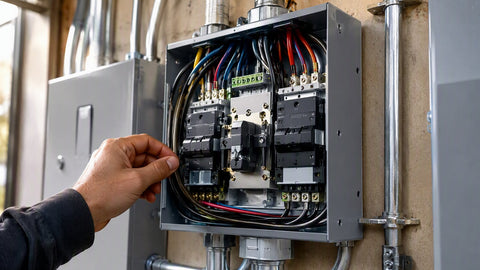
A hybrid inverter touches more NEC articles than any other box on the wall, and inspectors know it. The checklist:
| Code territory | Reference | What the inspector verifies |
|---|---|---|
| PV source circuits | Article 690 — 690.7 voltage, 690.8 current, 690.12 rapid shutdown | String math, RSD function, labels |
| Energy storage | Article 706; listing to UL 9540 for the ESS | Battery listing, disconnects, working clearances, location rules |
| Interconnection | Article 705 — 705.12 load/supply-side rules | Busbar math or supply-side tap done legally |
| Optional standby function | Article 702 | Transfer means preventing parallel utility/backup operation — the hybrid's internal relay must be listed for it |
| Grounding | Article 250 + 690.43 | EGC sizing, neutral-ground handling when islanded (separately derived system behavior) |
That last row fails more hybrid inspections than everything else combined. When the grid relay opens, many hybrids become a separately derived system, and neutral-ground bonding must be correct in both modes — the manufacturer's install manual addresses it explicitly, and the electrician must actually read that section. Our grounding guide and disconnect guide cover the surrounding requirements.
Reading a hybrid datasheet without being fooled
Datasheets in this category are marketing documents wearing engineering clothes. Five lines matter and the rest is decoration: continuous AC output in watts (at what ambient temperature — check the derating curve); surge rating with its duration; PV input maximum watts and per-MPPT current; battery voltage window and maximum charge/discharge current; and the listing block (UL 1741 SB, UL 9540 where applicable, IEEE 1547). A unit whose headline number is its PV input rather than its AC output is telling you something about which number looks bigger. Our inverter picks apply exactly this filter across the current market, and the 10–12 kW hybrid collection is where the residential winners live.
When a hybrid is the wrong answer
Honesty from the supply house: two cases argue against hybrids. First, the simple offset customer on a friendly net-metering tariff with a reliable grid and no outage anxiety — a string inverter does that job for meaningfully less money, and conventional inverter architectures deserve respect for it. Second, the heavily shaded roof where module-level electronics earn their premium — though the honest counter is that DC optimizers pair with some hybrid platforms, blurring even that line. And a caution in the other direction: a hybrid sized exactly to today's loads is a hybrid you will outgrow the day the EV arrives. Buy the surge and the output headroom. The EV charging cost guide is the preview of that future load.
Field notes: the ice storm that sold a hundred hybrids
February ice storms in our region have done more for hybrid adoption than any trade show. After the 2024 event, our will-call line was full of homeowners who had watched their neighbors' string-inverter arrays sit useless on sunny mornings because the grid was down — thousands of watts on the roof, not one watt in the fridge. The customers who already had hybrids ran their furnaces, kept their freezers, and became the neighborhood's emergency phone-charging station. We have answered the "why didn't my solar work during the outage?" question for years, and the answer is always the same sentence: anti-islanding is a safety feature, not a malfunction — your inverter did exactly what it was designed to do, and a hybrid is designed to do more. Nobody forgets that sentence twice.
Generator integration: the hybrid's secret weapon
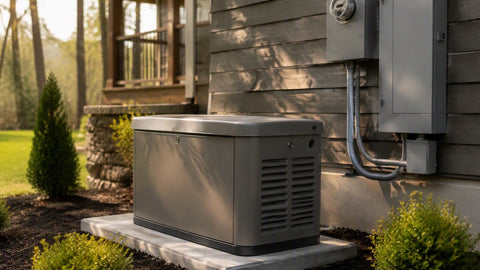
The feature that separates a good hybrid from a great one is a properly implemented generator input. In a long outage with poor solar — the December ice-week scenario — a generator connected to the hybrid's gen port does double duty: it carries the house while recharging the battery bank at the inverter's full charge rate, then shuts off and lets the battery carry the quiet hours. The arithmetic transforms generator ownership: instead of a 14 kW genset screaming at 30 percent load all night, a smaller unit runs hard and efficiently for three hours and rests for nine. Fuel consumption drops by half or better, noise becomes a daytime-only event, and the generator's service intervals stretch. Sizing note from the field: the generator must comfortably exceed the inverter's maximum charge draw plus the running house loads — a 10 kW hybrid pulling 6 kW of charge while the house draws 3 kW wants a genset in the 12 kW class, not the 8 kW unit the homeowner already owns. Our whole-home generator guide and the 14–17 kW standby range cover the genset side of that pairing.
Time-of-use arbitrage: the mode that pays the mortgage
In territories with time-of-use rates, the hybrid's battery stops being insurance and starts being a cash register. The mechanics: charge the bank from solar or cheap off-peak grid power, then discharge through the evening peak when rates run two to four times the off-peak price. A worked example with honest numbers — a 15 kWh usable bank cycling daily, shifting 12 kWh from a $0.35/kWh peak to a $0.12/kWh off-peak: each cycle saves 12 × ($0.35 − $0.12) = $2.76, call it $80 a month, roughly $1,000 a year, before counting any demand-charge management on commercial tariffs. The battery's cycle life is the cost side: LFP banks rated for thousands of cycles at 80 percent depth of discharge shrug at one daily cycle for a decade. Where flat-rate net metering reigns, this mode sits idle and backup is the whole story; where TOU rules, arbitrage alone can carry the battery's payback. Know your tariff before you choose your mode — the consumption calculation guide helps pull the interval data that makes the case.
Efficiency: the numbers and the honest footnotes
Building Your Complete Hybrid Solar System
What This Means in the Real World
Hybrid datasheets quote peak efficiencies of 96 to 98 percent, and they are true — at the peak. Real-world round-trip accounting is humbler. Solar-to-load direct conversion runs at the quoted peak across a modest power band. Solar-to-battery-to-load pays two conversion tolls plus battery round-trip losses: figure roughly 0.96 × 0.95 × 0.96 ≈ 88 percent end to end on a well-matched LFP system. And every hybrid burns standby power — 40 to 90 watts around the clock for the control brain, the display, the contactors staying ready — which is 350 to 800 kWh a year that never reaches a load. None of this argues against hybrids; all of it argues for reading the efficiency curve rather than the headline, and for sizing the battery so it cycles meaningfully instead of idling at float for months, paying standby tolls on capacity nobody uses. The 5–15 kWh battery tier exists precisely because right-sizing beats max-sizing.
Installation practicalities nobody puts in the brochure
Planning Your Hybrid System Installation
Wall real estate first: a 10–12 kW hybrid is the size of a suitcase and weighs 60 to 90 pounds — it wants structure, clearances per the manual, and a location the homeowner can reach in the dark during an outage. Conduit planning second: PV strings, battery DC, grid in, backup out, generator in, CT metering — a hybrid wall can host six separate raceways, and the neat ones were planned before the unit was hung, not after. Commissioning third: firmware current before first energization, battery protocol verified against the compatibility list, grid parameters set to the utility's required profile, and every mode tested live — including a deliberate outage test the customer watches, because the first transfer should not happen during an actual emergency with a flashlight in somebody's teeth. The system components overview maps where the hybrid sits among the rest of the hardware for anyone still assembling the mental picture.
The verdict from the counter
Five years ago we recommended hybrids selectively; today they are the default answer for any customer who flinches at outages, faces time-of-use rates, or plans to add storage within the life of the system. The price premium over a string inverter has compressed to the point where the backup port alone justifies it, and the flexibility — batteries later, generator anytime, export limits whenever the tariff changes — is the kind of insurance you buy once and use for twenty-five years. Size the three numbers honestly, match the battery protocol before the pallet ships, test the transfer with the customer watching, and the hybrid does what it promises: it makes the grid optional without making it the enemy.
That is the whole answer to the question in the title: a hybrid inverter is the box that assumes nothing about tomorrow — not the tariff, not the weather, not the grid — and keeps the lights on anyway.
Monitoring and the app that earns its icon
Every hybrid ships with a monitoring platform, and the quality spread between them is wider than the hardware spread. The good ones show per-string production, battery state of charge with a reserve slider the customer can actually find, and a load graph granular enough to catch the space heater somebody plugged into the backup panel. The mediocre ones show a green checkmark and a smile. During commissioning, install the app on the customer's phone, log in together, and demonstrate three things: how to read state of charge, how to tell grid from battery from solar at a glance, and how to force a backup test. Five minutes of that demo prevents a year of confused phone calls, and it converts the monitoring platform from a black box into the feature customers show their neighbors — which, at the end of the day, is the cheapest marketing in the trade.
Frequently asked questions
How Your Hybrid Inverter Manages Power Day and Night
What is a hybrid inverter in simple terms? It is a single device combining a solar inverter, a bidirectional battery inverter/charger, and an automatic transfer switch. It converts panel DC to household AC, manages battery charging and discharging, interacts with the grid, and powers a protected loads panel during outages.
Can a hybrid inverter work without batteries? Yes. Most operate as grid-tied solar inverters with the battery port left empty, and storage can be added later without replacing the inverter. You get the solar function today and the backup upgrade path preserved for the future.
What size hybrid inverter do I need? Size three numbers: continuous AC output above your simultaneous critical loads, surge capacity above your largest motor's starting demand, and PV input rating at or above your array size. For most whole-home backup builds that lands in the 10–12 kW class.
Is a hybrid inverter the same as an off-grid inverter? No. An off-grid inverter-charger creates your only AC source and cannot export to a utility. A hybrid does both: it grid-ties and exports when the utility is present, and islands your protected loads when it is not.
Do hybrid inverters work during a power outage? Yes — that is their defining feature. The unit isolates from the grid (anti-islanding, per UL 1741) and powers the circuits on its backup port from solar and batteries. Circuits left in the main panel still go dark, which is why protected-loads selection matters at design time.
What batteries work with hybrid inverters? Most modern hybrids support managed lithium (LiFePO4) batteries communicating over CAN or RS485, plus programmable voltage profiles for AGM and other chemistries. Always match the battery to the inverter manufacturer's compatibility list — protocol mismatches are the top commissioning failure we troubleshoot.