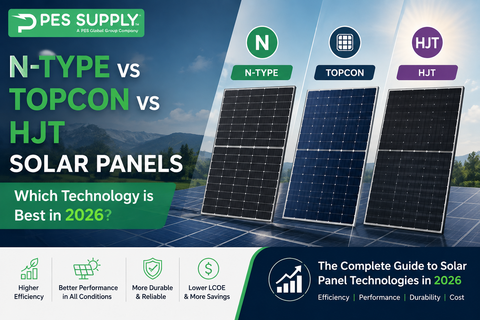
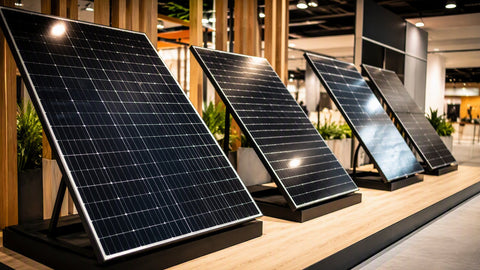
The Jinko JKM580N-72HL4-BDV is what commercial and utility solar looks like when the industry stops incrementing and starts compounding. A 580W N-type TOPCon bifacial module in glass-glass construction, rated for 1,500VDC strings and 30A series fusing, it exists for one reason: more energy per square foot, per string, and per installed dollar over a 30-year asset life. This guide walks through the technology, the electrical and mechanical specifications, string design at 1,500V with NEC 690.7 math, bifacial yield planning, applications where the 580W class wins, and how PES Supply supports project-scale procurement.

Module Class: Tiger Neo N-Type TOPCon Bifacial | Format: 144 half-cut cells, glass-glass
System Rating: 1,500VDC | Max Series Fuse: 30A | Market: Commercial, industrial, carport, and utility-scale
Why the 580W Class Exists
Commercial and utility-scale solar has three persistent pressures: owners want more energy from every square foot, engineers are designing around 1,500V systems to cut balance-of-system cost, and long-term investors expect assets to perform for three decades. Traditional 300–400W modules struggle against all three. At 580W per module, a fixed roof block or ground-mount row carries 30–45% more nameplate capacity than it did five years ago — with fewer modules, fewer clamps, fewer home runs, and fewer failure points.
I have walked enough commercial roofs to appreciate what fewer modules means in practice. Every module is two mid-clamps, one grounding path, four to eight wire-management clips, and a lifting cycle. Cut module count by a third on a 2 MW carport project and you have removed thousands of labor touches before the first production report ever matters.
N-Type TOPCon Cells: The Engine Inside
The "N" in JKM580N is the technology story. N-type TOPCon (Tunnel Oxide Passivated Contact) cells replace the boron-doped P-type base of legacy modules with phosphorus-doped silicon, eliminating the boron-oxygen defects that cause first-year light-induced degradation in P-type panels. A passivating tunnel-oxide layer at the rear contact then reduces the recombination losses that capped PERC efficiency around 21%.
The practical outcomes, versus the P-type generation these modules replace:
- First-year degradation near 1% instead of 2% — more warranted energy from day one.
- Annual degradation around 0.40% instead of 0.55% — the gap compounds for 30 years.
- A better temperature coefficient (N-type class runs about -0.29 to -0.30%/°C versus ≈-0.35%/°C for P-type), which pays every hot afternoon on a carport or ground-mount.
- Higher bifaciality. TOPCon's rear-side response (bifaciality factor in the ~80% class) turns reflected light into meaningful yield.
Bifacial Glass-Glass Design in Practice
Unlike traditional backsheet modules, the JKM580N-72HL4-BDV generates from both faces. The rear side harvests reflected irradiance — albedo — from the surface below: white TPO membrane, light gravel, concrete, or snow. Depending on mounting height, tilt, and ground cover, bifacial gain runs 5–20%, with 5–12% the defensible planning range for most commercial carports and fixed-tilt ground-mounts.
Glass-glass construction brings its own structural benefits: no polymer backsheet to UV-degrade, better fire classification, improved moisture barrier performance for coastal and agricultural ammonia environments, and a slower mechanical aging curve. The trade-off is weight — glass-glass modules are heavier than backsheet equivalents, so plan lift logistics and confirm structural loads with your engineer of record. The dual-glass build also changes handling: I tell crews to treat these like the commercial modules they are — suction cups, two-person minimum, no flexing the frame to "walk" a panel into position.
Key Electrical and Mechanical Specifications
Always verify against the current Jinko datasheet for your exact bin, but these datasheet-class values define how the module behaves in system design:
| JKM580N-72HL4-BDV Key Specifications (datasheet-class values) | |
|---|---|
| Nominal Power (STC) | 580W front side |
| Cell Configuration | 144 half-cut N-type TOPCon cells (6 × 24) |
| Module Efficiency | ≈22.4% class |
| System Voltage Rating | 1,500VDC |
| Maximum Series Fuse | 30A |
| Open Circuit Voltage (Voc) | ≈52.5V class |
| Short Circuit Current (Isc) | ≈14A class (front side) |
| Construction | Bifacial, dual-glass (2.0 mm + 2.0 mm class) |
| Dimensions | ≈2,279 × 1,134 × 30 mm class |
| Weight | ≈31 kg (≈68 lbs) class |
| Bifaciality Factor | ≈80% ±5% class |
Two design notes on those numbers. First, the 30A series fuse rating supports two-in-parallel stringing at combiner level in many designs — a meaningful wiring economy on large arrays. Second, the ≈30 mm frame depth means clamp hardware differs from legacy 35–40 mm stock; confirm clamp compatibility in the racking catalog before mobilization.
String Design at 1,500V: NEC 690.7 Worked Example
Long strings are where the 580W class pays its balance-of-system dividend. Using the class Voc of ≈52.5V and the NEC 690.7 cold-temperature correction of 1.14 for a -10°C design minimum:
| Design Step | Calculation | Result |
|---|---|---|
| Cold-corrected module Voc | 52.5V × 1.14 | 59.85V |
| Max modules per 1,500V string | 1,500 ÷ 59.85 | 25.06 → 25 modules |
| String Voc at 25 modules (corrected) | 25 × 59.85V | 1,496V ✓ |
| String nameplate (front side only) | 25 × 580W | 14.5 kW |
| Equivalent at 400W-class modules | 14.5 kW ÷ 400W | 36+ modules — 44% more units |
That last row is the entire value proposition in one line: the same string capacity with nearly half the module count. Voltage and current levels sit neatly inside the working ranges of today's 1,500V string inverters — the inverter sizing calculator checks DC/AC ratios, and our string inverter guide covers architecture selection.
Conductor and Overcurrent Sizing: NEC 690.8 and 310.16
Bifacial modules add a wrinkle to the 690.8 math: rear-side gain raises possible operating current above front-side Isc. The conservative field practice — and what I recommend on any bifacial design — is sizing conductors for front Isc plus a bifacial uplift factor (typically 1.10–1.25 depending on site albedo), then applying the 1.56 continuous multiplier:
| Design Item | NEC Reference | Calculation | Result |
|---|---|---|---|
| Front-side Isc | Datasheet | ≈14.0A | — |
| Bifacial uplift (10% albedo gain) | Engineering practice | 14.0 × 1.10 | 15.4A design current |
| Continuous-load multiplier | 690.8(B) | 15.4 × 1.56 | 24.0A minimum ampacity |
| OCPD | 240.6 | ≥24.0A | 25A fuse (within 30A max series rating) |
| Conductor @ 75°C | Table 310.16 | 24.0A required | 10 AWG Cu THWN-2 (35A) |
| Conductor @ 90°C PV free-air | 310.16 / 690.31 | 24.0A required | 12 AWG PV wire (30A) — check derating |
Note how bifacial gain pushed the conductor from the usual 12 AWG to 10 AWG at the 75°C termination column. I have seen exactly this get missed in plan review — the design used front-side Isc only, the AHJ's reviewer applied the bifacial note on the datasheet, and the submittal came back redlined. Cross-check against the NEC wire sizing guide, the ampacity chart, and the NEC 690 OCP guide before submittal, not after.
Degradation and the 30-Year Asset View
Checked math on a 1 MW block of 580W modules (1,724 modules), using the N-type warranty schedule of 1% first-year and 0.40% annual degradation:
| Year | Retention | Block Capacity |
|---|---|---|
| 0 | 100.0% | 1,000 kW |
| 1 | 99.0% | 990 kW |
| 10 | 95.4% | 954 kW |
| 20 | 91.4% | 914 kW |
| 25 | 89.4% | 894 kW |
| 30 (performance warranty horizon) | 87.4% | 874 kW |
Compare the year-25 figure against the 83.1% floor of the P-type generation: on a 1 MW block that is a 63 kW difference in warranted end-of-life capacity — roughly a house-sized array of free retained capacity, which is precisely why long-hold owners and their lenders have moved to N-type as the default specification.
Ideal Applications
The JKM580N-72HL4-BDV is aimed at professional projects where energy yield, space efficiency, and long-term reliability outweigh lowest-possible upfront module cost:
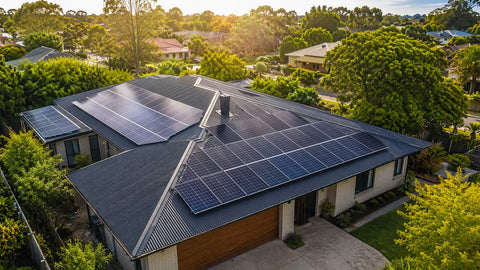
- Large commercial rooftops — more kW per roof block under a fixed structural allowance.
- Carports and canopies — bifacial gain from open structure and light-colored pavement, plus glass-glass durability.
- Ground-mount plants — fewer modules per structure, cleaner wiring, straightforward O&M, and long strings that shrink combiner counts.
- Interconnection-capped sites — when the utility caps AC export, DC density per structure becomes the design lever.
For residential-scale work, this is the wrong module — it is a 31 kg commercial panel. Homeowners should look at the 400–459W residential classes or the panel kits buyer's guide. For C&I and utility builders, the 550–709W category and Jinko Solar collection hold the current high-power options, including the 590W sibling of this module.
Financial Impact and LCOE
Module price is a minority of project cost on commercial work — racking, labor, electrical BOS, soft costs, and financing dominate. High-power N-type bifacial modules attack several lines at once: fewer modules cut racking and labor per kW; long strings cut combiner and home-run count; bifacial gain and slow degradation raise the energy denominator of the LCOE equation for 30 years. In the pro formas we see, the 580W class typically trims balance-of-system spend per watt while lifting lifetime yield per dollar — a rare both-directions win. Developers can also use the module to meet interconnection caps on tight sites, which in constrained markets is worth more than any equipment discount.
How PES Supply Supports Jinko 580W Projects

We back the JKM580N-72HL4-BDV with the support structure commercial projects require: project pricing at pallet and container quantities, bundled equipment across modules, racking, inverters, and BOS from 169 authorized brands, submittal documentation support, and nationwide LTL and flatbed logistics from our Louisville, KY supply house. The first step is sharing site details, target capacity, and schedule — from there we propose layouts and bill-of-material options built around the 580W module, with alternates priced for comparison. Start with the system calculator, browse 2026's best panels, or contact the team directly.
My bottom line: the 580W N-type bifacial class is where commercial module technology was always heading — more watts per lift, less steel per kW, and a degradation curve that treats a 30-year hold as normal rather than optimistic. Projects designed around it today are aligned with where the industry is going, not where it has been. If your next commercial roof, carport, or ground-mount is still being drawn around 400W-class modules out of habit, redraw it before you price it; the comparison rarely survives contact with the actual math.
Design and Installation Considerations at Project Scale
Modules in this class reward careful mechanical design and punish casual assumptions. Four areas deserve engineering attention before mobilization.
Row spacing and inter-row shading. Bifacial gain depends on the rear side seeing sky and ground, so row pitch affects yield twice — front-side shading and rear-side view factor. Widening pitch to lift bifacial gain trades against land or roof area; on space-constrained sites the marginal albedo gain usually loses to tighter packing, while on land-rich ground-mounts the wider pitch wins. Model both before fixing the layout.
Wind and snow loads. Glass-glass modules carry different load certifications than backsheet equivalents, and the 2.28 m length creates meaningful sail area. Your structural engineer should verify module load ratings against ASCE 7 site pressures with the specific racking system's test data — do not assume last year's module certs transfer. On carports, uplift governs more often than downward load, and edge-zone pressures on exposed structures routinely double the interior-zone values.
Torque and clamping. The ≈30 mm frame clamps differently than legacy 40 mm stock, and glass-glass modules are less forgiving of over-torque — there is no backsheet compliance to absorb a clamp that is a quarter-turn past spec. Calibrated torque tools on commercial crews are not a luxury; they are how you avoid microcrack claims at year three.
Wiring management. Long strings at 1,500V concentrate consequence: a single failed connector takes down 14.5 kW. Use listed PV wire, proper strain relief at every clip point, and the PV wire selection guide for jacket and rating choices that survive 30 years of UV and thermal cycling.
Albedo Planning: Getting Real About Rear-Side Gain
Bifacial marketing loves the 20% number; engineering should plan on measured surfaces. The albedo values below are the commonly cited literature ranges we use for first-pass modeling:
| Ground Surface | Typical Albedo Range | Practical Bifacial Gain (fixed tilt, elevated) |
|---|---|---|
| Dark asphalt / aged roof | 0.05–0.15 | 1–3% |
| Grass / soil | 0.15–0.25 | 3–6% |
| Concrete | 0.25–0.40 | 5–9% |
| Light gravel / crushed stone | 0.25–0.45 | 5–10% |
| White TPO/PVC membrane | 0.60–0.80 (new, degrading with age) | 8–14% |
| Snow cover | 0.70–0.90 | 10–18% (seasonal) |
Two cautions from lived experience. First, albedo degrades: white membrane dulls, gravel darkens, and the year-one model should not assume the year-ten surface. Second, bifacial gain is not free in the electrical design — as the 690.8 section showed, rear-side current uplift changes conductor and fuse sizing. Plan both sides of the coin.
O&M at the Module Level
Glass-glass construction changes the maintenance picture in mostly good ways. There is no backsheet to chalk, crack, or delaminate — the failure mode that wrote so many warranty claims in the 2010s. Soiling behavior is standard; cleaning cadence follows the site, not the module. What does change: thermography. On bifacial modules, rear-side hotspots read differently on IR scans, and technicians trained only on monofacial signatures misread them. If your O&M provider's scan reports flag the whole array, ask whether their analyst has bifacial experience before authorizing a truck roll per flag.
Spares planning for a project-scale install: hold 0.25–0.5% of module count as attic stock — call it five to nine modules per megawatt — stored flat, indoors, in original packaging. Hail events and handling damage do not schedule themselves around manufacturer lead times.
Case Pattern: The Interconnection-Capped Warehouse
The most common 580W conversation I have runs like this. A developer has a 120,000 sq ft distribution warehouse, a utility interconnection capped at a fixed AC figure, and a structural report limiting roof loading. The design lever that remains is DC density per square foot. Moving from a 400W-class layout to the 580W class lifts installed DC by 30%+ on identical area and racking count, lets the inverter fleet run at a higher DC/AC ratio through the morning and evening shoulders, and clips only the midday peak that the interconnection would not accept anyway. The customer monetizes the same AC capacity with more annual kWh behind it. That is not a marginal improvement — it is often the difference between a project that pencils and one that does not.
Where the Siblings Fit: 580W vs. 590W vs. Utility Tiger Neo
Within the Tiger Neo 72HL4-BDV family, the 590W sibling shares the same format and electrical neighborhood — a straight bin upgrade when availability or pricing favors it. Above the family, utility-format Tiger Neo 3.0 modules push past 600W with third-generation HOT 4.0 TOPCon at up to 24.8% efficiency, in larger formats that demand utility-scale handling and racking. The 580W sits in the practical middle: maximum density that standard commercial racking, two-person lifts, and conventional 1,500V string inverters all accept without special provisions. For most C&I projects, that middle is exactly right.
Getting Started on a 580W Project
The productive first conversation includes five inputs: site address (for irradiance and design temperature), available area and structural limits, target capacity or interconnection cap, preferred inverter strategy, and construction schedule. With those, we return layout concepts, a bundled bill of materials across modules, racking, inverters, and BOS, and freight-quoted pricing at the quantity your phase plan needs. The commercial installation cost guide frames the budget categories, and the ROI calculator stress-tests the returns.
Commissioning and Documentation at Commercial Scale
Large-format bifacial projects live or die on commissioning discipline. String-level Voc verification against the cold-corrected design value catches mis-landed home runs before energization. IV curve tracing on a sample of strings — one per combiner at minimum — establishes the performance baseline that every future warranty conversation will reference. And because bifacial output varies with ground conditions, document the albedo surface at commissioning with dated photos; five years later, when someone asks whether the array underperforms, the difference between "asphalt aged" and "modules degraded" is that photo folder.
Keep the module serial registry, flash-test reports, and as-built string maps in the owner's closeout package. On portfolio assets these documents trade with the building; missing commissioning records measurably complicate due diligence at sale time.
Bankability: Why Tier 1 Status Matters on 30-Year Paper
Commercial modules are financed, not just purchased, and the lender's due diligence list is short and unforgiving: manufacturer scale, balance-sheet survivability, warranty infrastructure, and independent test pedigree. Jinko's position as the industry's highest-volume manufacturer checks every box, which keeps the module off the lender's exception list and the project's financing terms competitive. I have watched projects save more in financing spread by specifying a bankable module than they would have saved buying a cheaper unbankable one — the module line item is visible, the interest-rate line item is larger.
Freight and Handling Logistics for Large-Format Modules
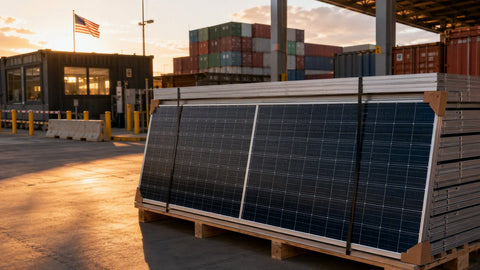
At ≈2.28 m long and ≈31 kg each, these modules ship on commercial pallets that demand real receiving infrastructure: a dock or forklift, not a liftgate and a hand truck. Pallet counts run lower per position than residential formats, so freight cost per module is slightly higher and worth quoting early. On site, plan staging with panel carts sized for the format and suction-cup handlers for the set crew. I have seen a schedule slip three days because a GC assumed the residential panel cart on site would carry commercial modules. It would not. Five minutes of logistics planning beats a three-day slip every time.
Frequently Asked Questions
- What applications suit the JKM580N-72HL4-BDV?
- Large commercial rooftops, carports, ground-mounts, and interconnection-capped sites — professional projects where density and 30-year yield matter most.
- How much extra energy does bifacial produce?
- Typically 5–20% depending on albedo and mounting; plan on 5–12% for most commercial sites.
- How many 580W modules fit a 1,500V string?
- About 25 modules (14.5 kW) at a -10°C design temperature using NEC 690.7's 1.14 correction — verify your bin's datasheet Voc.
- What wire and fuse does a bifacial 580W string need?
- Roughly 24A design ampacity (front Isc + 10% bifacial uplift, × 1.56), a 25A fuse, and 10 AWG copper at 75°C terminations.
- How does it degrade over 30 years?
- ≈1% first-year, 0.40% annually — about 89.4% of nameplate at year 25 and 87.4% at year 30.
- Can it be used on homes?
- Technically yes, practically no — it is a 31 kg commercial module. Use residential-format 400–460W panels instead.
PES Supply supports commercial and utility projects with project pricing, bundled BOMs, and nationwide logistics from Louisville, KY. Bring us your site details and schedule — contact our team.