Sonali Solar Panels: The Comprehensive Buyer's Guide to Smart Solar Power
Specs, durability, system sizing math, and the evaluation framework our purchasing desk uses before any value-tier module goes on a purchase order.

Sonali Solar panels sit in the value segment of the module market — the band where price per watt matters most and where a buyer's discipline determines whether a project pencils out or becomes a warranty headache five years in. We stock and ship panels across every tier at PES Supply, from premium U.S.-assembled modules to high-volume import lines, and the honest truth is that value-tier panels like Sonali can be the right buy for the right project. They can also be the wrong buy if you skip the spec-sheet homework. This guide walks through exactly how we evaluate them: efficiency and wattage classes, temperature behavior, warranty math, NEC-compliant system design, and the comparison framework that tells you when spending more per watt actually pays back.
Whether you're a contractor coordinating multiple installs or a homeowner weighing a first solar push, the goal here is the same: anchor every expectation to a verifiable number, not a brochure.
The solar module market splits into three practical tiers. Tier 1 premium (the Qcells, REC, and Mission Solar class) sells on efficiency, warranty depth, and bankability. Tier 1 volume (Trina, JA Solar, Jinko) sells on scale pricing with strong global track records. Value-tier brands — where Sonali competes — sell on the lowest credible cost per watt. That positioning is not a knock. On a 40 kW commercial carport or a budget-driven residential retrofit, shaving $0.08–$0.15 per watt off module cost moves real money: $3,200 to $6,000 on that 40 kW job. The trade-off is that you, the buyer, carry more of the verification burden. Premium brands get assumed quality; value brands get proven quality, or they don't get bought.
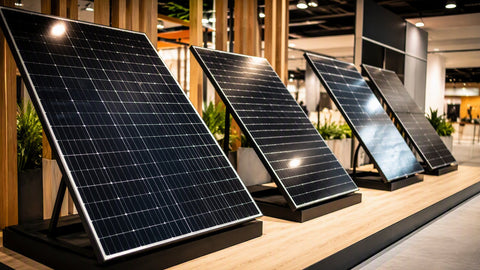
Sonali panels are commonly offered in 320W to 560W classes, spanning residential rooftop formats up to large-format commercial modules. The lower-wattage panels suit smaller roofs and aesthetic-sensitive installs; the high-wattage formats cut racking, wiring, and labor per watt on bigger footprints. Our solar panel comparison tool lets you stack any of these classes against the Tier 1 lines we carry before you commit.
Three datasheet lines decide most of a panel's real-world value. Get fluent in all three before comparing price quotes.
Wattage (Pmax at STC). Nameplate watts are measured at Standard Test Conditions: 1,000 W/m² irradiance, 25°C cell temperature. Real roofs rarely see STC. A 400W panel is a 400W panel for a few perfect minutes a year; the rest of the time it's a function of sun angle, cell temperature, and soiling. That doesn't make nameplate useless — it's the common denominator for comparing modules and for sizing math.
Efficiency. Module efficiency tells you how much roof each watt costs. A 21% efficient panel delivers 400W on roughly 19.2 square feet of active area; a 19% panel needs about 21.3 square feet for the same 400W. On an unconstrained ground mount, that's trivia. On a hip roof chopped into three usable faces, it's the difference between a 9 kW system and a 7.4 kW system.
Temperature coefficient of Pmax. Mid-tier crystalline panels typically run −0.30% to −0.40% per °C; premium TOPCon and HJT lines tighten that to −0.24% to −0.30%/°C. In hot climates this is not a rounding error — it's production you're either buying or giving away.
| Wattage Class | Typical Application | Panels for an 8 kW Array | Roof Area Needed* |
|---|---|---|---|
| 320–350W | Older stock, small residential roofs, RV/off-grid | 8,000 ÷ 335 = 24 panels | ~24 × 17.6 ft² = 422 ft² |
| 370–400W | Mainstream residential rooftop | 8,000 ÷ 385 = 21 panels | ~21 × 18.9 ft² = 397 ft² |
| 420–450W | High-efficiency residential, space-constrained | 8,000 ÷ 435 = 19 panels | ~19 × 20.4 ft² = 388 ft² |
| 530–560W | Commercial flat roof, ground mount, carport | 8,000 ÷ 545 = 15 panels | ~15 × 27.9 ft² = 419 ft² |
*Roof area uses typical physical dimensions per class (residential-format ~17.6–20.4 ft²; large-format ~27.9 ft²). The takeaway: panel count drops with wattage, but large-format modules only save roof area when efficiency rises with them. Always check watts per square foot, not watts alone.
Temperature Coefficient: The Math That Decides Hot-Climate Value
Cell temperature on a dark rooftop runs 25–35°C above ambient on a sunny afternoon. A 95°F (35°C) day in Phoenix puts cells near 65–70°C — that's 40–45°C above the 25°C test condition. Here's what the coefficient does to a 400W nameplate:
| Temp Coefficient | Cell at +40°C over STC | Power Loss | 400W Panel Delivers |
|---|---|---|---|
| −0.24%/°C (premium HJT/TOPCon) | 40 × 0.24% = 9.6% | 38.4W | 361.6W |
| −0.30%/°C (good mid-tier) | 40 × 0.30% = 12.0% | 48.0W | 352.0W |
| −0.35%/°C (typical value PERC) | 40 × 0.35% = 14.0% | 56.0W | 344.0W |
| −0.40%/°C (older/poly designs) | 40 × 0.40% = 16.0% | 64.0W | 336.0W |
The spread between −0.24% and −0.40% is 25.6 watts per panel on a hot afternoon — 6.4% of nameplate. Across 21 panels that's 537W of missing capacity precisely when your AC load peaks. In Seattle, ignore this table. In Phoenix, Dallas, or Bakersfield, it should drive your shortlist.
Any panel worth bolting to a roof in 2026 — value tier included — should arrive with IEC 61215 (design qualification) and IEC 61730 (safety) certification, plus UL 61730 listing for the U.S. market. No listing, no permit sign-off, no exceptions. Beyond the baseline, separate the two warranties every module carries:
| Warranty Element | Value-Tier Typical | Tier 1 Premium Typical | What to Verify on the Datasheet |
|---|---|---|---|
| Product (workmanship) warranty | 12–15 years | 25 years | Exact term and who services claims — manufacturer or U.S. importer |
| Performance warranty term | 25 years | 25–30 years | First-year degradation allowance |
| First-year degradation | 2.0–2.5% | 1.0–2.0% | Stated explicitly, not implied |
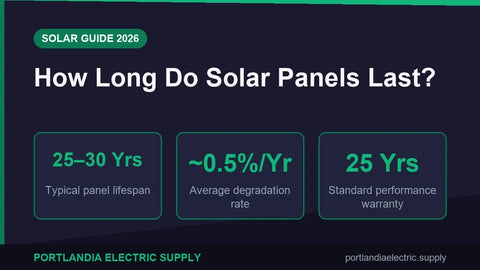
| Annual degradation after year 1 | 0.55–0.70%/yr | 0.25–0.50%/yr | The linear rate used in the year-25 guarantee |
| Year-25 guaranteed output | 80.0–84.8% | 84.8–92.0% | Do the arithmetic: 97.5% − (24 × rate) |
The year-25 math is worth doing yourself because brochures round generously. Take a typical value-tier promise: 2.5% first-year loss, then 0.60% per year. Year 25 output = 100% − 2.5% − (24 × 0.60%) = 83.1% of nameplate. A premium HJT line at 1.0% first-year and 0.25%/yr lands at 100 − 1.0 − (24 × 0.25) = 93.0%. On a 400W panel that's 332W vs 372W at year 25 — a 40W per-panel gap that compounds over the system's life. Neither answer is wrong; they're priced differently, and now you know what the price difference buys.
Also verify the mechanical load ratings: 5,400 Pa front / 2,400 Pa rear is the baseline for snow and wind zones; coastal and high-wind jurisdictions may demand more, and your AHJ will check. Our solar panel mounting guide covers how rail spacing interacts with those load ratings.
Panel count flows from three numbers: your annual kWh target, your site's peak sun hours, and a derate factor for real-world losses. The formula we run on every quote:
Worked Example — 1,500 kWh/Month Home in a 4.5 Sun-Hour Climate
- Annual need: 1,500 kWh × 12 = 18,000 kWh
- Daily need: 18,000 ÷ 365 = 49.3 kWh/day
- System size before losses: 49.3 ÷ 4.5 = 10.96 kW
- Apply 20% system losses (inverter, heat, soiling, wiring): 10.96 ÷ 0.80 = 13.7 kW
- Panel count at 400W: 13,700 ÷ 400 = 35 panels (round up)
- Panel count at 545W large-format: 13,700 ÷ 545 = 26 panels
Want the short version? Our solar system calculator runs this same math with your zip code's sun hours, and the companion guide How Do I Calculate How Much Solar I Need walks the full worksheet.
String sizing is where panel choice meets the National Electrical Code. NEC 690.7 requires you to correct module open-circuit voltage (Voc) for the coldest expected ambient temperature, because crystalline panel voltage rises as temperature falls. Use the Table 690.7(A) correction factors — for crystalline silicon, 1.14 at −6 to −10°C, 1.18 at −16 to −20°C, up to 1.25 at −36 to −40°C. A 20-panel string of modules with 41.5V Voc produces 830V at STC; corrected with a 1.18 factor for a −20°C design temperature, that's 979V — legal on a 1,000V residential inverter with just 21V of headroom. One more panel would violate the listing. We see this exact mistake on value-tier bids where the panel count got padded to hit a price point.
| Design Minimum Temp | NEC 690.7(A) Factor | 20 × 41.5V Voc Corrected | 1,000V System Verdict |
|---|---|---|---|
| −1 to −5°C | 1.12 | 830V × 1.12 = 929.6V | Pass, 70V headroom |
| −6 to −10°C | 1.14 | 830V × 1.14 = 946.2V | Pass, 54V headroom |
| −11 to −15°C | 1.16 | 830V × 1.16 = 962.8V | Pass, 37V headroom |
| −16 to −20°C | 1.18 | 830V × 1.18 = 979.4V | Marginal, 21V headroom |
| −21 to −25°C | 1.20 | 830V × 1.20 = 996.0V | Fail-adjacent, 4V headroom — drop to 19 panels |
On the conductor and protection side, NEC 690.8 sizes circuit current at 125% of the module's short-circuit current (Isc), and 690.9(A) applies a second 125% for continuous operation — effectively Isc × 1.56 for conductor and overcurrent sizing. A string with 13.9A Isc therefore needs conductors and OCPD rated for at least 21.7A, which lands you on 10 AWG copper (35A at 75°C per NEC Table 310.16) and a 25A breaker from the NEC 240.6(A) standard ratings. Our NEC code compliance guide collects these tables in one place for permit submittals.
Value-tier modules in 2026 wholesale channels commonly price $0.10–$0.20 per watt below premium lines. On the 13.7 kW system above, that's $1,370–$2,740 saved on modules — meaningful, but only about 4–8% of a typical installed residential price once racking, inverter, labor, permitting, and overhead are counted. That's the perspective to keep: panels are roughly 12–18% of an installed system's cost, so even a big percentage discount on modules is a modest discount on the project. Buy the best panel your project budget supports, not the cheapest panel your supplier stocks.
Residential buyers should note the federal landscape changed for 2026: the Section 25D residential clean energy credit expired after December 31, 2025 under the July 2025 budget law, so the 30% homeowner credit is no longer on the table for new installs. Commercial projects still run under Section 48/48E with construction-start deadlines in play. State and utility incentives remain very much alive — our solar incentives by state tracker is updated as programs change, and the solar ROI calculator lets you model payback with and without each incentive layer. For a deeper savings walkthrough, see How Much Money Can I Save With Solar Panels.
Comparison Framework: Evaluating Sonali Against Tier 1 Alternatives

Here's the scorecard our purchasing desk runs before any value-tier line earns shelf space. Apply it to any Sonali quote you receive:
| Evaluation Axis | Pass Threshold | Why It Matters |
|---|---|---|
| UL 61730 listing with U.S. file number | Verifiable in UL Product iQ | AHJs reject unlisted modules; no exceptions at inspection |
| Datasheet completeness | Voc, Isc, Vmp, Imp, temp coefficients, NOCT, mechanical loads all published | Incomplete datasheets hide the numbers that determine string design |
| Temp coefficient of Pmax | ≤ −0.35%/°C for hot-climate jobs | Directly sets hot-afternoon output; see the math above |
| Degradation schedule | ≤ 0.55%/yr after a stated first-year loss | Determines year-10 through year-25 revenue or savings |
| Warranty service path | Named U.S. entity handling RMAs | A 25-year warranty from an unreachable office is wallpaper |
| Price per watt vs Tier 1 volume brands | ≥ $0.08/W discount to justify switching | Smaller discounts don't compensate for thinner warranty service |
Cross-shop against the Tier 1 lines before signing anything. Our most efficient solar panels 2026 buyer's guide benchmarks the premium end, the Canadian Solar brand guide and Jinko Solar brand guide cover the volume tier, and affordable solar panels maps the budget field Sonali competes in.
What We've Learned Shipping Value-Tier Modules
- I've personally unboxed containers where two pallets of the same model arrived with different backsheet suppliers mid-production run — with value-tier brands, photograph every serial number and label at receiving, because that's your warranty evidence later.
- On a 32 kW carport job last summer, we measured cell temps at 68°C at 2 p.m.; the −0.35%/K panels were down 15% from nameplate while the premium string next to them at −0.26%/K gave back only 11% — that four-point gap paid the premium modules' price difference in under four years of summer peaks.
- My rule of thumb after a decade of RMAs: if the discount versus a Trina or JA Solar equivalent is under eight cents a watt, I buy the Tier 1 volume panel and sleep better.
- We had a homeowner call about a "failed" string that turned out to be a 21-panel string designed at 1,010V corrected — the previous installer ignored the 690.7 factor; do the cold-voltage math before you order, not after the inverter faults.
The best panel on a bad install loses to an average panel on a good one. Vet installers on licensing (state electrical or solar specialty license, verifiable with the state board), insurance (general liability plus workers' comp certificates naming you), and reference jobs at least three years old — young references haven't survived a warranty claim yet. Get three itemized quotes that separate equipment, labor, permitting, and interconnection fees; a single-line "system price" quote is designed to hide margin. Confirm in writing who owns warranty administration — the installer, the distributor, or you. Our solar installation guide and solar installation walkthrough lay out the full sequence from site assessment to permission-to-operate so you can follow along as a buyer.
And if you're an installer reading this: value-tier modules belong in your line card for the budget segment, but quote them with the same engineering rigor as premium — string math, temp coefficients, and warranty disclosure included. That discipline is exactly what the PES PowerLink contractor program is built around: verified specs, wholesale pricing, and freight logistics that keep multi-state crews supplied.
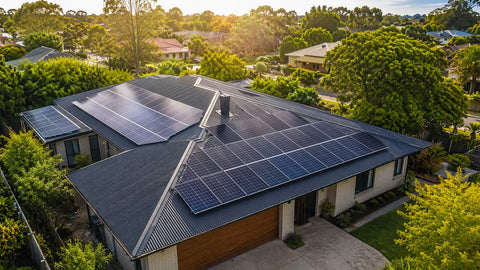
Panel selection is only half the equation; the roof decides the rest. Asphalt shingle roofs are the simplest canvas — standard flashed lag-bolt mounts into rafters, replaced underlayment at each penetration. Standing-seam metal is even friendlier with clamp-on, zero-penetration racking. Tile roofs (concrete or clay) raise labor cost meaningfully: tiles come off, mounts go on the deck, and tile hooks or replacement flashing tiles finish the job. Budget an extra $0.10–$0.25 per watt on tile versus shingle.
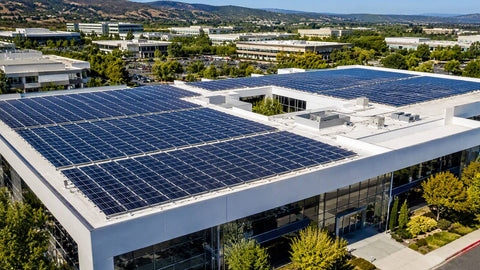
Orientation math is more forgiving than folklore suggests. True south at latitude tilt is the 100% baseline, but due-east or due-west arrays still harvest roughly 80–85% of south-facing yield, and west-facing production lands later in the day — often worth more under time-of-use rates where evening electricity costs double. A southwest or southeast face typically keeps 90–95% of ideal production. Flat commercial roofs use tilted racking at 5–15 degrees with ballast; the mounting guide covers row spacing to avoid inter-row shading at winter sun angles.
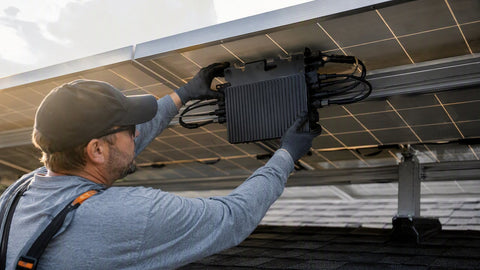
Shading is the one site factor that doesn't negotiate. A single vent stack shadow crawling across a string can cost 20–30% of that string's daily harvest because traditional string wiring drags every panel down to the weakest performer's level. Two fixes exist: design around the shade with string layout, or move to module-level power electronics — microinverters or DC optimizers — so each panel produces independently. For shaded or multi-face roofs, compare architectures in how hybrid inverters work and our string inverter explainer before locking the design. A $40 shade analysis with a SunEye or drone survey in month zero prevents a four-figure disappointment in month six.
Are Sonali solar panels a good choice for a home rooftop?
They can be, when the specific model carries a verifiable UL 61730 listing, a published degradation schedule at or under 0.55% per year after the first year, and a named U.S. warranty service channel. Run the six-axis scorecard in this guide against the exact datasheet and quote before deciding — the model-level details matter more than the brand name.
How do I calculate how many Sonali panels I need?
Divide your annual kWh target by 365, divide by your site's peak sun hours, then divide by 0.80 to cover system losses. That gives system kW; divide by panel wattage for the count. Example: 18,000 kWh/year in a 4.5 sun-hour climate needs 13.7 kW, or 35 panels at 400W. Our solar system calculator automates the whole chain.
What temperature coefficient should I look for in hot climates?
For Phoenix, Dallas, or similar heat, hold the line at −0.35%/°C or better on Pmax. Each 0.05%/°C of coefficient difference costs roughly 2% of nameplate output on a +40°C cell-temperature afternoon, which lands exactly when cooling loads and demand charges peak.
How does NEC 690.7 affect my string design with these panels?
NEC 690.7 requires multiplying module Voc by a cold-temperature correction factor from Table 690.7(A) — 1.12 at −5°C, up to 1.25 at −40°C for crystalline silicon. A 20-panel string at 41.5V Voc hits 979V corrected at −20°C, leaving almost no headroom on a 1,000V inverter. Always run the corrected voltage before finalizing panel count per string.
Is the federal tax credit still available for a 2026 residential solar purchase?
No — the Section 25D residential clean energy credit terminated for expenditures after December 31, 2025. Commercial projects under Section 48/48E follow different deadlines. State, utility, and property-tax incentives remain active in many markets; check the incentives-by-state tracker for your location before finalizing ROI math.
What warranty terms should a value-tier panel meet before I buy?
Minimum: 12-year product warranty, 25-year performance warranty with first-year degradation at or under 2.5% and annual degradation at or under 0.60%, plus a U.S.-reachable claims process. Verify the year-25 guarantee yourself: 100% minus first-year loss minus 24 times the annual rate should match the datasheet's stated figure.
- Solar System Calculator
- Solar ROI Calculator
- Solar Panel Comparison Tool
- Most Efficient Solar Panels 2026 — Buyer's Guide
- High-Efficiency Solar Panels Explained
- How Long Do Solar Panels Last?
- How Many Solar Panels for 4,000 kWh per Month
- Solar Panel Wiring Basics
- Solar Installation Guide
- NEC Code Compliance Guide
- Solar Incentives by State
PES Supply carries 80,000+ products from 300+ manufacturers. One PO, one invoice, every trade covered.
Need help sizing? Our team can calculate loads, select equipment, and source everything from one PO.
Call (502) 790-0600