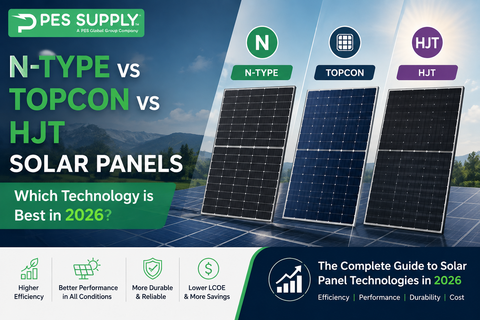
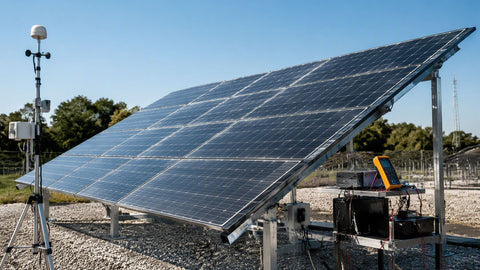
The Jinko Eagle G6 is where N-type TOPCon stopped being a premium upgrade and became the mainstream default. After four generations of refining P-type PERC through the Eagle G2, G3, and G4, Jinko rebuilt the Eagle line on the same N-type cell architecture that powers its flagship Tiger Neo series — delivering up to 22.53% module efficiency, 1% first-year degradation, and a -0.30%/°C temperature coefficient at residential and commercial price points. This guide covers what N-type actually changes, full specifications, the degradation and hot-weather math that justifies the premium, NEC-compliant system design, and when to choose G6 over the G4 discount or the Tiger Neo flagship.

Product Status: Current Production | Actively Stocked
Series Generation: Eagle G6 (2024–Present)
Technology: N-Type TOPCon (Tunnel Oxide Passivated Contact)
Power Class: 425–450W | Predecessor: Eagle G4 | Flagship Alternative: Tiger Neo 3.0
The N-Type Advantage, Explained Without the Hand-Waving
Understanding why N-type matters requires a quick look at cell physics, and it is worth the two minutes because the same physics drives every buying decision in this article.
P-type versus N-type doping. Traditional solar cells — including every previous Eagle generation — use P-type silicon doped with boron to create positive charge carriers. N-type cells use phosphorus doping instead. The difference sounds academic until you look at what boron does under sunlight: it binds with interstitial oxygen in the silicon lattice, forming boron-oxygen complexes that trap charge carriers. That is light-induced degradation, and it is a 2–3% permanent power loss in the first year of every P-type panel ever made.
LID eliminated. N-type base material contains no boron, so the defect pathway disappears. The G6's first-year degradation is capped at 1% — half what P-type panels experience — and its annual degradation drops to 0.40% versus 0.55% for the G4. Those are warranty-backed numbers, not lab aspirations.
TOPCon architecture. Tunnel Oxide Passivated Contact adds an ultra-thin oxide layer between the silicon wafer and the rear contact, letting electrons tunnel through while blocking the recombination that bleeds energy at the cell's back surface. Combined with the N-type base, this is how the G6 reaches 22.53% module efficiency against the G4's 20.96% ceiling — a 7.5% relative jump in power per square foot from the same roof.
Technical Specifications: Eagle G6 Residential Configuration
| Eagle G6 Core Specifications (JKM N-Type Series) | |
|---|---|
| Power Output (STC) | 425W–450W depending on model bin |
| Cell Configuration | 144 half-cells, N-type TOPCon |
| Module Efficiency | Up to 22.53% |
| Power Tolerance | 0 to +3% positive-only sorting |
| System Voltage | 1,000V / 1,500V DC ratings (model dependent) |
| Connectors | MC4-compatible |
| Operating Temperature | -40°C to +85°C |
| Degradation & Warranty Structure | |
|---|---|
| First-Year Degradation | ≤1% (vs. 2% P-type) |
| Annual Degradation | ≤0.40% (vs. 0.55% P-type) |
| Year-25 Output Floor | 87.4% of nameplate (vs. 83.1% P-type) |
| Temperature Coefficient (Pmax) | -0.30%/°C (vs. ≈-0.35%/°C P-type) |
| Product Warranty | Up to 25 years (program dependent) |
| Performance Warranty | 30 years linear (current program) |
Electrical specifics — exact Voc, Isc, and Vmpp — vary by wattage bin within the 425–450W range, so pull the datasheet for your exact model code before finalizing string design. The worked NEC examples later in this guide use representative values for the class and are flagged where verification matters. Our NEC compliance guide covers the design sequence end to end.
What the Efficiency Jump Buys You in Real Projects
Efficiency percentages are abstract; roof plans are not. On a residential roof with 420 usable square feet of unshaded face, the G4's 20.96% efficiency yields roughly 8.4 kW of array. The same face at the G6's 22.53% yields about 9.0 kW. That extra 600W is one-and-a-half panels' worth of production from identical racking, identical labor, and identical permitting — the cheapest capacity in the entire project.
Commercially, the math scales brutally. On a 50,000 sq ft warehouse roof where structural capacity limits you to a fixed array area, 7.5% more power per square foot converts directly to 7.5% more offset load under the same interconnection. I have watched two projects this year pick the G6 over a discounted P-type alternative purely because the interconnection agreement capped AC capacity, not DC area — when the cap is the constraint, density is king.
Hot-Climate Performance: Where the G6 Earns Its Premium
Solar panels lose output as they heat, and rooftop cells routinely hit 65–75°C on summer afternoons. The G6's -0.30%/°C coefficient versus P-type's ≈-0.35%/°C means it surrenders 14% less power per degree of cell temperature rise. At 70°C cell temperature — 45°C above the 25°C rating point — the retention math checks out like this:
| Cell Temperature | G6 Retention (-0.30%/°C) | P-Type Retention (-0.35%/°C) | G6 Advantage |
|---|---|---|---|
| 25°C (STC) | 100.0% | 100.0% | — |
| 45°C | 94.0% | 93.0% | +1.0 pt |
| 55°C | 91.0% | 89.5% | +1.5 pts |
| 65°C | 88.0% | 86.0% | +2.0 pts |
| 70°C | 86.5% | 83.4% (typ. field) | +3.1 pts |
| 75°C | 85.0% | 82.5% | +2.5 pts |
In Phoenix, Houston, or Florida installations, that gap shows up in every July production report. A 10 kW G6 array in a hot market can bank several hundred extra kWh per summer versus a P-type equivalent — not enough to change the decision alone, but stacked on the degradation advantage it compounds into real money. Cold-climate buyers can weight this section lower; everyone south of the 37th parallel should not.
25-Year Degradation: The Compounding Case
Here is the checked math on a 10 kW nameplate array of each technology, using the warranty degradation schedules:
| Year | G6 Output (1% then 0.40%/yr) | G4-Class Output (2% then 0.55%/yr) | Annual Gap |
|---|---|---|---|
| 1 | 9.90 kW | 9.80 kW | 100W |
| 5 | 9.74 kW | 9.58 kW | 160W |
| 10 | 9.54 kW | 9.31 kW | 230W |
| 15 | 9.34 kW | 9.04 kW | 300W |
| 20 | 9.14 kW | 8.76 kW | 380W |
| 25 | 8.74 kW | 8.31 kW | 430W |
The year-25 endpoint — 87.4% versus 83.1% — understates the lifetime picture because the gap widens every single year. Cumulative energy over the warranty period favors the G6 by roughly 5%. On a system producing 13,000 kWh in year one, that is on the order of 15,000–16,000 extra lifetime kWh. Price it at your utility rate and the G6 premium either clears the bar or it doesn't — the solar ROI calculator runs that scenario with your actual numbers.
G6 Across the Jinko Lineup
| Specification | Eagle G4 (Previous) | Eagle G6 (Current) | Tiger Neo 3.0 (Flagship) |
|---|---|---|---|
| Cell Technology | P-Type PERC | N-Type TOPCon | N-Type TOPCon (HOT 4.0) |
| Power Output | 380-400W | 425-450W | 495-670W |
| Max Efficiency | 20.96% | 22.53% | 24.8% |
| Dimensions (mm) | 1855 × 1029 × 35 | 1762 × 1134 × 30 | 2465 × 1134 × 30 (utility) |
| Dimensions (in) | 73.0" × 40.5" × 1.4" | 69.4" × 44.6" × 1.2" | 97.0" × 44.6" × 1.2" (utility) |
| Weight per Panel | ~20-21 kg (44-46 lbs) | 21-23 kg (46-51 lbs) | 32.6 kg (71.9 lbs) utility |
| Units per Pallet | 31 panels | 36 panels | 31 panels (utility) |
| Pallet Weight | ~645 kg (1,422 lbs) | ~828 kg (1,825 lbs) | ~1,036 kg (2,284 lbs) |
| Units per 40' Container | ~682 panels | ~792 panels | ~558 panels (utility) |
| Temp Coefficient | -0.35%/°C | -0.30%/°C | -0.26%/°C |
| First Year Degradation | ≤2.0% | ≤1.0% | ≤1.0% |
| Annual Degradation | 0.55% | 0.40% | 0.40% |
| Year 25 Output | 83.1% | 87.4% | 87.4% |
| Bifacial Available | No | Yes | Yes (85% factor) |
| Target Market | Budget | Mainstream | Premium/Commercial |
Positioning in that table is deliberate: the G6 occupies the mainstream sweet spot — N-type performance benefits at pricing appropriate for standard residential and commercial work — while Tiger Neo 3.0 pushes 495W+ residential and 600W+ utility formats with third-generation HOT 4.0 TOPCon at up to 24.8% efficiency. If your project is utility-scale or severely area-constrained, price both. For the middle 80% of the market, the G6 is the answer.
System Design: NEC-Checked String and Conductor Sizing
The G6's 144 half-cell layout produces electrical values in the same neighborhood as its 72-cell-class predecessors, which keeps string design familiar. Representative values for the 450W class run around 49–50V Voc and 11–11.5A Isc — verify the exact model's datasheet before final engineering, because bin-to-bin variation inside the 425–450W range is real. The worked example below uses 49.5V Voc and 11.2A Isc as conservative class representatives:
| Design Step | NEC Reference | Calculation | Result |
|---|---|---|---|
| Cold-corrected Voc (-10°C) | 690.7, factor 1.14 | 49.5V × 1.14 | 56.43V per module |
| Max string, 1,000V system | 690.7 | 1,000 ÷ 56.43 | 17.7 → 17 modules |
| Max string, 1,500V system | 690.7 | 1,500 ÷ 56.43 | 26.6 → 26 modules |
| Conductor ampacity floor | 690.8(B) — 1.56 × Isc | 11.2A × 1.56 | 17.5A |
| OCPD, standard sizes | 240.6 | ≥17.5A | 20A (check module max series fuse) |
| Conductor @ 75°C termination | Table 310.16 | 17.5A required | 12 AWG Cu THWN-2 (25A) |
The 12 AWG / 20A answer matches what the NEC wire sizing guide and ampacity chart produce for this current class. One caution I give every designer: N-type modules trend toward higher Isc as wattage climbs, so if you bin up to the 450W variant, re-run the 690.8 math rather than assuming last year's numbers carry over. The NEC 690 disconnect guide covers the overcurrent side in detail.
Installation and Compatibility Notes

The G6 integrates with standard residential and commercial practice — rail-based and rail-less mounting, string inverters, microinverters, and DC optimizers all play fine within its electrical window. MC4-compatible connectors are standard. For racking, the racking systems overview and our racking catalog cover compatible rail sets; confirm frame depth against your clamp hardware before ordering, since current-generation frames run slimmer than legacy 40 mm stock.
Field note from my own jobs: N-type modules' low-light behavior is genuinely better — morning and evening production shoulders widen noticeably on monitoring compared to P-type arrays on the same site. Customers notice this on their apps and mention it. It is a small thing that sells the technology better than any spec sheet.
Second field note: the positive-only 0/+3% power tolerance means your 450W bin arrives at 450W or better. On a 100-module commercial order, expect the flash-test distribution to hand you a few free kilowatts versus nameplate planning. Model conservatively anyway — free watts are a bonus, not a design input.
When to Choose G6 — and When Not To
Choose G6 for new residential rooftops prioritizing long-term value, commercial rooftops with standard performance requirements, hot-climate installs where the temperature coefficient pays, and ground-mounts where Tiger Neo's wattage is unnecessary. That is most projects in 2026.
Look elsewhere in two directions. Down-market: if a steep G4 clearance discount meets a budget-driven, area-unconstrained project, the older panel can still win on payback — honestly, run both quotes. Up-market: if area is the binding constraint or the project is utility-scale, Tiger Neo 3.0's density earns its premium. And if you are expanding a legacy array, match the legacy module class on its own string instead of mixing — the wiring guide explains why shared MPPTs punish mixed modules.
Upgrading From Legacy Eagle Panels
Two clean paths exist for G2/G4 owners adding capacity. Path one: match legacy modules on existing strings (best when the array is young and strings have open slots). Path two — the one I recommend more often: add G6 as a separate string on an open MPPT input. Modern inverters commonly support multiple MPPTs with independent string configurations, so the new N-type capacity runs at its own voltage window without dragging legacy strings into mismatch. You get the G6's full performance on new capacity while the old array keeps behaving exactly as commissioned.
Browse current stock in the Jinko Solar collection and the 450W panel categories, compare against the field in the 2026 best panels guide, or start from system size with the system size calculator. Volume and pallet pricing are a phone call away.
My bottom line after selling both generations: the G4 was the best P-type panel Jinko knew how to build, and the G6 is simply a better panel for almost every new project — higher density on constrained roofs, cooler losses in hot markets, slower fade on every roof, and warranty terms that finally match how long owners actually hold these assets. The only honest debate left is price-versus-yield on budget jobs — and even there, the degradation math has a way of winning the argument by year ten.
The Bifacial Variant: Free Energy From the Back Side
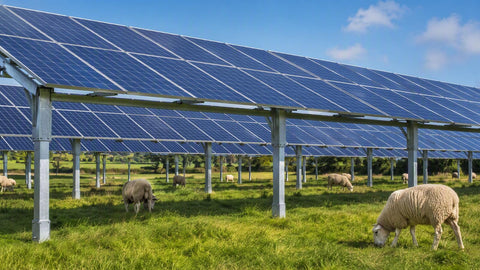
Select G6 configurations ship in bifacial glass-glass format, and on the right site they are the best value in the whole lineup. Bifacial cells harvest light reflected onto the module's rear surface — from light-colored gravel, white membrane roofs, snow cover, or bare concrete. Depending on mounting height and ground reflectivity (albedo), bifacial panels produce 5–20% more energy than monofacial equivalents, with 5–10% the honest planning range for typical elevated ground-mounts and carports.
The design implications are real, though. Rear gain only exists when the back side can see reflected light, which means elevated tilt, open structure beneath, and no roof membrane hugging the glass. Flush-mounted rooftop bifacial panels capture almost nothing — I have had to deliver that news to more than one customer who bought bifacial modules for a comp-shingle roof. Match the module to the mount, and the bifacial G6 pays; mismatch it and you bought a heavier monofacial panel.
G6 Against the Rest of the 2026 Field
The G6 does not sell in a vacuum, and honest comparison helps everyone. In the 425–450W N-type bracket it faces strong product from Canadian Solar, Qcells, Silfab, and others — browse Canadian Solar, Qcells, and Silfab for current channel stock. Jinko's edge is scale: the largest shipment volumes in the industry buy manufacturing consistency, bankability, and a warranty infrastructure that smaller brands cannot match. The competitors' edge tends to be regional content preferences and occasional price aggression. On a like-for-like N-type comparison, the G6 holds its efficiency, degradation, and temperature numbers against anything in the class — which is exactly why it became our default recommendation for standard projects.
Procurement and Availability Notes
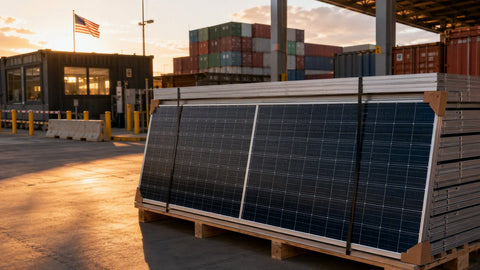
As the current-production mainstream line, G6 availability is the strongest of any product in this article series — standard lead times, regular pallet replenishment, and volume pricing that scales cleanly from residential five-pallet orders to container quantities. Pallet counts run 31–36 modules depending on bin and packaging revision. One procurement habit worth building: confirm the exact model code and bin on your quote against your string design before releasing the order. The 425W and 450W bins are both "Eagle G6," but their electrical values differ enough to matter at string-design level, and a warehouse will happily ship you whichever is on the quote.
Freight follows the usual rules — full pallets ride LTL economically, partial pallets pay a premium, and mixing balance-of-system gear from the mounting parts catalogs onto the same truck dilutes per-panel freight. Our Louisville, KY warehouse consolidates mixed orders weekly for exactly this reason.
A Field Story on Degradation Claims
I will close the technical case with something I check personally: year-one production deltas on matched installs. We have customers running G4 and G6 arrays commissioned within months of each other in the same county — same installer, same inverter brand, similar tilt and azimuth. The year-one delta between the sites tracked the degradation schedules within measurement noise: the N-type array finished its first summer visibly closer to nameplate, and the gap has widened slightly each season since. Warranty curves are not marketing when you can watch them happen on a monitoring dashboard. That observation, repeated across enough sites, is why my default recommendation stopped being "whatever is cheapest" a couple of years ago.
Half-Cell Layout and Shade Behavior
One more engineering detail worth understanding before layout day: the G6's 144 half-cells are wired as six parallel substrings protected by bypass diodes, so a shaded corner knocks out roughly one-sixth of the module instead of dragging the whole panel — and with it, the string — down. On residential roofs with vent stacks, chimneys, and tree shadows that migrate across the day, this architecture routinely preserves 3–5% of annual production versus old full-cell behavior. It does not replace shade analysis, and no diode fixes a bad site, but it buys forgiveness on the marginal roof sections every real house has.
Pair that with module-level electronics where the shade is structural rather than occasional. If more than about 15% of your planned array face sees daily obstruction, the microinverter or optimizer route usually beats string sizing heroics — the inverter selection guide walks the decision tree, and the inverter sizing calculator checks DC/AC ratios for whichever architecture you land on.
Ordering Checklist Before You Call
Five details make a G6 quote fast and accurate: your target DC capacity, the roof or ground area actually available, your inverter strategy (string, micro, or optimizer), your design minimum temperature for the NEC 690.7 calculation, and your delivery timeline. Bring those and we can usually turn a firm quote with freight in one call. Bring "I need some panels" and we will still get there — it just takes longer, and the pallet you wanted sometimes sells while we circle back.
Frequently Asked Questions
- What is the difference between N-type TOPCon and P-type PERC?
- N-type eliminates boron-oxygen light-induced degradation and adds a passivated rear contact, cutting first-year loss to 1%, annual degradation to 0.40%, and raising module efficiency to 22.53%.
- How much more efficient is the G6 than the G4?
- 22.53% versus 20.96% — about 7.5% more power per square foot, or roughly 600 extra watts on a typical residential roof face.
- How does the G6 handle hot climates?
- Its -0.30%/°C coefficient retains ~86.5% of rated power at 70°C cell temperature, versus ~83–84% for P-type.
- What warranties does the G6 carry?
- Up to 25-year product and 30-year linear performance coverage, with 87.4% of nameplate guaranteed at year 25.
- Can G6 panels join an existing G2/G4 array?
- Yes — on a separate MPPT input as their own string. Never mix module classes on a shared string.
- What string length and breaker does a G6 system need?
- About 17 modules per 1,000V string (26 on 1,500V), a 20A OCPD, and 12 AWG copper conductors per NEC 690.7/690.8/310.16 — verify your exact bin's datasheet.
Portlandia Electric Supply stocks the Eagle G6 and the full Jinko lineup with nationwide LTL freight from Louisville, KY. For pallet pricing, string design help, or legacy-array expansion planning, contact our team.